Connect with us

Business

FAA head hasn’t sold his stake in an airline despite promises to do so, Democratic Senator claims

Published

on


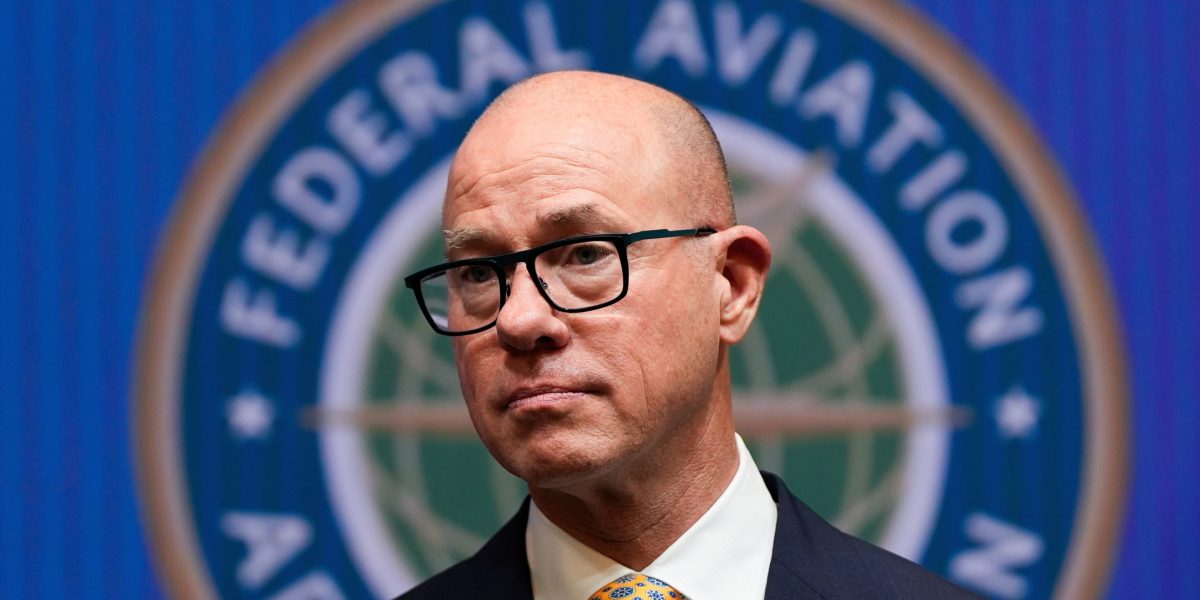
The head of the Federal Aviation Administration has not sold off his multimillion-dollar stake in the airline he led since 1999 despite a promise to do so as part of his ethics agreement, according to a Democratic senator.

In a letter to Bryan Bedford this week, Sen. Maria Cantwell said he vowed to sell all his shares in Republic Airways within 90 of his confirmation but 150 days have now passed. In Bedford’s financial disclosures, he estimated that his Republic stock was worth somewhere between $6 million and $30 million.

Republic completed a merger last month with another major regional airline, Mesa Air Group. Republic’s stock closed Thursday at $19.02, nearly double what it was before the deal was announced in April.

“It appears you continue to retain significant equity in this conflicting asset months past the deadline set to fully divest from Republic, which constitutes a clear violation of your ethics agreement. This is unacceptable and demands a full accounting,” Cantwell said in the letter.

Bedford declined a request for comment, and an FAA spokesperson said he plans to respond directly to Cantwell.

The agency has been in the spotlight since January, when an airliner collided with an Army helicopter over Washington, D.C., killing 67 people. The investigation has already highlighted shortcomings at the FAA, which failed to recognize an alarming number of close calls around Reagan National Airport in the years beforehand.

Then, in the spring, technical problems at the center that directs planes into New Jersey’s Newark Liberty International Airport highlighted a fragile and outdated system relied on by air traffic controllers.

And in the fall, a longstanding shortage of controllers led to thousands of flight cancellations and delays during the longest government shutdown ever as more controllers missed work while going without a paycheck.

Bedford has pledged to prioritize safety and upgrade the nation’s outdated air traffic control system. Congress approved $12.5 billion for that project, and last week the FAA picked the company that will oversee the work.

Join us at the Fortune Workplace Innovation Summit May 19–20, 2026, in Atlanta. The next era of workplace innovation is here—and the old playbook is being rewritten. At this exclusive, high-energy event, the world’s most innovative leaders will convene to explore how AI, humanity, and strategy converge to redefine, again, the future of work. Register now.


Source link

Continue Reading

Business

Gen Z is defiantly ‘giving up’ on ever owning a home

Published

on


The housing market only continues to look more bleak for younger generations—and it shows. The average age for a first-time homebuyer recently jumped to 40, signaling the housing market is starved for affordability.

And younger generations are so disappointed and frustrated by the state of the housing market they’re spending more of their earnings than they’re saving, working less, and making risky investments, according to a recently published paper by Northwestern University and University of Chicago researchers. 

In other words, younger generations are “giving up.” That’s according to Northwestern’s Seung Hyeong Lee and Chicago’s Younggeun Yoo, who also cited a 2024 Harris Poll survey about the state of real estate that showed 42% of Americans and 46% of Gen Z respondents agreed with this statement: “No matter how hard I work, I will never be able to afford a home I really love.”

While households typically adjust consumption to stay on track with long-term goals like buying a home, younger people are crossing a “threshold at which they begin to give up on [buying a home] entirely.”

The idea this generation is “giving up” is also echoed by an analysis by Gen Z’s favorite economist Kyla Scanlon, who argues younger people face a sense of “financial nihilism,” a phenomenon in which they question the American Dream amid stagnant wages, student loan debt, and corporate dominance. 

Gen Z has “watched the American Dream rot before their eyes, as higher education becomes a luxury good, a housing crisis exacerbates the cost of living, all backdropped by political stagnation and rapid (perhaps even too rapid) technological advancement,” she wrote, making the point this generation has lived through not one, or two, but three major economic downturns. 

Gen Z is saving less than they’re spending

The first phenomenon Lee and Yoo outline regarding Gen Z’s defiance toward buying a home is that they’re spending more money than they’re bringing in. 

“We find that when home prices rise to the point where renters can no longer afford to buy a house within the foreseeable future by saving their wages, renters give up on home purchases and instead use their savings to increase consumption,” they wrote. 

Several other studies this year have shown Gen Z is doomspending rather than saving, with one study showing nearly half don’t even have an emergency fund saved up. A Bankrate survey also showed as many as 27% of Gen Z carry more debt than they do savings.

“Many Gen Zers find themselves walking a financial tightrope, torn between covering immediate expenses or setting money aside for emergencies and paying for goods on credit instead,” previously told Fortune.

Some of that may be due to the fact Gen Z expects to inherit money and assets from the $124 Great Wealth Transfer, but a Northwestern Mutual survey shows very few can expect a windfall of cash upon a relative’s death.

Gen Z works differently

We’ve all heard Gen Z supposedly doesn’t work as hard as other generations, which may or may not be true—it’s somewhat impossible to measure. Lee and Yoo found in their research Gen Z has cut down on their effort at work because they don’t think it’s worth it if they can’t afford long-term financial goals. They cite answers to psychographic questions asking about the importance of “always giving my best effort” at work. Their research shows the share of renters reporting low work effort is nearly twice the rate observed among homeowners.

“This shift is consistent with a reallocation of time and effort by discouraged renters,” the researchers wrote. “As the perceived returns to labor (in terms of progressing toward homeownership) diminish, so does the value they place on maintaining high work effort.”

Scanlon has a different take on Gen Z’s work effort, though. 

She argues, “maybe it’s not that they don’t want to do anything anymore, but rather they don’t want to do anything in the way that it’s always been done anymore.” 

Gen Z is making risky investments

The third way Gen Z is acting out against their inability to buy a home, the researchers argue, is by taking on risky investments, like buying cryptocurrencies. Their research also shows when buying a home for a Gen Zer seems unaffordable, they also increase their leisure spending.

“Renters with a plausible path to homeownership may exhibit lower risk tolerance, as significant losses could derail their progress toward that goal,” they wrote. “In contrast, those who have already given up on homeownership may perceive they have less to lose, and therefore engage more willingly in risky financial behavior.”

Other 2025 research indicates Gen Z is far more likely to own crypto than have a retirement account, illustrating how they’re more willing to take on riskier investments. And finance experts are worried about the pattern, they told Fortune’s Emma Burleigh.

“It’s never a bad thing for people in any generation to take interest in their personal finances,” Mark Smrecek, financial well-being market leader at Willis Towers Watson (WTW), told Fortune’s Burleigh. “I think as long as they’re looking at risk and reward based on what their goals are, it’s generally fine. But I do get concerned when I see over-indexing toward risky assets.”


Source link

Continue Reading

Business

‘Godmother of AI’ says degrees are less important than ‘how quickly can you superpower yourself’

Published

on


Founders and AI startups in Silicon Valley are valuing degrees less and are seeking out candidates who can work quickly, adapt and build AI models.

Fei-Fei Li, a Stanford professor and CEO of the AI startup World Labs, is known as the “Godmother of AI” for her work building a large-scale database of labeled images, which changed the way computers comprehend digital images and videos.

Li, also the founding co-director of Stanford’s Human-Centered AI Institute, said she values candidates’ experience and relationship with AI tools more than their educational background.

“When we interview a software engineer, I personally feel the degree they have matters less to us now,” Li said of the talent search process for her AI startup in an interview on The Tim Ferriss Show this week.

“Now, it’s more about what have you learned, what tools do you use, how quickly can you superpower yourself in using these tools — and a lot of these are AI tools,” she added. “What’s your mindset toward using these tools matter more to me.”

When discussing the broader impacts of AI on education and the labor market, Li said assessing qualified workers used to rely on which school job candidates graduated from and the degree they earned. But “that will be changing with AI being at the fingertip of so many people,” she said.

For her own talent acquisition, Li added that she wouldn’t hire software engineers who don’t “embrace AI collaborative software tools.” She explained this requirement is not because she believes AI software tools are perfect, but because she believes they show a person’s ability to grow with fast-moving technologies and them being able to use AI to their own benefit.

Li’s view of AI skills and their value proposition compared to college degrees echoes a similar sentiment from other leaders in the industry.

In October, Mark Zuckerberg, a Harvard dropout, said skills outweigh a flashy college degree when hiring for Meta—but he noted that entry-level roles at his company still require a bachelor’s.

Palantir CEO Alex Karp has even challenged the value of a college education by recently launching a four-year paid internship for young entrepreneurs not enrolled in college to instead learn by doing and to “skip the debt, skip the indoctrination.” 

As more tech leaders look for AI-fluent candidates, Li looks for candidates that can help realize her company’s mission.

World Labs aims to build AI that can process and replicate the three-dimensional world through spatial reasoning—a feat that would revolutionize the tech all over again. Li bootstrapped the startup into a more than $1 billion valuation after only four months, according to the Financial Times.

As she works towards the next AI breakthrough, Li said during the Fortune Most Powerful Women Summit in 2024 that AI could change the world, and that “everyone who cares” should have a place in the technological shift.

“It’s so important that people from all backgrounds feel they have a role,” Li said.


Source link

Continue Reading

Business

40% of Stanford undergrads receive disability accommodations—but it’s become a college-wide phenomenon as Gen Z try to succeed in the current climate

Published

on


The pandemic has shaken up college life for good: Since then, social media and AI have revolutionized classroom expectations, and the bar for landing a job after graduation has become impossibly high. Many are now questioning whether getting a degree was even worth it.

The ripple effect of those strains is already showing in campus accessibility offices,  where diagnoses of ADHD, anxiety, and depression are rising—and so are requests for extended time on coursework.

At Harvard, 21% of undergraduates received disability accommodations last year, an increase of more than 15% over the past decade, according to data published by the National Center for Education Statistics analyzed by the Harvard Crimson. Top schools like Brown, Cornell, and Yale reported similar numbers, roughly in line with national trends. But the increase is more pronounced at other institutions: 34% of students at UMass Amherst and 38% at Stanford are registered as disabled, according to The Atlantic

In the 2011-12 school year, the number of undergraduates with a disability was about 11%, based on U.S. Department of Education data—highlighting just how much of a dramatic shift this phenomenon has become.

One founder says students are trying to get a leg up in today’s tough job market

Experts note that many students have medical conditions that merit accommodations, and the increase is in part linked to broader access to mental-health care and reduced stigma around seeking support.

The rise has nonetheless drawn national attention, with some critics arguing that students are abusing the system to secure lighter workloads or an edge in hypercompetitive classrooms.

Derek Thompson, author of the recent bestseller Abundance called the numbers “mind-boggling,” arguing that colleges may be overcorrecting after years of underrecognizing disability. 

“America used to stigmatize disability too severely,” he wrote on X. “Now elite institutions reward it too liberally. It simply does not make any sense to have a policy that declares half of the students at Stanford cognitively disabled and in need of accommodations.”

Joe Lonsdale, a billionaire venture capitalist and Palantir cofounder, expressed similar concerns, suggesting some families are seeking diagnosis just to give students “a leg up.”

After all, the post-graduation job hunt has tightened into a numbers game few can win.

In 2023 and 2024, more than 1.2 million applications were submitted for just under 17,000 open graduate roles in the U.K., according to the Institute of Student Employers. And in the U.S., lawmakers warn the funnel is narrowing further. Sen. Mark Warner has warned that joblessness among recent graduates could hit 25% in the next two to three years, as AI reshapes entry-level work.

But in reality, there is no evidence of widespread misuse, and not all students registered with a disability receive accommodation in every class. Still, the scale of requests has raised questions among some faculty members about how accommodations intersect with academic expectations.

Faculty grapple with balancing support of students and avoidance of stigma

For instructors, the rise in accommodations can be challenging to navigate. Many say they want to support students with legitimate needs but worry that requesting clarification could be seen as insensitive or ableist.

One adjunct professor, posting to Reddit, said the number of students with accommodations has “increased exponentially” across the three schools where they teach.

“I had an increasingly large number of students at this particular school be given the accommodation to turn work in 48 hours late, and I got tired of constantly having to extend due dates for just them,” the professor wrote, noting that they themselves have ADHD and autism.

“The students I’ve had on this accommodation would use it pretty much every week since they were perpetually behind.”

Harry Lewis, former dean of Harvard College, expressed a related concern to the Harvard Crimson.

“The whole system of accommodations for things other than physical disabilities just seems badly mismatched with the educational purposes that students and faculty share,” he said.

However, Katy Washington, CEO of the Association of Higher Education and Disability, argued that students seeking accommodations are not “unfair burdens” on professors, and rather than questioning whether too many students qualify—which can perpetuate stereotypes—the focus should be on designing assessments that are inclusive for all learners.

“For decades, students with invisible disabilities were denied support because their struggles were dismissed as laziness or lack of effort,” Washington wrote in a letter to her organization’s members, shared with Fortune. “The rise in accommodations reflects a cultural shift toward acknowledging mental health, not a decline in academic integrity.”

A shifting skill-based job market could leave some students unprepared

For students, the increase in accommodations coincides with employers rethinking what actually matters in hiring. Fewer companies are prioritizing degrees, and more are evaluating on what they can do—through portfolio, projects, and real-world problem-solving.

Less than half of U.S. professionals at the director-level and above say a university degree is essential for getting ahead, according to LinkedIn. Moreover, nearly 1 in 5 job postings on the platform do not require a degree.

That shift could complicate the picture for students who’ve grown accustomed to extended deadlines or extra time. Whether a small number of students are abusing the system, workplace assessments typically don’t come with accommodations—and performance is often judged on speed, accuracy, and consistency.  Some Gen Zers have already faced the pink slip just months into the start of their career due to employers being unimpressed with some of their soft skills, like organization.

In other words: even as college becomes more flexible, the job market is moving in the opposite direction.



Source link

Continue Reading

Trending

Copyright © Miami Select.