Connect with us

Business

Exelon CEO: ‘Warning lights are on’ for U.S. grid resilience, utility prices amid AI demand surge

Published

on


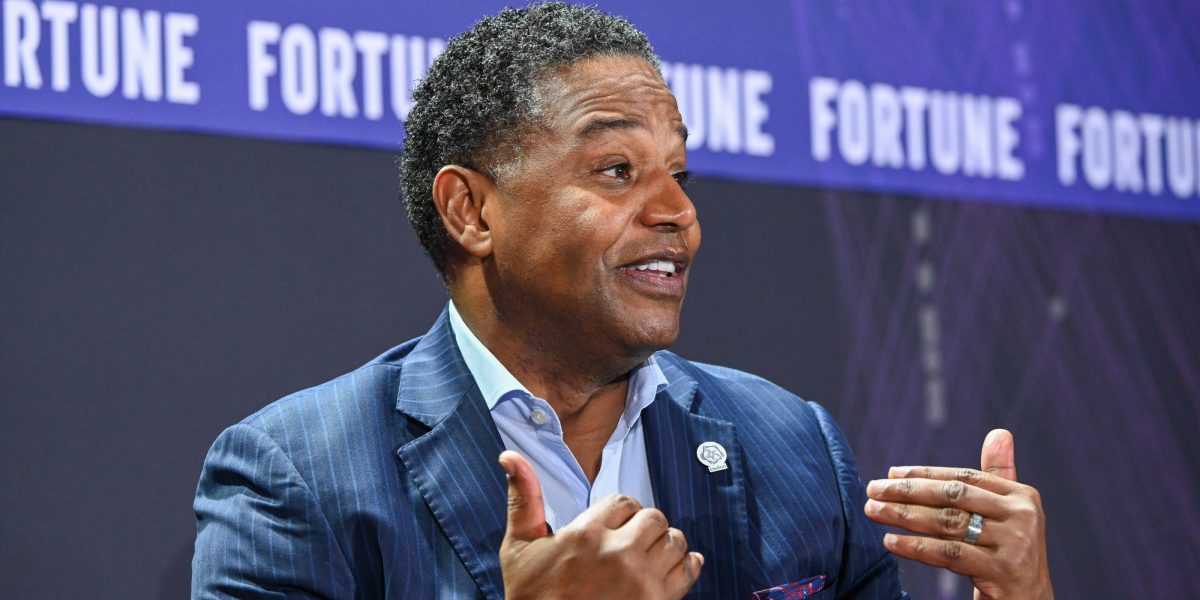
The U.S. must invest in power generation of all kinds, including renewables, and focus on improving efficiencies to keep the grid from breaking down and utility prices from soaring out of control, said Calvin Butler, president and CEO of the major utility Exelon.

While now is not yet the time to panic, it is time for immediate action to meet surging demand from the AI boom and electrification, and to keep everyday Americans from drowning in costs from spiking utility bills, said Butler, who also chairs the Edison Electric Institute, which represents investor-owned electric utilities nationwide.

“The warning lights are on. You’re driving your car and the check-engine light is on. You’re like, ‘I’m going to keep pushing this.’ And no one is going to pay attention until it breaks down,” Butler said Tuesday at Fortune’s Brainstorm AI conference in San Francisco.

The fear is that the grid will break down in different regions on their hottest and coldest days. “And people are going to suffer. You have to fix it now,” said Butler, whose Exelon (No. 192 on the Fortune 500) services communities from Chicago to Washington, D.C.

After nearly 15 years of flat demand, U.S. electricity generation growth is expected to hit 2.4% in 2025 and rise by close to 2% next year as well, the U.S. Department of Energy said Dec. 9.

Residential electricity prices have skyrocketed about 30% since 2021. As of the end of September, electricity costs are up nearly 7.5% in 2025 from the prior year, and are projected to continue rising in 2026, according to the DOE.

Electricity and natural gas for heating and cooking are now the leading pressures on inflation in 2025, even exceeding food and grocery costs, according to the latest Consumer Price Index data. Utility bills have surpassed the price at the pump and the cost of eggs as a top political bellwether in 2025 and heading into next year’s congressional midterm elections.

Renewables are projected to account for 25% of U.S. electricity generation in 2026 for the first time ever, trailing only natural gas as a fuel for power, the DOE said Dec. 9.

“We need every electron to make a difference,” Butler said, citing the need for everything from renewable energy to nuclear power and natural gas. Butler has bemoaned the Trump administration’s attacks on wind and solar this year.

“We’re 5% of the economy,” Butler said of the utility and power sector, “but we power the next 95%.”

Exelon is doing its part, he said. Exelon and NextEra Energy partnered Dec. 8 to build a new, 220-mile power transmission system through parts of Pennsylvania and West Virginia to increase grid reliability, especially in areas where data center campuses are growing.

The concern is that utilities need to serve the wealthiest and the poorest of customers in cities that have huge wealth gaps and high poverty rates. Keeping prices lower is increasingly harder when power generation and wholesale electricity prices continue to rise.

So, what’s going to happen to prices next year? “They’re going to go up,” Butler said.

Read more from Fortune Brainstorm AI:

Cursor developed an internal AI help desk that handles 80% of its employees’ support tickets, says the $29 billion startup’s CEO

OpenAI COO Brad Lightcap says ‘code red’ will force the company to focus, as the ChatGPT maker ramps up enterprise push

Amazon robotaxi service Zoox to start charging for rides in 2026, with ‘laser focus’ on transporting people, not deliveries, says cofounder


Source link

Continue Reading

Business

Physical AI will automate ‘large sections’ of factory work in the next decade, Arm CEO says

Published

on


AI-powered humanoid robots could take over large sections of factory work within the next five to ten years, transforming the manufacturing industry, predicts Arm CEO Rene Haas.

One of the key forces pushing humanoid robots into factories is their advantage over the robotic arms and other automation machinery in use today, Haas said. Traditional factory robots are purpose-built machines designed for a single task, with both hardware and software optimized for that specific function. General purpose humanoid robots by contrast, combined with increasingly sophisticated “physical AI” that helps navigate the real world, will be able to take on different jobs on-the-fly with quick modifications to their instructions.

“I think in the next five years, you’re going to see large sections of factory work replaced by robots—and part of the reason for that is that these physical AI robots can be reprogrammed into different tasks,” Haas said at Fortune’s Brainstorm AI conference in San Francisco on Monday.

“One of the issues you’d had with factory robots in the past is that if it was a pick and place machine for a factory, they’re just optimized for one task—the software was for one task, the hardware is for one task. Now, if you design a general-purpose humanoid that the software is all AI and it learns by doing, it’s going to completely replace a large set of factory workers,” he said.

What happens to those workers and the broader job market as AI and robots proliferate in businesses is a growing concern among many policymakers and industry-observers, with ideas ranging from worker re-skilling to universal basic income among the options under debate.

Haas did not specifically address the jobs issue, but suggested that widespread physical AI adoption could reshape global manufacturing dynamics, potentially helping to level the global competitive playing field by automating a large amount of factory work. “Physical AI will be a great enabler,” he said. 

Haas also pointed to Waymo’s autonomous vehicles as an early indicator of physical AI’s potential. 

He said the next generation of autonomous systems may require even less hardware. While current self-driving cars are fitted with radar and cameras surveying their surroundings, future iterations using more advanced AI models could operate with fewer sensors—relying on artificial intelligence rather than exhaustive data collection to make decisions.

The semiconductor supply chain has ‘many single points of failure’

Arm, which does not manufacture or sell its own chips, designs and licenses the architecture used in processors made by companies including Qualcomm and Apple. Chips based on Arm’s designs are used in everything from smartphones and refrigerators to cars and servers, and most people use between 50 to 100 Arm chips on their person or in their homes, Haas said.

That widespread use and market share is a testament to the energy efficiency and performance that have made Arm’s chip design so popular. But it also raises risks to the semiconductor supply chain.

Asked about this vulnerability, Haas acknowledged the extreme market concentration within the industry, and noted that several large companies each control vital parts of the semiconductor supply chain.

“The semiconductor supply chain has many single points of failure…there’s TSMC, which is in a very obviously interesting part of the world geopolitically. There is also a very sophisticated device that has to go into these fabs that comes from one company on the planet…called the ASML.”

In the last few years, the COVID-19 pandemic exposed some of these supply chain fragilities when chip shortages left consumers unable to get key fobs for new cars for weeks. That crisis, Haas said, was “just a function of the semiconductor supply chain that has many single points of failure.”

Haas said the entire industry is “learning to live with” the concentration risk. 

Read more from Fortune Brainstorm AI:

Cursor developed an internal AI help desk that handles 80% of its employees’ support tickets, says the $29 billion startup’s CEO

OpenAI COO Brad Lightcap says ‘code red’ will force the company to focus, as the ChatGPT maker ramps up enterprise push

Amazon robotaxi service Zoox to start charging for rides in 2026, with ‘laser focus’ on transporting people, not deliveries, says cofounder


Source link

Continue Reading

Business

‘Fodder for a recession’: Top economist Mark Zandi warns about so many Americans ‘already living on the financial edge’ in the K-shaped economy 

Published

on


Mark Zandi is worried that the labor market no longer has a buffer.

So many Americans are “already living on the financial edge,” the chief economist for Moody’s Analytics told Fortune. If they start to pull back, that’s “fodder for a recession.”

The stark assessment comes as hiring has stalled, unemployment is rising – especially for the most vulnerable workers – and layoff announcements are piling up. To Zandi, the next stage is already visible: “If we actually do see layoffs pick up,” he told Fortune, “then it certainly would be a jobs recession.”

Zandi reached that assessment before the government released its long-delayed JOLTS report Tuesday, but the official numbers largely confirm the pullback he has been tracking through private data. Since the summer, job openings have risen by only a few hundred thousand and remain far below the highs seen in the frenzy of the pandemic. Layoffs upticked slightly, while quit rates fell, a sign that workers are increasingly hesitant to leave their current positions. Hiring, meanwhile, has held at 3.2%, a level consistent with employers who are not actively slashing staff but are no longer expanding their workforces either: a “low hire, low fire” market. 

If the cooling in the official data looks slow, the private indicators tell a sharper story. ADP’s November report found that private employers cut 32,000 jobs, the steepest decline in more than two years. Nearly all of those losses came from small businesses, which eliminated 120,000 positions. Larger employers moved in the opposite direction and kept hiring.

For Zandi, the pattern is not random. He sees it as the continuation of a break that appeared earlier in the year, when the administration escalated reciprocal tariffs.

 “If you look at when job growth really came to a standstill, it is back soon after Liberation Day,” he said. 

Because these firms often lack the financial cushions that larger corporations can draw upon, payroll becomes the most immediate and often the only mechanism through which they can respond to rising input costs. The result, Zandi argues, is a labor market in which the earliest fractures appear among precisely the kinds of employers most sensitive to policy and price shifts. Those fractures then begin to ripple outward, first through hiring freezes and only later, if conditions worsen, through broader layoffs.

Layoffs are coming, Zandi warns

So for Zandi, if ADP offers a snapshot of the present, the announcement data from Challenger, Gray & Christmas hints at what may lie ahead. Employers have announced 1.1 million layoffs this year, a figure surpassed only during the pandemic shock of 2020 and the depths of the Great Recession. These announcements are global and not all will materialize as U.S. cuts, Zandi advised, yet he considers their scale meaningful because they reflect decisions made months in advance of actual separations. 

“That would suggest that there are layoffs coming,” he said. “They seemingly have not occurred yet.” The disconnect between rising layoff announcements and historically low unemployment-insurance claims feels increasingly “incongruous” to him, and he suspects one reason may be that early cuts are falling on higher-income workers who receive severance or wait longer before filing for benefits, obscuring the first phase of the weakening.

Pressure is also building in pockets of the labor market that are typically harbingers of broader stress. Unemployment has risen for young workers and for Black workers, both groups that tend to see deterioration earlier in the cycle, Zandi said. Industries that rely heavily on foreign-born labor—including construction, logistics and agriculture—are grappling with a tighter supply of workers due to deportations, placing additional strain on small firms. 

Meanwhile, early research on AI adoption suggests that entry-level hiring in technology and information services is already being reshaped, a development Zandi believes may be understated in traditional data sets but is nonetheless starting to influence the distribution of job opportunities. All of these dynamics contribute to what he sees as a labor market that is weakening in slow but structurally significant ways.

What has kept the labor market from slipping into outright contraction is the continued strength of spending among higher-income households, even as borrowing costs remain elevated and prices have yet to fully ease. That persistence, despite rising layoff announcements and weakening hiring, reflects how insulated wealthier consumers remain after a year of strong equity gains fueled in part by the AI boom. It is also the clearest sign that the “K-shaped economy” has not dissipated but deepened, with affluent households buoyed by financial markets while lower- and middle-income workers face mounting strain

Zandi regards this spending as one of the last buffers preventing the slowdown from becoming self-reinforcing. Lower- and middle-income households remain stretched, however, and he warns that any further erosion in hiring could push them to retrench. Because these households account for a large share of day-to-day consumer activity, even a modest pullback could turn the current pattern of weak hiring into a contraction.

A pivotal moment for the Federal Reserve

The Federal Reserve is debating over an interest rate cut Monday and Tuesday into precisely this environment, a choice that reflects the central bank’s growing concern that the labor market could deteriorate more quickly in early 2026 if not supported now. 

The chances of the Fed delivering its third interest rate cut of the year tomorrow are 90%, according to the CME FedWatch Fed funds futures index. Economists expect the Fed to deliver a kind of hawkish cut, a move that acknowledges the weakness in hiring but refrains from promising a sustained cutting cycle.

That’s because the tension inside the committee is unusually pronounced. Bank of America economist Aditya Bhave wrote in a research note that Powell is confronting “the most divided committee in recent memory.” Some officials believe unemployment risks are rising and see a compelling case for further accommodation. Others remain convinced that the economy retains enough underlying strength that aggressive easing would be premature and potentially inflationary. 

For the Fed, the challenge is to articulate a strategy that acknowledges the unmistakable weakening Zandi has been warning about without assuming that the slowdown has already reached a stage requiring an aggressive response. 

For Zandi, the concern is more immediate: that the softening now visible in small-business payrolls, layoff announcements and early demographic stress will eventually coalesce into the layoffs he believes are coming.

“If we’re not in a jobs recession, we’re close,” Zandi said.


Source link

Continue Reading

Business

Jamie Dimon taps Jeff Bezos, Michael Dell and Ford CEO Jim Farley to advise JPMorgan’s $1.5 trillion national-security initiative

Published

on


Jamie Dimon’s JPMorganChase just unveiled a list of business leaders and retired government officials that will make up a new advisory team to guide the investment bank’s $1.5 trillion national-security initiative. 

The external advisory council, announced on Monday, features prominent tech business leaders Jeff Bezos and Michael Dell as well as Ford CEO Jim Farley, alongside a number of national security and defense experts. 

JPMorganChase first announced its national-security push—coined the Security and Resilience Initiative (SRI)—in October by saying it would first invest up to $10 billion in direct equity and venture capital to companies it characterizes as paramount to U.S. national security.

Dimon also said on Monday he poached one of Warren Buffet’s personally selected investors to head the investment fund starting in January.

Both of the announcements are initial steps to realizing the company’s national-security pledge, which will span the next 10 years.

The council will be chaired by Dimon himself, and will “convene periodically” to “help spur growth and innovation in industries critical to the United States’ national security and economic resiliency,” the company said in its press release.

“We are humbled by the extraordinary group of leaders and public servants who have agreed to join our efforts as senior advisors to the SRI,” Dimon said in the Monday announcement. “With their help, we can ensure that our firm takes a holistic approach to addressing key issues facing the United States—supporting companies across all sizes and development stages through advice, financing and equity capital.”

Here is a list of the advisory council members: 

Business leaders

  1. Jeff Bezos, executive chairman and founder of Amazon and founder of Blue Origin

Bezos previously partnered with Dimon and Warren Buffett on the not-for-profit Haven health‑care venture in 2018, which was backed by Amazon, JPMorgan, and Berkshire Hathaway. Dimon has said the two “hit it off” in 1999, and Bezos even discussed hiring Dimon as Amazon’s president before Dimon chose to stay in banking.

  1. Michael Dell, CEO of Dell Technologies

Dell worked closely with Dimon and JPMorgan when the bank led the multibillion‑dollar financing for Dell’s $67 billion takeover of tech giant EMC in 2015, the largest tech deal ever at the time.

  1. Jim Farley, CEO of Ford Motor Company

Farley has publicly warned about U.S. dependence on China for chips and rare earths, arguing it is a strategic vulnerability. In a third-quarter earnings call in October, he told investors he had discussed these issues with U.S. officials as a chip shortage caused by China threatened to impact the automaker. 

  1. Alex Gorsky, former CEO of Johnson & Johnson

Gorsky, most recently the company’s former executive chairman, oversaw the company’s expansion and helped steer J&J through the Covid‑19 vaccine rollout as CEO.

  1. Phebe Novakovic, CEO of General Dynamics

Novakovic previously worked in the U.S. government in roles at the Central Intelligence Agency and the Department of Defense before moving to the private sector in 2001. After working her way up at General Dynamics, she now heads one of the Pentagon’s major defense contractors.

  1. Todd Combs, Berkshire Hathaway investment manager, CEO of GEICO

Combs is a longtime Berkshire Hathaway investment manager and CEO of Geico who left Geico this week and is leaving his Berkshire role as well to lead JPMorganChase’s SRI Strategic Investment Group and join the advisory council in early 2026. For years, he was one of Warren Buffett’s top stock pickers.

  1. Paul Ryan, Partner at Solamere Capital, former Speaker of the U.S. House of Representatives

Ryan is a partner at private-equity firm Solamere Capital and formerly served as Speaker of the U.S. House of Representatives from 2015 to 2019, where he was a key figure on fiscal and economic policy. He previously chaired both the House Budget Committee and the Ways and Means Committee, making him a central Republican figure on fiscal and economic policy and tax legislation.

National security experts

  1. Condoleezza Rice, former U.S. Secretary of State

Rice is a former U.S. Secretary of State under George W. Bush from 2005 to 2009 and, prior to that, was National Security Adviser. She played a central role in U.S. foreign policy and national‑security decision-making in the 2000s.

  1. Robert Gates, former U.S. Secretary of Defense

Gates is a former CIA director under former president George H.W. Bush from 1991 to 1993 and former U.S. Secretary of Defense, with a long career in national security and intelligence under both Republican and Democratic presidents.

  1. Chris Cavoli, retired general

Cavoli is a retired U.S. Army general who most recently served as Supreme Allied Commander Europe and Commander of U.S. European Command, overseeing NATO forces and U.S. military operations in Europe.

  1.  Ann Dunwoody, retired Commanding General of U.S. Army Material Command

Dunwoody is a retired four‑star general and former Commanding General of U.S. Army Materiel Command. She’s the first woman in U.S. history to achieve the rank of four‑star general.

  1.  Paul Nakasone, retired general and former NSA Director

Nakasone is a retired four‑star Army general who led the U.S. Cyber Command and served as director of the National Security Agency and chief of the Central Security Service from 2018 to 2024.


Source link

Continue Reading

Trending

Copyright © Miami Select.