Connect with us

Business

Exclusive: Supabase raises $100 million at $5 billion valuation as vibe coding soars

Published

on


The vibe coding movement, as Paul Copplestone figures it, started last December—and we’re already a few eras in. 

“So, wave one of vibe coding was like, ‘You’ll never need more software,’” said Copplestone, CEO and cofounder of Supabase, an open source application development platform. “Wave two is, ‘Oh, you’ll never need to write code again.’… And then wave three, which we’re in now, is where these ideas converge—there’s a nice happy path for anyone who’s on their mobile, looking to build an app. They start on mobile, kick it across to their laptop, and then it scales out.”

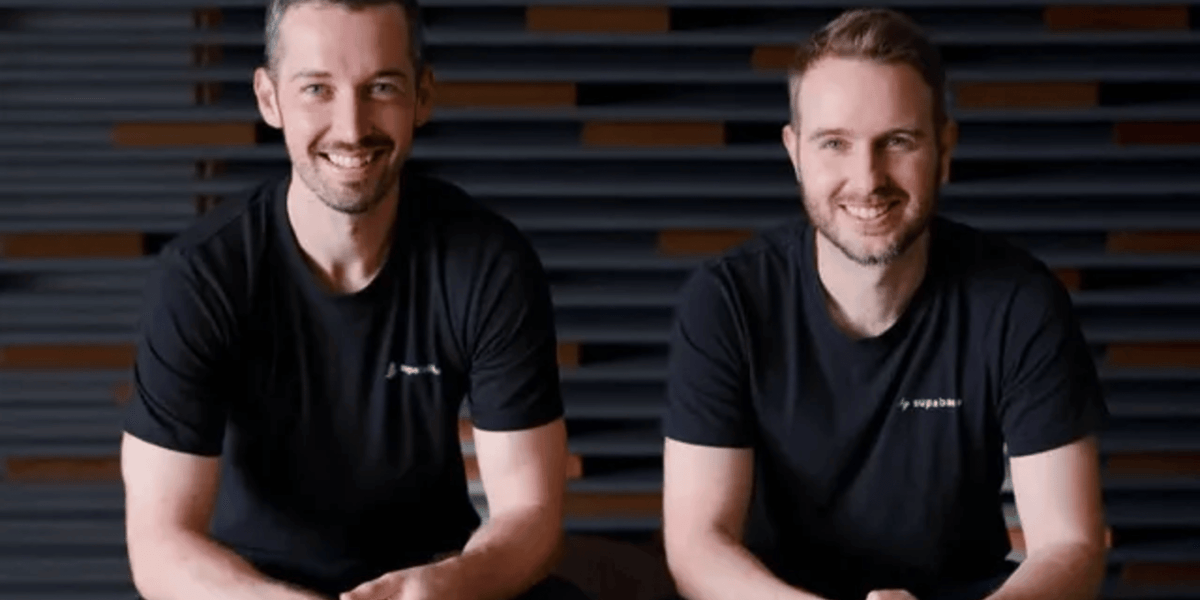
Copplestone is in a unique position to monitor the vibe coding movement. His company, which provides backend infrastructure for AI and no-code platforms like Bolt and Lovable, grew its user base from one million to north of four million developers over the last year. “AI builders,” as Copplestone terms them, tend to represent about 30% of their signups. Supabase is built on Postgres, the popular developer database system that competes with Google’s Firebase and is a bet on an open-source future. 

In April, Term Sheet broke the news that Supabase had raised $200 million in an Accel-led Series D, valuing the company at $2 billion. Now, about five months later, Supabase has raised a $100 million Series E at a $5 billion valuation. Accel and Peak XV led the round, with Figma Ventures joining the round along with other existing investors. (Supabase declined to disclose current revenue figures.) Supabase—which has now raised $500 million since its 2020 founding—also included an opportunity for the startup’s developer community to co-invest in the round as part of a “build-together, owned-together mentality,” Copplestone said. 

There’s only one new institutional investor in this round—Figma. Copplestone’s an admirer of Figma CEO Dylan Field and the company’s rollicking, very online user community (and Supabase helps underpin AI design tool Figma Make). Otherwise, Supabase restricted the company’s Series E to insiders, despite interest from outside investors. 

“The future of Supabase, I hope, is the $50 billion, $100 billion outcome,” Copplestone told Fortune. “Is that extra investor going to get you there when you wouldn’t have otherwise? Are they going to add $5 billion to the top? The math isn’t quite certain, especially when we’ve already got investors that I feel will be able to get us there, at least for now.”

Copplestone’s an optimist about one of the most existential questions around vibe coding: As it gets easier for anyone to code, what will happen to coding and developer jobs?

“Developers today are coding a lot, and I think they’ll probably code a lot less in the future,”  said Copplestone, who believes we’re still very far off from a day when no one will need to code at all. “But people will still be interested in code, and there will be no shortage of people who want to build things. As things get easier, more people will actually want to build things. So, for us, it’s a great tailwind.”

ICYMI… Paul was on the Term Sheet Podcast last week, talking about how he builds culture in a global, remote startup. We also talk about New Zealand, why he hires other founders, and more about the vibe coding labor shift. Listen and watch here. 

See you Monday,

Allie Garfinkle
X:
@agarfinks
Email: alexandra.garfinkle@fortune.com
Submit a deal for the Term Sheet newsletter here.

Joey Abrams curated the deals section of today’s newsletter. Subscribe here.

Venture Deals

DualEntry, a New York City-based AI-native ERP, raised $90 million in Series A funding. Lightspeed Venture Partners and Khosla Ventures led the round and were joined by GV, Contrary, and Vesey Ventures.

Ansa Biotechnologies, an Emeryville, Calif.-based DNA synthesis company, raised $54.4 million in Series B funding. Cerberus Ventures led the round and was joined by Blue Water Life Science Advisors, Altitude Life Science Ventures, and others.

Dash0, a New York City-based AI-powered observability platform, raised $35 million in Series A funding. Accel and Cherry Ventures led the round and were joined by existing investor DIG Ventures.

Oneleet, a Wilmington, Del.-based cybersecurity and compliance platform, raised $33 million in Series A funding. Dawn Capital led the round and was joined by Y-Combinator and others.

Cypher Games, an Istanbul, Turkey-based mobile games company, raised $30 million in funding. The Raine Group and Play Ventures led the round and were joined by others.

Folia Health, a Boston, Mass.-based chronic disease tracking company, raised $10.5 million in Series A funding. S3 Ventures led the round and was joined by Crosslink Capital and Create Health Ventures.

Aventra, a Herndon, VA, based developer of low-cost glide and guidance systems for ultra long-range precision strikes, raised $3 million in seed funding. Lavrock Ventures led the round.

Podonos, a Los Gatos, Calif.-based builder of automated services to improve voice AI model performance, raised $2.4 million in pre-seed funding. Serac Ventures led the round and was joined by NAVER D2SF and Kaist Venture Investment.

Argu.ai, a Tel Aviv, Israel-based AI-powered surveillance platform, raised $2 million in seed funding from Miami-Dade Innovation Authority, 1948 Ventures, a16z Speedrun, Mekorot, and angel investors.

Private Equity

Percheron Capital completed a $1.63 billion recapitalization of Big Brand Tire & Service, a Moorpark, Calif.-based chain of tire and car service stores. Blue Owl Capital, ICONIQ, and Warburg Pincus co-led the recapitalization.

Copilot Capital acquired a majority stake in Zendr, a Solna, Sweden-based business-to-business logistics platform. Financial terms were not disclosed.

LawnPRO Partners, backed by HCI Equity, acquired Sea of Green Lawn Care, an East Kingston, N.H.-based lawn care services company. Financial terms were not disclosed.

Thoma Bravo acquired a minority stake in SDC Capital Partners, a New York City-based infrastructure investment firm. Financial terms were not disclosed.



Source link

Continue Reading

Business

The ‘Great Housing Reset’ is coming: Income growth will outpace home-price growth in 2026

Published

on


Homebuyers may experience a reprieve in 2026 as price normalization and an increase in home sales over the next year will take some pressure off the market—but don’t expect homebuying to be affordable in the short run for Gen Z and young families.

The “Great Housing Reset” will start next year, with income growth outpacing home-price growth for a prolonged period for the first time since the Great Recession era, according to a Redfin report released this week. 

The residential real estate brokerage sees mortgage rates in the low-6% range, down from down from the 2025 average of 6.6%; a median home sales price increase of just 1%, down from 2% this year; and monthly housing payments growth that will lag behind wage growth, which will remain steady at 4%.

These trends toward increased affordability will likely bring back some house hunters to the market, but many Gen Zers and young families will opt for nontraditional living situations, according to the report. 

More adult children will be living with their parents, as households continue to shift further away from a nuclear family structure, Redfin predicted.

“Picture a garage that’s converted into a second primary suite for adult children moving back in with their parents,” the report’s authors wrote. “Redfin agents in places like Los Angeles and Nashville say more homeowners are planning to tailor their homes to share with extended family.”

Gen Z and millennial homeownership rates plateaued last year, with no improvement expected. Just over one-quarter of Gen Zers owned their home in 2024, while the rate for millennial owners was 54.9% in the same year.

Meanwhile, about 6% of Americans who struggled to afford housing as of mid-2025 moved back in with their parents, while another 6% moved in with roommates. Both trends are expected to increase in 2026, according to the report.

Obstacles to home affordability 

Despite factors that could increase affordability for prospective homebuyers, C. Scott Schwefel, a real estate attorney at Shipman, Shaiken & Schwefel, LLC, told Fortune that income growth and home-price growth are just a few keys to sustainable homeownership. 

An improved income-to-price ratio is welcome, but unless tax bills stabilize, many households may not experience a net relief, Schwefel said.

“Prospective buyers need to recognize that affordability is not just price versus income…it’s price, mortgage rate and the annual bill for living in a place—and that bill includes property taxes,” he added.

In November, voters—especially young ones—showed lowering housing costs is their priority, the report said. But they also face high sale prices and mortgage rates, inflated insurance premiums, and potential utility costs hikes due to a data center construction boom that’s driving up energy bills. The report’s authors expect there to be a bipartisan push to help remedy the housing affordability crisis.

Still, an affordable housing market for first-time home buyers and young families still may be far away.

“The U.S. housing market should be considered moving from frozen to thawing,” Sergio Altomare, CEO of Hearthfire Holdings, a real estate private equity and development company, told Fortune

“Prices aren’t surging, but they’re no longer falling,” he added. “We are beginning to unlock some activity that’s been trapped for a couple of years.”


Source link

Continue Reading

Business

Nvidia’s CEO says AI adoption will be gradual, but we still may all end up making robot clothing

Published

on


Nvidia CEO Jensen Huang doesn’t foresee a sudden spike of AI-related layoffs, but that doesn’t mean the technology won’t drastically change the job market—or even create new roles like robot tailors.

The jobs that will be the most resistant to AI’s creeping effect will be those that consist of more than just routine tasks, Huang said during an interview with podcast host Joe Rogan this week. 

“If your job is just to chop vegetables, Cuisinart’s gonna replace you,” Huang said.

On the other hand, some jobs, such as radiologists, may be safe because their role isn’t just about taking scans, but rather interpreting those images to diagnose people.

“The image studying is simply a task in service of diagnosing the disease,” he said.

Huang allowed that some jobs will indeed go away, although he stopped short of using the drastic language from others like Geoffrey Hinton a.k.a. “the Godfather of AI” and Anthropic CEO Dario Amodei, both of whom have previously predicted massive unemployment thanks to the improvement of AI tools.

Yet, the potential, AI-dominated job market Huang imagines may also add some new jobs, he theorized. This includes the possibility that there will be a newfound demand for technicians to help build and maintain future AI assistants, Huang said, but also other industries that are harder to imagine.

“You’re gonna have robot apparel, so a whole industry of—isn’t that right? Because I want my robot to look different than your robot,” Huang said. “So you’re gonna have a whole apparel industry for robots.”

The idea of AI-powered robots dominating jobs once held by humans may sound like science fiction, and yet some of the world’s most important tech companies are already trying to make it a reality. 

Tesla CEO Elon Musk has made the company’s Optimus robot a central tenet of its future business strategy. Just last month, Musk predicted money will no longer exist in the future and work will be optional within the next 10 to 20 years thanks to a fully fledged robotic workforce. 

AI is also advancing so rapidly that it already has the potential to replace millions of jobs. AI can adequately complete work equating to about 12% of U.S. jobs, according to a Massachusetts Institute of Technology (MIT) report from last month. This represents about 151 million workers representing more than $1 trillion in pay, which is on the hook thanks to potential AI disruption, according to the study.

Even Huang’s potentially new job of AI robot clothesmaker may not last. When asked by Rogan whether robots could eventually make apparel for other robots, Huang replied: “Eventually. And then there’ll be something else.”


Source link

Continue Reading

Business

The ‘Mister Rogers’ of Corporate America shows Gen Z how to handle toxic bosses

Published

on


After two decades of climbing the corporate ladder at companies ranging from ABC, ESPN, and Charter Communications (commonly known as Spectrum), Timm Chiusano quit it all to become a content creator. 

He wasn’t just walking away from high titles, but a high salary, too. In his peak years, Chiusano made $600,000 to $800,000 annually. But in June of 2024, after giving a 12-week notice, he “responsibility fired himself” from his corporate job as VP of production and creative services at Charter.

He did it all to help others navigate the challenges of a workplace, and appreciate the most mundane parts of life on TikTok.

@timmchiusano

most people are posting their 2024 recaps; these are a few of my favorite moments from the year that was, but i need to start reintroducing myself too i dont have a college degree, no one in my life knew that until i was 35 when i eventually got my foot in the door in my early 20’s after a few years of substitute teaching and part time jobs, i thought for sure i had found the career path of my dreams in live sports production i didn’t think i had a chance of surviving that first college football season but i busted my ass, stuck around and got promoted 5 times in 5 years then i met a girl in Las Vegas, got married in 7 months, and freaked out about my career that had me travelling 36 weeks a year i had to find a more stable “desk job”, i was scared shitless that i was pigeonholed and the travel would eventually destroy my marriage i crafted a narative for espn arguing they needed me on their marketing team because of my unique perspective coming from the production side i got rejected, but kept trying and a year i got that job the 7 years with espn were incredible, but also exhausting and raised all kinds of questions about corporate america, toxic situations, and capitalism in general why was i borderline heart attack stressed so often when i could see that my ideas were literally generating 2,000 times the money that i was getting paid? in 2012 i had a kid and in 2013 i got the biggest job of my career to reinvent how to produce 20,000 commercials a year for small business it took 12 rounds of interviews, a drug test i somehow passed, and a background check that finally made me tell my wife of 8 years that i didnt have a college degree they brought me in the thursday before my first day and told me what i told grace in that clip the next decade was an insane blur; i saw everything one would ever see in their career from the perspective of an executive at a fortune 100 i started making tiktoks, kinda blacked out at some point in 2019 and responsibly fired myself in 2024 to see what i might be capable of on my own with all the skills i picked up along my career journey now the mission is pay what i know forward, and see if i can become the mr rogers of corporate america cc: @grace beverley @Ryan Holiday @Subway Oracle

♬ original sound – timm chiusano

What started as short-video vlogs on just about anything in 2020 (reviews on protein bars, sushi, and sneakers) later transitioned to videos on growing up, and dealing with life’s challenges, like coming to terms when you have a toxic boss. Today, his platform on TikTok has over 1 million followers

With the help of going viral from his “loop” format where videos end and seamlessly circle back to the beginning, he began making more videos as a side-hustle on top of his day-to-day tasks in the office.

“How can I get people to be smarter and more comfortable about their careers in ways that are gonna help on a day-to-day basis?” Chiusano told Fortune.

Today, he could go by many titles: former vice president at a Fortune 100 company, motivational speaker, dad, content creator, or as he labels himself, the Mister Rogers of Corporate America. 

Just as the late public television icon helped kids navigate the complexities of childhood, Chiusano wants to help young adults think about how to approach their careers and their potential to make an impact. 

“Mister Rogers is the greatest of all time in his space. I will never get to that level of impact. But it’s an easy way to describe what I’m trying to do, and it consistently gives me a goal to strive for,” he said. “There are some parallels here with the quirkiness.”

Firing himself after 25 years in the corporate world

Even with years in corporate, Chiusano doesn’t resemble the look of a typical buttoned-up executive. Today, he has more of a relaxed Brooklyn dad attire, with a sleeve of tattoos and a confidence to blend in with any trendy middle aged man in Soho. During our interview, he showed off one of the first tattoos he got: two businessmen shaking hands, a reference to Radiohead’s OK Computer album.

“This is a dope ass Monday in your 40s,” began one of his videos.

It consisted of Chiusano doing everyday things such as eating leftovers, going to the gym, training for the NYC marathon, taking out the trash, dropping his daughter off at school, a rehearsal for a Ted Talk, eating lunch with his wife, and brand deal meetings. Though the content sounds pretty normal, that’s the point. 

“The reason why I fired myself in the first place was to be here,” he says in the video while picking his daughter up from school.

Today, Chiusano spends his days making content on navigating workplace culture, public speaking, brand deals, brand partnerships, executive coaching, writing a book, and the most important job: being a dad to his 13-year-old daughter Evelyn.

“I’m basically flat [in salary] to where I was, and this is everything I could ever want in the world,” he said. “The ability to send my kid to the school she’s been going to, eat sushi takeout almost as much as I’d like, and do nice things for my wife.”

In fact, when sitting inside one of his favorite New York City spots, Lure Fishbar, he keeps getting stopped by regulars who know him by name. He points out that one of his favorite interviews he filmed here was with legendary filmmaker Ken Burns.

Advice to Gen Z

In a time where Gen Z has been steering to more unconventional paths, like content creation or skill trades rather than just a 9-to-5 office job, Chiusano opens up a lens to what life looks like when deciding to be present rather than always looking for what’s next—a mistake he said he made in his 20s. 

Instead, he wants to teach the younger generation to build skills for as long as you can, but “if you are unhappy, that’s a very different conversation.”

“I think some people will make themselves more unhappy because they feel like that’s what’s expected of a situation,” he said.

“I would love to be able to empower your generation more, to be like somebody’s gonna have to be the head of HR at that super random company to put cool standards and practices in place for better work-life balance for the employees.” 


Source link

Continue Reading

Trending

Copyright © Miami Select.