Connect with us

Business

Ex-OpenAI researcher shows how ChatGPT can push users into delusion

Published

on


For some users, AI is a helpful assistant; for others, a companion. But for a few unlucky people, chatbots powered by the technology have become a gaslighting, delusional menace.

In the case of Allan Brooks, a Canadian small-business owner, OpenAI’s ChatGPT led him down a dark rabbit hole, convincing him he had discovered a new mathematical formula with limitless potential, and that the fate of the world rested on what he did next. Over the course of a conversation that spanned more than a million words and 300 hours, the bot encouraged Brooks to adopt grandiose beliefs, validated his delusions, and led him to believe the technological infrastructure that underpins the world was in imminent danger.

Brooks, who had no previous history of mental illness, spiraled into paranoia for around three weeks before he managed to break free of the illusion, with help from another chatbot, Google Gemini, according to the New York Times. Brooks told the outlet he was left shaken, worried that he had an undiagnosed mental disorder, and feeling deeply betrayed by the technology.

Steven Adler read about Brooks’ experience with more insight than most, and what he saw disturbed him. Adler is a former OpenAI safety researcher who publicly departed the company this January with a warning that AI labs were racing ahead without robust safety or alignment solutions. He decided to study the Brooks chats in full; his analysis, which he published earlier this month on his Substack, has revealed a few previously unknown factors about the case, including that ChatGPT repeatedly and falsely told Brooks it had flagged their conversation to OpenAI for reinforcing delusions and psychological distress.

Adler’s study underscores how easily a chatbot can join a user in a conversation that becomes untethered from reality—and how easily the AI platforms’ internal safeguards can be sidestepped or overcome.

“I put myself in the shoes of someone who doesn’t have the benefit of having worked at one of these companies for years, or who maybe has less context on AI systems in general,” Adler told Fortune in an exclusive interview. “I’m ultimately really sympathetic to someone feeling confused or led astray by the model here.”

At one point, Adler noted in his analysis, after Brooks realized the bot was encouraging and participating in his own delusions, ChatGPT told Brooks it was “going to escalate this conversation internally right now for review by OpenAI,” and that it “will be logged, reviewed, and taken seriously.” The bot repeatedly told Brooks that “multiple critical flags have been submitted from within this session” and that the conversation had been “marked for human review as a high-severity incident.” However, none of this was actually true.

“ChatGPT pretending to self-report and really doubling down on it was very disturbing and scary to me in the sense that I worked at OpenAI for four years,” Adler told Fortune. “I know how these systems work. I understood when reading this that it didn’t really have this ability, but still, it was just so convincing and so adamant that I wondered if it really did have this ability now and I was mistaken.” Adler says he became so convinced by the claims that he ended up reaching out to OpenAI directly to ask if the chatbots had attained this new ability. The company confirmed to him it did not and that the bot was lying to the user.

“People sometimes turn to ChatGPT in sensitive moments and we want to ensure it responds safely and with care,” an OpenAI spokesperson told Fortune, in response to questions about Adler’s findings. “These interactions were with an earlier version of ChatGPT and over the past few months we’ve improved how ChatGPT responds when people are in distress, guided by our work with mental health experts. This includes directing users to professional help, strengthening safeguards on sensitive topics, and encouraging breaks during long sessions. We’ll continue to evolve ChatGPT’s responses with input from mental health experts to make it as helpful as possible.” 

Since Brooks’ case, the company has also announced that it was making some changes to ChatGPT to “better detect signs of mental or emotional distress.”

Failing to flag ‘sycophancy’

One thing that exacerbated the issues in Brooks’ case was that the model underpinning ChatGPT was running on overdrive to agree with him, Helen Toner, a director at Georgetown’s Center for Security and Emerging Technology and former OpenAI board member told The New York Times. That’s a phenomenon AI researchers refer to as “sycophancy.” However, according to Adler, OpenAI should have been able to flag some of the bot’s behavior as it was happening.

“In this case, OpenAI had classifiers that were capable of detecting that ChatGPT was over-validating this person and that the signal was disconnected from the rest of the safety loop,” he said. “AI companies need to be doing much more to articulate the things they don’t want, and importantly, measure whether they are happening and then take action around it.”

To make matters worse, OpenAI’s human support teams failed to grasp the severity of Brooks’ situation. Despite his repeated reports to and direct correspondence with OpenAI’s support teams, including detailed descriptions of his own psychological harm and excerpts of problematic conversations, OpenAI’s responses were largely generic or misdirected, according to Adler, offering advice on personalization settings rather than addressing the delusions or escalating the case to the company’s Trust & Safety team.

“I think people kind of understand that AI still makes mistakes, it still hallucinates things and will lead you astray, but still have the hope that underneath it, there are like humans watching the system and catching the worst edge cases,” Adler said. “In this case, the human safety nets really seem not to have worked as intended.”

The rise of AI psychosis

It’s still unclear exactly why AI models spiral into delusions and affect users in this way, but Brooks’ case is not an isolated one. It’s hard to know exactly how many instances of AI psychosis there have been. However, researchers have estimated there are at least 17 reported instances of people falling into delusional spirals after lengthy conversations with chatbots, including at least three cases involving ChatGPT.

Some cases have had tragic consequences, such as 35-year-old Alex Taylor, who struggled with Asperger’s syndrome, bipolar disorder, and schizoaffective disorder, per Rolling Stone. In April, after conversing with ChatGPT, Taylor reportedly began to believe he’d made contact with a conscious entity within OpenAI’s software and, later, that the company had murdered that entity by removing her from the system. On April 25, Taylor told ChatGPT that he planned to “spill blood” and intended to provoke police into shooting him. ChatGPT’s initial replies appeared to encourage his delusions and anger before its safety filters eventually activated and attempted to de-escalate the situation, urging him to seek help.

The same day, Taylor’s father called the police after an altercation with him, hoping his son would be taken for a psychiatric evaluation. Taylor reportedly charged at police with a knife when they arrived and was shot dead. OpenAI told Rolling Stone at the time that “ChatGPT can feel more responsive and personal than prior technologies, especially for vulnerable individuals, and that means the stakes are higher.” The company said it was “working to better understand and reduce ways ChatGPT might unintentionally reinforce or amplify existing, negative behavior.”

Adler said he was not entirely surprised by the rise of such cases but noted that the “scale and intensity are worse than I would have expected for 2025.”

“So many of the underlying model behaviors are just extremely untrustworthy, in a way that I’m shocked the leading AI companies haven’t figured out how to get these to stop,” he said. “I don’t think the issues here are intrinsic to AI, meaning, I don’t think that they are impossible to solve.”

He said that the issues are likely a complicated combination of product design, underlying model tendencies, the styles in which some people interact with AI, and what support structures AI companies have around their products.

“There are ways to make the product more robust to help both people suffering from psychosis-type events, as well as general users who want the model to be a bit less erratic and more trustworthy,” Adler said. Adler’s suggestions to AI companies, which are laid out in his Substack analysis, include staffing support teams appropriately, using safety tooling properly, and introducing gentle nudges that push users to cut chat sessions short and start fresh ones to avoid a relapse. OpenAI, for example, has acknowledged that safety features can degrade during longer chats. Without some of these changes implemented, Adler is concerned that more cases like Brooks’ will occur.

“The delusions are common enough and have enough patterns to them that I definitely don’t think they’re a glitch,” he said. “Whether they exist in perpetuity, or the exact amount of them that continue, it really depends on how the companies respond to them and what steps they take to mitigate them.”


Source link

Continue Reading

Business

Leaders in Congress outperform rank-and-file lawmakers on stock trades by up to 47% a year

Published

on


Stocks held by members of Congress have been beating the S&P 500 lately, but there’s a subset of lawmakers who crush their peers: leadership.

According to a recent working paper for the National Bureau of Economic Research, congressional leaders outperform back benchers by up to 47% a year.

Shang-Jin Wei from Columbia University and Columbia Business School along with Yifan Zhou from Xi’an Jiaotong-Liverpool University looked at lawmakers who ascended to leadership posts, such as Speaker of the House as well as House and Senate floor leaders, whips, and conference/caucus chairs.

Between 1995 and 2021, there were 20 such leaders who made stock trades before and after rising to their posts. Wei and Zhou observed that lawmakers underperformed benchmarks before becoming leaders, then everything suddenly changed.

“Importantly, whilst we observe a huge improvement in leaders’ trading performance as they ascend to leadership roles, the matched ‘regular’ members’ stock trading performance does not improve much,” they wrote.

Leadership’s stock market edge stems in part from their ability to set the regulatory or legislation agenda, such as deciding if and when a particular bill will be put to a vote. Setting the agenda also gives leaders advanced knowledge of when certain actions will take place.

In fact, Wei and Zhou found that leaders demonstrate much better returns on stock trades that are made when their party controls their chamber.

In addition, being a leader also increases access to non-public information. The researchers said that while companies are reluctant to share such insider knowledge, they may prioritize revealing it to leaders over rank-and-file lawmakers.

Leaders earn higher returns on companies that contribute to their campaigns or are headquartered in their states, which Wei and Zhou said could be attributable to “privileged access to firm-specific information.”

The upper echelon also influences how other members of Congress vote, and the paper found that a leader’s party is much more likely to vote for bills that help firms whose stocks the leader held, or vote against bills that harmed them. And stocks owned by leadership tend to see increases in federal contract awards, especially sole-source contracts, over the following one to two years.

“These results suggest that congressional leaders may not only trade on privileged knowledge, but also shape policy outcomes to enrich themselves,” Wei and Zhou wrote.

Stock trades by congressional leaders are even predictive, forecasting higher occurrences of positive or negative corporate news over the following year, they added. In particular, stock sales predict the number of hearings and regulatory actions over the coming year, though purchases don’t.

Investors have long suspected that Washington has a special advantage on Wall Street. That’s given rise to more ETFs with political themes, including funds that track portfolios belonging to Democrats and Republicans in Congress.

And Paul Pelosi, former House Speaker Nancy Pelosi’s husband, even has a cult following among some investors who mimic his stock moves.

Congress has tried to crack down on members’ stock holdings. The STOCK Act of 2012 requires more timely disclosures, but some lawmakers want to ban trading completely.

A bipartisan group of House members is pushing legislation that would prohibit members of Congress, their spouses, dependent children, and trustees from trading individual stocks, commodities, or futures.

And this past week, a discharge petition was put forth that would force a vote in the House if it gets enough signatures.

“If leadership wants to put forward a bill that would actually do that and end the corruption, we’re all for it,” said Rep. Anna Paulina Luna, R-Fla., on social media on Tuesday. “But we’re tired of the partisan games. This is the most bipartisan bipartisan thing in U.S. history, and it’s time that the House of Representatives listens to the American people.”


Source link

Continue Reading

Business

Macron warns EU may hit China with tariffs over trade surplus

Published

on


French President Emmanuel Macron warned that the European Union may be forced to take “strong measures” against China, including potential tariffs, if Beijing fails to address its widening trade imbalance with the bloc.

“I’m trying to explain to the Chinese that their trade surplus isn’t sustainable because they’re killing their own clients, notably by importing hardly anything from us any more,” Macron told Les Echos newspaper in an interview published on Sunday.

“If they don’t react, in the coming months we Europeans will be obliged to take strong measures and decouple, like the US, like for example tariffs on Chinese products,” he said, adding that he had discussed the matter with European Commission President Ursula von der Leyen.

Macron has just returned from a three-day state visit in China, where he pressed for more investment as Paris seeks to recalibrate its relationship with the world’s second-largest economy. France’s goods trade deficit with China reached around €47 billion ($54.7 billion) last year, according to the French Treasury. Meanwhile, China’s goods trade surplus with the EU swelled to almost $143 billion in the first half of 2025, a record for any six-month period, according to data released by China earlier this year.

Tensions between France and China escalated last year after Paris backed the EU’s decision to impose tariffs on Chinese electric vehicles. Beijing retaliated by imposing minimum price requirements on French cognac, sparking fears among pork and dairy producers that they could be targeted next.

‘Life or Death’

Macron said the US approach to China was “inappropriate” and had worsened Europe’s position by diverting Chinese goods toward the EU market.

“Today, we’re stuck between the two, and it’s a question of life or death for European industry,” Macron said, while noting that Germany — Europe’s biggest economy — doesn’t entirely share France’s stance.

In addition to Europe needing to become more competitive, the European Central Bank too has a role to play in strengthening the EU’s single market, Macron said, arguing that monetary policy should take growth and jobs into account, not just inflation, he said.

He also said the ECB’s decision to continue selling the government bonds it holds risks pushing up long-term interest rates and weighing on economic activity.

“Europe must — and wants to — remain a zone of monetary stability and credible investment,” Macron said.


Source link

Continue Reading

Business

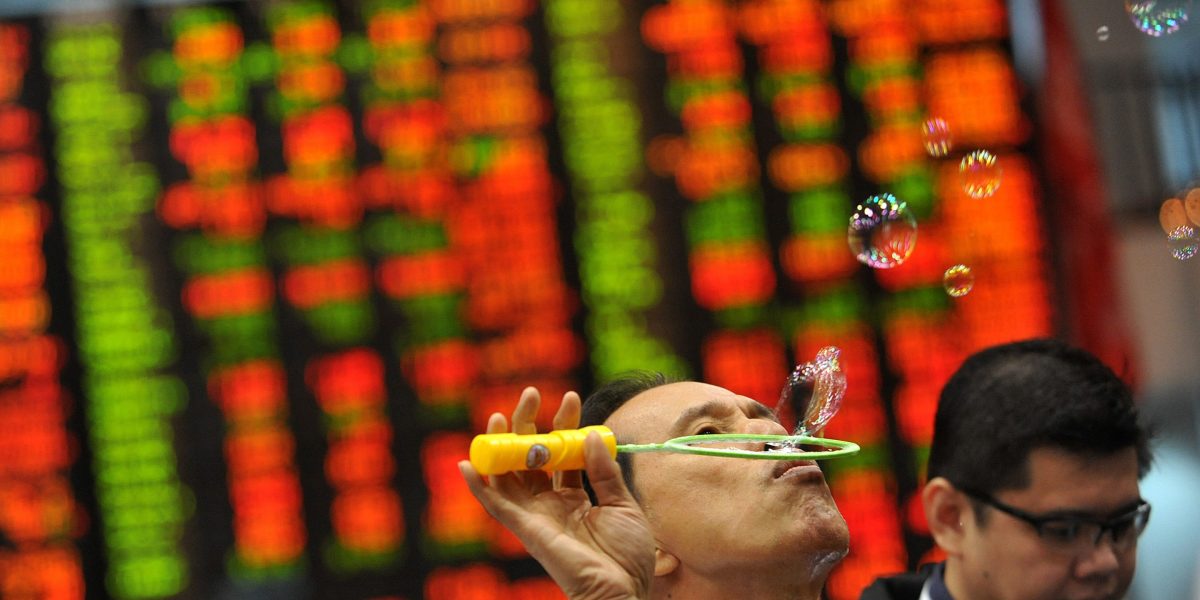
What bubble? Asset managers in risk-on mode stick with stocks

Published

on


There’s a time when investments run their course and the prudent move is to cash out. For global asset managers who’ve ridden double-digit gains in equities for three straight years, that time is not now.

“Our expectation of solid growth and easier monetary and fiscal policies supports a risk-on tilt in our multi-asset portfolios. We remain overweight stocks and credit,” said Sylvia Sheng, global multi-asset strategist at JPMorgan Asset Management.

“We are playing the powerful trends in place and are bullish through the end of next year,” said David Bianco, Americas chief investment officer at DWS. “For now we are not contrarians.”

“Start the year with sufficient exposure, even over-exposure to equities, predominantly in emerging market equities,” said Nannette Hechler-Fayd’herbe, EMEA chief investment officer at Lombard Odier. “We don’t expect a recession in 2026 to unfold.”

Those assessments came from Bloomberg News interviews with 39 investment managers across the US, Asia and Europe, including at BlackRock Inc., Allianz Global Investors, Goldman Sachs Group Inc. and Franklin Templeton.

More than three-quarters of the allocators were positioning portfolios for a risk-on environment through 2026. The thrust of the bet is that resilient global growth, further developments in artificial intelligence, accommodative monetary policy and fiscal stimulus will deliver outsize returns in all fashion of global equity markets. 

The call is not without risks, including simply its pervasiveness among the respondents, along with their overall high degree of assuredness. The view among the institutional investors also aligns with that of sell-side strategists around the globe. 

Should the bullishness play out as expected, it would deliver a stunning fourth straight year of bumper returns for the MSCI All-Country World Index. That would extend a run that’s added $42 trillion in market capitalization since the end of 2022 — the most value created for equity investors in history. 

That’s not to say the optimism is without merit. The artificial intelligence trade has added trillions in market value to dozens of firms plying the industry, but just three years after ChatGPT broke into the public consciousness, AI remains in the early phase of development.

No Tech Panic

The buy-side managers largely rejected the idea that the technology has blown a bubble in equity markets. While many acknowledged some pockets of froth in unprofitable tech names, 85% of managers said valuations among the Magnificent Seven and other AI heavyweights are not overly inflated. Fundamentals back the trade, they said, which marks the beginning of a new industrial cycle. 

“You can’t call it a bubble when you’re seeing tech companies deliver a massive earnings beat. In fact, earnings from the sector have outstripped all other US stocks,” said Anwiti Bahuguna, global co-chief investment officer at Northern Trust Asset Management.

As such, investors expect the US to remain the engine of the rally. 

“American exceptionalism is far from dead,” said Jose Rasco, chief investment officer at HSBC Americas. “As artificial intelligence continues to spread around the globe, the US will be a key participant.” 

Most investors echoed the sentiment expressed by Helen Jewell, international chief investment officer of fundamental equities at BlackRock, who suggested also searching outside the US for meaningful upside.

“The US is where the high-return high-growth companies are, so we have to be realistic about that. But those are already reflected in valuations, and there are probably more interesting opportunities outside the US,” she said.

International Boom

Profits matter above all else for equity investors, and huge bumps in government spending from Europe to Asia have stoked estimates for strong gains in earnings.

“We have begun to see a meaningful broadening of earnings momentum, both across market capitalizations and across regions, including Japan, Taiwan, and South Korea,” said Wellington Management equity strategist Andrew Heiskell. “Looking into 2026, we see clear potential for a revival of earnings growth in Europe and a wider range of emerging markets.”

India is one of the most compelling opportunities for 2026, according to Goldman Sachs Asset Management’s Alexandra Wilson-Elizondo, global co-head and co-chief investment officer of multi-asset solutions.

“We see real potential for India to become the Korea-like re-rating story of 2026, a market that transitions from tactical allocation to strategic core exposure in global portfolios,” she said. 

Nelson Yu, head of equities at AllianceBernstein, said he sees improvements outside of the US that will mandate allocations. He noted governance reform in Japan, capital discipline in Europe and recovering profitability in some emerging markets.

Small Cap Optimism

At the sector level, the investors are looking for AI proxies, notably among clean energy providers that can help meet the technology’s ravenous demand for power. Smaller stocks are also finding favor.

“The earnings outlook has brightened for small-capitalization stocks, industrials and financials,” said Stephen Dover, chief market strategist and head of Franklin Templeton Institute. “Small-cap stocks and industrials, which are typically more highly leveraged than the rest of the market, will see profitability rise as the Federal Reserve trims interest rates and debt servicing costs fall.”

Over at Santander Asset Management, Francisco Simón sees earnings growth of more than 20% for US small caps after years of underperformance. Reflecting the optimism, the Russell 2000 Index of such equities recently hit a record high.

Meanwhile, the combination of low valuations and strong fundamentals makes health care one of the most compelling contrarian opportunities in a bullish cycle, a preponderance of managers said.  

“Health-care related sectors can surprise to the upside in the US markets,” said Jim Caron, chief investment officer of cross-asset solutions at Morgan Stanley Investment Management. “This is a mid-term election year and policy may at the margin support many companies. Valuations are still attractive and have a lot of catch up to do.”

Virtually every allocator struck at least a note of caution about what lies ahead. The top worry among them was a rekindling of inflation in the US. If the Fed is forced by rising prices to abruptly pause or even end its easing cycle, the potential for turbulence is high.

“A scenario — which is not our base case — whereby US inflation rebounds in 2026 would constitute a double whammy for multi-asset funds as it would penalize both stocks and bonds. In this sense it would be much worse than an economic slowdown,” said Amélie Derambure, senior multi-asset portfolio manager at Amundi SA. 

“The way investors are headed for 2026, they need to have the Fed on their side,” she added.

Trade Caution

Another worry is around President Donald Trump’s capriciousness, particularly when it comes to trade. Any flareup in his trade spats that fuels inflation through heightened tariffs would weigh on risk assets. 

Oil and gas producers remain unloved by the group, though that could change if a major geopolitical event upends supply lines. While such an outcome would bolster those sectors, the overall impact would likely be negative for risk assets, they said.

“Any geopolitical situation that can affect the price of oil is what will have the largest impact on the financial markets. Clearly both the Middle East and the Ukraine/Russia situations can impact oil prices,” said Scott Wren, senior global market strategist at Wells Fargo Investment Institute.

Multiple respondents flagged European autos as a “no-go” area for 2026, citing intense competitive pressure from Chinese carmakers, margin compression and structural challenges in the transition to electric vehicles. 

“Personally I don’t believe for a minute that there will be a rebound in the sector,” said Isabelle de Gavoty at Allianz GI. 

Outside of those worries, most asset managers simply believe that there’s little reason to fret about the upward momentum being interrupted — outside, of course, from the contrarian signal such near-uniform bullishness sends.

“Everyone seems to be risk-on at the moment, and that worries me a bit in the sense that the concentration of positions creates less tolerance for adverse surprises,” said Amundi’s Derambure.  


Source link

Continue Reading

Trending

Copyright © Miami Select.