Connect with us

Politics

Evan Power at RNC meeting calls for Florida’s election integrity laws to be adopted nationwide
Published

on


The days of weekslong recounts and razor-thin statewide margins seem to be a thing of the past for the Republican Party of Florida (RPOF). But as the party holds maybe its greatest level of influence ever, state GOP Chair Evan Power said the party’s work is far from done.

At a meeting of the Republican National Committee (RNC) in Atlanta, Power, shortly before leading the Pledge of Allegiance at a luncheon with Vice President JD Vance, discussed the role of the Sunshine State in national politics. Power will cast a vote Friday to make Florida Republican National Committeeman Joe Gruters the new Chair of the RNC, but that one vote represents but a piece of the influence now enjoyed by the Florida GOP.

“We’ve been given a little more influence and given a lot of respect,” Power said. “People see what we’ve done in Florida, and the Florida model works, and they want to replicate that. We have a lot of people who ask for our advice in some of these states that are trying to replicate what we did, and we’re happy to do it.”

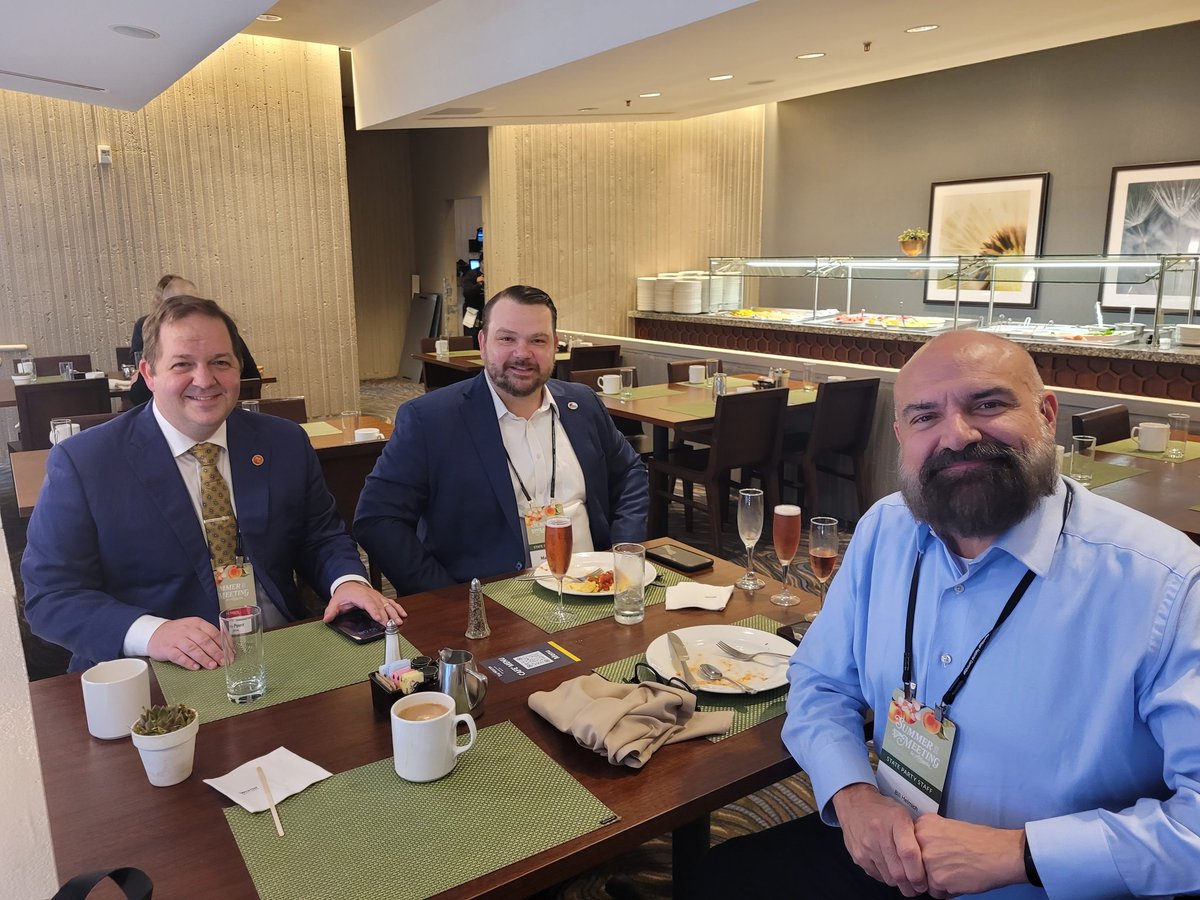
At an Atlanta hotel breakfast bar, Power shared a table with RPOF Executive Director Bill Helmich and Illinois Republican Party Executive Director Matt James. While James faces a different environment in deep-blue Prairie State, he said he has been eager to import Sunshine State policies to Chicago. The party there recently brought in U.S. Rep. Byron Donalds, a candidate for Florida Governor, to raise money for the Illinois GOP.

It’s not just booming voices but solid practices that James hopes to imitate.

“After talking with the Florida team and some of these other states here at the RNC, our fundraising has gone up, I won’t say exponentially, but it has gone up at a much more rapid rate than I had anticipated,” James said.

Florida Republicans, of course, haven’t hurt for money in many years. The party as of July had more than $238 million in cash on hand while the Florida Democratic Party’s most recent fundraising report showed the party in the red $5 million.

But Power also sees the party leading in other ways. A quarter century after the infamous 2000 Presidential Election, Power and Helmich both point to Florida’s election integrity statutes as a “gold standard” other states should follow. Power notes that many of the election laws were passed since 2018, when Gruters served as RPOF Chair and as a member of the Florida Senate.

“In 2018, for instance, we all thought Governor (Ron) DeSantis won, and we won Matt Caldwell’s (Agriculture Commissioner) race too, and we saw over the course of the next 24 hours those votes dwindle, and all tended to be from two counties that were run by Democrat Supervisors of Elections,” Power recalled. “So we have strengthened the Florida law based on that.”

Ultimately, DeSantis won his election by some 30,000 votes while Caldwell that year lost to Democrat Nikki Fried by about 7,000 votes.

Does Power believe that Fried, now the Florida Democratic Party Chair, won the election illegitimately?

“I think that there was fraud. I think that’s why two Supervisors ended up getting removed. They weren’t following the rules,” Power said, referencing the removal of Palm Beach Supervisor of Elections Susan Bucher and resignation of late Broward Supervisor of Elections Brenda Snipes.

“So I think, you know, obviously that was a close race. I don’t know if she (Fried) would have won or not won, but there were places we needed to clean up, because there’s evidence in court cases that things were not followed in the law.”

The most important reforms since, Power said, involved timely reporting, which became law after that election.

“The most important piece of our election integrity is the fact that the Supervisors, within 30 minutes, have to turn over the full number of ballots that they have on hand,” he said. “When those ballots come in late, I understand the human temptation, but the longer they sit there, the closer the race it is, human nature says, well, I can add those to them. But we have that safeguard in Florida so that you’re not having those problems.”

Helmich said that’s a preferable system to many blue states like California, where close elections routinely take weeks to call.

“In California, they’re taking one, two, three, four weeks to tell you who wins a congressional race. And oftentimes it seems, the longer these things go on and the more ballots that magically appear, it often seems to favor one party over another,” Helmich said.

“It’s inherently obvious to the most casual observer. So literally, we think most states, if not the entire nation, should take Florida’s election laws and just transpose them into their statutes, and then we’ll have fair elections, and then let the candidates have the battles and let the voters decide.”

President Donald Trump has also railed about election security, most recently calling for an end to mail-in voting. Those ballots in recent years have favored Democrats, and in states where those can be collected days after Election Day, that often has helped to swing the elections in California and other places.

But Power said Florida does vote-by-mail right as well. Indeed, the Florida GOP pioneered the practice of chasing absentee votes, even if Democrats now have adopted the practice as well. Florida notably doesn’t accept ballots by mail after polls close on Election Day, even if they are postmarked before polls open.

“I understand the President’s frustration, because you look at places like California and Arizona, they count for weeks. And I’m not saying there is or isn’t, but even if there is not fraud, just the counting for several weeks and the results changing in the last couple of days raises suspicion and makes people question the integrity of that ballot,” Power said.

“In Florida, we’ve been doing it correctly. But I understand the President’s frustration from a party standpoint. I’m going to chase voters by the rules that are in place. And so that’s a legislative decision, and I’ll deal with the ramifications of whatever the Legislature decides to do.”

The meeting in Atlanta also takes place as multiple states, including Florida, consider a mid-decade redistricting of congressional lines. Power sees potential gains from that.

“I think we’re going to get to a fairer map than we have now that the courts have ruled that we don’t have to gerrymander to get Democrat outcomes, and we can reject the Democrat maps drawn by judges. We can get to fairer maps, which mean more Republicans,” he said.

While the Florida Supreme Court in 2015 threw out a map drawn by the Legislature and put in place one with more competitive seats, the current congressional map was drawn by DeSantis’ Office. It was recently upheld by a more conservative court. But is that GOP-crafted map unfair to Republicans?

“It could be improved on. It’s a fair map. But there are still some of those gerrymanders in South Florida that are drawn to create districts for the liberals,” Power said.

“South Florida is a key area where there are districts that do not look like they’re not drawn for (racial) intent, and I think we could straighten those out. It’s more like when you draw those fair, it puts (Democratic U.S. Rep. Jared) Moskowitz in play. It puts (Democratic U.S. Rep.) Debbie Wasserman Schultz in play. Because they really don’t represent the people that are in their district. It’s really more Republican there than you would think.”


Post Views: 0


Source link

Continue Reading

Politics

Debbie Wasserman Schultz language protecting Everglades from pipeline fastrack rejected in committee

Published

on


Florida Democrats say an amendment shot down by the U.S. House Rules Committee could have protected the Everglades from energy exploration.

U.S. Rep. Debbie Wasserman Schultz, a Weston Democrat, pushed for a change in language in the Improving Interagency Coordination for Pipeline Reviews Act (HR 3668) during Committee proceedings. That bill, filed by U.S. Rep. Richard Hudson, a North Carolina Republican, would expedite review of natural gas or liquified gas pipelines by the Federal Energy Regulatory Commission (FERC).

Wasserman Schultz’s amendment to the bill would have excluded the Everglades and other Florida navigable waters from that change, still requiring extensive review to put a pipeline through Florida’s largest national park. However, the Rules Committee did not allow the amendment to come to a vote.

“While we spend billions to restore the Everglades, House Republicans voted to pollute it,” Wasserman Schultz posted on social media.

She said the amendment was worked on with the support of most Democrats in Florida’s congressional delegation, including U.S. Reps. Kathy Castor, Lois Frankel, Darren Soto and Frederica Wilson. Wasserman Schultz is the Democratic co-chair of the congressional delegation.

The proposed change “tried to exempt the Everglades from this dirty water bill, but House Republicans rejected it,” Wasserman Schultz said.

Republicans characterized the legislation differently, with some members from Florida.

U.S. Rep. Cory Mills, a New Smyrna Beach Republican, said he supported advancing the bill from the Committee to the floor.

“I voted to support HR 3668, the Improving Interagency Coordination for Pipeline Reviews Act, to cut red tape and speed up approvals for natural gas pipelines and LNG terminals,” he posted. “This bill puts FERC in charge of NEPA (National Environmental Policy Act) reviews, sets strict timelines, improves agency coordination and strengthens pipeline security. This is how we lower energy costs and boost American energy independence.”

FERC is responsible for reviewing and issuing permits for new or expanded gas lines. The legislation, as written, would shift oversight responsibilities from state governments to the agency and eliminate the need for state certifications.


Source link

Continue Reading

Politics

Sheila Cherfilus-McCormick is fundraising off of charges she stole $5M from FEMA

Published

on


Democratic U.S. Rep. Sheila Cherfilus-McCormick is staying true to the old maxim, “Never let a crisis go to waste.”

This week, her re-election campaign sent texts to voters imploring them to donate to help her in “fighting back” against what she calls a “politically motivated” attack against her.

She’s referring, of course, to federal charges filed in November accusing her of stealing $5 million in Federal Emergency Management Agency (FEMA) funds to bankroll her 2021 congressional campaign.

“2 weeks ago, I took a stand and voted to demand transparency, truth and accountability from our leaders. The next day, the attacks began. An indictment was filed. This was not random. This was politically motivated retaliation,” the text said.

“But this isn’t about silencing one person. It’s about sending a clear message to anyone who dares to challenge powerful interests: ‘Fall in line — or pay the price. Well, I’m fighting back — but I need you with me. DONATE NOW.”

The text then links to a donations page that, among other things, says, “She voted for the truth. They answered with retaliation.”

The fundraising text.

A perusal of Cherfilus-McCormick’s votes from around two weeks back reveals what she is likely referring to: “yesvotes on measures concerning the release of files connected to convicted sex offender Jeffrey Epstein.

Notably, none of the 426 other members of the House who voted to release the Epstein files were federally indicted for embezzling COVID funds in recent weeks.

The grand jury indictment against Cherfilus-McCormick, announced Nov. 19, alleges she and her brother secured funding intended for a COVID vaccine distribution program, but when overpayments were made, she rerouted the money through several accounts that later donated to her campaign.

U.S. Attorney General Pam Bondi described the alleged act as “a particularly selfish, cynical crime.”

Cherfilus-McCormick, 46, has maintained and reiterated that she is innocent of wrongdoing, calling the charges “unjust” and “baseless.”

“The timing alone is curious and clearly meant to distract from far more pressing national issues,” she said a day after the indictment was announced, noting that she has “fully cooperated” with a yearslong investigation into the matter. “I look forward to my day in court. Until then, I will continue fighting for my constituents.”

The fundraising site.

Should Cherfilus-McCormick be found guilty of all counts in the indictment, she could face up to 53 years in prison.

Cherfilus-McCormick isn’t the only federal lawmaker from Florida to fundraise off of her legal travails. Last year, following a House Ethics Committee report that there was “substantial evidence” he paid for sex, including with a 17-year-old, former U.S. Rep. Matt Gaetz sent out a fundraising plea citing his troubles.

“I need your help,” Gaetz, a Republican, said in an email through his political committee last December. “I’ve fought for you in Congress for eight years against the worst of the Radical Left and Uniparty. Now, they’re seeking their revenge.”

Gaetz, who resigned the month before, called the scrutiny over his alleged impropriety a “witch hunt.”

Former Republican U.S. Rep. George Santos of Long Island used the exact phrase to describe the fraud and money-laundering charges he faced in May 2023, about seven months before his peers in the House expelled him.

Republican U.S. Rep. Greg Steube introduced a resolution last month to expel Cherfilus-McCormick. Other than its referral to the Ethics Committee, no action has been taken on the bill.

Cherfilus-McCormick represents Florida’s 20th Congressional District, which spans parts of Broward and Palm Beach counties. She faces Primary challenges from Dale Holness and Elijah Manley, the latter of whom she is suing for defamation over the FEMA funds issue.

Republicans Sendra Dorce and Rodenay Joseph are also running in the district, which leans heavily Democratic.

Florida Politics contacted Cherfilus-McCormick’s Communications Director, Kailyn McBride, seeking comment about the Congresswoman’s texts, but received no response.

___

Jacob Ogles contributed to this report.


Source link

Continue Reading

Politics

PFAS water contamination has met its match

Published

on


Toxic PFAS “forever chemicals” are found in nearly half of all U.S. drinking water. These harmful chemicals are linked to cancer, developmental issues, and immune system damage. They enter our water systems through industrial discharges, firefighting foams, and landfill runoff. Once present, they are nearly impossible to remove using traditional methods.

For years, families, utilities, and local governments have faced a difficult choice: accept unsafe water or pay for costly, slow, and incomplete cleanup methods.

After 10 years of research and development, Eco World Water has the solution.

At Eco World Water, we have completed four months of rigorous pilot testing with an independent laboratory, under protocols reviewed by the Florida Department of Environmental Protection. The verified lab results confirm that our system can reduce PFAS to non-detectable levels in a safe, reliable, and quick manner. More importantly, the system produces clean, safe water in minutes, not days.

For a national problem needing a scalable solution, this is a breakthrough with transformative potential.

Per- and polyfluoroalkyl substances (PFAS) earned the nickname “forever chemicals” for a good reason. They persist in the environment for decades, are resistant to conventional treatment, and pose serious risks to public health. That is why our verified results are so significant.

For too long, PFAS have been viewed as an unsolvable challenge. We can now say with confidence: problem solved. Our system demonstrates that communities don’t have to accept “forever chemicals” as a fact of life. PFAS-free water is not theoretical. It’s operational.

Just as important, Eco World Water’s patented, modular technology is a complete, all-in-one system built for permanent installation. It takes up significantly less space than traditional wastewater treatment systems and can be scaled to meet the needs of communities, large or small. Its modular design also enables a version that fits inside a shipping container, ideal for rapid deployment to disaster relief zones or remote locations where clean water is urgently needed.

The system turns raw wastewater into water that meets drinking quality standards, not just removing PFAS, but also eliminating a wide range of harmful contaminants like heavy metals, pharmaceuticals, and pathogens. It’s fast, compact, and easy to operate, bringing clean water where it’s needed most, without the delays or complexity of traditional systems.

This is the result of more than 10 years of focused research and development. Eco World Water’s mission is simple: give every community access to clean, safe, and affordable water. With these latest independent lab-verified results, we are delivering on that mission.

This progress comes at a crucial moment in the quest for clean water.

States across the country are preparing for more demanding PFAS standards and increased federal oversight. Billions of dollars in federal infrastructure funding are available to support water system upgrades. Yet many communities still lack tools that can meet those expectations. Our technology can adapt to the needs of each site and provides a clear, cost-effective path toward compliance with new federal mandates.

Families deserve water they can trust. Local governments deserve options that don’t strain their budgets. Communities deserve solutions that meet the urgency of the clean water moment.

Eco World Water is ready to deliver.

After decades of frustration and uncertainty, we now have a verified solution. Water with undetectable PFAS levels is not just an aspiration. It’s a proven, tested reality.

___

Steve Adelstein is the Executive Chair of Eco World Water.


Source link

Continue Reading

Trending

Copyright © Miami Select.