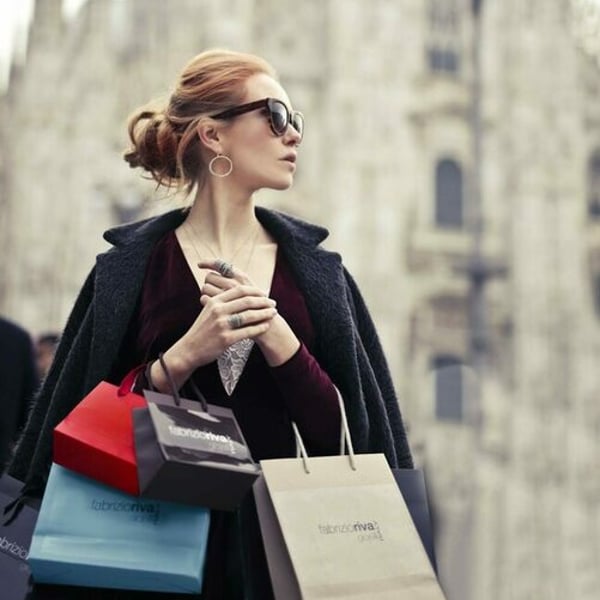
A new report on the high-end and luxury sector in Europe shows that it’s a “€986 billion economic powerhouse driving jobs, tourism and craftsmanship”.
Photo: Pexels
The study comes from the European Cultural and Creative Industries Alliance (ECCIA), which includes EU countries and the UK, and shows that Europe’s high-end/luxury sector represents 5% of the continent’s GDP and that it “continues to drive economic growth, preserve cultural heritage, and champion excellence well beyond the continent”.
The study was conducted by Bain & Company for ECCIA and also said that the sector has global leader status with 70% global market share. And for personal goods, that share is 80%. But the prospects are “clouded” due to “external challenges such as tariffs and emerging global trade uncertainty”.
That’s a worrying situation given that the sector employees as many as 2 million people throughout Europe and further concerns include the difficulty of attracting and retaining the next generation of skilled artisans.
“European luxury goods continue to dominate global markets, with the latest figures demonstrating a strong performance over the past five years and a solid position for growth within the global high-end and luxury market — rooted in the sector’s unique resilience and its ability to adapt and seize opportunities in emerging markets,” said Claudia D’Arpizio of Bain & Company.
And she added that “while these new findings show that the sector accounts for 11.5% of total European exports, high-end and luxury goods are much more than economic drivers.
Luxury represents Europe’s soft power
“The brands, through their products and experiences, also represent the ultimate expression of the soft power Europe wields through its creativity, innovation, and craftsmanship — Europe’s unique ‘artisanal intelligence’. This sector is a creative powerhouse that invests up to 5% of revenues in education and training, and up to 3% in sustainability and innovation, which contribute to social prosperity, cultural preservation, and economic growth across Europe’s clusters of excellence”.
But as mentioned, the sector has huge challenges to deal with, notably “escalating geopolitical tensions, rising tariffs, and protectionist trade policies, especially between the US and China which make up 35%-45% of the global revenues for the sector”.
“It’s tempting to assume that this the sector is shock-proof from some of the economic turbulence we’ve been seeing…. [but] we are sensitive to the some of the warning signs,” said Michael Ward, the MD of luxury London retailer Harrods who’s also president of ECCIA. “European high-end and luxury brands supported 2 million jobs in 2024, with 160,000 new jobs created since 2019, outpacing broader EU labour market growth. Tariff measures threaten to disrupt global demand, drive up costs, and force companies to reconsider supply chains as we focus on profitability and call for greater stability.”
The reports shows that the high-end/luxury sector is also key for 40% of international travellers who cite luxury as a reason for visiting Europe. And high-spending tourists represent up to 25% of tourism-generated value.
One aim of the report is to publicise the need for “smart and urgent policy support to safeguard one of Europe’s cultural and economic treasures”.
Among the measure the body is calling for are strengthened intellectual property rights (IPR) and more power given to combat counterfeiting.
It also wants to see a boost to the EU’s legislative framework to help brands enforce their selective distribution networks against unauthorised distributors, protecting brand image and investments while ensuring consumer safety.
And it’s calling for more EU support for craftsmanship and skills development, as well as support for free trade agreements, simplifying procedures for obtaining EU visas and encouraging VAT-free shopping for non-EU tourists.
The ECCIA, established in 2010, is composed of seven European cultural and creative industries organisations — Altagamma (Italy), Circulo Fortuny (Spain), Comité Colbert (France), Gustaf III Kommitté (Sweden), Laurel (Portugal), Meisterkreis (Germany) and Walpole (UK). Between them they represent 750 brands and cultural institutions.
Burberry has named a new chief operating and supply chain officer as well as a new chief customer officer. They’re both key roles at the recovering luxury giant and both are being promoted from within.
Matteo Calonaci becomes chief operating and supply chain officer, moving from his role as senior vice-president of strategy and transformation at the firm.
In his new role, he’ll be oversee supply chain and planning, strategy and transformation, and data and analytics. He succeeds Klaus Bierbrauer, who’s currently Burberry supply chain and industrial officer. Bierbrauer will be leaving the company following its winter show and a transition period.
Matteo Calonaci – Burberry
Meanwhile, Johnattan Leon steps up as chief customer officer. He’s currently currently Burberry’s senior vice-president of commercial and chief of staff. In his new role he’ll be leading Burberry’s customer, client engagement, customer service and retail excellence teams, while also overseeing its digital, outlet and commercial operations.
Both Calonaci and Leon will join the executive committee, reporting to Company CEO Joshua Schulman.
JohnattanLeon – Burberry
Schulman said of the two execs that the appointments “reflect the exceptional talent and leadership we have at Burberry. Both Matteo and Johnattan have been instrumental in strengthening our focus on executional excellence and elevating our customer experience. Their deep understanding of our business, our people, and our customers gives me full confidence that their leadership will help drive [our strategy] Burberry Forward”.
Traditional and occasion wear designer Puneet Gupta has stepped into the world of fine jewellery with the launch of ‘Deco Luméaura,’ a collection designed to blend heritage and contemporary aesthetics while taking inspiration from the dramatic landscapes of Ladakh.
Hints of Ladakh’s heritage can be seen in this sculptural evening bag – Puneet Gupta
“For me, Deco Luméaura is an exploration of transformation- of material, of story, of self,” said Puneet Gupta in a press release. “True luxury isn’t perfect; it is intentional. Every piece is crafted to be lived with and passed on.”
The jewellery collection features cocktail rings, bangles, chokers, necklaces, and statement evening bags made in recycled brass and finished with 24 carat gold. The stones used have been kept natural to highlight their imperfect and unique forms and each piece in the collection has been hammered, polished, and engraved by hand.
An eclectic mix of jewels from the collection – Puneet Gupta
Designed to function as wearable art pieces, the colourful jewellery echoes the geometry of Art Deco while incorporating distinctly South Asian imagery such as camels, butterflies, and tassels. Gupta divides his time between his stores in Hyderabad and Delhi and aims to bring Indian artistry to a global audience while crafting a dialogue between designer and artisan.
A look inside the salon of the French luxury house’s new Vienna store. – CELINE
The 150-square-metre luxury boutique in Vienna spans three storeys. It showcases the latest womenswear and menswear collections, beauty, fragrances, and Maison pieces. From the outside, the flagship impresses with a listed façade of sculpted marble, paired with large, dark-framed, floor-to-ceiling windows.
Inside, natural stone prevails, with materials such as Grand Antique marble combined with travertine. Basaltina flooring laid throughout features a French-inspired chevron pattern. The sense of luxury is heightened by ultra-clear mirrors- some finished in antique gold- neon lighting, and polished metal.
On the ground floor, womenswear is presented, beginning with accessories, leather goods, beauty products, and fragrances. This is followed by the ready-to-wear area.
A staircase with cantilevered steps, inspired by minimalism, leads to the first floor, where the menswear collections are presented. The scheme here is darker overall, with black-lacquered walls and a selection of timbers that contrast with the lighter woods in the other areas.
A look inside the luxury boutique. – CELINE
An intimate salon on the second floor, accessible exclusively via a private lift, expands the store and includes an enlarged fitting room.
Throughout the store and its numerous lounge areas, the furnishings comprise a selection of vintage and contemporary pieces. As part of the ongoing Celine Art Project, a curated selection of artworks is on display with a stoneware composition by Anders Hald, a painting by Jasmine Gregory, and sculptures by Rosalind Tallmadge and Marcelo Silveira.
This article is an automatic translation. Click here to read the original article.