Fashion
European textile stakeholders argue that levies and Europe’s approach to its textile industry will determine whether circularity can work in practice
Published
October 2, 2026
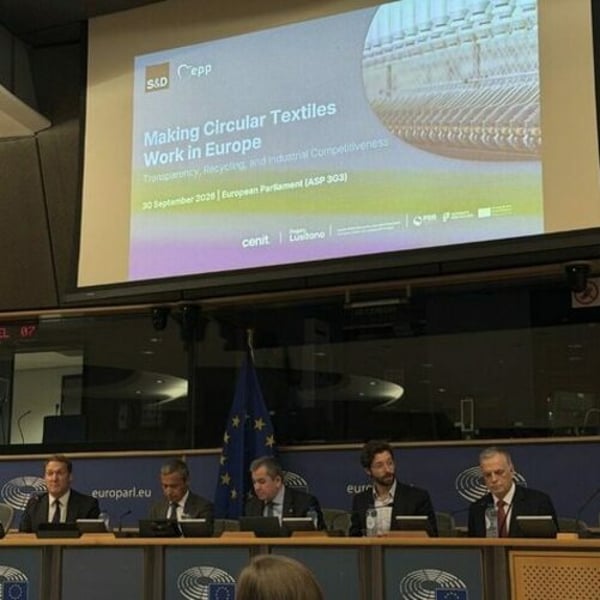
Just one week after the European Commission (EC) set a handling fee of 2 euros for small parcels from third countries, Europe’s textile and clothing industry is arguing that the fee should be raised to 10 euros. The proposal was tabled at the European Parliament in Brussels during a debate entitled ‘Making circularity in textiles viable in Europe: transparency, recycling, and industrial competitiveness’, held on September 30, at which representatives of the Portuguese and European textile sectors maintained that the way the European Union (EU) regulates imports and supports the industry will be decisive in achieving circularity goals.
César Araújo, president of ANIVEC — Portugal’s National Association of the Clothing, Apparel and Fashion Industries — said the current 2‑euro charge is insufficient and called for a fee of 10 euros per parcel. He also highlighted the rapid growth in small parcels entering the European market.
According to the data presented, there were around 2.7 billion in 2023, 4.1 billion in 2024 and close to 6 billion in 2025. In Araújo’s view, the previous ‘de minimis’ regime ultimately facilitated the massive influx of products into the European market, particularly via Asian e‑commerce platforms.
“This is not about customs duties. It is about fair competition, product safety, taxation and consumer protection,” said the ANIVEC president, further arguing that the revenue generated by the levy should help fund the human and technological resources needed to inspect millions of parcels.


César Araújo also called for closer monitoring of imports and of the impact of the Generalised System of Preferences, enabling the EU to act swiftly in the event of any trade imbalances.
At the heart of the debate was the competitiveness of European industry. Its transition to a more sustainable model, Araújo argued, must not translate into costs borne solely by European producers: “Europe cannot become greener or cleaner by losing its industry. If production simply moves to another part of the world, emissions will not disappear. European jobs will disappear,” he said.
The debate brought together representatives of European institutions, industry and organisations involved in circularity, recycling, and innovation, including Mário Jorge Machado from EURATEX; Marc Puyuelo from Coleo; Eva Moalic from Refashion; and Miguel Gonçalves from Nau Verde. It was moderated by journalist and event host Jack Parrock.


The discussion also focused on the practical application of instruments such as the Digital Product Passport, eco-design requirements and Extended Producer Responsibility (EPR) schemes, as well as the challenges related to the collection, sorting, and recycling of textile waste.
Araújo highlighted three priorities for making circularity economically viable: creating an effective market for recycled fibres; recognising the value of recycled materials produced in Europe; and an EPR scheme with eco‑modulation mechanisms capable of rewarding products that are more durable and repairable, have a smaller carbon footprint, and incorporate a higher proportion of recycled materials.
He also argued that the ‘Made in Europe’ label should enable consumers to know not only the place of production, but also the conditions and methods used in manufacturing.
In closing, César Araújo called for European support for recycled fibres, the creation of eco‑modulation mechanisms to encourage investment in sustainability, and the development of a European solution for textile waste. He argued that the European Union’s next budget should allocate resources to support the sector’s transformation.


The meeting was the organisers’ second held in Brussels this year. According to those responsible, the intention is to continue contributing to the European debate on competitiveness, sustainability and the future of the textile industry.
“We are not asking Europe to protect our industry from competition. We are asking Europe to ensure that competition is fair,” Araújo said, referring to the scale of the European sector, which comprises around 200,000 companies and 1.2 million jobs.
The LUSITANO Project brings together 17 partners and involves a total investment of 111.5 million euros, with the aim of driving the transformation of the Portuguese textile industry across the entire value chain, from fibre to consumer. The initiative focuses on adopting advanced technologies, including artificial intelligence, and on developing sustainable, circular solutions for the production of yarns, fabrics, knits and garments from natural and recycled fibres.
CENIT — the Centre for Textile Intelligence — is a Portuguese non‑profit association whose principal member organisation is ANIVEC/APIV — the National Association of the Clothing and Fashion Industries. The organisation carries out strategic projects in the areas of internationalisation, innovation and communication within the Portuguese textile and clothing industry. Through the MODAPORTUGAL strategy, it seeks to strengthen the international competitiveness of a sector that combines tradition, creativity, sustainability and technology, the press release received by the FashionNetwork.com editorial team directly from Brussels concludes.
Copyright © 2026 FashionNetwork.com All rights reserved.