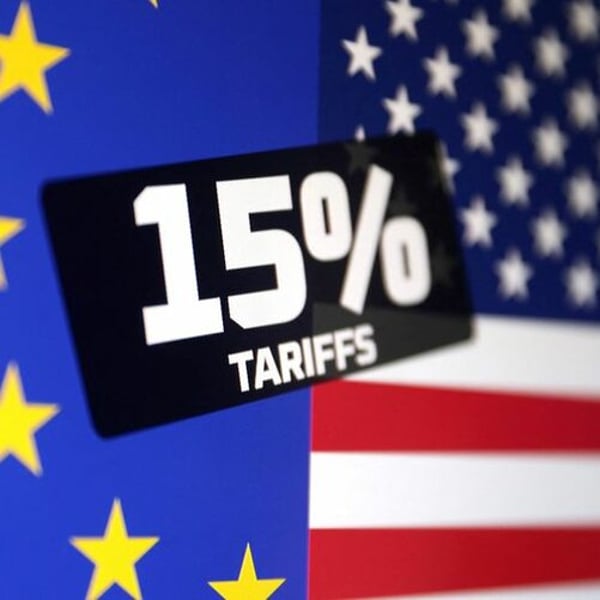
European companies were on edge Monday following the announcement of a new trade agreement between the United States and the European Union. This outcome marks the end of prolonged tariff uncertainty but introduces new cost pressures.
The trade deal, announced Sunday, imposes a 15% import tariff on most EU goods. After an initial relief rally—simply because a deal had been reached—shares of carmakers and alcohol producers fell.
Leading the way lower were BMW, Volkswagen, Mercedes-Benz and Stellantis, along with Pernod Ricard and Anheuser-Busch InBev, all down between 1% and 2%.
The declines reflect a perception that the deal is lopsided—more of a win for U.S. President Donald Trump—and ongoing uncertainty around the fine print of the agreement.
The 15% rate is lower than the 30% once threatened by Trump and brings clarity for European producers of cars, aircraft and chemicals. However, it still falls short of early hopes for a “zero-for-zero” tariff structure, and sits well above last year’s average rate of around 2.5%.
“The price is high for both sides. European exports are losing competitiveness. U.S. customers are paying the tariffs,” said Wolfgang Große Entrup, head of the German Chemical Industry Association (VCI). “But it could have been worse. Those who expect a hurricane are grateful for a storm.”
The deal also includes $600 billion in EU investments in the U.S. and $750 billion in EU purchases of U.S. energy over Trump’s second term. While some exemptions have been outlined, key details are still pending.
For automakers, the 15% tariff marks a reduction from over 25% under the global levy imposed by Trump in April. A senior European Commission official involved in the talks noted that the EU is also cutting its tariff on U.S.-made cars to 2.5%.
Auto parts suppliers were among the day’s strongest stock market performers. France’s Valeo rose around 4%, while peer Forvia—also buoyed by strong earnings earlier Monday—jumped more than 10%.
“Tariffs are lower than those imposed by the U.S. administration in recent months. If this reduces volatility and uncertainty, it’s better for all economic players,” said Olivier Durand, chief financial officer at Forvia, during an earnings call.
Aircraft and aircraft parts will be exempt from tariffs—good news for French planemaker Airbus—as will certain chemicals, some generic pharmaceuticals, semiconductor equipment, farm products, natural resources and critical raw materials.
Shares in drugmakers Sanofi, Roche and Novo Nordisk edged higher, while generics maker Sandoz posted strong gains.
“It’s definitely better than 200%. Most had 25% factored in. But I don’t think anyone believes it until it’s signed,” one pharmaceutical industry source told Reuters, referring to earlier threats from Trump to tax drug imports.
Shares in ASML, the world’s leading supplier of chipmaking equipment, also rose more than 4%, ranking among the biggest gainers on the pan-European STOXX 600 index.
Still to be negotiated: spirits, wine, and cosmetics sectors await clarity
Dutch brewer Heineken welcomed the agreement, with CEO Dolf van den Brink praising the certainty it brings.
The world’s second-largest brewer ships its namesake lager from Europe and Mexico to the U.S. and has also suffered from falling consumer confidence in key markets, such as Brazil.
However, tariff levels for spirits—impacting brands such as Diageo, Pernod Ricard and LVMH—remain under negotiation.
“In the coming days, there may be talks for certain agricultural products under a zero-for-zero model, which both the European and U.S. sectors have advocated,” said José Luis Benítez, director of the Spanish Wine Federation. He warned that a 15% tariff could disadvantage European wine exporters against competitors facing only 10% tariffs.
“If there are any exemptions, we hope the European Commission recognizes that wine should be included,” he added.
Lamberto Frescobaldi, president of Italian wine consortium UIV, stated Sunday that a 15% tariff on wine would result in a loss of €317 million ($372.6 million) over the next 12 months. The group is waiting for the final text of the deal.
Some executives said that while the agreement—following a similar one with Japan—offers clarity, it still poses risks to European industries.
“While this agreement puts an end to uncertainty, it poses a significant threat to the competitiveness of the French cosmetics industry,” said Emmanuel Guichard, secretary general of French cosmetics association FEBEA, whose members include L’Oréal, LVMH and Clarins.
The demerger of Unilever‘s ice cream division, to be named ‘The Magnum Ice Cream Company,’ which had been delayed in recent months by the US government shutdown, will finally go ahead on Saturday, the British group announced.
Reuters
Unilever said in a statement on Friday that the admission of the new entity’s shares to listing and trading in Amsterdam, London, and New York, as well as the commencement of trading… is expected to take place on Monday, December 8.
The longest federal government shutdown in US history, from October 1 to November 12, fully or partially affected many parts of the federal government, including the securities regulator, after weeks without an agreement between Donald Trump‘s Republicans and the Democratic opposition.
Unilever, which had previously aimed to complete the demerger by mid-November, warned in October that the US securities regulator (SEC) was “not in a position to declare effective” the registration of the new company’s shares. However, the group said it was “determined to implement in 2025” the separation of a division that also includes the Ben & Jerry’s and Cornetto brands, and which will have its primary listing in Amsterdam.
“The registration statement” for the shares in the US “became effective on Thursday, December 4,” Unilever said in its statement. Known for Dove soaps, Axe deodorants and Knorr soups, the group reported a slight decline in third-quarter sales at the end of October, but beat market expectations.
Under pressure from investors, including the activist fund Trian of US billionaire Nelson Peltz, to improve performance, the group last year unveiled a strategic plan to focus on 30 power brands. It then announced the demerger of its ice cream division and, to boost margins, launched a cost-saving plan involving 7,500 job cuts, nearly 6% of the workforce. Unilever’s shares on the London Stock Exchange were steady on Friday shortly after the market opened, at 4,429 pence.
This article is an automatic translation. Click here to read the original article.
Burberry has named a new chief operating and supply chain officer as well as a new chief customer officer. They’re both key roles at the recovering luxury giant and both are being promoted from within.
Matteo Calonaci becomes chief operating and supply chain officer, moving from his role as senior vice-president of strategy and transformation at the firm.
In his new role, he’ll be oversee supply chain and planning, strategy and transformation, and data and analytics. He succeeds Klaus Bierbrauer, who’s currently Burberry supply chain and industrial officer. Bierbrauer will be leaving the company following its winter show and a transition period.
Matteo Calonaci – Burberry
Meanwhile, Johnattan Leon steps up as chief customer officer. He’s currently currently Burberry’s senior vice-president of commercial and chief of staff. In his new role he’ll be leading Burberry’s customer, client engagement, customer service and retail excellence teams, while also overseeing its digital, outlet and commercial operations.
Both Calonaci and Leon will join the executive committee, reporting to Company CEO Joshua Schulman.
JohnattanLeon – Burberry
Schulman said of the two execs that the appointments “reflect the exceptional talent and leadership we have at Burberry. Both Matteo and Johnattan have been instrumental in strengthening our focus on executional excellence and elevating our customer experience. Their deep understanding of our business, our people, and our customers gives me full confidence that their leadership will help drive [our strategy] Burberry Forward”.
Traditional and occasion wear designer Puneet Gupta has stepped into the world of fine jewellery with the launch of ‘Deco Luméaura,’ a collection designed to blend heritage and contemporary aesthetics while taking inspiration from the dramatic landscapes of Ladakh.
Hints of Ladakh’s heritage can be seen in this sculptural evening bag – Puneet Gupta
“For me, Deco Luméaura is an exploration of transformation- of material, of story, of self,” said Puneet Gupta in a press release. “True luxury isn’t perfect; it is intentional. Every piece is crafted to be lived with and passed on.”
The jewellery collection features cocktail rings, bangles, chokers, necklaces, and statement evening bags made in recycled brass and finished with 24 carat gold. The stones used have been kept natural to highlight their imperfect and unique forms and each piece in the collection has been hammered, polished, and engraved by hand.
An eclectic mix of jewels from the collection – Puneet Gupta
Designed to function as wearable art pieces, the colourful jewellery echoes the geometry of Art Deco while incorporating distinctly South Asian imagery such as camels, butterflies, and tassels. Gupta divides his time between his stores in Hyderabad and Delhi and aims to bring Indian artistry to a global audience while crafting a dialogue between designer and artisan.