Mario Jorge Machado, president of the European textile industry confederation Euratex, was in Paris on September 16 to take part in an exceptional gathering of European federations, determined to stand up to the ultra-fast-fashion players Shein and Temu. The battle adds to the fallout from the U.S. tariff war, which is pushing producers in Asia to redirect output to Europe, where manufacturers continue to invest in improving their processes. There is, therefore, an urgent need for political action, the Euratex president tells FashionNetwork.com.
Mário Jorge Machado – MG/FNW
FashionNetwork: The first half of the year was marked by great uncertainty over U.S. tariffs. Do you expect Asian exports to Europe to increase as a result of Washington’s measures?
Mario Jorge Machado: The acceleration of Asian imports is already affecting Europe. Between January and June, European imports from Asian countries rose by 20%–30%. At the same time, prices fell by 15%–20%. This shows that Asian manufacturers are already offloading in Europe the garments they can no longer sell in the U.S. That is another form of unfair competition, because it amounts to product dumping in Europe. And the anti-dumping process is so complicated, so costly and so time-consuming that SMEs are unable to find the means to protect themselves against this new form of unfair competition. We are trying to maintain an open market in Europe, but this enables such unfair competitors to flout our rules and destroy our industry.
FNW: A European industry that invests in improving its production…
MJM: The situation is indeed very dangerous for an industry in which we have invested so much in decarbonisation, innovation, sustainability, reducing water consumption and the management of chemicals. We have done a great deal of work and made huge investments which, ultimately, should be reflected in our products.
And yet we see companies closing and textile jobs disappearing in Europe. We have already seen that over the last eighteen months, around 100,000 textile jobs have been lost in Europe. This is unacceptable. In a sector that employs 1.3 million people, this means that nearly 10% of European textile jobs have gone, and nothing has been done about it.
MJM: Yes, Euratex is working on this at various levels in Brussels, which involves not only the commission, but also the council and parliament. We have already organised a dinner at the European Parliament with MEPs, to which we invited CEOs from across Europe so they could explain what is happening in the sector. And fairness is indeed a subject we return to frequently. We are also seeing tariff barriers being erected. We do not believe that is the right solution. We continue to believe in treaties, trade, free trade and fair trade. But we cannot play this game alone: if everyone else plays their cards under the table and only Europeans lay theirs on the table, we will lose. We cannot be naïve. We must defend our values and our industry.
FNW: Should we look beyond the textile industry for answers?
MJM: I say this very often: this is not just a problem for the textile industry. Textiles and clothing remain leading industries globally. And it is a sector where we are under unfair attack. We have to defend ourselves against those who do not play fair. How can we do this? As an industry alone, we cannot defend ourselves, because we are subject to the rule of law. It is the rule of law that must protect industry in Europe. We must comply. And that is the right way to proceed. We must comply with social and environmental standards, and with all applicable taxes in Europe. And that is normal. That is how things are supposed to be. But then, as Europeans, we cannot allow those who do not comply with all these rules to come here and sell their products.
FNW: So it’s transparency that should differentiate textile players?
MJM: We advocate transparency. Brands selling in Europe must be transparent about how they produce, both socially and environmentally. And if they do not produce properly—or if, at the very least, they do so abusively—they should not be rewarded for having low costs: their production costs may be low, but the environment pays the price.
Yet European companies that pass the cost of improved production through to the product find themselves squeezed out of the market by brands that do not comply with the same requirements, while their customers have no idea what lies behind the products they buy.
FNW: So there’s still work to be done with European consumers?
MJM: Clothing buyers assume that if they purchase a product and Europe allows it to be marketed, it is safe and regulated. As Europeans, we tend to believe we are protected when we buy something. We think the product is controlled and that we can buy it safely. But that is not true.
Faced with very low-priced products from outside Europe, the European Commission and European politicians are endangering the lives of European consumers by failing to take appropriate safety measures. At the same time, they are rewarding companies that offer cheaper products because they do not pass the real costs on to the price of the product. These companies are rewarded with access to European consumers. In the end, the textile companies that do the right thing are the ones that disappear from the market. This is totally unacceptable. We therefore need action from political leaders.
This article is an automatic translation. Click here to read the original article.
Platinum extended its steep rally to a 17-year high, driven by tight supplies and elevated trading activity in a new Chinese futures contract.
Platinum jewellery is one of the main uses of the precious metal – Platinum Days of Love- Facebook
Spot prices climbed as much as 4.9% on Wednesday, and have chalked up gains of more than 2% each day since Thursday. The metal has more than doubled this year, set for the biggest annual gain in Bloomberg data going back to 1987.
The surge has come as the London market shows signs of tightening, as banks park metal in the US to insure against the risk of tariffs. Exports to China have also been robust this year, and optimism for the nation’s demand has been bolstered as futures recently began trading on the Guangzhou Futures Exchange.
Highlighting the tight supply, the annualised cost of borrowing platinum for one month was at about 14% on Wednesday in London, a historically high level that indicates traders are unwilling to part with metal while inventories are low.
“We’ve got this really tight environment globally, with three-way geographic competition for metal between the US, Europe, and China,” said Ed Sterck, director of research at the World Platinum Investment Council. “You’ve still got really elevated lease rates, which is indicative of a shortage of metal.”
Against a tight background, the metal has been hit by a wave of investment that poured into precious metals this year, a rush that helped silver to also double in price and soar to a record.
As traders wait for the outcome of Washington’s Section 232 probe- which could lead to tariffs or trade restrictions on platinum- more than 600,000 ounces of the metal are sitting in US warehouses, an amount much higher than usual.
In China, the newly launched platinum futures on GFEX have attracted a wave of speculators, with prices rising well above other international benchmarks.
While Sterck said trading volumes on the new offering were significant, he noted that the contract wasn’t yet fully open for non-domestic traders to take advantage of premium prices by sending platinum to China. Smoothing out the arbitrage process would make it easier for the futures contracts to pull global benchmarks higher, as inflows cause other markets to tighten.
The exchange has shared ambitions about opening vaults overseas in the future, to take a larger role in the price discovery process, according to Sterck.
“China’s the biggest market in the world for a lot of commodities, but hasn’t necessarily been as influential in global price discovery yet,” he said.
Platinum is on course for a third annual deficit this year, helped by supply disruptions in major producer South Africa. The auto and jewellery sectors are among the biggest consumers, but high borrowing costs have been an issue for manufacturers that use the metal to produce goods ranging from chemicals to glass to laboratory equipment. Industrial users often choose the less capital-intensive option of leasing, rather than buying the commodity outright. Given the cost of borrowing, a move to buying instead could propel prices higher.
The electric-vehicle transition had long weighed on platinum and its sister metal palladium, both of which are used in catalytic converters to filter pollution. Still, slower-than-expected adoption of EVs in some markets has boosted sentiment, and the European Union this week eased requirements that would have halted sales of new gasoline and diesel-fuelled cars starting in 2035.
Platinum was up 2.2% at $1,885.40 an ounce by 3:55 p.m. in London. Sister metal palladium gained as much as 3.1%.
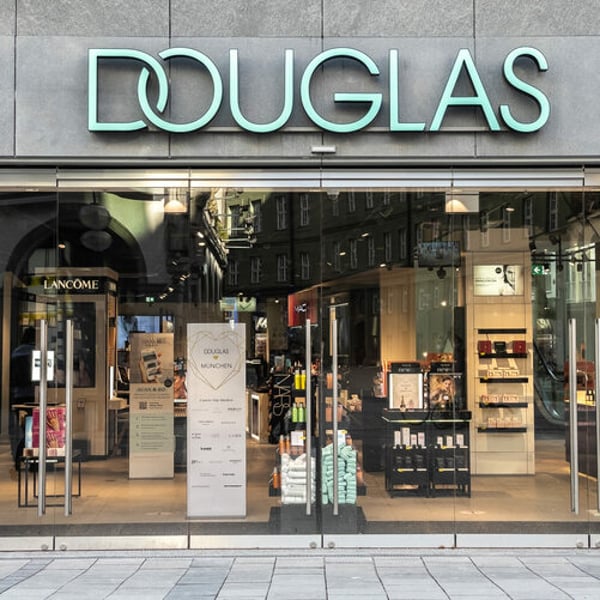
The perfumery chain Douglas posted higher revenue and earnings in the 2024/25 financial year. However, in the final quarter the company felt the impact of greater customer price sensitivity and intensifying competitive pressure from discount promotions, Douglas said in Düsseldorf on Thursday. In the financial year to the end of September, revenue rose by 2.8% to just under 4.6 billion euros. Earnings before interest, taxes, depreciation and amortisation (EBITDA) improved by 3.6% to 756.5 million euros.
shutterstock
“In a very volatile and therefore challenging year, we delivered results broadly in line with expectations,” said Group CEO Sander van der Laan. He expects the European premium beauty market to remain on a growth trajectory, although consumer uncertainty could persist. For the new 2025/26 financial year, Douglas anticipates a slight increase in revenue to between 4.65 and 4.8 billion euros, while the adjusted EBITDA margin is likely to decline from 16.8% to around 16.5%.
In the medium term, Douglas is targeting low- to mid-single-digit percentage growth and a stable adjusted EBITDA margin. The company is also exploring expansion beyond Europe: Group CEO van der Laan sees significant potential in the Gulf region, given its affluent clientele, and is considering market entry. A final decision is expected during 2026.
This article is an automatic translation. Click here to read the original article.
One of India’s richest states that’s heavily reliant on exports said high US tariffs are causing “irreparable damage” to businesses in the region and called on Prime Minister Narendra Modi to urgently seek a trade deal with Washington.
Tamil Nadu’s chief minister M K Stalin – MK Stalin- Facebook
M. K. Stalin, the chief minister of Tamil Nadu, said export orders have dried up in some districts, resulting in a daily loss of 600 million rupees ($6.7 million) in revenue. In Tiruppur district- also known as the knitwear capital of the nation- there’s been “a staggering wipe out” of 150 billion rupees in confirmed orders, forcing production cuts of up to 30%, Stalin said in a letter to Modi on Thursday.
US President Donald Trump slapped tariffs of 50% on Indian goods in August, one of the highest rates in the world, slashing exports to India’s biggest market and threatening Modi’s manufacturing ambitions. Despite months of negotiations and New Delhi officials expressing optimism of a deal soon, both sides remain locked in talks without any clear sign whether the tariffs will be lowered.
Stalin, who is part of the opposition and often critical of the Modi government, described the situation in Tamil Nadu as an “escalating crisis” in his letter to the prime minister. The resulting economic setback has pushed many small and medium enterprises to the “brink of collapse,” he added.
The US is India’s biggest export market and the high tariffs have impacted labour-intensive sectors such as textiles, gems and jewellery, and leather and footwear, forcing the federal government to step in with relief measures for exporters.
“The current trade stalemate is not merely an economic setback but a looming humanitarian challenge due to the irreparable damage caused by the tariffs,” Stalin said in his letter.
Ruled by the Dravida Munnetra Kazhagam party, Tamil Nadu is one of India’s largest exporting hubs for textiles, electronics, leather and footwear, and automobiles. As the country’s most industrialised state, it competes with Vietnam and Mexico and is home to Apple Inc. factories. Mobile phone exports are currently exempted from Trump’s tariffs.
Tamil Nadu contributes 28% to the nation’s textile exports and employs around 7.5 million people in the sector, Stalin said. The leather and footwear industry in the state contributes 40% to the nation’s sectoral exports and employs over one million workers, he said.
“In this context, I implore you to prioritise resolution of this tariff issue through bilateral agreement at the earliest possible juncture,” the letter said.
Chandrababu Naidu, chief minister of Andhra Pradesh state who is Modi’s coalition partner in the government, has also raised concerns about the damage the high US tariffs is having on the state’s shrimp exports.








 Politics8 years ago