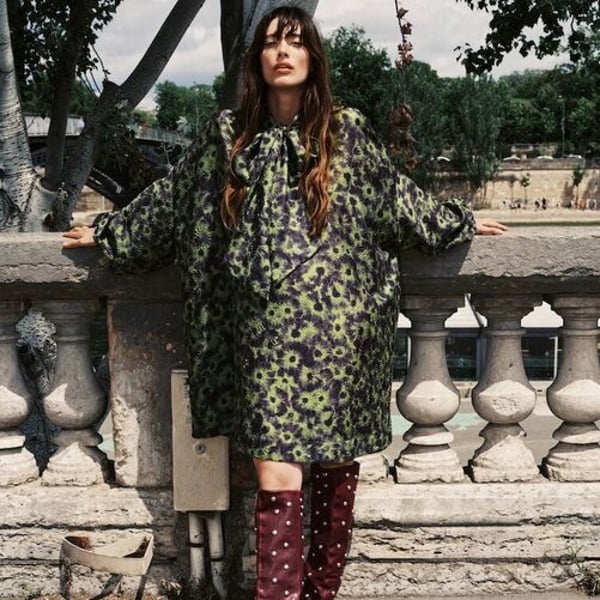
Esfan Eghtessadi, who founded the Essentiel Antwerp label in 1999 in Antwerp with Inge Onsea, has told FashionNetwork.com that the label expects revenue to keep on growing in 2025, bolstered by new physical and online retail initiatives. Eghtessadi, the Franco-Iranian-Belgian son of designer Nicole Cadine, grew up in a fashion environment, amidst fabrics, sketches and collections. Onsea, whose mother loved vintage clothes, worked as a model and lived for five years in India, a country that has inspired her with its colours, printed patterns, and quirky combinations.
Essentiel Antwerp, Fall/Winter 2025-26
“The current market context is proving unsettled and complex for the entire sector. We’re proud we’re keeping up a healthy, steady growth, thanks to our staff’s efforts and commitment,” said Eghtessadi. “Having generated a revenue of €64 million in 2024, a 14.5% increase over 2023, we’re expecting solid, double-digit growth for 2025 too, driven by our new business initiatives and our label’s ability to generate a positive organic performance despite the current market challenges,” he added.
Essentiel Antwerp, with its extensive ready-to-wear collections and a full accessories line, was created by Eghtessadi and Onsea as an antidote to minimalist, monochrome fashion. It is distinctive for its fresh, original and sophisticated style, and is renowned for original prints and bold colour combinations.
“Our ready-to-wear collections are produced in China, Europe, India and Africa,” said Eghtessadi. “Through long-standing collaborations with our suppliers – with many of them for over 20 years – and by carefully choosing [producers] whose skills are best-suited to each garment’s requirements, we’re able to preserve a strong brand identity and offer high craftsmanship quality, the distinctive features of our most iconic items. In addition, we’re always committed to strengthening our ESG performance and improving sustainability across the value chain, via due diligence, supplier audits, attentive materials selection, and frequent process reviews, notably for transportation and packaging,” he added.
Essentiel Antwerp, Fall/Winter 2025-26
Essentiel Antwerp is currently distributed via 752 multibrand stores across 40 countries. Its main markets, considering all distribution channels, are Belgium, the Netherlands, Germany, the UK and France. Eghtessadi said that the label’s best results in the wholesale channel come from Italy and the USA. “Italy accounts for approximately 8% of our wholesale business. We launched our e-shop in the country in March 2025, and the results are very promising. Site visits grew 74% in four months, and online sales increased by a factor of 3.5 in the same period. In May, we staged a brand awareness initiative by opening a kiosk in Milan, further boosting Essentiel Antwerp’s visibility and sales performance in the month,” said Eghtessadi.
Eghtessadi expects Essentiel Antwerp to continue growing in Italy, both in wholesale and e-tail: “Italy is a key market within our strategic plan, which is aimed at developing a complete brand experience through physical and digital channels,” he said.
Essentiel Antwerp currently has 40 monobrand stores, 32 of them directly operated. The label’s overall direct retail performance is solid, and sales have increased 6% since January. “Our second Parisian store’s opening is scheduled in early November, while our 2026 expansion plan is designed to boost our presence in Europe’s main cities,” said Eghtessadi.
Essentiel Antwerp, Fall/Winter 2025-26
Essentiel Antwerp has 300 employees but, given its growth rate and expansion plans, Eghtessadi indicated that staff numbers will increase “to respond to the market’s evolving needs and new consumer trends. Recruitment will be geared toward new skills to support business expansion and innovation,” he said. “Our quality, creativity and affordability give us stability. We believe they are key values that continue to inspire our customers. Fashion must retain its power to make people dream, and we’re confident the industry will be able to address its current challenges,” said Eghtessadi.
What about tariffs? “Like all brands, we’ve been impacted. The challenge is to adapt without penalising customers, and to continue to grow despite these new barriers to trade,” concluded Eghtessadi.
The advertising campaign for Essentiel Antwerp’s Fall/Winter 2025-26 collection is entitled Paris s’éveille (Paris awakens). The collection is characterised by a grunge aesthetic elevated by ironic touches and refined layering, as well as tailored constructions and starkly contrasting materials.
An Essentiel Antwerp handbag
The collection is an eclectic blend of deconstructed skirts and shirts, thin ties, faux-fur looks, pearls, lace and sequins. Check, snakeskin and camo prints inject a rock ‘n’ roll vibe to a vibrant palette featuring bright red, electric blue and dark green.
High-end menswear brand Canali recorded a slight decline in turnover in the 2025 financial year, to 205 million euros from 210 million in 2024; a decrease “linked to contingencies in certain international markets,” according to president and CEO Stefano Canali, who nonetheless describes himself as “very optimistic” about business in 2026.
Canali, Autumn-Winter 2026/27
“Right now, I think we have a kind of alignment of the stars: the right collection, backed by a credible brand that has been around for 91 years and offers top-quality products at a fair price. This is our formula for success in 2026,” the manager tells FashionNetwork.com. “The Autumn-Winter 2026/27 collection presented in Milan marks a further evolutionary step in the wake of the changes we set in motion about four years ago, designed to ensure that our offering is increasingly lifestyle-oriented while remaining consistent with our sartorial DNA, from which we will never depart, and to reflect, in a credible, authentic and recognisable way, the evolution of customers’ tastes around the world. Our DNA, tied to the highest-quality canvassed suit, therefore permeates every element of the collection, from outerwear to shoes and knitwear.”
“We are talking about the very highest quality of materials,” Canali continues, “exceptional construction quality, a unified colour palette, and a collection that can be easily mixed and matched, creating a clear and distinctive identity for the Canali brand. The ultimate goal, which we believe we have further achieved with this collection, is an elevated and sophisticated offer that is, at the same time, genuinely easy to buy and to mix and match throughout the week according to the customer’s needs. It offers the functionality and versatility in garments that people are looking for.”
Canali, Autumn-Winter 2026/27, the presentation at Galleria Meravigli
The market was almost shocked to see certain price rises applied by fashion and luxury brands. What are your thoughts on this? “Price rises are not an issue for Canali,” the CEO responds unequivocally. “Our brand has always maintained a very fair pricing position, which matters even more today, because customers out there- as they have been telling us, obsessively, for some time- no longer accept certain price points, which we, moreover, have never charged.”
Stefano Canali aims to ensure that in 2026 the overall message of the collection is increasingly amplified across all distribution channels- wholesale, directly operated retail, and online, launched in-house 10 years ago and considered “a service complement to the physical channel.” The executive signals upcoming store openings (50 directly operated Canali mono-brand stores, over 1,000 wholesale accounts worldwide), but declines to disclose details, remaining focused on healthy, credible growth in all countries.
Canali, Autumn-Winter 2026/27
The North American market accounts for 50% of the brand’s sales. Any issues with US-imposed tariffs, and with the strengthening of the euro against the dollar? “Clearly, exchange-rate fluctuations affect prices; however, it is an issue we have always dealt with throughout my time at this company,” says Stefano Canali. “Let’s remember that over two decades the euro went from being worth $0.82 to $1.60, and everyone is still here. The market clearly adapts; and of course all brands have to make their own assessments of the most appropriate price to charge in each area, but that will never be a problem.”
This article is an automatic translation. Click here to read the original article.
China sold more goods to the world than ever in 2025, but export saleswoman Aimee Chen says it was the hardest of her roughly two-decade career. After US President Donald Trump‘s tariff hikes led to US orders plunging by a third, Chen’s pet products company moved to diversify geographies, chasing new and often lower-income markets like South America. The response mirrored China’s official trade policy, which led to a record $1.2 trillion surplus for 2025 despite new trade barriers.
Chinese flags flutter near containers stacked at the Yangshan Deep Water Port in Shanghai, China January 13, 2022. Picture taken January 13, 2022 – REUTERS/Aly Song/File Photo
Reuters interviews with 14 salespeople working on the frontlines of China’s export diversification push, however, reveal the costs and caveats behind the rosy headline trade figures. Four of the salespeople said that orders from the new markets were often smaller in volume and less lucrative than US sales, resulting in lower commissions and pay. Government data show profits at China’s industrial firms fell 13.1% year-on-year in November, the fastest pace in over a year.
Many of the employees also described longer working hours as well as greater intensity and uncertainty amid the export boom. “I’m very anxious,” said Chen, adding that she had recently experienced stress symptoms like hair loss and insomnia.
Mingwei Liu, director at the Center for Global Work and Employment at Rutgers University, said that China’s export strategy in alternative markets depended on firms chasing high volumes of cheap orders. Companies that succeed often give clients longer payment cycles and bear higher default risks, he said.
“This market reorientation increases the labour intensity, the emotional burden and income uncertainty faced by workers in export sales,” Liu said. China’s commerce ministry and human resources ministry, as well as the office which manages the cabinet’s media queries, did not respond to requests for comment.
China and the US have grown increasingly interconnected since Beijing’s 2001 accession to the World Trade Organization. Their relationship has also become more imbalanced, with their respective economic policies favouring production in the former country and consumption in the latter.
Some American retailers and Chinese producers have said they developed relationships that were so close that they could anticipate each other’s needs and red lines, making deals feel almost automatic. Chen, for instance, described her past interactions with US retailers in largely glowing terms. Clients in the world’s largest economy were often “easy-going” and signed deals quickly, she said.
By contrast, customers in new markets like to haggle on price, she said. Chinese shipments to the US fell 20% in 2025, though it remains a top export destination. Shipments rose 25.8% to Africa, 7.4% to Latin America, 13.4% to Southeast Asia, and 8.4% to the European Union last year.
While Washington and Beijing have had previous trade disputes, tensions escalated after Trump took office at the start of 2025. He raised tariffs to over 100% in April, before partially reversing and settling for a fragile detente. His re-election sent China’s export-oriented industrial complex into a rat race for foreign demand across the world.
Monica Chen, who has been selling auto parts for more than a decade in the eastern Zhejiang province, had long relied on email to keep business going. But with US tariffs in place, she’s had to fight harder to win business. That means ramping up business travel to as much as three times a month and cold-calling prospects.
“It’s very hard to develop new markets, they are basically saturated,” said Monica, who isn’t related to Aimee Chen. Her company ultimately responded by cutting prices to undercut other Chinese firms that are also looking for buyers abroad. The firm’s orders were down a third in value from 2024, Monica said.
With profits falling, companies have placed pressure on their sales agents. Cici Lv, 24, who has sold electric bicycle batteries since 2022 from the southern city of Shenzhen, earns about 5,000 yuan ($717) per month- not much more than workers in the factories that produce such units.
But while workers’ shifts come to an end, Lv said she is constantly on the clock talking to foreign clients. One of her peers, Rowan Wang, a sales rep for an exporter of agricultural equipment in eastern China, summed up the demands as “if we’re alive, we have to reply.”
Five of the salespeople also described struggles to manage less-affluent clients in markets with which they have little familiarity. Lv said she traded messages with one client for months, discussing everything from news events to lunch choices and religion. He eventually ordered just one battery, earning Lv a commission of less than $2.
A review of the top 100 most liked export-related posts on social media platform RedNote in the six months to mid-January found 37 that raised complaints about heightened job stress. Another six complained about unprofessional client interactions.
“Sometimes it messes with your mind,” said Lv, who said she’s fielded relationship proposals. The hardship described by the sales staff may be an early warning that China’s trade diversification success in 2025 could be hard to replicate in the years ahead, said Chen Bo, senior research fellow at the National University of Singapore’s East Asian Institute.
Economists have long argued that China has to develop local markets if it wants to end its deflationary cycle. Weak consumption pushes Chinese producers to compete overseas, often against each other, which brings revenue into the economy but erodes profits, Chen said. China “can’t maintain sustainable economic growth by relying on foreign markets,” the academic said.
Spanish designer David Catalán, whose eponymous label is registered in Porto, and Portuguese designer Miguel Vieira once again took to the runway at Milan Fashion Week, supported by Portugal Fashion. According to the organisers of the Portuguese project, the initiative was included in the official show calendar of Italy’s fashion capital, one of the most important stages in the global industry. Their autumn/winter 2026/2027 collections were presented at Fondazione Sozzani on the morning of Monday, January 19, one following the other.
Foto: Filippo Fior
While the “ASSEMBLED” collection marks David Catalán’s new approach to construction and functionality, the ‘A Tea in the Desert’ line “brings Miguel Vieira’s vision inspired by Bernardo Bertolucci’s The Sheltering Sky,” Portugal Fashion said in a statement.
“ASSEMBLED is the title of David Catalán’s collection for autumn/winter 26/27. The concept draws on the logic of traditional patchwork blankets, looking to their principles of construction, reinforcement, and layering as practical responses to cold, wear, and continued use,” the note explains. “Those principles are translated into menswear through panelled cuts, contrasting materials, and structured silhouettes, creating a winter wardrobe designed to be combined, adapted and worn in day-to-day life.”
“The pieces function as layered systems, with each element playing a specific role within the whole, combining structural rigour with a contemporary approach to menswear, and focusing on functionality, durability, and versatility.”
Foto: Filippo Fior
On his social media channels, David Catalán writes: “Inside the studio and in factories, where streetwear meets the precision of tailoring and youthful instinct intersects with craftsmanship, @davidcatalanbrand shapes a contemporary, fluid, and deeply personal voice.”
“Born in Spain, Catalán chose Porto as his base on arriving to study fashion- a city that has become integral to the growth of his brand and creative identity. Today, his work reflects an intercultural journey, combining relaxed tailoring, utilitarian elements, and a modern approach to menswear, rooted in quality and experimentation,” the post further explains, announcing that in Milan, “David Catalán takes to the runway at @milanfashionweek, representing Portugal via the Portugal Fashion platform. The ‘Assembled’ collection unfolds as a reflection on construction, layering and the dialogue between function and form- a collection that captures the energy of a new generation of menswear.”
Foto: Filippo Fior
“A statement shaped by versatility, movement and the freedom to build one’s identity through clothes,” the brand adds, underscoring: “Assembled. Versatility in every layer. Freedom in every step”.
Miguel Vieira then presented the ‘A Tea in the Desert’ collection, inspired by Bernardo Bertolucci’s film The Sheltering Sky, developed “from the arid landscapes of North Africa and the emotional intensity of the protagonists, translating these references into a tailoring proposal marked by contrasting textures, volumes and atmospheres.”
Foto: Isidore Montag
“The silhouette oscillates between structured shapes and more fluid lines, creating a constant tension between restraint and freedom,” it continues. “The colour palette includes ecru, beige, camel, brown, pink, and black, rendered in materials such as flannel, silk, alpaca, cashmere, fur, wool, and sequins. Details include prints developed in the atelier and hand-braided flannel, with accessories such as scarves, ties, and bags completing the collection.”
On its social media channels, the eponymous Miguel Vieira brand highlights “A Tea in the Desert. Rigor in every cut. Sensitivity in every detail”, reads a post on @miguelvieiraofficial, shared with @portugalfashion.
Foto: Isidore Montag
“Inside the atelier, where precision defines each line and tailoring becomes language, @miguelvieiraofficial continues a career shaped by mastery, discipline, and vision,” another publication explains. “With decades of close collaboration with the textile industry, the designer refines silhouettes that have long defined contemporary menswear. Each piece reflects a commitment to structure, detail, and the discreet confidence of impeccable tailoring”.
It further previews, in Milan, ‘A Tea in the Desert’, which reveals itself as “a new chapter in a work dedicated to men’s fashion, where rigour meets sensitivity and experience is transformed into expression.” In short: “A collection rooted in tailoring, elevated by time and guided by an enduring dialogue between fabric and form.”
Foto: Isidore Montag
After Milan, Portugal Fashion moves on to Paris and, subsequently, Copenhagen, continuing the autumn/winter 2026/2027 season with a series of actions aimed at buyers, the media, and industry professionals. This reinforces the presence of creations developed in Portugal across Europe’s main fashion centres, the organisation behind the Portuguese passerelle notes, as it invests beyond borders to take Portuguese talent and fashion labels further afield.
Portugal Fashion is a project run by ANJE- National Association of Young Entrepreneurs- with the support of its strategic partners and co-financed by SIAC- Support for Collective Actions- Internationalisation of Portugal 2030, within the scope of Compete 2030- Innovation and Digital Transition Programme- with funds from the European Union, through the European Regional Development Fund.
This article is an automatic translation. Click here to read the original article.