Connect with us

Business

Enterprise Products: Trump “weaponizing” ethane exports to China backfires against U.S.

Published

on


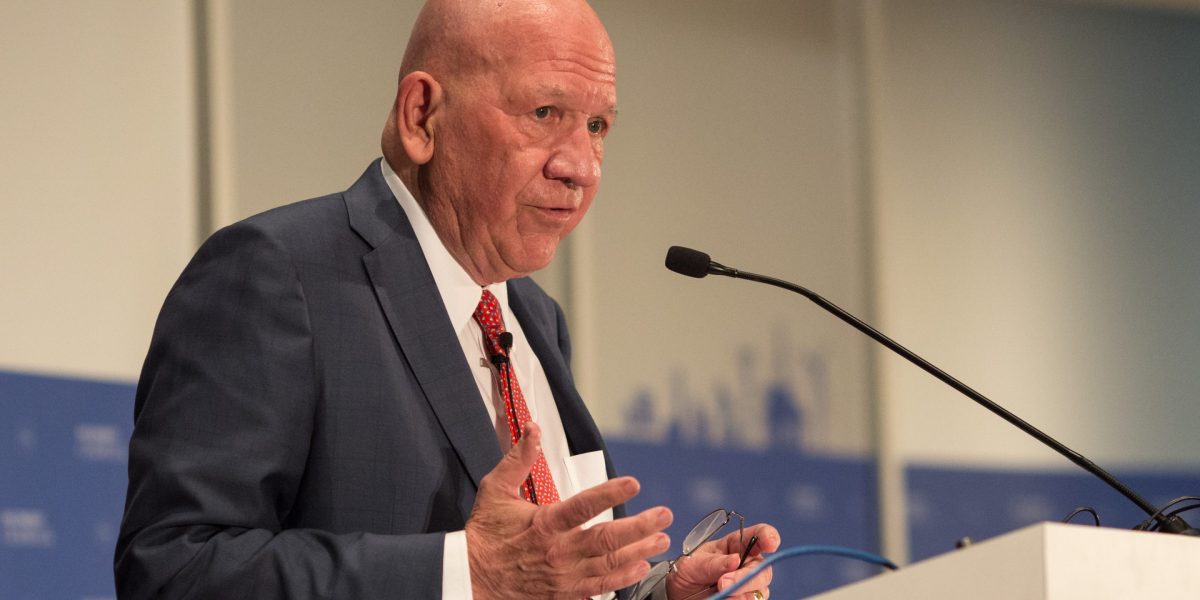
Leading U.S. energy products exporter Enterprise Products Partners warned that the Trump administration continuing to “weaponize” fossil fuel shipments to China would only backfire against U.S. shippers.

Enterprise co-CEO Jim Teague issued his complaints during the July 28 earnings call about two months after the U.S. Commerce Department temporarily banned ethane exports to China as a trade agreement negotiating tool after China placed restrictions on the exports of certain rare earth metals to the U.S. Teague is frequently vocal about his right-leaning political allegiances and has personally donated to Trump.

Both countries in July lifted their restrictions as part of a trade truce while a longer-term trade agreement is negotiated, which remains pending.

“We’ve been clear about the risk of weaponizing U.S. energy exports,” Teague said in the earnings call. “These kinds of actions rarely hurt the intended target and often backfire, hurting our own industry more.”

China is by far the largest importer of American ethane—the most common building block for petrochemicals and plastics worldwide. The U.S. is the only major exporter of ethane, making China entirely dependent on America’s exports. Roughly half of all U.S. ethane exports go to China, and the cargoes are not easily redirected to other nations. Enterprise (No. 78 in the Fortune 500) is the leading ethane exporter from its Houston Ship Channel terminal.

“We are fortunate this administration understands the important importance of energy and global trade, even if the Commerce Department may need a little reminder,” Teague said. “Unfortunately, we could face similar challenges in the future.”

Specifically, the Commerce Department temporarily required Enterprise and other exporters to apply for special federal licenses to export ethane and butane to China for the stated reason of the “unacceptable risk” the natural gas liquids could be utilized for a “military end use.”

Enterprise Executive Vice President Tony Chovanec said the Commerce Department’s actions cost Enterprise at least one ethane customer that wasn’t from China.

“What it has done and where it’s been a problem, you really compromised the U.S. brand for reliable supply and energy security when you just cut off a counterparty like that,” Chovanec said of the Commerce Department’s actions. “It’s been disruptive but, in the short term, we were able to manage through it with our diverse contract mix.”

Apart from China, he said Enterprise ships ethane to Mexico, Brazil, Europe, India, Vietnam, and Thailand.

Seeking alternatives

In a new report, the East Daley Analytics firm said China may look to develop alternatives for U.S. ethane to avoid geopolitical disruptions. China could push Middle Eastern and European nations to further develop their own ethane exports to diversify supplies.

“In recent years, U.S. ethane was the quiet powerhouse of global petrochemicals—cheap, abundant, and presumably insulated from geopolitics. That assumption no longer holds,” East Daley stated. “The US-China trade war has exposed a critical truth: there is no global substitute for U.S. ethane at scale. What was once a stable feedstock is now caught in the crosscurrents of trade policy and long-cycle demand risk.”

In the meantime, Enterprise is only doubling down on its ethane and propane exports businesses, including expanding its Houston Ship Channel facilities.

Enterprise this month also just opened the first phase of its new Neches River Terminal ethane export hub in Texas near the Louisiana border. The facility will initially be able to ship 120,000 barrels of ethane a day. A second phase coming online in the first half of 2026 will more than double the exporting capacity to 300,000 barrels daily.

Typically produced as a byproduct along with oil or natural gas, U.S. natural gas liquids volumes more than doubled in a decade to over 7 million barrels a day, nearly 6 million barrels of which are ethane, propane, and butane, according to the U.S. Energy Information Administration (EIA). That spike triggered a U.S. petrochemical plant construction boom, as well as burgeoning export markets because domestic supplies now far exceed demand. The ethane is typically converted into the petrochemical ethylene, which is used to make products such as polyethylene, the world’s most common plastic.

“The appetite for U.S. ethane and ethylene remains strong in both Asia and Europe,” Teague said.


Source link

Continue Reading

Business

Cadillac returns as sponsor for PGA tour event at Trump National Doral

Published

on


Cadillac is returning as the title sponsor of a lucrative PGA Tour event held at Trump National Doral, which will hold one of the $20 million signature events in 2026.

The Cadillac Championship will be held the first weekend in May on the course once dubbed the “Blue Monster.” Doral first became part of the PGA Tour schedule in 1962, and it was held each year through 2016 until becoming a World Golf Championship under various names.

Brian Rolapp, the CEO of the PGA Tour, referred to Trump National Doral as a “legacy venue on our schedule.”

“We appreciate the support of Cadillac as we bring a new era of the PGA Tour to our fans in Miami,” Rolapp said in a statement.

Cadillac was the title sponsor of the WGC at Trump National Doral from 2011 through 2016. But the automaker chose not to renew its contract, the PGA Tour could not find a replacement sponsor for Doral in 2016 when President Donald Trump was the presumptive Republican nominee and the WGC event was moved to Mexico City.

Doral is among eight courses that has held a regular PGA Tour event for at least 50 years — the others are Riviera, Pebble Beach and Torrey Pines in California; Colonial (Texas), Waialae (Hawaii), Harbour Town (South Caroline) and Muirfield Village (Ohio).

It returned to the golf landscape in 2022 by hosting a LIV Golf event each of the last four years until returning to the PGA Tour schedule for 2026. The tour designated Trump National Doral a signature event before it signed Cadillac as the title sponsor.

This story was originally featured on Fortune.com


Source link

Continue Reading

Business

Rob Reiner’s 32-year-old son in jail after fatal stabbing at Los Angeles home

Published

on


Rob Reiner’s younger son, Nick Reiner, was in jail Monday after being booked for what investigators believe was the fatal stabbing of the director-actor and his wife at their Los Angeles home a day earlier, authorities said.

It was not immediately clear what charges Nick Reiner, 32, would face. A police statement said he was being held without bail and the case will be presented to the district attorney’s office on Tuesday.

Representatives for the Reiner family did not immediately respond to a request for comment, and it wasn’t immediately clear if Nick Reiner had an attorney who could speak on his behalf.

Nick Reiner has spoken publicly of his struggles with addiction. By 18, he had cycled in and out of treatment facilities with bouts of homelessness and relapses in between. Rob and Nick Reiner explored their difficult relationship and Nick Reiner’s struggles with drugs in a semi-autobiographical 2016 film, “ Being Charlie.”

Rob and Michele Singer Reiner were found dead Sunday afternoon at their home in Los Angeles, and investigators believe they were stabbed, a law enforcement official told The Associated Press. The official, who was briefed on the investigation, could not publicly discuss the details and spoke to the AP on condition of anonymity.

Nick Reiner was arrested Sunday around 9:15 p.m., police said.

Reiner was long one of the most prolific directors in Hollywood, and his work included some of the most memorable movies of the 1980s and ’90s, including “This is Spinal Tap,” “A Few Good Men,” “When Harry Met Sally” and “The Princess Bride.”

His role as Michael “Meathead” Stivic in Norman Lear’s 1970s TV classic “All in the Family” as a liberal foil to Carroll O’Connor’s Archie Bunker catapulted him to fame and won him two Emmy Awards.

The son of comedy legend Carl Reiner, Rob Reiner married photographer Michele Singer Reiner in 1989. The two met while he was directing “When Harry Met Sally.” They had three children together: Nick, Jake and Romy.

Reiner told The New York Times in 1989 that the cinematographer on “When Harry Met Sally,” Barry Sonnenfeld, predicted he would marry her. “I look over and I see this girl, and whoo! I was attracted immediately,” Reiner said.

Michele Singer Reiner was a producer for “Spinal Tap II: The End Continues,” “God & Country,” “Albert Brooks: Defending My Life” and “Shock and Awe,” according to IMDB. Earlier in her career, she photographed the cover image of President Donald Trump’s 1987 bestseller “The Art of the Deal.”

Trump on Monday blamed Rob Reiner’s outspoken opposition to the president for the actor-director’s killing, delivering the unsubstantiated claim in a social media post that seemed intent on decrying his opponents even in the face of a tragedy.

Relatives of Lear, the legendary producer who died in 2023, said the Reiners’ deaths left them bereft.

“Norman often referred to Rob as a son, and their close relationship was extraordinary, to us and the world,” a Lear family statement said. “Norman would have wanted to remind us that Rob and Michele spent every breath trying to make this country a better place, and they pursued that through their art, their activism, their philanthropy, and their love for family and friends.”

Los Angeles Mayor Karen Bass called the deaths a devastating loss for the city.

“Rob Reiner’s contributions reverberate throughout American culture and society, and he has improved countless lives through his creative work and advocacy fighting for social and economic justice,” Bass said in a statement. “An acclaimed actor, director, producer, writer, and engaged political activist, he always used his gifts in service of others.”

Reiner was previously married to actor-director Penny Marshall from 1971 to 1981. He adopted her daughter, Tracy Reiner. Carl Reiner died in 2020 at age 98 and Marshall died in 2018.

Killings are rare in the Brentwood neighborhood. The scene is about a mile from the home where O.J. Simpson’s wife Nicole Brown Simpson and her friend Ron Goldman were killed in 1994.

__

Balsamo reported from Washington. Associated Press Entertainment Writer Andrew Dalton in Los Angeles contributed.


Source link

Continue Reading

Business

AI investment pressures, supply-chain risks, and strategy misalignment are all on the line for CFOs

Published

on


The talk is over. In 2026, it’s time to execute.

When the CFO Alliance, a finance-professional peer community, released its latest report, called Project Greenlight, in late November, the organization said that finance experts expect 2026 to be “the most pivotal year the finance function has faced in a decade.” There’s a lot at stake for CFOs and their organizations, according to the report, including supply-chain risks, pressure to make big AI investments, and the perils of stakeholder misalignment on strategy.

CFO Brew recently spoke with Nick Araco, the CEO of CFO Alliance, to get a sense of why 2026 is shaping up to be a high-stakes year. He also shared what’s top of mind for the finance leaders he’s been speaking with.

This interview has been edited for length and clarity.

What makes you think that 2026 will be such a pivotal year in finance?

2026 has to be a year where we replace debate with data and execution. I call it “informed execution.” We’ve seen such a rapid acceleration, given AI and technology advancements, converge with a year of volatility and uncertainty. Imagine you’re sitting in the seat of a CFO, where you’re at the intersection of that, and you’ve had a 2025 that’s caused you and your enterprises to hit a pause button. You had months, if not a whole year of pause. 2026 has to be a year of execution.

How did the group that worked on the Project Greenlight report identify the top execution risks, and how did it lay out a roadmap for addressing each?

What we did was convene about an hour-and-a-half’s time and openly debated until we got to a point where we agreed on the most material and critical areas of risk. You can imagine we started with a laundry list, because the CFO Alliance population of almost 10,000 or more is very diverse…At the end of the day, we identified four execution risks that most often stall plans, or stall action. [According to the report, these are geopolitical and regulatory disruption, technology and AI adoption, talent and team capabilities, and stakeholder alignment and governance.]

I want to focus on one specific risk: AI adoption. What would you say are the keys to identifying where an organization should be investing its money, but also how to track the ROI?

A year ago at this time, I would tell you that nine out of 10 of our members were saying, ‘We agree, it’s time to lean in, and it’s time to have the right discussions. Let’s bring in cross-functional leaders and cross-level leaders, and let’s make sure we are demonstrating comfort, and make sure that we’re demonstrating through our own actions, an embrace.’ Let me fast forward to where we are in 2025. These discussions need to be about enterprise value and performance. They need to be about, ‘How would this impact our business?’

I’m going to be very specific as to what the discussions need to be and are, because our members are using the following framework around AI. “What’s the specific opportunity or pain point that we are attempting to address…when it comes to AI? Why does it matter now? What’s blocking our progress that we’re even having this discussion? What’s one condition, and if we solve for this, what would be different by X date, and how would we know it helped us?” Those questions they’re using in every conversation, so they can tie it back to value.

What have been the biggest recurring topics in your conversations with CFOs from the past two or three months?

There are three key areas of focus: What type of leader do I want to be in ’26? How do I best stand up the highest performing finance function? And that includes accounting, treasury, FP&A, and capital markets or strategy functions. And then, from an enterprise standpoint, am I really at the forefront of understanding how technology and AI may disrupt our position in our industry, or our industry or business as a whole?

Standing up a high-performing finance function and team [is] more complex than ever before. I’m tired of the bashing of accounting…No one can do their job in finance without a strong accounting function. We’re done complaining about it; we’re going to do something about it. We’re going to try to make accounting sexy again by embracing the AI factor and bringing critical thinking into the accounting skill set.

This report was originally published by CFO Brew.


Source link

Continue Reading

Trending

Copyright © Miami Select.