Connect with us

Business

Employees are using ‘2025 tools inside 2015 job structures,’ a new Workday study says

Published

on


Good morning!

As executives keep pushing to find the magic ROI of AI, a new Workday study suggests that employees aren’t being set up to succeedthanks to archaic job structures.

Employees are using 2025 tools while stuck in 2015 job structures, as less than half of job roles have been updated to reflect AI capabilities, according to the study. Workday’s survey featured responses from 3,200 full-time employees at organizations with annual revenue of $100 million or more. 

Workers are rapidly being asked to apply human judgment and insight to a huge load of content that AI is generating for them, and historically, those types of skillsets take 10 years to build, said Aashna Kircher, group general manager for the office of the CHRO at Workday.

“Those are super high level skillsets,” Kircher said. “Right now, all the training that I see is very focused on how to use AI and not how to develop and apply discernment and judgment around the output that AI is driving. And I think that’s the disconnect for senior leaders.” 

Kircher said the first step to addressing this disconnect is analyzing each business function to figure out what the core skillsets associated with the job should be, and which parts of it should be automated. 

The study found that HR leaders bear a disproportionate share (38%) of the burden of “reworking AI”—fact-checking, reviewing, and editing copy that AI has produced. Those in IT roles, meanwhile, only represent 32% of those doing this work. 

That’s partly a function of the different work processes. “[IT roles] are using it as the starting point, as a thought partner, to accelerate the creativity and iteration process—but understanding that the outcome is imperfect and it doesn’t need the same level of scrutiny,” Kircher said. “Whereas in the context of something like HR, accuracy, tone, impact, how you frame things, matter so much.”

Kristin Stoller
Editorial Director, Fortune Live Media
kristin.stoller@fortune.com

This story was originally featured on Fortune.com


Source link

Continue Reading

Business

Molson Coors CEO: We’re doing our part to solve society’s ‘occasion problem’ – and we’re getting some unexpected help

Published

on


Source link

Continue Reading

Business

A cautionary Hollywood tale: the Ellisons’ lose-lose Paramount positioning

Published

on


A cautionary Hollywood tale: the Ellisons’ lose-lose Paramount positioning | Fortune

Jeffrey Sonnenfeld is Lester Crown Professor of Leadership Practice at the Yale School of Management and founder of the Yale Chief Executive Leadership Institute. A leadership and governance scholar, he created the world’s first school for incumbent CEOs and he has advised five U.S. presidents across political parties. His latest book, Trump’s Ten Commandments, will be published by Simon & Schuster in March 2026.
Stephen Henriques is a senior research fellow of the Yale Chief Executive Leadership Institute. He was a consultant at McKinsey & Company and a policy analyst for the governor of Connecticut.



Source link

Continue Reading

Business

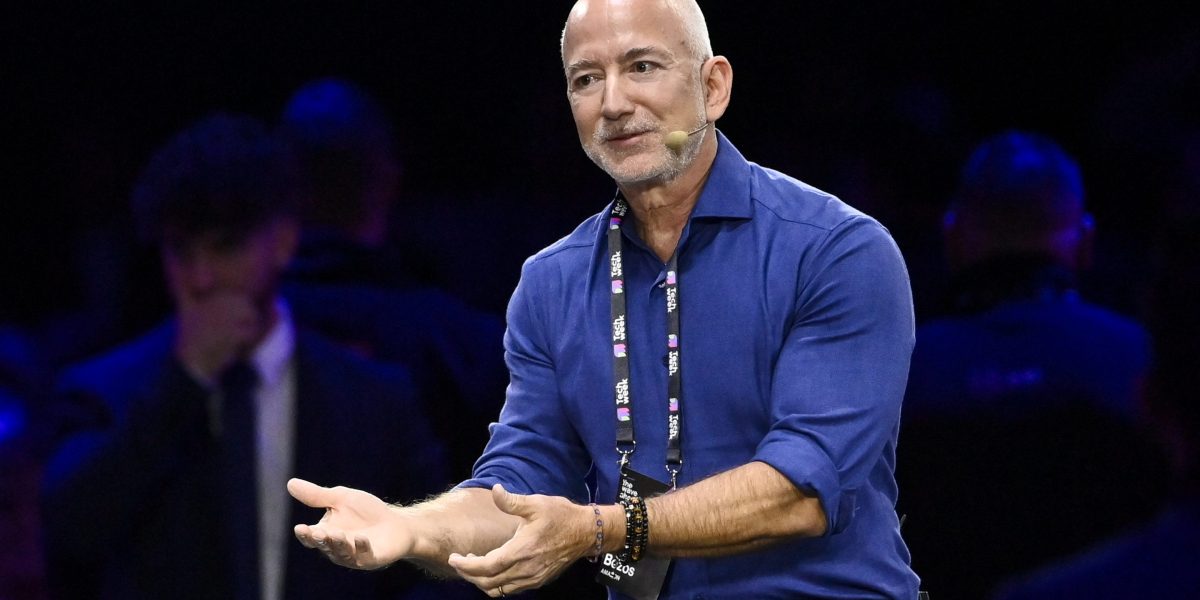
Jeff Bezos tells Gen Z entrepreneurs to gain work experience before launching new companies
Published

on


Some of Big Tech’s greatest success stories are from college dropouts. Mark Zuckerberg launched Facebook in 2004 from his Harvard University dorm room (and later dropped out). Bill Gates also left Harvard and cofounded Microsoft with Paul Allen in 1975. 

But Jeff Bezos, founder of the world’s largest online retailer Amazon, said Zuckerberg and Gates are the “exception” to the idea that all major tech companies were founded by college dropouts and that a degree doesn’t matter as much these days. 

While it’s “possible” to be 18, 19, or 20 years old and drop out of college to become a great entrepreneur, Bezos said these tech leaders are an exception.

“I always advise to young people: Go work at a best-practices company somewhere where you can learn a lot of basic fundamental things [like] how to hire really well, how to interview, etc.,” Bezos said during an interview at Italian Tech Week last fall. “There’s a lot of stuff you would learn in a great company that will help you, and then there’s still lots of time to start a company after you have absorbed it.”

Working at a company, instead of immediately trying to start one, “increases your odds” of being successful, he added. 

Bezos, now the third-richest person in the world at a $268 billion net worth, founded Amazon when he was 30 years old after about a decade of work experience. Both Gates and Zuckerberg, on the other hand, were just 19 years old when they launched Microsoft and Facebook, respectively. Still, Zuckerberg is the sixth-wealthiest person in the world with a $231 billion net worth, and Gates is the 16th-richest at a $118 billion net worth. 

But Bezos says that “extra 10 years of experience actually improved the odds that Amazon would succeed.” And succeed it did: Today, the online retailer has a whopping $2.64 trillion market cap.

Not only did Bezos have work experience, but he also finished college. He graduated summa cum laude—the highest honors—from Princeton University in 1986 with a bachelor’s degree in engineering. 

He was also elected to honor societies Phi Beta Kappa and Tau Beta Pi, and also served as president of the Princeton chapter of the Students for the Exploration and Development of Space. That academic focus later came to fruition in 2000 with Bezos’s aerospace-tech company Blue Origin, which he’s described as the “most important work” he does. Blue Origin is a private company, so its valuation has never been disclosed, but Bezos has said he thinks it will eventually be bigger than Amazon.

“That would always be my advice: I finished college, and I enjoyed college,” Bezos said. “I think it’s been helpful to me.”

Still, younger generations continue to question the value of a college degree. As the cost of college continues to grow and available jobs for newer grads shrink, many are starting to question the real return on investment for a degree. Even Jim Farley, the CEO of Ford, said during a recent company conference last week, going to college “should be a debate.”

“Nothing in the history of Western civilization has gotten more expensive, more quickly,” added Mike Rowe, a longtime vocational advocate. “Not energy, not food, not real estate, not even health care, [nothing has been inflated more] than the cost of a four-year degree.”

A version of this story was published on Fortune.com on October 6, 2025.

More on entrepreneurship:

Join us at the Fortune Workplace Innovation Summit May 19–20, 2026, in Atlanta. The next era of workplace innovation is here—and the old playbook is being rewritten. At this exclusive, high-energy event, the world’s most innovative leaders will convene to explore how AI, humanity, and strategy converge to redefine, again, the future of work. Register now.


Source link

Continue Reading

Trending

Copyright © Miami Select.