Connect with us

Business

Electricity as the new eggs: Affordability concerns will swing the midterms just like the 2024 election, Bill McKibben says

Published

on


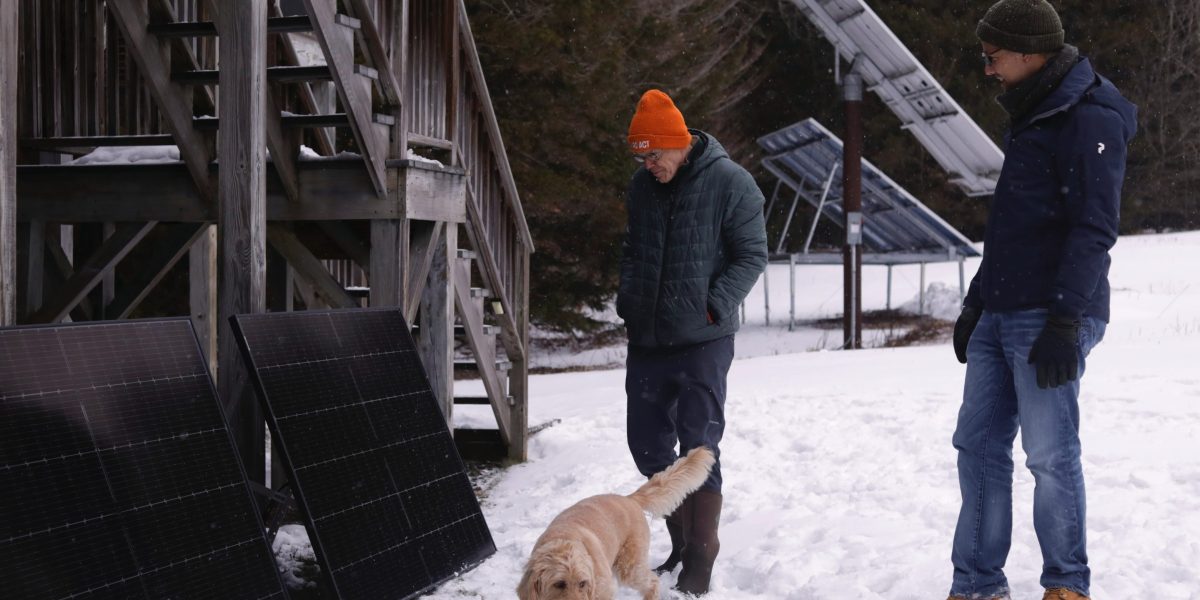
That sun has provided him cheap power for 25 years, and this month he installed his fourth iteration of solar panels on his Vermont home. In an interview after he set up the new system, he said President Donald Trump’s stance against solar and other cheap green energy will hurt the GOP in this year’s elections as electricity bills rise.

After the Biden and Obama administrations subsidized and championed solar, wind and other green power as answers to fight climate change, Trump has tried to dampen those and turn to older and dirtier fossil fuels. The Trump administration froze five big offshore wind projects last month but judges this week allowed three of the projects to resume. Federal clean energy tax incentives expired on Dec. 31 that include installing home solar panels.

Meanwhile, electricity prices are rising in the United States, and McKibben is counting on that to trigger political change.

“I think you’re starting to see that have a big political impact in the U.S. right now. My prediction would be that electric prices are going to be to the 2026 election what egg prices were to the 2024 election,” said McKibben, an author and founder of multiple environmental and activist groups. Everyday inflation hurt Democrats in the last presidential race, analysts said.

The Trump administration and a bipartisan group of governors on Friday tried to step up pressure on the operator of the nation’s largest electric grid to take urgent steps to boost power supplies in the mid-Atlantic and keep electricity bills from rising even higher.

“Ensuring the American people have reliable and affordable electricity is one of President Trump’s top priorities,” said White House spokesperson Taylor Rogers.

Renewable energy prices drop around the world

Globally, the price of wind and solar power is plummeting to the point that they are cheaper than fossil fuels, the United Nations found. And China leads the world in renewable energy technology, with one of its electric car companies passing Tesla in annual sales.

“We can’t economically compete in a world where China gets a lot of cheap energy and we have to pay for really expensive energy,” McKibben told The Associated Press, just after he installed a new type of solar panels that can hang on balconies with little fuss.

When Trump took office in January 2025, the national average electricity cost was 15.94 cents per kilowatt-hour. By September it was up to 18.07 cents and then down slightly to 17.98 cents in October, according to the U.S. Energy Information Administration.

That’s a 12.8% increase in 10 months. It rose more in 10 months than the previous two years. People in Maryland, New Jersey and Maine have seen electricity prices rise at a rate three times higher than the national average since October 2024.

At 900 kilowatt-hours per month, that means the average monthly electricity bill is about $18 more than in January 2025.

Democrats blame Trump for rising electric bills

This week, Democrats on Capitol Hill blamed rising electric bills on Trump and his dislike of renewable energy.

“From his first day in office, he’s made it his mission to limit American’s access to cheap energy, all in the name of increasing profits for his friends in the fossil fuel industry. As a result, energy bills across the country have skyrocketed,” Illinois Rep. Sean Casten said at a Wednesday news conference.

“Donald Trump is the first president to intentionally raise the price of something that we all need,” Hawaii Sen. Brian Schatz, also a Democrat, said Wednesday on the Senate floor. “Nobody should be enthused about paying more for electricity, and this national solar ban is making everybody pay more. Clean is cheap and cheap is clean.”

Solar panels on McKibben’s Vermont home

McKibben has been sending excess electricity from his solar panels to the Vermont grid for years. Now he’s sending more.

As his dog, Birke, stood watch, McKibben, who refers to his home nestled in the Green Mountains of Vermont as a “museum of solar technology” got his new panels up and running in about 10 minutes. This type of panel from the California-based firm Bright Saver is often referred to as plug-in solar. Though it’s not yet widely available in the U.S., McKibben pointed to the style’s popularity in Europe and Australia.

“Americans spend three or four times as much money as Australians or Europeans to put solar panels on the roof. We have an absurdly overcomplicated permitting system that’s unlike anything else on the rest of the planet,” McKibben said.

McKibben said Australians can obtain three hours of free electricity each day through a government program because the country has built so many solar panels.

“And I’m almost certain that that’s an argument that every single person in America would understand,” he said. “I don’t know anyone who wouldn’t say: ‘I’d like three free hours of electricity.’”

__

Swinhart reported from Vermont. Borenstein reported from Washington. Matthew Daly contributed to this report from Washington.

__

The Associated Press’ climate and environmental coverage receives financial support from multiple private foundations. AP is solely responsible for all content. Find AP’s standards for working with philanthropies, a list of supporters and funded coverage areas at AP.org.


Source link

Continue Reading

Business

Democrats think a war-powers resolution for Greenland would get more GOP votes than one on Venezuela

Published

on


Republican lawmakers are scrambling to contain President Donald Trump’s threats of taking possession of Greenland, with some showing the most strident opposition to almost anything the Trump administration has done since taking office.

They gave floor speeches on the importance of NATO last week. They introduced bills meant to prevent the U.S. from attacking Denmark. And several traveled to Copenhagen to meet with Danish counterparts.

But it’s not clear that will be enough, as the president continues to insist that he will take control of the Arctic island. It’s raised fears of an end to NATO — a decades-old alliance that has been a pillar of American strength in Europe and around the globe — and raised questions on Capitol Hill and around the world about what Trump’s aggressive, go-it-alone foreign policy will mean for world order.

“When the most powerful military nation on earth threatens your territory through its president over and over and over again, you start to take it seriously,” Sen. Chris Coons told The Associated Press.

The Delaware Democrat organized the bipartisan trip to Denmark to “bring the temperature down a bit,” he said, as well as further talks about mutual military agreements in the Arctic. Republican Sens. Thom Tillis of North Carolina and Lisa Murkowski of Alaska accompanied a handful of Democrats on the trip. Also, Republican lawmakers joined in meetings in Washington last week with the Danish foreign minister and his Greenlandic counterpart where they discussed security agreements.

Yet it’s clear Trump has other ideas. He said Saturday he will charge a 10% import tax starting in February on goods from eight European nations because of their opposition to his Greenland plans.

Trump said on social media that because of modern weapons systems “the need to ACQUIRE is especially important.”

The pushback to Trump’s Greenland plans

Key Republicans have made clear they think that forcefully taking Greenland is out of the question. But so far, they’ve avoided directly rebuking Trump for his talk of possessing the island.

Tillis on social media called Trumps tariff plans “bad for America, bad for American businesses, and bad for America’s allies.”

Senate Majority Leader John Thune, R-S.D., told reporters Thursday that “there’s certainly not an appetite here for some of the options that have been talked about or considered.”

In a floor speech, Thune’s predecessor as Republican leader, Sen. Mitch McConnell, warned that an attempt to seize Greenland would “shatter the trust of allies” and tarnish Trump’s legacy with a disastrous foreign policy decision.

Republican and Democratic lawmakers alike see an obvious path to bolstering American interests in Greenland while keeping the relationship with NATO-ally Denmark intact.

In a meeting with lawmakers Thursday, Danish Foreign Minister Lars Løkke Rasmussen and his Greenlandic counterpart Vivian Motzfeldt discussed how the countries could work together to develop critical mineral industries and military cooperation, Coons said. The diplomats also told the senators there is no evidence of Chinese or Russian activity in Greenland.

Trump has made the argument that the U.S. should take Greenland before China or Russia do, prompting worry across Europe. Troops from several nations have been sent to Greenland in support of Denmark.

Murkowski said on social media that “our NATO allies are being forced to divert attention and resources to Greenland, a dynamic that plays directly into Putin’s hands by threatening the stability of the strongest coalition of democracies the world has ever seen.”

What can Congress do?

Lawmakers are looking at a few options for taking a military attack on Greenland off the table. Still, the Trump administration has shown little if any willingness to get congressional approval before taking military action.

Lawmakers, including Republicans like Murkowski, are pushing legislation that would prohibit Department of Defense funds from being used to attack or occupy territory that belongs to other NATO members without their consent.

The Alaska senator also suggested Congress could act to nullify Trump’s tariffs. Murkowski and several other Republicans have already helped pass resolutions last year meant to undo tariffs around the globe, but those pieces of legislation did not gain traction in the House. They would have also required Trump’s signature or support from two-thirds of both chambers to override his veto.

Democrats have also found some traction with war powers resolutions meant to force the president to get congressional approval before engaging in hostilities. Republicans last week narrowly defeated one such resolution that would prohibit Trump from attacking Venezuela again, and Democrats think there could potentially be more Republicans who would support one applying to Greenland.

“What I’ve noticed is these war powers resolutions, they do put some pressure on Republicans,” said Sen. Tim Kaine, a Virginia Democrat who has forced votes on several similar resolutions. He said the tactic has also compelled the Trump administration to provide lawmakers with briefings and commitments to get congressional approval before deploying troops.

Still, while dismissing the Venezuela war powers resolution on Wednesday, Republican leaders made the argument that the legislation should be ruled out of order because the Trump administration has said there are currently no U.S. troops on the ground in Venezuela.

That argument may set a precedent for future war powers resolutions, giving Republicans a way to avoid voting against Trump’s wishes.

“If you don’t have boots on the ground, it’s a moot point,” said Sen. Mike Rounds, a South Dakota Republican, about war powers resolutions in general. He also argued that the prospect of taking Greenland over the objections of Denmark is nothing “more than a hypothetical.”

Other Republicans have expressed support for Trump’s insistence that the U.S. possess Greenland, though they have downplayed the idea that the U.S. would take it by force.

That’s left the strongest objections on the Republican side of the aisle coming from a handful of lawmakers who are leaving Congress next year.

Rep. Don Bacon, a Nebraska Republican, told The Omaha World Herald that an invasion of Greenland would lead to Trump’s impeachment — something he would “lean” towards supporting.

Tillis, another retiring Republican, has directed his criticism at Trump advisors like White House Deputy Chief of Staff Stephen Miller.

“The fact that a small handful of ‘advisors’ are actively pushing for coercive action to seize territory of an ally is beyond stupid,” he said.


Source link

Continue Reading

Business

Europe can wield a $8 trillion ‘sell America’ weapon as Trump reignites a trade war over Greenland

Published

on


As the European Union weighs options to retaliate against President Donald Trump’s latest tariffs, its most potent weapon may be in financial markets.

France is already urging the EU to deploy its “anti-coercion instrument,” which can target foreign direct investment and finance as well as trade. That’s after Trump announced new U.S. tariffs on NATO countries that sent troops to Greenland amid his plans to take over the semi-autonomous Danish territory.

At face value, a 10% tariff rising to 25% would have minimal economic consequences, Capital Economics chief economist Neil Shearing said in a note Sunday, estimating they would reduce GDP in the targeted NATO economies by 0.1-0.3 percentage points and add 0.1-0.2 points to U.S. inflation.

“The political ramifications would be far greater than the economic ones,” he warned, with any attempt by the U.S. to seize Greenland by force or coercion potentially leading to irreparable harm to NATO. 

So far, European officials have signaled Greenland’s sovereignty is a red line that’s not up for compromise, while the Trump administration isn’t budging either on its stance.

But the U.S. has a key vulnerability the EU can exploit, according to George Saravelos, head of FX research at Deutsche Bank.

“Europe owns Greenland, it also owns a lot of Treasuries,” he wrote in a note on Sunday.

Holding those bonds helps balance America’s massive external deficits, and Europe is the world’s biggest lender to the U.S.

For example, offsetting the U.S. trade imbalance requires heavy inflows of capital from abroad. Meanwhile, the Treasury Department must also finance budget gaps by issuing more debt, often to foreign investors.

“European countries own $8 trillion of US bonds and equities, almost twice as much as the rest of the world combined,” Saravelos pointed out. “In an environment where the geoeconomic stability of the western alliance is being disrupted existentially, it is not clear why Europeans would be as willing to play this part.”

As Trump threatened to upend global trade and finance last year, Danish pension funds led the charge in reducing their dollar exposure and repatriating money back home, he said.

Such moves represented the “sell America” trade that saw investors dump dollar-denominated assets amid doubts that they would continue serving as safe havens or still deliver attractive returns.

“With USD exposure still very elevated across Europe, developments over the last few days have potential to further encourage dollar rebalancing,” Saravelos added.

At the same time, the euro and Danish krone may see minimal impact from the fallout of Trump’s tariffs on NATO and any subsequent retaliation, he predicted.

That’s as European political cohesion stands to solidify in the face of Trump’s threats, with even right-wing officials previously sympathetic to him now rejecting his heavy-handed approach.

Saravelos sees additional leverage for Europe ahead of U.S. midterm elections with the Trump administration focused on affordability issues. On that front, the EU could influence inflation and Treasury yields, which affect borrowing costs.

“With the US net international investment position at record negative extremes, the mutual inter-dependence of European-US financial markets has never been higher,” he said. “It is a weaponization of capital rather than trade flows that would by far be the most disruptive to markets.”


Source link

Continue Reading

Business

Down Arrow Button Icon

Published

on


Rows of businesses stood shuttered inside a sprawling complex of Somali businesses on a recent afternoon.

Karmel Mall in south Minneapolis contains more than a hundred small businesses in suites offering everything from clothing and food to insurance and accounting services. On Thursday, the noisy hallways inside lay quiet, save for occasional chatter between neighboring vendors. The smell of fried food still wafted from the bakeries, the central heating hummed and the sound of Quran recitation flowed quietly from some shops.

But many sellers sat alone in their clothing stores, waiting for the occasional customer to walk by. Everyone is afraid of federal immigration agents, business owners said. Sellers and customers, citizens and noncitizens. Some don’t bother opening shop because they aren’t expecting any customers.

“It’s been like this for three weeks now,” said Abdi Wahid, who works at his mom’s convenience store in the mall. “Everywhere it’s all been closed up, all the stores.”

Karmel Mall is an economic hub for the area’s Somali population, which is the largest in the U.S. But it also features housing, a mosque and Quran classes, serving as a robust community center for the area.

The economic impact of the Trump administration’s “Operation Metro Surge” stretches beyond the Somali community: many immigrants are on edge, afraid to go to work or leave their homes amid the immigration crackdown.

But President Donald Trump has made the Somali community a special target of his deportation rhetoric after a recent government fraud case in Minnesota included a number of Somali defendants. Since December, Trump has made numerous jabs at the community, calling them “garbage” and saying “they contribute nothing.”

Wahid said early afternoons at the family business once meant 15 to 20 customers. These days, it’s tough to get one.

Wahid is a citizen, but he said the fear extends beyond just immigrants. Citizens are also scared of coming in, especially following the killing of Renee Good and the ICE raid at Roosevelt High School in south Minneapolis.

“I think that caused a lot of people to not even want to come,” he said, because they could be targeted “just because of their race.”

Homeland Security assistant secretary Tricia McLaughlin said in a statement that law enforcement uses “reasonable suspicion” to make arrests under the fourth amendment.

“A person’s immigration status makes them a target for enforcement, not their skin color, race or ethnicity,” she said.

Upstairs, Bashir Garad runs Safari Travel & Accounting Services. Not only has the crackdown in Minneapolis meant he’s lost almost all his customers, but his existing clients are cancelling upcoming trips because they’re worried they won’t be let back into the country.

“They see a lot of unlawful things going on in the city,” he said. “They look at something bad, and then they think some bad things may happen to them.” The majority of his clients are East African, and nearly all are U.S. citizens. They still hesitate to travel.

“The government is not doing the right thing,” he said. “If there’s a criminal, there’s a criminal. Regardless, there are ways to find the criminal, but to marginalize the community’s name, and a whole people, that is unlawful.”

Ibrahim Dahiye, who sells electronics, said winter always used to be slow, “but now it’s totally different. No one comes here. All the stores are closed, few are open.”

Since the crackdown began, Dahiye said his business is down $20,000 monthly, and he’s now pooling funds to make rent.

He said he’s lost most of his customers. His employees are too scared to come to work. He tapped his jacket pocket, saying he keeps his passport on him at all times.

“I don’t know what we can do,” Dahiye said. “We believe in Allah, but we can’t do anything.”


Source link

Continue Reading

Trending

Copyright © Miami Select.