Connect with us

Business

Early AI darling LangChain is now a unicorn with a fresh $125 million in funding

Published

on


LangChain, one of the earliest breakout startups of the generative AI era, announced a $125 million Series B funding round on Monday at a $1.25 billion valuation.

The startup, which created an eponymous open source framework for connecting AI apps to real-time data, hopes its tools can become the default building blocks that companies use to unleash a multitude of AI agents—while its investors believe the company has the potential to become as successful as other foundational digital infrastructure companies like Crowdstrike (for cybersecurity) and Datadog (for data monitoring). 

The round, which was rumored to have been completed over the summer, was led by IVP, with participation from existing investors Sequoia and Benchmark and new backers including CapitalG, Sapphire Ventures, ServiceNow Ventures, Workday Ventures, Cisco Ventures, Datadog, Databricks, and Frontline. LangChain says its tools are already used by AI teams at companies like Cisco, Replit, Clay, Cloudflare, Workday, and ServiceNow.

The company argues that building reliable AI agents—systems that can reason, act, and use tools on behalf of users—is still far too difficult. “Today, agents are easy to prototype but hard to ship,” LangChain wrote in a press release announcing the round. “Any input or change to an agent can create a host of unknown outcomes.”

The solution, the company says, is a new approach that blends product, engineering, and data science—what it calls agent engineering. The company is positioning itself as the connective tissue of the agent era—not just stitching together connectors, but providing the entire lifecycle of tools developers need to build, deploy, and monitor agents in production. A company like ServiceNow, for example, might use LangChain to connect an LLM to its internal knowledge base and use it to trigger workflows or track performance. 

LangChain began in late 2022 as an open-source project by Harrison Chase, then an engineer at Robust Intelligence, just weeks after OpenAI released ChatGPT. It pioneered the idea of “chains”—building blocks that connect large language models to external tools and data sources in a sequence, letting them take action instead of just generating text. A simple chain might let an AI take a user’s question, call a web search API, summarize the results, and return an answer—steps stitched together like links. It was an immediate hit:  “It was very crazy,” Chase recalled. “I didn’t know I was going to leave my previous job. I had no clue what I was going to do next.” 

It turned out that the project that became the startup LangChain, which Chase co-founded with Ankush Gola, became a darling of developers. That’s because it solved one of the most pressing problems in the early days of large language models: the models couldn’t access real-time information or perform actions like searching the web, calling APIs, or interacting with databases. LangChain’s framework let developers build those capabilities into their LLM apps—and adoption skyrocketed. The San Francisco startup raised a $10 million seed round led by Benchmark in April 2023, and announced a $25 million Series A in 2024 led by Sequoia, and valuing the company at $200 million.

Since then, however, the market has grown crowded with other companies offering similar tools, such as LlamaIndex and Haystack, while OpenAI, Anthropic, and Google now provide built-in capabilities that were once LangChain’s differentiators. 

To stay ahead, LangChain expanded its product lineup, including LangSmith, an observability, monitoring, evaluation and deployment platform built specifically for LLM applications and agents. Since launching last year, LangSmith has surged in popularity, as LangChain keeps some of its early products open source while creating proprietary platforms.

Langchain would not not provide details about its financials, thought a spokesperson said that a TechCrunch report in July that pegged its annual recurring revenue at between $12 million and $16 million was “low for where we are today.” While the company is not profitable, Langchain is “fairly efficient in spend” compared to high-growth, VC-backed startups, the spokesperson said.

IVP’s Tom Loverro, who led the investment, said the firm had “high conviction” in Chase and the company’s potential from the beginning. “Two years ago, the question was whether an open-source project like LangChain could become a major commercial company,” he said. “We saw Harrison and Ankush take the first important steps boldly into that journey,” including building multiple products that customers want. 

Loverro said he sees LangChain as potentially as successful as companies like Crowdstrike and Datadog, which became indispensable for taming the complexity of cybersecurity and cloud infrastructure, respectively. LangChain is betting it can become the layer that makes AI agents reliable and observable enough for enterprises to trust—turning today’s chaotic prototypes into business-critical systems.  “It feels increasingly sure that agents are super important to the future,” he said. “And if you believe that, then agent engineering is going to be incredibly important.” 

Chase admits the agent platform landscape is already crowded, but he argues LangChain’s breadth and neutrality will give it staying power. “There’s a ton of players,” he said. “I like to say we have 500 competitors and zero competitors at the same time.” Most enterprises, he predicts, will ultimately use multiple agent platforms, and many of them, like ServiceNow, will be powered under the hood by LangChain.

IVP’s Loverro emphasized that Langchain already has strong revenue, adoption, and big enterprises like Cisco and Workday building on LangChain. There will be competition, he says, “but it’s TBD if they matter.” And if the investors are right, LangChain could become the indispensable layer powering the agent era—just as CrowdStrike and Datadog did for the last generation of infrastructure.


Source link

Continue Reading

Business

Macron warns EU may hit China with tariffs over trade surplus

Published

on


French President Emmanuel Macron warned that the European Union may be forced to take “strong measures” against China, including potential tariffs, if Beijing fails to address its widening trade imbalance with the bloc.

“I’m trying to explain to the Chinese that their trade surplus isn’t sustainable because they’re killing their own clients, notably by importing hardly anything from us any more,” Macron told Les Echos newspaper in an interview published on Sunday.

“If they don’t react, in the coming months we Europeans will be obliged to take strong measures and decouple, like the US, like for example tariffs on Chinese products,” he said, adding that he had discussed the matter with European Commission President Ursula von der Leyen.

Macron has just returned from a three-day state visit in China, where he pressed for more investment as Paris seeks to recalibrate its relationship with the world’s second-largest economy. France’s goods trade deficit with China reached around €47 billion ($54.7 billion) last year, according to the French Treasury. Meanwhile, China’s goods trade surplus with the EU swelled to almost $143 billion in the first half of 2025, a record for any six-month period, according to data released by China earlier this year.

Tensions between France and China escalated last year after Paris backed the EU’s decision to impose tariffs on Chinese electric vehicles. Beijing retaliated by imposing minimum price requirements on French cognac, sparking fears among pork and dairy producers that they could be targeted next.

‘Life or Death’

Macron said the US approach to China was “inappropriate” and had worsened Europe’s position by diverting Chinese goods toward the EU market.

“Today, we’re stuck between the two, and it’s a question of life or death for European industry,” Macron said, while noting that Germany — Europe’s biggest economy — doesn’t entirely share France’s stance.

In addition to Europe needing to become more competitive, the European Central Bank too has a role to play in strengthening the EU’s single market, Macron said, arguing that monetary policy should take growth and jobs into account, not just inflation, he said.

He also said the ECB’s decision to continue selling the government bonds it holds risks pushing up long-term interest rates and weighing on economic activity.

“Europe must — and wants to — remain a zone of monetary stability and credible investment,” Macron said.


Source link

Continue Reading

Business

What bubble? Asset managers in risk-on mode stick with stocks

Published

on


There’s a time when investments run their course and the prudent move is to cash out. For global asset managers who’ve ridden double-digit gains in equities for three straight years, that time is not now.

“Our expectation of solid growth and easier monetary and fiscal policies supports a risk-on tilt in our multi-asset portfolios. We remain overweight stocks and credit,” said Sylvia Sheng, global multi-asset strategist at JPMorgan Asset Management.

“We are playing the powerful trends in place and are bullish through the end of next year,” said David Bianco, Americas chief investment officer at DWS. “For now we are not contrarians.”

“Start the year with sufficient exposure, even over-exposure to equities, predominantly in emerging market equities,” said Nannette Hechler-Fayd’herbe, EMEA chief investment officer at Lombard Odier. “We don’t expect a recession in 2026 to unfold.”

Those assessments came from Bloomberg News interviews with 39 investment managers across the US, Asia and Europe, including at BlackRock Inc., Allianz Global Investors, Goldman Sachs Group Inc. and Franklin Templeton.

More than three-quarters of the allocators were positioning portfolios for a risk-on environment through 2026. The thrust of the bet is that resilient global growth, further developments in artificial intelligence, accommodative monetary policy and fiscal stimulus will deliver outsize returns in all fashion of global equity markets. 

The call is not without risks, including simply its pervasiveness among the respondents, along with their overall high degree of assuredness. The view among the institutional investors also aligns with that of sell-side strategists around the globe. 

Should the bullishness play out as expected, it would deliver a stunning fourth straight year of bumper returns for the MSCI All-Country World Index. That would extend a run that’s added $42 trillion in market capitalization since the end of 2022 — the most value created for equity investors in history. 

That’s not to say the optimism is without merit. The artificial intelligence trade has added trillions in market value to dozens of firms plying the industry, but just three years after ChatGPT broke into the public consciousness, AI remains in the early phase of development.

No Tech Panic

The buy-side managers largely rejected the idea that the technology has blown a bubble in equity markets. While many acknowledged some pockets of froth in unprofitable tech names, 85% of managers said valuations among the Magnificent Seven and other AI heavyweights are not overly inflated. Fundamentals back the trade, they said, which marks the beginning of a new industrial cycle. 

“You can’t call it a bubble when you’re seeing tech companies deliver a massive earnings beat. In fact, earnings from the sector have outstripped all other US stocks,” said Anwiti Bahuguna, global co-chief investment officer at Northern Trust Asset Management.

As such, investors expect the US to remain the engine of the rally. 

“American exceptionalism is far from dead,” said Jose Rasco, chief investment officer at HSBC Americas. “As artificial intelligence continues to spread around the globe, the US will be a key participant.” 

Most investors echoed the sentiment expressed by Helen Jewell, international chief investment officer of fundamental equities at BlackRock, who suggested also searching outside the US for meaningful upside.

“The US is where the high-return high-growth companies are, so we have to be realistic about that. But those are already reflected in valuations, and there are probably more interesting opportunities outside the US,” she said.

International Boom

Profits matter above all else for equity investors, and huge bumps in government spending from Europe to Asia have stoked estimates for strong gains in earnings.

“We have begun to see a meaningful broadening of earnings momentum, both across market capitalizations and across regions, including Japan, Taiwan, and South Korea,” said Wellington Management equity strategist Andrew Heiskell. “Looking into 2026, we see clear potential for a revival of earnings growth in Europe and a wider range of emerging markets.”

India is one of the most compelling opportunities for 2026, according to Goldman Sachs Asset Management’s Alexandra Wilson-Elizondo, global co-head and co-chief investment officer of multi-asset solutions.

“We see real potential for India to become the Korea-like re-rating story of 2026, a market that transitions from tactical allocation to strategic core exposure in global portfolios,” she said. 

Nelson Yu, head of equities at AllianceBernstein, said he sees improvements outside of the US that will mandate allocations. He noted governance reform in Japan, capital discipline in Europe and recovering profitability in some emerging markets.

Small Cap Optimism

At the sector level, the investors are looking for AI proxies, notably among clean energy providers that can help meet the technology’s ravenous demand for power. Smaller stocks are also finding favor.

“The earnings outlook has brightened for small-capitalization stocks, industrials and financials,” said Stephen Dover, chief market strategist and head of Franklin Templeton Institute. “Small-cap stocks and industrials, which are typically more highly leveraged than the rest of the market, will see profitability rise as the Federal Reserve trims interest rates and debt servicing costs fall.”

Over at Santander Asset Management, Francisco Simón sees earnings growth of more than 20% for US small caps after years of underperformance. Reflecting the optimism, the Russell 2000 Index of such equities recently hit a record high.

Meanwhile, the combination of low valuations and strong fundamentals makes health care one of the most compelling contrarian opportunities in a bullish cycle, a preponderance of managers said.  

“Health-care related sectors can surprise to the upside in the US markets,” said Jim Caron, chief investment officer of cross-asset solutions at Morgan Stanley Investment Management. “This is a mid-term election year and policy may at the margin support many companies. Valuations are still attractive and have a lot of catch up to do.”

Virtually every allocator struck at least a note of caution about what lies ahead. The top worry among them was a rekindling of inflation in the US. If the Fed is forced by rising prices to abruptly pause or even end its easing cycle, the potential for turbulence is high.

“A scenario — which is not our base case — whereby US inflation rebounds in 2026 would constitute a double whammy for multi-asset funds as it would penalize both stocks and bonds. In this sense it would be much worse than an economic slowdown,” said Amélie Derambure, senior multi-asset portfolio manager at Amundi SA. 

“The way investors are headed for 2026, they need to have the Fed on their side,” she added.

Trade Caution

Another worry is around President Donald Trump’s capriciousness, particularly when it comes to trade. Any flareup in his trade spats that fuels inflation through heightened tariffs would weigh on risk assets. 

Oil and gas producers remain unloved by the group, though that could change if a major geopolitical event upends supply lines. While such an outcome would bolster those sectors, the overall impact would likely be negative for risk assets, they said.

“Any geopolitical situation that can affect the price of oil is what will have the largest impact on the financial markets. Clearly both the Middle East and the Ukraine/Russia situations can impact oil prices,” said Scott Wren, senior global market strategist at Wells Fargo Investment Institute.

Multiple respondents flagged European autos as a “no-go” area for 2026, citing intense competitive pressure from Chinese carmakers, margin compression and structural challenges in the transition to electric vehicles. 

“Personally I don’t believe for a minute that there will be a rebound in the sector,” said Isabelle de Gavoty at Allianz GI. 

Outside of those worries, most asset managers simply believe that there’s little reason to fret about the upward momentum being interrupted — outside, of course, from the contrarian signal such near-uniform bullishness sends.

“Everyone seems to be risk-on at the moment, and that worries me a bit in the sense that the concentration of positions creates less tolerance for adverse surprises,” said Amundi’s Derambure.  


Source link

Continue Reading

Business

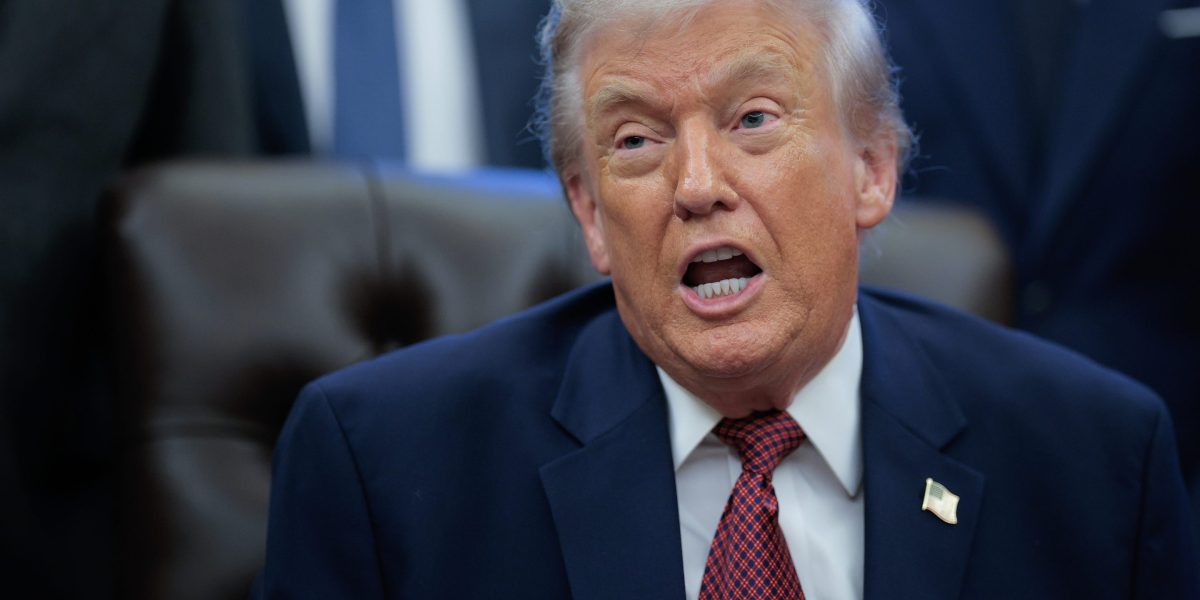
Trump says Netflix-Warner Bros. deal ‘could be a problem’

Published

on


President Donald Trump raised potential antitrust concerns for Netflix Inc.’s planned acquisition of Warner Bros. Discovery Inc., noting that the market share of the combined entity may pose problems. 

“Well, that’s got to go through a process, and we’ll see what happens,” Trump said when asked about the deal as he arrived at the Kennedy Center for an event, confirming that he has met Netflix co-CEO Ted Sarandos last week and complimenting the streaming company. “But it is a big market share. It could be a problem.”

The $72 billion deal would combine the world’s No. 1 streaming player with the No. 4 service HBO Max, which has raised red flags from antitrust regulators. 


Source link

Continue Reading

Trending

Copyright © Miami Select.