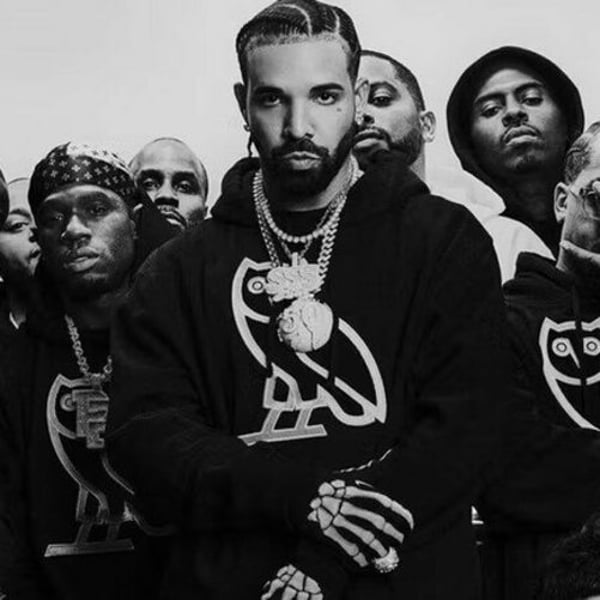
October’s Very Own (OVO) on Tuesday announced it has received capital investment from firm Applied Real Intelligence (A.R.I.), as the Canadian streetwear brand looks to increase its reach globally.
OVO
The U.S.-based investment firm highlighted the “demand for culturally authentic brands right now” adding that the “timing couldn’t be better for OVO,” a lifestyle brand founded by Aubrey “Drake” Graham, Oliver El-Khatib, and Noah “40” Shebib, in Toronto, in 2008.
“Recently, Human Made, the streetwear brand partially owned by Pharrell Williams, went public at nearly $500 million and was reportedly 60 times oversubscribed,” said Dr. Zack Ellison, A.R.I.’s founder and managing general partner.
“It’s a clear signal that investors see tremendous value in brands that blend creativity, community, and cultural credibility. OVO is uniquely positioned within that movement, combining global influence across fashion, music, sports, and a cultural and lifestyle presence that sets it apart.”
Since its inception nearly 20 years ago, OVO has evolved from a music collective into a fully-fledged lifestyle company with retail stores across Toronto, Mississauga, Ottawa, Calgary, and British Columbia, along with international locations in Los Angeles, New York, Las Vegas, and London.
Under the leadership of CEO Derek “Drex” Jancar, OVO will continue to scale its global e-commerce business, expand partnerships, and grow its physical retail footprint, with the help of the new A.R.I. funds, according to a press release.
“OVO represents the next generation of Canadian entrepreneurship,” said Dr. Ellison. “Drake, Oliver, and 40 created something culturally unparalleled, and Drex is now scaling that vision with remarkable discipline and strategic clarity. It’s a rare combination, and one that A.R.I. is proud to support.”
Financial terms of the investment were not disclosed.
The British brand Superdry & Co. has confirmed its entry into Argentina as the launchpad for an ambitious regional expansion. The company plans to invest between 40 million US dollars and $50 million over the first four years, as part of a strategy with a 20-year development horizon in Latin America.
Superdry announces the opening date of its first store in Argentina – DR
The first flagship store is scheduled to open in August, coinciding with the spring/summer season, in the San Isidro Racecourse area. The store will serve not only as the flagship but also as the regional headquarters and decision-making centre for South America. In parallel, the official online store for the Argentine market will launch; the brand’s arrival is already being teased on its local website.
According to the announcement, the first phase will create 150 direct jobs, with a target of ending 2026 with five franchises in operation. From March 2027, at the start of the autumn/winter season, a further five openings are planned, with the aim of reaching a rate of ten franchises per year, measured by financial year rather than calendar year.
Founded in 1985 in Cheltenham, UK, Superdry has built its global standing on a proposition that combines vintage-inspired design, quality garments, and accessible pricing. It currently operates in more than 60 countries and has over 700 stores worldwide.
Superdry’s entry into Argentina will be via an alliance with Tango Fabric, the company founded by Ezequiel García and Juan Ignacio Tubio Mónaco, which will oversee local operations and the brand’s regional development.
This article is an automatic translation. Click here to read the original article.
US e-commerce giant Amazon will appeal against a decision by an Italian court that reduced a fine imposed by the country’s antitrust regulator as it believes it should not be charged at all, Italian daily MF reported on Wednesday.
The logo of Amazon is seen at the company logistics centre in Boves, France, August 8, 2018 – REUTERS/Pascal Rossignol/File Photo
On Monday, Italy’s antitrust authority said it had reduced to 752.4 million euros ($876.3 million) a 1.13-billion-euro fine it imposed on Amazon in 2021 for abusing its dominant position, restricting competition in e-commerce logistics services in Italy.
The reduction followed a regional administrative court ruling last September. The Italian regulator will also appeal against the ruling to reduce the fine, MF reported.
The antitrust authority declined to comment. Amazon did not immediately reply a request for comment.
With a brand that’s as loved as Mulberry has been for years in the UK, it’s been painful to watch it going into decline in recent years. Each new trading update can bring disappointment. But recent ones have held out some hope. So what did the latest update on Wednesday tell us? Well, there was not only hope but some tangible good news, showing that the turnaround plan put in place around a year ago is paying off.
Mulberry
The company said it saw a “strong festive trading period” underpinned by its full-price sales mix and newness. And there was “positive customer response” to its “right product, at the right price” strategy. You may remember that in November 2024, its still-new CEO Andrea Baldo said it was aiming to sell most of its luxury handbags for less than £1,095 (that is, less than the price of the star Bayswater) to broaden the brand’s appeal and boost sales.
For Q3 (the 13 weeks to 27 December) that translated into total group sales (that is, physical retail, e-tail and wholesale) rising 5.3% with retail and digital sales rising 11% on a like-for-like basis.
In the UK, those two figures were a positive 3.5% and 6.5%, respectively, while in the US they were an even bigger 12.7% and 12.6%. In Europe excluding the UK, the rises were 14.9% and an impressive 27.2%. In Asia Pacific, the total sales rise was just 0.8% (due to the continued right-sizing of its store estate as part of its simplification strategy) but on a like-for-like basis, sales rose 12.1%.
During the period, the group delivered revenue growth across all markets, with “a successful focus on full-price sales in the lead up to and during the festive period, against a highly promotional wider retail market”. This resulted in the previously mentioned group like-for-like sales rise in digital and e-commerce of 11%, with retail full-price sales up 19%.
The company said that the “strength of this performance reflects the group’s ongoing delivery of its new strategy – focused on simplifying the business, refreshing the brand, and more fully leveraging customer insights”.
Success at home and abroad
Part of its new strategy had been about refocusing on the UK market and customer, and this appeared to have been successful as sales in its home market rose. Full-price was the lynchpin, and it also delivered a larger proportion of the sales mix online than the prior year, “amid a backdrop of more challenging growth in the broader retail market”. This tells it that “the product is resonating positively with the UK consumer”.
As for the rest of the world, those figures for the US, Europe and Asia Pacific show that the strategy is working elsewhere too. The strength of the Apac like-for-like rise was a reflection of strong trading during the Double 11 shopping festival in November 2025.
The company added that it’s seen customers responding enthusiastically to its “differentiated product range, at a time when we have been realigning Mulberry’s identity as a British lifestyle brand, and reinvigorating its cultural relevance. Mulberry has successfully re-engaged their existing customer base as well engaging new shoppers across both retail and digital, reinforcing the core offering and signalling the Back to the Mulberry Spirit strategy is working”.
It’s something that’s also being seen at larger peer Burberry and in the case of both companies is a sign that focusing on Britishness and brand heritage doesn’t have to mean products and campaigns that are traditional, even boring.
In fact, both firms have been adding new products and reworking existing ones, using heritage materials, and promoting them via campaigns where creativity is to the fore.
CEO Andrea Baldo said that “there remains plenty more to be done” but the early results are “encouraging” and the business is also maintaining “disciplined cost control, while at the same time growing full-price sales by having products that resonate at the right price”.
He also said the response to its Christmas campaign “has been in line with expectation, with particularly strong demand for the Roxanne, the Hackney and the continued resurgence of the Bayswater”.