Business
Down Arrow Button Icon
Published
1 day agoon
By
Jace Porter
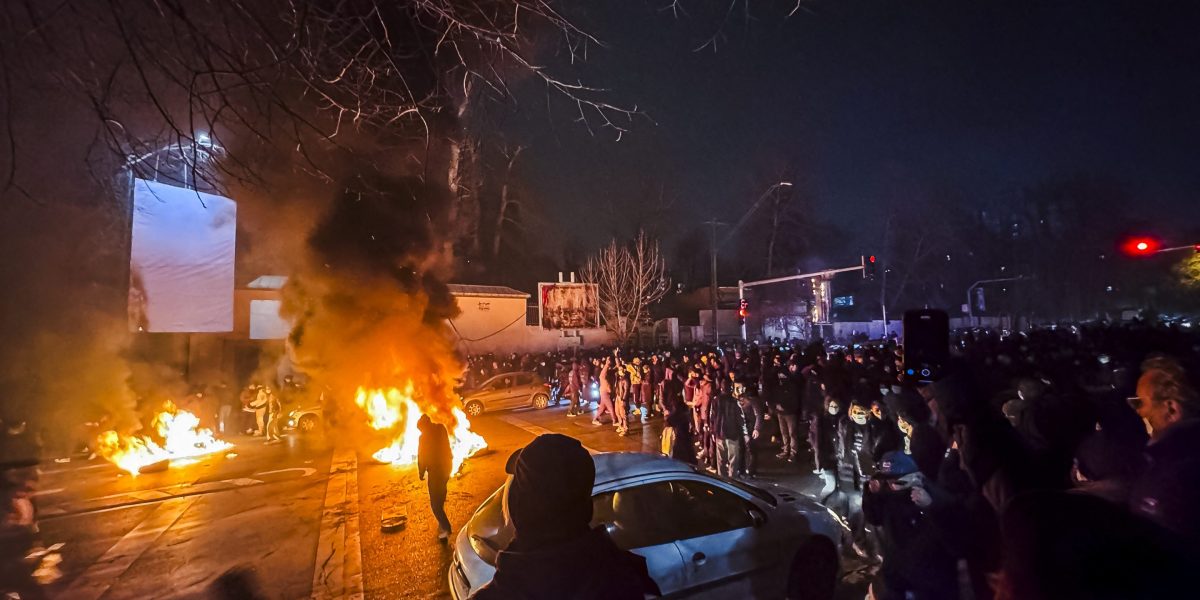
The largest anti-government demonstrations to rock Iran in recent years intensified Friday night, fueling fears of growing fatalities as authorities battle to suppress the protests.
Social media footage trickling out of Iran amid a blanket shutdown of internet and telecommunications networks showed hundreds of thousands marching and chanting anti-regime slogans across the country, with graphic scenes of bodies lying in blood. Other clips showed that the elderly made up many of the protesters.
Separate mobile-camera footage from Fardis, a city about 50 kilometers (31 miles) west of Tehran, showed at least seven bodies covered in blood inside a building. In the videos, people are seen bandaging the head and patching an eye of another individual, while a voice says at least 10 people were killed by gunfire. None of the footage could be independently verified by Bloomberg.
Security forces have arrested nearly 200 “leaders of terrorist groups,” seizing ammunition, hand grenades and Molotov cocktails, Tasnim reported Saturday, citing an informed security official. Iran’s prosecutor general warned that all detainees would be charged as an “enemy of God” — a broadly defined offense punishable by death under Islamic law in the country.
Mohammad Movahedi Azad said all “rioters” would face the same charge, “whether an individual has assisted rioters and terrorists” or “whether they are mercenaries who have taken up arms.” He said trial proceedings will be carried out without any delay and “without leniency, compassion, or indulgence,” the state-run IRIB News reported.
The US-based Human Rights Activists News Agency said Friday that at least 65 people have been killed and 2,311 arrested since protests began on Dec. 28, when traders in Tehran protested a currency crisis and worsening living conditions. The demonstrations have since spread nationwide.
Thirty-eight of the fatalities were identified in Chaharmahal and Bakhtiari, Ilam, Kermanshah, and Fars provinces in central and western Iran, according to the Human Rights Activists group. Time magazine reported Friday that at least 217 protesters have died in Tehran, mostly by live ammunition, citing a doctor in the capital.
Internet-monitoring group NetBlocks said in an X posting that a nationwide internet blackout remained in place in Iran as of Saturday. People inside the country appeared largely cut off from international online services afternoon local time, with many users worldwide reporting they had been unable to get in touch with loved ones at home for almost two days.
Read More: Iran’s Growing Unrest Risks Deepening Crisis for Islamic Regime
The protests over Thursday and Friday — Iran’s weekend — followed a call by Reza Pahlavi, the exiled son of the country’s former shah who’s positioning himself as an opposition leader. He urged demonstrators again to return to the streets after 6 p.m. local time on Saturday and Sunday.
“Our goal is no longer merely to take to the streets,” the US-based, 65-year-old Pahlavi said in an X posting. “The goal is to prepare to seize city centers and hold them.” Pahlavi urged workers in oil, gas and transportation industries to begin a nationwide strike, and said he is “preparing to return to the homeland.”
Oman’s Foreign Minister Badr Albusaidi arrived in Tehran on Saturday, Iranian media reported. The visit comes amid rising tensions between the US and Iran over the Islamic Republic’s handling of protests, a day after Iranian Foreign Minister Abbas Araghchi said it was unclear whether Albusaidi was carrying “a message from anywhere.” Oman mediated five rounds of nuclear talks between Tehran and Washington last year, which stalled after US and Israeli attacks on Iran in June.
State TV played down the protests on Saturday, saying security forces had largely contained the demonstrations on Friday after what it described as unrest by “armed terrorists” in Tehran and other cities the night before.
Iran’s regular army signaled its loyalty to Supreme Leader Ayatollah Ali Khamenei, saying it will “monitor enemy movements in the region and firmly safeguard the nation’s interests, strategic infrastructure, and public property” under the 86-year-old leader, the semi-official Tasnim news agency reported.
Chanting Crowds
Iranian authorities have so far refrained from releasing an official tally of fatalities among protesters or security forces. State-affiliated media reported at least a dozen deaths among police and Basij volunteer militia forces since Thursday. Tasnim said “armed terrorists” killed several police personnel in gunfire on Thursday.
Violence also broke out in Zahedan, a Sunni-majority city in south-western Iran and a long-standing flashpoint for deadly security incidents. The Norwegian-registered Hengaw Organization for Human Rights said security forces opened fire on demonstrators after Friday prayers, leaving several wounded.
State media published images of several burned buildings in Tehran, while a social media video purportedly showed a municipality building in Karaj, west of the capital, engulfed in flames.
Chants recorded in footage included “Death to the dictator,” “No Gaza, no Lebanon, my life for Iran,” and “This is the year of blood; Seyyed Ali will be toppled,” referring to Khamenei, who on Friday repeated his pledge to quash protesters.
While the US has so far been reluctant to embrace Pahlavi as a potential replacement for the Iranian government, President Donald Trump has warned the regime repeatedly against killing protesters.
On Friday, the leaders of France, the UK and Germany also called on the regime to “exercise restraint, to refrain from violence, and to uphold the fundamental rights of Iran’s citizens.”
You may like
Business
Iran’s $7 monthly payments fail to ease unrest over economic crisis as Trump eyes military options
Published
18 minutes agoon
January 11, 2026By
Jace Porter
Protests in Iran appeared to intensify over the weekend, representing the biggest challenge to the regime’s rule in years, as President Donald Trump considers ways to respond.
The mounting unrest comes as Tehran’s piecemeal efforts to address an economic crisis have done little to appease Iranians. Since protests began late last month, the government has offered words of sympathy, fired the central bank’s chief, and announced plans to provide most people with a monthly payment of about 1 million Iranian tomans—equivalent to $7.
Instead of spending $10 billion annually to subsidize imports, that money will instead go directly to 80 million Iranians in the form of credit to buy certain goods.
But the $7 monthly payments offer little relief to beleaguered consumers who are suffering from food inflation of 64%. It’s made worse by a 60% crash in the currency’s value since June, when Iran and Israel fought a 12-day war that was capped by the U.S. bombing of Tehran’s nuclear facilities.
Now, what began as a protest among merchants in Tehran’s bazaars has spread to students as well as Iran’s working and middle classes all across the country.
The security forces that keep the regime in power have not escaped hardship either. While human rights groups estimate hundreds have died from the government’s crackdown, Iranians say it’s not as severe as it could be.
“Security and law enforcement people are facing the same economic issues and high prices, themselves,” a protester in Tehran told the New York Times. “They are not fighting back wholeheartedly.”
Meanwhile, Trump has threatened Iran if the regime kills protesters and doubled down on that Friday, when he said the U.S. would “start shooting” if authorities fired on demonstrators.
With the violence worsening, Trump is looking at ways to follow through. Reports said that administration officials have already started discussing options to attack Iran again. On Sunday, sources told the Wall Street Journal that Trump will be briefed on Tuesday with Secretary of State Marco Rubio, Defense Secretary Pete Hegseth and Joint Chiefs Chair Gen. Dan Caine also due to attend.
In addition to military strikes, other options include boosting antigovernment sources online, cyber attacks, and more economic sanctions, the report said.
But the Journal added that the Pentagon hasn’t sent any forces to the region and that the redeployment of the a USS Gerald R. Ford aircraft carrier to South America means there are none in the Middle East or Europe now.
The U.S. raid on Venezuela last week to capture Nicolas Maduro could weigh on military considerations for Iran as a large armada of Navy ships remain in the Caribbean and continue to enforce a “quarantine” on the country’s oil.
But Trump has shown his appetite for more foreign intervention hasn’t abated, even as the reality of a years-long commitment to rebuild Venezuela’s shattered oil industry sets it.
On Sunday, he sent another warning via social media to Cuba, which had benefited from economic assistance when Maduro was in power but is now feeling more strains.
“THERE WILL BE NO MORE OIL OR MONEY GOING TO CUBA – ZERO!” Trump said in a post. “I strongly suggest they make a deal, BEFORE IT IS TOO LATE.”
Business
This CEO laid off nearly 80% of his staff because they refused to adopt AI fast enough
Published
49 minutes agoon
January 11, 2026By
Jace Porter
Eric Vaughan, CEO of enterprise-software powerhouse IgniteTech, was unwavering as he reflected on the most radical decision of his decades-long career. In early 2023, convinced generative AI was an “existential” transformation, Vaughan looked at his team and saw a workforce not fully on board. His ultimate response: He ripped the company down to the studs, replacing nearly 80% of staff within a year, according to headcount figures reviewed by Fortune.
Over the course of 2023 and into the first quarter of 2024, Vaughan told Fortune, IgniteTech replaced hundreds of employees, declining to disclose a specific number. “That was not our goal,” he told Fortune. “It was extremely difficult … But changing minds was harder than adding skills.” It was, by any measure, a brutal reckoning—but Vaughan insists it was necessary, and said he’d do it again.
For Vaughan, the writing on the wall was clear and dramatic.
“In early 2023, we saw the light,” he told Fortune in an August 2025 interview, adding he believed every tech company was facing a crucial inflection point around adoption of artificial intelligence. “Now I’ve certainly morphed to believe that this is every company, and I mean that literally every company, is facing an existential threat by this transformation.”
Where others saw promise, Vaughan saw urgency—believing failing to get ahead on AI could doom even the most robust business. He called an all-hands meeting with his global remote team. Gone were the comfortable routines and quarterly goals. Instead, his message was direct: Everything would now revolve around AI. “We’re going to give a gift to each of you. And that gift is tremendous investment of time, tools, education, projects … to give you a new skill,” he explained. The company began reimbursing for AI tools and prompt-engineering classes, and even brought in outside experts to evangelize.
“Every single Monday was called ‘AI Monday,’” Vaughan said, with his mandate for staff that they could work only on AI. “You couldn’t have customer calls; you couldn’t work on budgets; you had to only work on AI projects.” He said this happened across the board, not just for tech workers, but also for sales, marketing, and everybody else at IgniteTech. “That culture needed to be built. That was the key.”
This was a major investment, he added: 20% of payroll was dedicated to a mass-learning initiative, and it failed because of mass resistance, even sabotage. Belief, Vaughan discovered, is a hard thing to manufacture.
“In those early days, we did get resistance, we got flat-out, ‘Yeah, I’m not going to do this’ resistance,” he said. “And so we said goodbye to those people.”
The pushback: white collar resistance
Vaughan was surprised to find it was often the technical staff, not marketing or sales, who dug in their heels. They were the “most resistant,” he said, voicing various concerns about what the AI couldn’t do, rather than focusing on what it could. The marketing and salespeople were enthused by the possibilities of working with these new tools, he added.
This friction is borne out by broader research. According to the 2025 enterprise AI adoption report by Writer, an agentic AI platform for enterprises, one in three workers say they’ve “actively sabotaged” their company’s AI rollout—a number that jumps to 41% of millennial and Gen Z employees. This can take the form of refusing to use AI tools, intentionally generating low-quality outputs, or avoiding training altogether. Many act out because of fears that AI will replace their jobs, while others are frustrated by lackluster AI tools or unclear strategy from leadership.
Writer’s chief strategy officer Kevin Chung told Fortune the “big eye-opening thing” from this survey was the human element of AI resistance.
“This sabotage isn’t because they’re afraid of the technology,” he said. “It’s more like there’s so much pressure to get it right, and then when you’re handed something that doesn’t work, you get frustrated.”
He added Writer’s research shows workers often don’t trust where their organizations are headed.
“When you’re handed something that isn’t quite what you want, it’s very frustrating, so the sabotage kicks in, because then people are like, ‘Okay, I’m going to run my own thing. I’m going to go figure it out myself.’” You definitely don’t want this kind of “shadow IT” in an organization, he added.
Vaughan said he didn’t want to force anyone.
“You can’t compel people to change, especially if they don’t believe,” he said, adding belief was really the thing he needed to recruit for.
Company leadership ultimately realized they’d have to launch a massive recruiting effort for what became known as “AI innovation specialists.” This applied across the board: to sales, finance, marketing, and elsewhere. Vaughan said this time was “really difficult” as things inside the company were “upside down … We didn’t really quite know where we were or who we were yet.”
A couple of key hires helped, starting with the person who became IgniteTech’s chief AI officer, Thibault Bridel-Bertomeu. That led to a full reorganization of the company that Vaughan called “somewhat unusual.” Essentially, every division came to report into the AI organization, regardless of domain.
This centralization, Vaughan said, prevented duplication of efforts and maximized knowledge sharing—a common struggle in AI adoption, where Writer’s survey shows 71% of the C-suite at other companies say AI applications are being created in silos and nearly half report their employees have been left to “figure generative AI out on their own.”
No pain, no gain?
In exchange for this difficult transformation, IgniteTech reaped extraordinary results. By the end of 2024, the company had launched two patent-pending AI solutions, including a platform for AI-based email automation (Eloquens AI), with a radically rebuilt team.
Financially, IgniteTech remained strong. Vaughan disclosed the company, which he said was in the nine-figure revenue range, finished 2024 at “near 75% Ebitda”—all while completing a major acquisition, Khoros.
“You multiply people … give people the ability to multiply themselves and do things at a pace,” he said, touting the company’s ability to build new customer-ready products in as little as four days, an unthinkable timeline in the old regime. In the months since, Vaughan told Fortune in an early 2026 statement, the company has only kept growing its headcount, recruiting globally for AI Innovation Specialists across every function, from marketing to sales to finance to engineering to support.
What does Vaughan’s story say for others? On one level, it’s a case study in the pain and payoff of radical change management. But his ruthless approach arguably addresses many challenges identified in the Writer survey: lack of strategy and investment, misalignment between IT and business, and the failure to engage champions who can unlock AI’s benefits.
The ‘boy who cried wolf’ problem
To be sure, IgniteTech is far from alone in wrestling with these challenges. Joshua Wöhle is the CEO of Mindstone, a firm that provides AI upskilling services to workforces, training hundreds of employees monthly at companies including Lufthansa, Hyatt, and NBA teams. He recently discussed the two approaches described by Vaughan—upskilling and mass replacement—in an appearance on BBC Business Today.
Wöhle contrasted the recent examples of Ikea and Klarna, arguing the former’s example shows why it’s better to “reskill” existing employees. Klarna, a Swedish buy-now, pay-later firm, drew considerable publicity for a decision to reduce members of its customer support staff in a pivot to AI, only to rehire for the same roles.
“We’re near the point where [AI is] more intelligent than most people doing knowledge work. But that’s precisely why augmentation beats automation,” Wöhle wrote on LinkedIn.
A representative for Klarna told Fortune the company did not lay off employees, but has instead adopted several approaches to its customer service, which is managed by outsourced customer service providers who are paid according to the volume of work required. The launch of an AI customer service assistant reduced the workload by the equivalent of 700 full-time agents—from roughly 3,000 to 2,300—and the third-party providers redeployed those 700 workers to other clients, according to Klarna. Now that the AI customer service agent is “handling more complex queries than when we launched,” Klarna says, that number has fallen to 2,200. Klarna says its contractor has rehired just two people in a pilot program designed to combine highly trained human support staff with AI to deliver outstanding customer service.
In an interview with Fortune, Wöhle said one client of his has been very blunt with his workers, ordering them to dedicate all Fridays to AI retraining, and if they didn’t report back on any of their work, they were invited to leave the company.
He said it can be “kinder” to dismiss workers who are resistant to AI: “The pace of change is so fast that it’s the kinder thing to force people through it.” He added he used to think if he got all workers to really love learning, then that could help Mindstone make a real difference, but he discovered after training literally thousands of people that “most people hate learning. They’d avoid it if they can.”
Wöhle attributed much of the AI resistance in the workforce to a “boy who cried wolf” problem from the tech sector, citing NFTs and blockchain as technologies that were billed as revolutionary but “didn’t have the real effect” that tech leaders promised.
“You can’t really blame them” for resisting, he said. Most people “get stuck because they think from their work flow first,” he added, and they conclude AI is overhyped because they want AI to fit into their old way of working. “It takes a lot more thinking and a lot more kind of prodding for you to change the way that you work,” but once you do, you see dramatic increases. A human can’t possibly keep five call transcripts in their head while you’re trying to write a proposal to a client, he offers, but AI can.
Ikea echoed Wöhle when reached for comment, saying its “people-first AI approach focuses on augmentation, not automation.” A spokesperson said Ikea is using AI to automate tasks, not jobs, freeing up time for value-added, human-centric work.
The Writer report notes companies with formal AI strategies are far more likely to succeed, and those who heavily invest in AI outperform their peers by a large margin. But as Vaughan’s experience shows, investment without belief and buy-in can be wasted energy. “The culture needed to be built. Ultimately, we ended up having to go out and recruit and hire people that were already of the same mind. Changing minds was harder than adding skills.”
From the vantage point of early 2026, Vaughan reflected in a statement to Fortune, monthly all-hands meetings look nothing like they used to: “We killed the format of reviewing goals and metrics. Now teams demo what they built.” He wanted to stress something else: Despite the drastic actions he took to restructure, he still doesn’t think he’s ahead of the curve.
“We’re just not getting run over from behind yet,” he said. “The pace of change in AI is relentless. If we don’t keep pushing, keep learning every single day, we’re toast.”
For Vaughan, there’s no ambiguity. Would he do it again? He doesn’t hesitate: He’d rather endure months of pain and build a new, AI-driven foundation from scratch than let an organization drift into irrelevance.
“This is not a tech change. It is a cultural change, and it is a business change,” he said, adding he doesn’t recommend others follow his lead and swap out 80% of their staff.
“I do not recommend that at all,” he said. “That was not our goal. It was extremely difficult.”
But at the end of the day, he added, everybody’s got to be in the same boat, rowing in the same direction. Otherwise, “we don’t get where we’re going.”
A version of this story was published on Fortune.com on August 17, 2025.
More on AI in the workplace:
Business
Rethinking affordability: policy has to start with how households experience shocks
Published
2 hours agoon
January 11, 2026By
Jace Porter
Public debate often treats economic disruptions as short-lived problems—sharp swings in prices, employment, or growth that settle once the broader economy finds its footing again. Early November’s election results suggest voters may see things somewhat differently. Candidates who focused squarely on affordability did well because households may be responding, at least in part, to something far more persistent: years of declining economic well-being that do not roll back once the headlines move on.
For decades, policy conversations have too often accepted a simple assumption: that it is only rational to tolerate short-run turmoil in exchange for long-run stability. In this model, policymakers adjust course—sometimes modestly, sometimes not at all—while workers, small-business owners, jobseekers, and caregivers are expected to weather the turbulence. In theory, these shocks are supposed to fade, and the greater good is served by merely bandaging the complaints of lower-income groups until the headline metrics herald an apparent return to normalcy. In practice, however, households experience these shocks—and their aftermath—very differently. And while some economic turbulence is truly inevitable, appreciating the disconnect between the picture painted by the aggregate indicators and the ripple effects households feel is a necessary step towards identifying policies that can improve affordability.
Everyday Americans certainly feel the effects of economic shocks that are captured in the headline statistics, but there are many reasons why an improvement in those headline numbers doesn’t map to an improvement in a household’s financial situation. For example, most people don’t budget for the 80,000 goods and services tracked by the Consumer Price Index (CPI). They manage a much smaller set of expenses, e.g. rent, groceries, childcare, utilities, insurance premiums, and a few others. If the weekly grocery bill jumps by $40, that often becomes the new number they have to live with.
Even when market forces eventually push prices down, the clock is rarely fully wound back and wages often fail to keep pace with the new cost realities. A rent increase does not automatically reverse when inflation cools. Childcare prices do not necessarily fall just because CPI moderates. Shocks to essentials are rarely one-time disturbances that disappear when the crisis fades, even if the price increases only once—more often, they become lasting additions to the cost of living, raising the baseline from which working Americans make every subsequent financial decision.
Recent price surges underscore how rare true reversals are. The CPI for food shows prices decelerating but not reversing from their 2022 spike, a frustration grocery shoppers have experienced firsthand. Milk prices, for example, fell briefly from $4.20 per gallon in January 2023 to $3.86 by May 2024, only to stabilize around $4.00 by August. By November 2025, consumers were paying 25% more for the same purchases than they had in 2019. Egg prices tell a similar story: despite easing from their most serious spikes in January 2023 and March 2025, they remained roughly double their pre-inflation level as of September 2025.
Housing offers little reassurance. The Zillow Observed Rent Index (ZORI) shows rents jumping more than 15% in 2021. The increases slowed down between 2022 and 2025, but rents did not plunge back to their 2019 level; instead, they resumed climbing at roughly their pre-pandemic pace from a much higher baseline. The end of the inflation shock does not mean a return to affordability—it means the return to typical price movement. For many working households, that means a continuation of the faster-than-CPI-U accumulation that characterized the cost of necessities for the previous two decades.
Even if a one-time shock dissipates, the damage households sustained in the interim can slow their progress for years. A temporary hit to purchasing power may force a household to take on additional debt or postpone savings for college or retirement—effects that do not show up clearly in present-day headline indicators. From that perspective, a one-time shock at the macro level can easily become a permanent shift in a household’s financial position.
This distinction explains, in part, why voters responded so strongly to affordability-focused campaigns. They may not be rejecting long-run thinking entirely; rather, they are likely reacting not just to today’s “sticker shock,” but to the reality that the long run they have been living is defined by accumulated, irreversible shocks—none of which appear clearly in top-line indicators.
For policymakers, the implication is straightforward: there is often no such thing as a one-time effect for households. A shock might disappear from the inflation tables or unemployment charts, but everyday Americans continue to feel its consequences long after the data normalizes. Further, even when a shock resolves at the national level, local communities may continue to struggle if critical employers have downsized or if reduced spending within the community has resulted in a more permanent slowdown.
From a macroeconomic perspective, shocks do often look temporary. The unemployment rate eventually fell after the 2008 financial crisis. Gross Domestic Product (GDP) rebounded after the 2020 lockdowns. The CPI surge in 2022 slowed as supply chains recovered. From that vantage point, the economy appears to move past each disruption in turn, reinforcing the idea that these are temporary events.
But this “recovery” story breaks down at the household level much more than policy leaders take into account. In 2021, households reported surviving the initial COVID slowdown by postponing their progress towards financial goals: either by drawing on savings set aside for something else, by taking on additional debt or putting off bills, or making plans to delay retirement. But by 2023, when the slowdown was replaced by inflation, consumers once again leaned on the savings to cover the rising costs of groceries—with nearly one in five relying on funds they had not intended to use for everyday purchases.
Aggregate indicators do not show how much financial well-being households lost during those periods, how long it will take them to rebuild, or whether they ever will. This is a critical blind spot: the metrics policymakers rely on were never designed to measure the compounding, non-reversible nature of household-level shocks.
Research from my colleagues at the Ludwig Institute for Shared Economic Prosperity (LISEP) and others shows just how large this gap has become. When inflation rose in 2021, much of the debate framed price increases as a temporary concern overshadowed by the risk of recession. But for many, the pressure had been building for years. Essential expenses had outpaced median wages over the past two decades. For a family of four, between 2001 and 2023:
- Rent: 40th percentile rents rose 125%.
- Healthcare: Annual health-insurance premiums borne by middle-income workers more than tripled.
- Childcare: The average price of center-based childcare doubled.
- Wages: Median wages for typical workers rose by only 92% in nominal terms, resulting in a 4% decline in purchasing power for families whose budgets are dominated by necessities.
These aren’t short-term fluctuations. They are structural and cumulative increases in the cost of essentials, compounded by wage growth that lagged behind. That combination steadily eroded families’ room to maneuver. So, when inflation in groceries and consumer goods spiked in 2021—even for a relatively brief period—low- and middle-income Americans had precious little slack left to absorb it.
This is why focusing on headline inflation misses the larger, persistent threat. Rising unavoidable expenses have been pushing up the household cost structure for decades. CPI understates the rise in many essentials, and labor-market metrics often overstate the prevalence of living-wage jobs. Add in higher barriers to homeownership and education, and the financial path forward becomes even steeper. Consumer behavior reflects this reality. New tariffs introduced in 2025 were described as temporary “trade adjustments,” yet analysis from the Budget Lab at Yale University estimates they will raise consumer prices by roughly 1.7% and cost the average household $2,300 this year alone. Even if those increases eventually unwind, the impact will fall on households that have already been squeezed for decades, and many households are no longer assuming prices will fall back—they’ve been burned too often.
In a recent survey, 44% believe tariffs have already increased the price of goods and services, and a quarter reported switching to generic or private-label goods in response. These are not the behaviors of households expecting a quick return to pre-shock conditions.
Against this backdrop, new shocks—whether from AI-driven disruptions, federal layoffs, or additional trade-policy changes—may well land on households that are already stretched thin. Even well-intentioned policies can have unintended consequences if they are not evaluated through the lens of a household balance sheet. Focusing only on short-term affordability or only on long-term reform which may never come misses the point; both matter, because families must make both short- and long-run decisions at the same time.
After more than two decades of declining well-being for most middle- and low-income households, it is clear that structural reforms are needed to bring costs back in line with wages. Short-term fixes alone are unlikely to address the root causes of affordability and, if misguided, could even prove counterproductive. Effective leaders should recognize that working-class households need both immediate breathing room and policies that make long-term stability possible.
Ultimately, policy must be judged not only by aggregate performance of the economy as a whole or political resonance but by its ability to strengthen household financial resilience of all income groups—helping families make progress in good times and avoid lasting setbacks in bad. Until our measurement tools capture these realities directly, policymakers will continue to rely on short-termism, intuition, and ideological prejudices rather than evidence.
And while intuition and such prejudices may shape elections, and too often do, effective policy and the country’s well-being require something more precise: an economic framework that recognizes that very few shocks are ever truly “one-time” for the households who have to bear them.
The opinions expressed in Fortune.com commentary pieces are solely the views of their authors and do not necessarily reflect the opinions and beliefs of Fortune.
Iran’s $7 monthly payments fail to ease unrest over economic crisis as Trump eyes military options
Melissa Gilbert Deletes Instagram as Timothy Busfield Faces Child Sex Abuse Claims
Erika Booth starts 2026 with commanding cash lead in HD 35
Trending
-
Politics8 years agoCongress rolls out ‘Better Deal,’ new economic agenda
-
Entertainment8 years agoNew Season 8 Walking Dead trailer flashes forward in time
-
Politics8 years agoPoll: Virginia governor’s race in dead heat
-
Entertainment8 years agoThe final 6 ‘Game of Thrones’ episodes might feel like a full season
-
Politics8 years agoIllinois’ financial crisis could bring the state to a halt
-
Entertainment8 years agoMeet Superman’s grandfather in new trailer for Krypton
-
Business8 years ago6 Stunning new co-working spaces around the globe
-
Tech8 years agoHulu hires Google marketing veteran Kelly Campbell as CMO