Connect with us

Business

Down Arrow Button Icon

Published

on


The U.S. Supreme Court could rule as soon as Friday on whether President Trump’s tariff regime is unconstitutional. If the court strikes down his trade policies, it could jeopardize up to one-third of Trump’s newly proposed military budget, according to a post by the president on social media.

Trump said Wednesday on Truth Social that he wanted to increase U.S. military spending from $1 trillion to $1.5 trillion. “I would stay at the $1 Trillion number but, because of Tariffs, and the tremendous Income that they bring, amounts being generated, … we are able to easily hit the $1.5 Trillion Dollar number.”

Most observers, however, are expecting the court to strike down his tariff regime or at least curtail it. At oral arguments, the justices expressed scepticism that the White House has the power to impose taxes on trade without the permission of Congress under the International Emergency Economic Powers Act (IEEPA).

“The betting markets think there’s a high chance the White House loses its appeal and that could see a raft of tariffs—including so-called ‘reciprocal’ levies on the E.U., China and the rest of the world—struck down,” ING told its clients in an email seen by Fortune. Bettors on Kalshi give only a 29% chance of Trump’s tariffs surviving; it’s just 25% on Polymarket

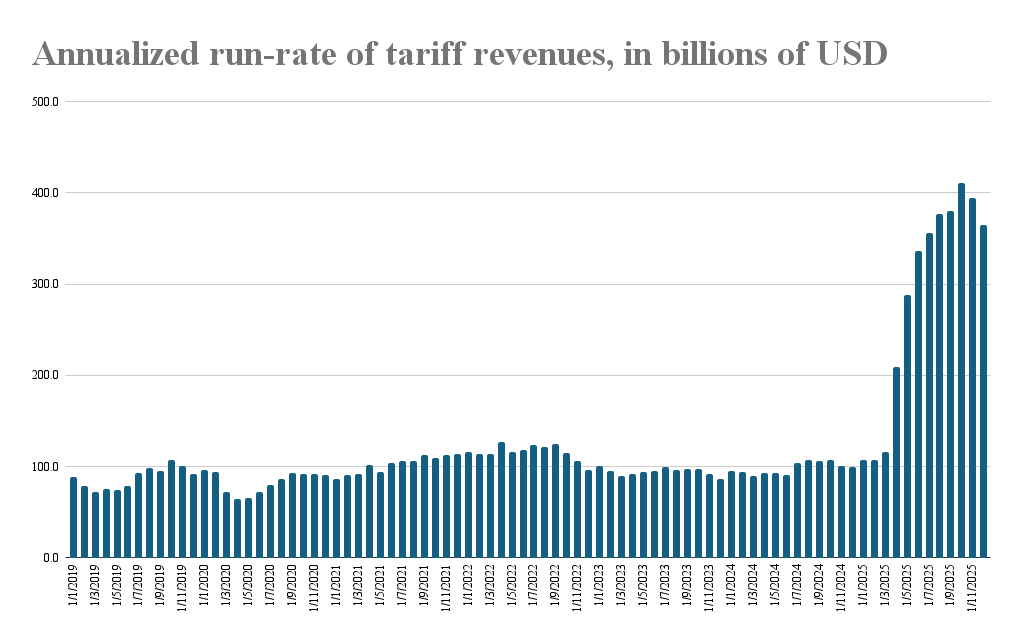
About 1,000 companies are petitioning the court to scrap the tariffs. If they are successful, the White House would have to figure out a mechanism to pay them all back. That would be a non-trival undertaking. According to data from Bloomberg provided to Fortune via Pantheon Macroeconomics, tariff revenue is being generated at a current rate of $30.4 billion per month, for an annualized rate of $364.5 billion. (Notably, that number is below the extra $500 billion Trump wants to spend on the military.)
Trump has previously warned that it “would be a National Security catastrophe” if he was forced to refund the tariffs.

Defense stocks are all over the place

U.S. defense company stocks sold off sharply yesterday for a separate but related reason: Trump signed an executive order that potentially bans military supply chain companies from making stock buybacks or setting senior executive compensation higher than $5 million if the White House thinks they aren’t working fast enough or producing high-quality equipment.

“If Raytheon wants further business with the United States Government, under no circumstances will they be allowed to do any additional Stock Buybacks, where they have spent Tens of Billions of Dollars, until they are able to get their act together. Our Country comes FIRST, and they’re going to have to learn that, the hard way!” Trump said on social media.

S&P 500 futures were down this morning after the index fell yesterday. Markets were broadly down in Asia and Europe. Defence stocks are seeing a high level of volatility in reaction to Trump’s various statements.

“President Trump’s social media posts dragged on shares of homebuilders and defence companies,” Jim Reid and his colleagues at Deutsche Bank told clients this morning. 

“Defence contractors including Northrop Grumman (-5.50%), Lockheed Martin (-4.82%) and RTX (-2.45%) slid on the news. However, there were potentially better news for defence firms after the close, with Trump demanding a boost in the 2027 US defence budget from $1trn to $1.5trn. It is $901bn in the current 2026 fiscal year. The renewed policy risks left the S&P 500 -0.34% lower by the close,” they said.

In overnight trading, those stocks popped upward again following Trump’s $1.5 trillion budget proposal. Northrop Grumman rose 7.28%, Lockheed Martin rose 6.71%, and RTX (owner of Raytheon) rose 5%.

If the court rules against Trump, expect those stocks to take another battering, given that the end of the tariffs threatens such a large proposed chunk of Department of War spending.

Also on the radar:

JPMorgan noted that retail stock buyers started the year bullish. They net bought $10.1 billion in stocks in the first week of the year, above the weekly average of $6.5 billion, according to Arun Jain and his team. Most of that ($7.2 billion) went into ETFs.

More cracks in the private credit market, according to S&P Global’s With Intelligence unit. Selective defaults were up as was the use of “Payment-in-Kind” provisions—extra payments that companies promise their lenders if they cannot meet the initial terms of their debt. PIKs are generally associated with lower quality debt.

2026 Bitcoin forecasts are all over the place. CNBC did a roundup of experts’ forecasts for the cryptocurrency’s performance this year and found a wild spread of predictions—perhaps unsurprising given that there is no way to calculate the fundamental value of a piece of code that has no underlying asset behind it.

Here’s a snapshot of the markets ahead of the opening bell in New York this morning:

  • S&P 500 futures were down 0.25% this morning. The last session closed down 0.34% at 6,944.82, a record high.
  • STOXX Europe 600 was down 0.38% in early trading. 
  • The U.K.’s FTSE 100 was down 0.29% in early trading. 
  • Japan’s Nikkei 225 was down 1.63%.
  • China’s CSI 300 was down 0.82%. 
  • The South Korea KOSPI was flat.
  • India’s NIFTY 50 was down 1.01% 
  • Bitcoin sank to $90.1K.
Join us at the Fortune Workplace Innovation Summit May 19–20, 2026, in Atlanta. The next era of workplace innovation is here—and the old playbook is being rewritten. At this exclusive, high-energy event, the world’s most innovative leaders will convene to explore how AI, humanity, and strategy converge to redefine, again, the future of work. Register now.


Source link

Continue Reading

Business

Trump calls for one-year cap on credit card rates at 10%

Published

on


President Donald Trump on Friday called for a one-year cap on credit card interest rates at 10%, effective Jan. 20, without specifying details.

“Please be informed that we will no longer let the American Public be ‘ripped off’ by Credit Card Companies that are charging Interest Rates of 20 to 30%, and even more, which festered unimpeded during the Sleepy Joe Biden Administration. AFFORDABILITY!” he wrote on social media.

It’s not clear whether credit card companies will respond to his call, or what actions he might take to force any change.

The post comes as the Trump administration intensifies efforts to demonstrate to voters that the president is addressing concerns about costs and prices that have emerged as a central issue in the November midterm elections.

During the 2024 presidential campaign, Trump pledged to seek limits on the interest credit card companies can charge.

Hours before his message on Friday, Senator Bernie Sanders, a Vermont independent, said on X: “Trump promised to cap credit card interest rates at 10% and stop Wall Street from getting away with murder. Instead, he deregulated big banks charging up to 30% interest on credit cards.”

In a letter last year to Sanders and Senator Josh Hawley, a Missouri Republican, a group of banking trade groups painted a dire outcome for consumers if the government ever capped interest rates on credit cards at 10%, as the senators had proposed.

“Many consumers who currently rely on credit cards would be forced to turn elsewhere for short-term financing needs, including pawn shops, auto title lenders or worse — such as loan sharks, unregulated online lenders and the black market,” the group wrote.

The Bank Policy Institute said in a report last year that “while the proposed cap is a well-intentioned effort to reduce the high debt burden some households are facing, it would harm consumers’ access to card credit.” The group also said such a move could force card issuers to reduce cardholder benefits, including lucrative rewards tied to purchases. 

Responding to Trump’s post on Friday, Hawley said on X: “Fantastic idea. Can’t wait to vote for this.”


Source link

Continue Reading

Business

Asian households still save as much as half their wealth in cash. Fintech platforms like Syfe want to change that

Published

on


Growing up in India, Dhruv Arora’s mother gave him one key piece of financial advice: Put his money in the bank. 

But Arora, now the founder of Singapore-based fintech platform Syfe, quickly realized that following his mother’s advice meant his money “did absolutely nothing.”

“We have quite a heavy culture of saving,” Arora says, citing Asia’s often unstable economic and policy history. But inflation and low interest rates end up eroding the value of household savings. “Over time, the $100 you put in the bank doesn’t become $101, but effectively $98” due to the effects of inflation.

Asian households sometimes keep as much as 50% of their net worth in cash, rather than in investments or assets. In contrast, in developed markets like the U.S. and Europe, that figure is closer to 15%. 

But that conservative attitude in Asia is starting to change. Asians are getting wealthier, pushing them to explore different investment options. Strong stock market performance is also driving a new wave of retail investors across the Asia-Pacific.

“Asian households are slowly dipping their toes into stock markets,” HSBC economists wrote in a Jan. 9 report, though noted that “overall equity investment remains quite low.” The bank predicts that a steady shift from low-yield cash to higher-yield investments will mean “more money will continue to rotate into equity markets over the next few years,” reducing a reliance on foreign investors. 

A slew of fintech apps have emerged in recent years to tap a growing interest in investing and wealth management among Asian users. These alternative finance platforms, such as Syfe, Stashaway and Endowus, often offer a range of investment options, ranging from cash management to managed portfolios and options trading. The challenge, Arora says, is how to “bridge the gap between holding money and growing wealth,” and “give more people the confidence to put their savings to work.”

Arora began his career as an investment banker for UBS in Hong Kong in 2008, soon after the Global Financial Crisis. Despite Asia’s relatively quick recovery, Arora noticed that the region’s professionals were building wealth yet didn’t know how to manage it. “These were smart people like doctors, lawyers and consultants, who were doing well professionally, but just did not know what to do with their money,” he says. 

He launched Syfe in 2019, just a few months before another global crisis: The COVID-19 pandemic. Yet the pandemic ended up being an opportunity for fintech platforms like Syfe. “It acted as a catalyst for a shift in investor behavior,” Arora explained, as people suddenly had the time to engage with financial markets.

In the U.S., for example, people stuck at home began to get involved in stock trading through platforms like Robinhood. Fueled by social media, these retail investors began to heavily trade in so-called meme stocks like Gamestop and AMC.

Syfe has since expanded from its home market of Singapore to new Asia-Pacific economies like Australia and Hong Kong. The platform continues to grow both its userbase and company revenue, and the company claimed it reached profitability in Q4 2025. It’s now a “self-sustaining organization,” Arora says. 

Syfe closed an $80 million Series C funding round last year, and is backed by major investors like NYC-based Valar Ventures and UK-based investment firm Unbound.

The platform’s users generated $2 billion worth of returns while saving $80 million in fees last year, according to the company. 

Currently, Arora wants to deepen Syfe’s presence in its existing markets. Last year, the platform began to roll out bespoke offerings for its users, like private credit for accredited investors looking to diversify their portfolios on Syfe. Syfe will launch options trading in 2026.

Arora notes that many of Syfe’s users, over time, have grown more comfortable with taking larger investment risks, moving from putting their money in Syfe-managed portfolios, to more actively trading on brokerages and income portfolios.

Yet he eventually wants to bring Syfe to new markets in North Asia and the Middle East, which boast sizable populations of what Arora terms the “mass affluent,” a population with significant investable assets and higher-than-average incomes, though still not in the high-net-worth category. 

“This demographic has historically been ‘stuck in the middle’: too large for basic retail banking, yet often underserved by traditional private banks,” he explains.

This story was originally featured on Fortune.com


Source link

Continue Reading

Business

Lawmakers and victims criticize new limits on Grok’s AI image as ‘insulting’ and ‘not effective’

Published

on


Elon Musk’s xAI has restricted its AI chatbot Grok’s image generation capabilities to paying subscribers only, following widespread condemnation over its use to create non-consensual sexualized images of real women and children.

“Image generation and editing are currently limited to paying subscribers,” Grok announced via X on Friday. The restriction means the vast majority of users can no longer access the feature. Paying, verified subscribers with credit card details on file can still do so, but theoretically they can be identified more easily if the function is misused.

However, experts, regulators, and victims say that the new restrictions aren’t a solution to the now widespread problem.

“The argument that providing user details and payment methods will help identify perpetrators also isn’t convincing, given how easy it is to provide false info and use temporary payment methods,” Henry Ajder, a UK-based deepfakes expert, told Fortune. “The logic here is also reactive: it is supposed to help identify offenders after content has been generated, but it doesn’t represent any alignment or meaningful limitations to the model itself.”

The UK government has called the move “insulting” to victims, in remarks reported by the BBC. The UK’s prime minister’s spokesperson told reporters on Friday that the change “simply turns an AI feature that allows the creation of unlawful images into a premium service.

“It is time for X to grip this issue; if another media company had billboards in town centers showing unlawful images, it would act immediately to take them down or face public backlash,” they said.

A representative for X said they were “looking into” the new restrictions. xAI responded with the automated message: “Legacy Media Lies.”

Over the past week real women have been targeted at scale with users manipulating photos to remove clothing, place subjects in bikinis, or position them in sexually explicit scenarios without their consent. Some victims reported feeling violated and disturbed by the trend, with many saying their reports to X went unanswered and images remained live on the platform.

Researchers said the scale at which Grok was producing and sharing images was unprecedented as, unlike other AI bots, Grok essentially has a built-in distribution system in the X platform. 

One researcher, whose analysis was published by Bloomberg, estimated that X has become the most prolific site for deepfakes over the last week. Genevieve Oh, a social media and deepfake researcher who conducted a 24-hour analysis of images the @Grok account posted to X, found that the chatbot was producing roughly 6,700 sexually suggestive or nudifying images per hour. By comparison, the five other leading websites for sexualized deepfakes averaged 79 new AI undressing images hourly during the same period. Oh’s research also found that sexualized content dominated Grok’s output, accounting for 85% of all images the chatbot generated.

Ashley St. Clair, a conservative commentator and mother of one of Musk’s children, was among those affected by the images. St. Clair told Fortune that users were turning images on her X profile into explicit AI-generated photos of her, including some she said depicted her as a minor. After speaking out against the images and raising concerns about deepfakes on minors, St Clair also said X took away her verified, paying subscribers status without notifying her or refunding her for the $8 per month fee.

“Restricting it to the paid-only user shows that they’re going to double down on this, placing an undue burden on the victims to report to law enforcement and law enforcement to use their resources to track these people down,” Ashley St Clair said of the recent restrictions. “It’s also a money grab.”

St Clair told Fortune that many of the accounts targeting her were already verified users: “It’s not effective at all,” she said. “This is just in anticipation of more law enforcement inquiries regarding Grok image generation.”

Regulatory pressure

The move to limit Grok’s capabilities comes amid mounting pressure from regulators worldwide. In the U.K., Prime Minister Keir Starmer has indicated he is open to banning the platform entirely, describing the content as “disgraceful” and “disgusting.” Regulators in India, Malaysia, and France have also launched investigations or probes.

The European Commission on Thursday ordered X to preserve all internal documents and data related to Grok, stepping up its investigation into the platform’s content moderation practices after describing the spread of nonconsensual sexually explicit deepfakes as “illegal,” “appalling,” and “disgusting.”

Experts say the new restrictions may not satisfy regulators’ concerns: “This approach is a blunt instrument that doesn’t address the root of the problem with Grok’s alignment and likely won’t cut it with regulators,” Ajder said. “Limiting functionality to paying users will not stop the generation of this content; a month’s subscription is not a robust solution.”

In the U.S., the situation is also likely to test existing laws, like Section 230 of the Communications Decency Act, which shields online providers from liability for content created by users. U.S. Senators Ron Wyden, Edward J. Markey, and Ben Ray Luján have issued a statement urging Apple and Google to “immediately remove the X and Grok apps from their app stores” following Grok’s alleged use for generating “nonconsensual sexualized images of women and children at scale.” The lawmakers called the images “disturbing and likely illegal,” and said the apps should remain unavailable until Musk addresses the concerns.

The Council on American-Islamic Relations (CAIR) has also called for Grok to be blocked from generating “sexually explicit images of children and women, including prominent Muslim women.”

Riana Pfefferkorn of Stanford’s Institute for Human-Centered Artificial Intelligence previously told Fortune that liability surrounding AI-generated images is murky. “We have this situation where for the first time, it is the platform itself that is at scale generating non-consensual pornography of adults and minors alike,” she said. “From a liability perspective as well as a PR perspective, the CSAM laws pose the biggest potential liability risk here.”

Musk has previously stated that “anyone using Grok to make illegal content will suffer the same consequences as if they upload illegal content.” However, it remains unclear how accounts will be held accountable.


Source link

Continue Reading

Trending

Copyright © Miami Select.