Connect with us

Business

Down Arrow Button Icon

Published

on


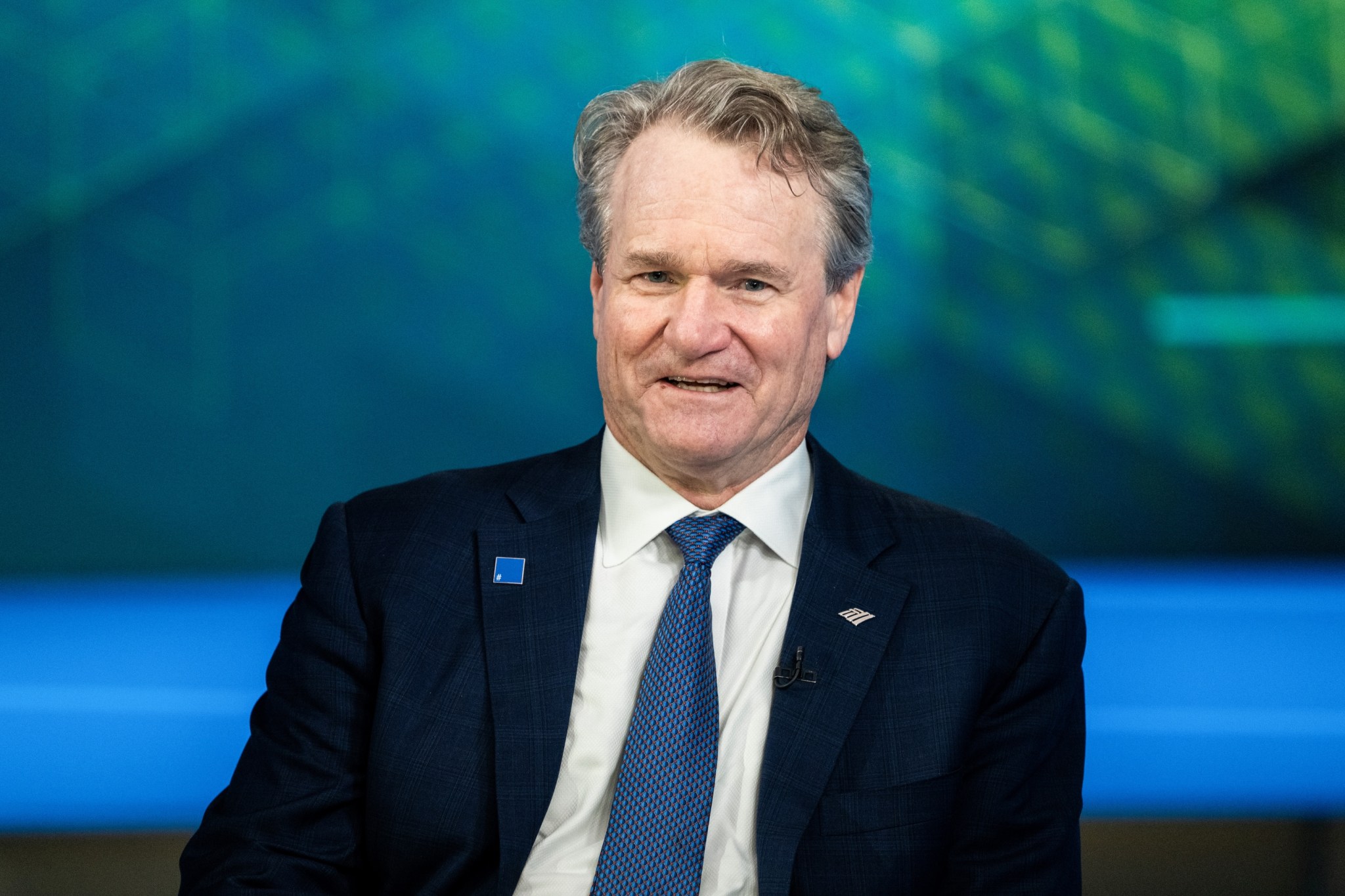
The bank recently hired 2,000 top grads from 200,000 applications, the executive said in an interview with CBS News‘ Margaret Brennan on Face the Nation. As companies cite AI for widespread layoffs, Moynihan acknowledges that many young people feel scared and uncertain about the future.

“My advice to those kids, if you ask them if they’re worried about, they say they’re worried about—these are kids that we hire, 200,000 applications, we hire 2000 people.” Moynihan added that “if you ask them if they’re scared, they say they are. And I understand that. But I say, harness it … It’ll be your world ahead of you,” Moynihan said.

Moynihan said it’s too soon to say how AI will play out in the job market, but he hopes to use efficiencies created by the technology to invest in more growth.

“We want to drive more growth. So the AI will be spent—the efficiencies from AI will be spent to keep growing the company, I think,” he said.

Moynihan also said Americans are focusing too much on the Fed and its impact on the economy. He argued that the private sector is a more important driver of economic growth.

“The idea that we are, like, hanging on the thread by the Fed moving rates 25 basis points, it seems to me we’ve gotten out of whack,” he said.

Gen Z’s hiring fears

Jerome Powell and multiple economists have validated that Gen Z is facing a genuine “hiring nightmare,” especially for recent college graduates trying to land their first white-collar job. This is tied to a low‑hire, low‑fire labor market, the rapid automation of entry‑level roles, and a tech industry whose workforce is getting older as Gen Z’s presence shrinks.

In September 2025, Powell used his post‑meeting press conference to highlight an “interesting labor market” where “kids coming out of college and younger people, minorities, are having a hard time finding jobs.” He emphasized that the job-finding rate is “very, very low” even as layoffs remain subdued, creating a stagnant low‑hiring, low‑firing environment that is particularly punishing for new entrants. Asked whether AI was to blame, he called it “probably a factor” but not the main driver, suggesting that slower overall job creation plus some AI substitution is squeezing young workers at precisely the moment they try to get on the ladder.

Employers are using AI to automate the predictable, process‑heavy tasks that once justified many junior roles, especially in corporate and tech settings. Platforms that track early‑career hiring, like Handshake, point to a double squeeze: entry‑level job postings in corporate roles are down roughly 15% year over year, while references to “AI” in job descriptions have jumped about 400% over two years. Economists like Dartmouth’s David Blanchflower tell Fortune that even when young people do find work, they report rising “despair” and a pervasive “this job sucks” sentiment, compounding the effect of higher recent‑grad unemployment rates compared with the national average.

Some unemployed Gen Z grads are piling into additional business degrees or specialized programs to differentiate themselves, effectively delaying full‑time work and reflecting a cohort that feels forced to over‑credential to compete for fewer true entry‑level spots.


Source link

Continue Reading

Business

An anonymous Polymarket trader made $400k betting on Maduro’s downfall—now Washington wants answers

Published

on


On Jan. 3, soon after U.S. forces captured Venezuelan president Nicolás Maduro at his compound in Caracas, the political researcher Tyson Brody noticed strange activity on  Polymarket. Brody is one of a growing group of observers who monitor for unusual trades on the platform, which allows people to gamble on the outcome of future events, from the weather to NFL games to governmental upheavals. 

Following Maduro’s capture, Brody found one user, who only created their account a week before, had taken a massive position on Maduro leaving office. The user, Burdensome-Mix, had become the largest holder of “yes” contracts for the event—which paid out in the event Maduro was toppled before the end of January—well before the news of the raid reached the public. The user ended up making over $400,000 from the well-timed trade. Brody’s early morning post quickly went viral, spurring widespread accusations of insider trading and a growing backlash against unchecked prediction markets by lawmakers. 

The controversy comes as courts and regulators struggle to define rules for prediction markets, which have exploded in popularity, with Polymarket netting a $9 billion valuation late last year. Critics argue that trades like the Maduro bet threatens the integrity of U.S. markets, while proponents maintain that companies like Polymarket function as truth machines, informing the public faster than traditional media. Some hardline libertarians even contend that insider trading is a feature, not a bug, with information more likely to surface due to financial incentive. 

Many Democrats disagree, including Rep. Ritchie Torres (D-NY), who on Friday introduced a bill that would crack down on government employees’ ability to use the platforms. “The intersection of insider trading and government decision making is not only corrupting to the market, it’s corrupting the government itself,” Torres told Fortune in an interview. 

Betting on the future

Prediction markets have existed in the U.S. for decades on a small scale, but the twin rise of Polymarket and rival Kalshi over the past few years has vaulted them into the mainstream—and raised questions about how to police the nascent platforms. Kalshi won a crucial court victory before the 2024 presidential election that allowed it to list political contracts, while Polymarket is poised to return to the U.S. after the Commodity Futures Trading Commission barred it from operating in the country in 2022. 

As Kalshi and Polymarket have grown, they have moved into all sorts of sectors, from sports to political contracts, where users might have insider knowledge of future events. In its rulebook, Kalshi explicitly bans insider trading from anyone who has access to material nonpublic information related to a contract, or could exert influence on the subject of the contract. Polymarket founder Shayne Coplan has stated that his platform can self-police insider trading by its own users and has the ability to conduct internal audits, the Wall Street Journal reported. A Polymarket spokesperson declined to comment. 

Torres’s bill would narrowly focus on government employees, banning anyone from trading on prediction market platforms who has access to material nonpublic information relevant to the contract—or, more broadly, who could reasonably obtain the information.

A former CFTC attorney, who spoke with Fortune on the condition of anonymity due to potential client conflicts, said this would represent an expansion of how the agency currently polices government insider trading, including the so-called “Eddie Murphy rule,” named for the actor’s film Trading Places, which prohibits trading on misappropriated government information. 

Torres’s senior advisor Benny Stanislawski told Fortune that the idea was to start with a wide scope that could later be narrowed by the agency during the rulemaking process. Still, he argued it was important to include people who might reasonably get access to insider information given the often porous nature of government, such as a House staffer overhearing a discussion in the halls of the U.S. Capitol. The effort mirrors other legislative initiatives to ban lawmakers from trading individual stocks.  

Even if Torres’s bill does pass, questions remain about whether the perpetually underfunded CFTC has the capacity to investigate insider trading allegations, especially given the vast array of markets that Polymarket and Kalshi operate in and people who could have access to material nonpublic information. “If there were a significant amount of [insider trading] going on, it would be very hard with the agency’s current resources to effectively police them,” said the former CFTC attorney, who noted that most of the agency’s leads come from whistleblowers. 

Kalshi cofounder Tarek Mansour endorsed Torres’s bill in a LinkedIn post, implying that Polymarket is an “unregulated, non-American” company. Torres told Fortune that he sees his proposed legislation as a starting point to implement more robust regulation for prediction markets, though he admitted he has not yet received bipartisan support. “The status quo strikes me as unsustainable,” Torres said. On Friday, his colleague Rep. Dina Titus (D-Nev.) sent a letter to Polymarket’s Coplan requesting more information on his platform’s safeguards to prevent insider trading. Republican lawmakers have not publicly commented on Torres and Titus’s efforts.  

Mansour has stated that the long-term goal of his company is to “financialize everything” by turning any difference in opinion, from the deposition of world leaders to the outcome of a basketball game, into a tradable asset. But for Brody, the political strategist who surfaced the Maduro trade, the latest episode is just another example of the unfair nature of the financial system. “It hits all the corruption high notes while happening brazenly in the open,” he told Fortune. “Prediction markets can confirm a lot of people’s nagging suspicions about systems being rigged and honestly being penalized instead of rewarded in today’s economy.”


Source link

Continue Reading

Business

High-income Americans are losing faith in the economy

Published

on


The U.S. economy is a slightly steadier ship than many had expected heading into 2026, but with the labor market looking increasingly shaky, even one of the most optimistic demographics of the past year is starting to feel down. 

U.S. consumer sentiment may have risen slightly in recent weeks, according to preliminary findings from the University of Michigan’s January Consumer Sentiment Survey released Friday. Its index rose to 54 from 52.9 last month. The improvement stems from “gradually receding” worries about the effects of tariffs, according to a statement, as year-ahead inflation expectations remained at their lowest level since January of last year.

But the uptick in positivity was tempered by declining faith in labor markets, particularly sensitive for high-income households, said Joanne Hsu, an economist who directs the university’s research surveys. As the job market’s “no-hire, no-fire” regime of the past year shows signs of wavering, pessimism is starting to creep into America’s upper echelons.

“While labor market expectations have essentially held steady for lower income consumers, higher income consumers have seen quite a bit of deterioration,” Hsu told Fortune. “Higher income, higher educated consumers are just showing increased worries about what’s happening in labor markets.”

While Hsu stressed that consumer confidence has declined across the board, and that the December results are only preliminary and will be updated with a final release later this month, earlier findings reported that consumer sentiment declined steeply among high earners throughout 2025. The survey sorts replies into three groups by income level, with the highest third of U.S. incomes sorted into the survey’s highest tercile. Between January and November last year, consumer sentiment among the lowest and middle terciles of American household income fell 29.8% and 27.6%, respectively, while the country’s highest third of earners suffered a steeper 32.1% decline.

Job security anxieties fuel declining sentiment

While most Americans dealt with inflation and rising prices for housing, food, and electricity over the past year, high earners, who are more likely to own stocks, may have been somewhat insulated. After the U.S. stock market hit record highs and posted double-digit gains, the top 10% of households walked away with trillions in new wealth created last year. The discrepancy led to what some economists termed a “K-shaped economy,” with appreciating assets benefiting wealthy consumers at the top, and mounting inflation and tariff headaches causing pain at the bottom.

In the University of Michigan’s November consumer sentiment report, Hsu noted that an outlier in declining sentiment could be found among consumers in the largest tercile of stock holdings, for whom optimism had risen 11% that month.

But that cheeriness might be starting to wear off. In December, nonfarm payrolls increased by only 50,000, the Bureau of Labor Statistics reported last week. The U.S. economy added only 584,000 jobs last year, down from 2 million in 2024, and posted the weakest job growth year outside a recession since the early 2000s.

A weakening labor market spells trouble for white-collar workers. In these sectors, while unemployment hasn’t surged, hiring has essentially been frozen for the past year, especially for entry-level roles, as firms juggle worries over economic uncertainty and AI fears. Anxiety over job loss is rife among white-collar employees, and those concerns might now be manifesting in the data.

In the latest University of Michigan report, worries about job stability in the next five years and earning potential were “particularly elevated” among higher-income and higher-educated consumers, Hsu said. 

Other surveys have reported similar findings in recent weeks. Fears of joblessness in the next year were highest among the highest-earning individuals last summer, according to an August survey by the New York Federal Reserve. And last week, research firm Morning Consult reported a 10.5-point decline in sentiment among consumers earning more than $100,000 a year. 

“Consumer sentiment looks like it is starting to fall, particularly for high-income Americans who started to experience weaker labor-market conditions at the end of December,” John Leer, Morning Consult’s chief economist, said in an interview with MarketWatch.


Source link

Continue Reading

Business

In an echo of the Great Recession, Gen Z seeks out Teach for America roles

Published

on


As companies shed staffers and hiring stagnates, thousands of Gen Zers are abandoning the dream that an elite degree will land them a six-figure, cushy office job. While blue-collar work has become an attractive, stable career for some, a swath of young professionals is flocking to education amid uncertainty.

Over the past three years, Teach for America (TFA), an education non-profit, experienced a 43% surge in incoming corps members (full-time teachers), according to the organization’s data, confirmed by Fortune. This school year, Teach For America welcomed 2,300 new corps members as the teacher shortage persists and Gen Z embraces the profession. It’s a rare bright spot in a job market increasingly short on entry-level roles. 

There has also been a renewed Gen Z interest in Teach for America jobs after years of waning applications; from 2013 to 2016, the organization faced declining recruitment into the program, according to Chalkbeat. In 2013, TFA received a record high of 57,226 candidates, but the figure dwindled by 23% three years later as the economy boomed. However, the recent flood of Gen Z workers into the education non-profit could reflect broader attitudes towards work and an uncertain labor market. Teach For America experienced a 40% surge in applications in 2009—in the wake of the U.S. financial crisis—according to the National Council on Teacher Quality. 

Teach for America’s chief growth and program officer, Whitney Petersmeyer, told The Guardian there was a connection between the applicant surge and job disruptions. Other than flocking to education careers because they’re “craving human connection and experiences that feel real,” Gen Zers are also looking for practical jobs. The young workers see teaching as a career path that is better shielded from what employment challenges lie ahead, and are “responding to the opportunity for purpose and responsibility at a time where many entry jobs feel uncertain or disconnected from impact,” Petersmeyer noted. 

“We know that members of Gen Z are eager to have real impact, and they’re seeking connection and community in their careers, and our applicants are finding those opportunities through TFA,” Petersmeyer tells Fortune. “They’re seeking exposure to careers where they can create real impact while gaining the skills to thrive in the emerging economy.”

Teach for America’s program: how to get in, salary, and benefits

The Teach for America corps is a full-time, paid opportunity for young educators to get their foot in the classroom door. The two-year leadership role funnels talent into positions at under-resourced K-12 schools—and allows hires to choose their placement across 40 U.S. locations. 

Salaries can range from $32,000 to $72,000, depending on the region, and benefits include health insurance, retirement benefits, a $3,000 to $6,500 summer training stipend, needs-based grants, and access to graduate school scholarships. In addition to the perks, Teach for America says it offers lifelong career support, including exclusive partnerships with top employers, scholarships, career accelerators, career coaching, and mentorship. 

There are only a few requirements to get into the program: a perfect opportunity for early-career Gen Zers with fairly blank resumes. At a minimum, talent must have a bachelor’s degree from an accredited university with a cumulative GPA of at least 2.5, and the organization says it has no preference for specific majors or backgrounds. Job-seekers also must be a U.S. citizen, national, lawful permanent resident, or EAD (Employment Authorization Document) holder. 

Despite having very few requirements, it’s still no cake walk to get into the program. Teach For America has boasted competitive acceptance rates over the years; in 2010, it accepted just 13% of 46,000 candidates, and in 2013, it hired only 14% of around 57,000 applicants.

Disillusioned Gen Zers are turning to education 

White-collar jobs aren’t as plentiful as they once were, as AI optimization and pandemic-era overhiring drag down the number of open roles. Last November, job openings fell to about 7.1 million, a sharp decline from October and nearly 900,000 positions lower than the year before. And across 2025 altogether, headcounts only grew by an average of 49,000 jobs per month—a steep drop from 168,000 monthly in 2024, according to the U.S. Bureau of Labor Statistics. 

As the labor market lags and six-figure dreams have been dashed, Gen Zers are turning to fulfilling careers—and education makes the top of the list.

About 9 in 10 Gen Zers consider a sense of purpose important to their job satisfaction—even ranking it above pay—according to a 2025 report from Deloitte. And teaching can offer just that, including job security; the education sector is the fastest-growing industry in the U.K., according to a 2024 LinkedIn analysis. Roles including teachers, lecturers, and learning support assistants have particularly taken off as “being some of the most sought-after roles,” LinkedIn’s career expert Charlotte Davies told Fortune last year. 

It’s a welcome change as Gen Z high school students’ interest in studying education in college had been on the decline for around a decade, according to a 2024 study from SREB. Education has long been seen as an incredibly tough, low-paying profession, with 77% of teachers reporting that their job is frequently stressful, and 88% calling it overwhelming, according to a 2023 Pew Research Center survey. The career can be tough, and more than half of educators “would not advise a young person starting out today to become a teacher.” Yet the profession has exactly what Gen Z is looking for: purpose in their work. 

Despite the headaches and long days, around 67% of public and private school teachers feel a strong sense of purpose and hope when thinking about the future, according to a 2025 Morning Consult and EdChoice poll. And the profession is looking to hire—there were 41,920 unfilled teacher positions across 30 U.S. states in 2024, according to the Learning Policy Institute. Plus, at least 406,964 education positions were vacant or filled by teachers not fully certified for their assignments—about 1 in 8 of all teaching positions across America. 


Source link

Continue Reading

Trending

Copyright © Miami Select.