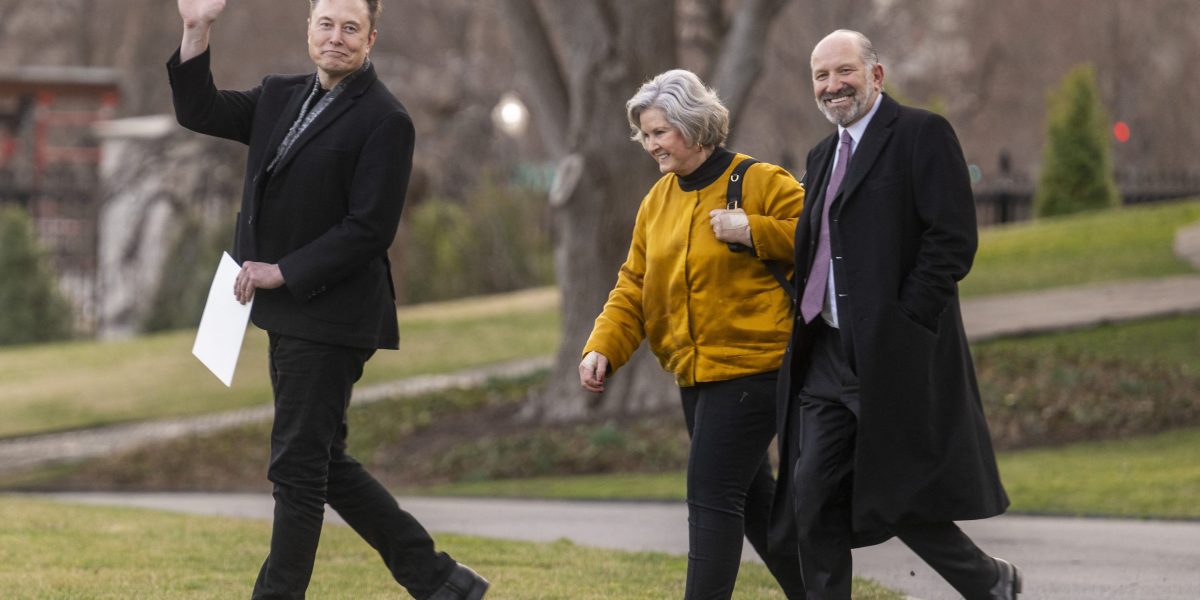
White House chief of staff Susie Wiles offered an unusually candid look inside President Donald Trump’s administration in a series of interviews published Tuesday by Vanity Fair magazine, delivering details and reservations that presidential aides usually save for memoirs.
From criticizing Attorney General Pam Bondi as having “whiffed” on the Jeffrey Epstein case to saying that no rational person could believe Elon Musk did a good job dismantling the United States Agency for International Development, Wiles revealed her own thoughts about her boss and the work of his aggressive administration. The assessments are even more notable because Wiles, before now, has maintained a low profile.
Wiles dismissed Vanity Fair’s work as a “hit piece,” and a number of Cabinet officials and other aides rushed to her defense. But Wiles notably has not denied any details or quotes.
Here are some takeaways from Wiles’ interview:
Wiles defends Trump while comparing him to an alcoholic
Wiles described Trump as an intense figure who thinks in broad strokes yet is often unconcerned about process and policy details.
She assessed Trump as having “an alcoholic’s personality,” even though the president does not drink. But the personality trait is something she recognizes from her father, the famous sports broadcaster Pat Summerall.
“High-functioning alcoholics or alcoholics in general, their personalities are exaggerated when they drink. And so I’m a little bit of an expert in big personalities,” she said.
Said Wiles: “I’m not an enabler. … I try to be thoughtful about what I even engage in. I guess time will tell whether I’ve been effective.”
Trump’s revenge crusade has gone longer than Wiles initially wanted
Wiles affirmed Trump’s ruthlessness and determination to achieve retribution against those he considers his political enemies, especially those who prosecuted him.
“We have a loose agreement that the score settling will end before the first 90 days are over,” Wiles said early in Trump’s second administration, telling Vanity Fair she did try to tamp down Trump’s penchant for retribution.
But in August 2025, she shifted. “I don’t think he’s on a retribution tour,” she said, arguing Trump has a different principle: “‘I don’t want what happened to me to happen to somebody else.’”
Still, she said, “there may be an element of that from time to time” and Trump “will go for it … when there’s an opportunity.”
“Who would blame him?” she asked rhetorically. “Not me.”
On Epstein, Pam Bondi gets scorched and Trump was ‘wrong’ about Bill Clinton
In some of her most eye-popping commentary, Wiles said Attorney General Pam Bondi “whiffed” on handling the Jeffrey Epstein sex trafficking case, particularly trying to manage public expectations by suggesting the Justice Department had a client list waiting to be disclosed only for the administration to later say it doesn’t exist.
Wiles also said Trump pushed false narratives that former President Bill Clinton frequented Epstein’s infamous island. “There is no evidence” those visits happened, according to Wiles, and there are no damning findings concerning Clinton at all.
“The president was wrong about that,” Wiles said.
Wiles pays attention to Trump’s inner circle — and has thoughts
Wiles often sits to the side in the Oval Office, out of camera view. But she’s paying attention.
Vice President JD Vance has been “a conspiracy theorist for a decade,” she said, and his MAGA conversion — he once compared Trump to Adolf Hitler — was “sort of political.”
Elon Musk overstepped on his Department of Government Efficiency efforts, she said. She called him “a complete solo actor … an odd, odd duck” and an “avowed ketamine user.” (Musk has acknowledged using the dissociative anesthetic.) She recalled having to explain to him that “you can’t just lock people out of their offices” and said his gutting of USAID left her “initially aghast.“
“Because I think anybody that pays attention to government and has ever paid attention to USAID believed, as I did, that they do very good work,” she said, adding that “no rational person could think the USAID process was a good one. Nobody.”
She calls Health Secretary Robert F. Kennedy Jr. “quirky Bobby” and White House budget chief Russell Vought “a right-wing absolute zealot.”
But in praising Kennedy, Wiles explained her embrace of the administration’s hard-liners: “He pushes the envelope — some would say too far. But I say in order to get back to the middle, you have to push it too far.”
Wiles sees Trump’s tariffs as ‘more painful’ than expected
Few events undermined Trump’s standing quite like his April 2 announcement of “Liberation Day” tariffs, in which he announced import taxes ranging from 10% to 99% on most of the world. Trump’s move sparked recession fears and a delay in imposing his wider tariff strategy, leading to a rollercoaster of negotiations and new tariff threats.
Wiles called the April rollout “so much thinking out loud” and said there were internal disputes about it among Trump’s aides. She said she told aides to “work into what he’s already thinking” and asked Vance to tell Trump to “not talk about tariffs today” until his team was “in complete unity.”
Trump proceeded on his own.
Wiles said she believed a middle ground on tariffs would be successful. But, she concluded, “It’s been more painful than I expected.”
Wiles concedes mistakes on immigration
When a federal judge chided the administration for deporting Maryland resident Kilmar Abrego Garcia, Trump publicly defended the approach despite the administration telling the court it was a mistake. Wiles did not mince words, telling Vanity Fair at the time, “We’ve got to look harder at our process for deportation.”
When the administration deported two mothers and their U.S. citizen children, including one who was a cancer patient, Wiles was even more plainspoken: “It could be an overzealous Border Patrol agent, I don’t know. I can’t understand how you make that mistake, but somebody did.”
Trump is more skeptical of Putin’s intentions than reflected in public
After nearly four years of fighting, Trump has made the case that Russian President Vladimir Putin can be persuaded to end the war in Ukraine if Kyiv agrees to cede Ukrainian land in the eastern Donbas region and if Western powers offer economic incentives that would bring Russia back into the economic world order.
“I actually think that President Putin wants to see it end,” Trump told reporters Monday.
But Wiles offered deep skepticism to Vanity Fair about Putin.
“The experts think that if he could get the rest of Donetsk, then he would be happy,” Wiles said in August, referring to the oblast that is a key part of Donbas.
“Donald Trump thinks he wants the whole country,” Wiles told her interviewer.
For Trump, boat strikes are about knocking Nicolás Maduro out of power
Wiles said in November that Trump “wants to keep on blowing boats up until Maduro cries uncle.”
Trump has repeatedly said Maduro’s “days are numbered” as the U.S. intensifies deadly attacks on vessels in the Caribbean Sea and eastern Pacific. The administration alleges the targets are drug-smuggling cartels.
Still, Trump and administration officials have stopped short of saying they want to topple the Maduro regime. They insist the strikes, which have killed at least 95 people in 25 known incidents since September, are a strategy to stem the flow of fentanyl and other illegal drugs into the U.S.
___
Associated Press reporters Aamer Madhani and Josh Boak contributed from Washington.
The financially struggling Trump Media & Technology Group’s shocking, $6 billion merger with a nuclear fusion developer represents either a bet on more taxpayer dollars being invested in the first fusion player to go public—soon owned in part by the Trump family—or a belief that an influx of capital will speed up the launch of clean, limitless electricity that eventually will transform the global grid.
Trump Media’s struggling stock had plummeted nearly 70% year-to-date prior to the announcement. But the stock value spiked over 40% on the deal news with the market cap rising back above $4 billion on Dec. 18—even though TAE Technologies doesn’t plan to bring its first power plant online until 2031 to start generating revenues.
TAE Technologies CEO Michl Binderbauer recognizes the potential negative perception, but he told Fortune he’s eager to speed up the clean energy revolution that he is confident will come with the so-called merger of equals with Trump Media, which will become a Truth Social media, cryptocurrency, and fusion power conglomerate.
“In the end, if we get more scrutiny because of the deal we did, I actually don’t mind that,” Binderbauer said. “It’s perversely sounding, but I welcome it in a way because we let the technology speak.
“It’s big, bold and fast. You make a big bet with boldness at heart, and it allows you to run really fast,” he said. “I know our technology will succeed. Let it be adjudicated on a perhaps even deeper level. We need more energy; we need clean, scalable power.”
Robert Weissman, co-president of Public Citizen government watchdog group, sees it quite differently as an obviously unethical cash grab by the president and his family.
“It’s a ridiculous merger. Why in the world would those two companies merge, and why would the markets respond positively?” Weissman said. “The markets are betting on the prospect of the Trump grift expanding and for … direct federal government payments to a company whose leading shareholder is the president of the United States.”
TAE has received federal Department of Energy grants dating back to Trump’s first term and continuing through the Biden administration. As part of a reorganization announced in November, the DOE is opening a new Office of Fusion.
The deal would value the merged company at $6 billion, including debt, and Binderbauer and Trump Media head Devin Nunes would serve as co-CEOs, they said. Shareholders of each company would own about 50% of the combined company. Donald Trump Jr. would take one of the nine board seats.
Trump Media will invest up to $200 million in TAE up front and another $100 million before the deal closes in mid-2026, they said.
TAE aims to select a site for its first power plant by the end of 2026 and generate first power by late 2031, on par with the goals of some of its top competitors.
In a statement, White House Press Secretary Karoline Leavitt said the media is irresponsibly trying to fabricate conflicts of interest.
“Neither the president nor his family have ever engaged, or will ever engage, in conflicts of interest,” Leavitt said.
The DOE, Trump Org, and Trump Media did not respond to interview or comment requests.
In a media call during which no questions were allowed, Nunes said fusion power will lower energy prices, bolster national defense, and support “America’s dominance” of AI.
“Why is fusion power revolutionary? It’s because fusion power plants are now feasible at commercial scale, and they will produce reliable, cost-effective, dispatchable, and carbon-free electricity, and industrial heat with no nuclear meltdown risk or radioactive waste,” Nunes added.
The potential of fusion
The joke about fusion energy is it’s always 30 years away and not getting any closer.
However, the breakthrough scientific moment came at the end of 2022 when scientists at Lawrence Livermore National Laboratory successfully achieved “first ignition,” fusing atoms through extreme heat to generate more energy than the setup consumes for the first time ever.
Since then, TAE and other competitors have continued to make greater fusion progress on their various scientific approaches to fusion power generation.
Whereas traditional nuclear fission energy creates power by splitting atoms, fusion uses heat to create energy by melding them together. In the simplest form, it fuses hydrogen found in water into an extremely hot, electrically charged state known as plasma to create helium—the same process that powers the sun. When executed properly, the process triggers endless reactions to make energy for electricity. But stars rely on overwhelming gravitational pressure to force their fusion. Here on Earth, creating and containing the pressure needed to force the reaction in a consistent, controlled way remains an engineering challenge.
While TAE and others are targeting the early 2030s to bring the first commercial fusion power plants online, industry analysts agree it will take several additional years at least to start making a notable dent in the nationwide or even global energy grid. Still, the long-term potential remains huge.
“Fusion power is the answer to providing reliable, cost-effective, carbon-free electricity,” Binderbauer said.
TAE was founded 27 years ago—originally as Tri Alpha Energy—but stayed in stealth mode until 2015. Actor turned entrepreneur and angel investor Harry Hamlin was even a cofounder back in 1998. An Austrian-American physicist, Binderbauer served as the founding chief technology officer, eventually rising to CEO in 2018.
“Do you raise $1 billion in scaled capital over multiple years? Or do you have it come at high velocity?” Binderbauer asked. “The high velocity is critical if you want to build something quickly and efficiently.
“The concerns are very secondary.”
That’s what makes the Trump Media deal so critical, he said.
When it comes to a potential future conflict, especially with China, the U.S. may be on its back foot, claim experts at the intersection of AI and defense.
Speaking at the Fortune Brainstorm AI conference in San Francisco last week, Tara Murphy Dougherty, the CEO of defense software company Govini, said that in a conflict with China the U.S. could run out of some munitions in seven days, while China could potentially hold out longer.
“They are planning for a very protracted conflict, and would be happy to draw that fight out to bleed American stockpiles dry, because they aren’t missing the economic piece of this puzzle,” Dougherty said.
This possibility should be troubling to the U.S., and yet there is no easy fix, explained Dougherty. The U.S. stockpile of munitions and other war time resources are held up by various obstacles established over years, she said.
“Unfortunately, those stockpiles are low enough, and the United States has outsourced so much manufacturing capacity at this point, that the amount of time it will take to build the munitions and weapons systems that the United States needs is just much, much too long,” she said.
The U.S. could indeed run out some munitions especially in a conflict with China over the Taiwan strait, according to a study by the Center for Strategic and International Studies. Still, the study only singled out certain types of munitions such as long range and precision-guided munitions in under a week.
At the same time, the U.S. has the second most number of nuclear warheads, just behind Russia, and significantly more than China’s 600, according to the International Campaign to Abolish Nuclear Weapon (ICAN).
The war in Ukraine, which has escalated since Russia’s invasion in 2022, has shown the need for countries to be nimble when it comes to the resources required for war. Yet, in a war time situation it’s unclear how quickly the U.S. would be able to mobilize, Dougherty added.
“Our weapon systems and military platforms have historically low operational availability, which basically means, if we need to go to war, half the fleet is sitting in depot or at dock,” she said.
The Trump administration and Department of War secretary Pete Hegseth have tried to spur a change in the status quo. Earlier this year, Hegseth sent a memo to senior Pentagon leadership asking for the Army to restructure its acquisition systems and close redundant and inefficient programs.
Using AI, though, may be another way to help America’s war readiness, added Gary Steele, the CEO of AI-powered autonomous systems company Shield AI. Steele said AI will completely transform the aerospace and defense industry so much so that in 20 years it will look radically different.
“You’re gonna have lower cost systems, AI-led, software-led, not these super expensive, incredibly elaborate systems that just get shut down,” said Steele. “I think there’s a revolution happening, and we’re at the very beginning of that journey.”
Swedish AI coding startup Lovable has just raised $330 million in Series B funding round at a $6.6 billion valuation, more than tripling its worth from just five months ago. CEO Anton Osika told Fortune the funding would further the company’s mission to become “the last piece of software” needed by companies and developers.
The round was led by CapitalG and Menlo Ventures’ Anthology fund, with participation from NVIDIA’s venture arm NVentures, Salesforce Ventures, Databricks Ventures, and strategic investors including Atlassian Ventures and HubSpot Ventures. It comes just one month after Lovable announced it had hit $200 million in annual recurring revenue.
The company has grand aims to make software engineering accessible to anyone by promoting “vibe-coding,” a process in which a user describes in plain language the product they want to build or the function of a piece of software they want to create, and AI writes the code to produce that result.
“Our mission is to let anyone be a builder,” Osika said.
He predicted a world where every company can build its own bespoke software, rather than depending on expensive, and less customized products from major tech vendors. For instance, rather than purchasing different tools for customer relationship management, project tracking, or inventory management, Osika envisions companies using Lovable to simply build whatever they need on demand.
Companies are already seeing results from some of Lovable’s products. At Zendesk, teams using Lovable have been able to move from idea to working prototype in three hours instead of six weeks, according to Jorge Luthe, the company’s Senior Director of Product. While at management consulting firm McKinsey, Osika said engineers used his company’s product to build in a few hours what they had been waiting four to six months for their internal development team to deliver.
“Anyone being able to go with an arbitrary software problem and just explain it to Lovable and solve it, is becoming a universal reality,” he said.
Skeptics say that vibe coding doesn’t always result in the best quality software. The code vibe coding tools produce can be inefficient or contain security flaws that could present a serious risk to the company deploying it, depending on what it is being used for. In addition, just because tools like Lovable allow people without any coding experience to create software for their specific needs, it doesn’t mean that those non-developers will be able to maintain that code over time, these critics say.
Lovable says it sees three main use cases emerge among enterprise customers, Osika said. Some organizations are building core business systems entirely on Lovable; others are using it to build internal tools that previously stalled in development backlogs for months; and some product teams are using it to validate ideas with functional prototypes rather than static designs.
“Enterprises are reworking entire workflows with AI, because you can build AI applications with Lovable in just one prompt,” Osika said. “It becomes kind of the work where work gets done.”
Competition heats up in AI-powered coding
Lovable is operating in an increasingly competitive landscape and facing competition from fellow start-ups as well as bigger players that are now releasing their own coding products. While Lovable uses foundational models from OpenAI, Google, and Anthropic to power its own product, these companies are now releasing their own coding tools that could compete more directly.
“We just see them as partners,” Okisa said of the competition with major AI labs. “I think as software and AI kind of converges, there’s going to be more overlap in what companies do, but what people say and why they choose us, despite that there are other alternatives, is that Lovable just works.”
Matt Murphy, a partner at Menlo Ventures who led the investment, said that Lovable’s strategy is to build a “beloved layer” of software on top of the AI labs’ models that customers want to pay for. “The numbers speak for themselves,” Murphy said, noting that Lovable has transformed a latent market of tens of millions of people into developers.
“Lovable has done something rare: built a product that enterprises and founders both love. The demand we’re seeing from Fortune 500 companies signals a fundamental shift in how software gets built,” Laela Sturdy, Managing Partner at CapitalG added.