Connect with us

Business

Down Arrow Button Icon

Published

on


Addressing one of the most persistent critiques of the current artificial intelligence boom, CoreWeave CEO Michael Intrator pushed back against the narrative of a “circular AI economy” in an appearance at the Fortune Brainstorm AI conference in San Francisco.

While skeptics often point to the tangled web of investments between chipmakers, cloud providers, and AI startups as a financial bubble, he argued that deep industry collaboration is the only viable response to a historic supply chain crisis.

Circular is “the incorrect way of looking at it,” Intrator told Fortune Editorial Director Andrew Nusca, reframing the dynamic not as financial engineering, but as logistical necessity. “It’s a lot of companies working to address an imbalance that is distorting the globe.”

The concept of the “circular economy” in AI suggests that revenue is merely being recycled between a handful of tech giants—such as Nvidia investing in CoreWeave, which in turn uses that capital to buy Nvidia chips. However, Intrator described the market conditions as a “violent change in supply demand,” adding that the only way to navigate such volatility is “by working together.”

The ‘physical bottleneck

According to Intrator, the primary constraint facing the AI sector is not funding or policy, but “a physical bottleneck associated with getting … the most performant compute into the hands of the most cutting-edge players.” This scarcity forces companies to cooperate in ways that may look insular to outsiders but are essential for survival, he insisted.

The CEO recounted a recent conversation with a mining company boss, whom he declined to name. Intrator said he learned just how deep the supply chain is being impacted: “two levels deeper,” down to the raw metals and copper required to build the infrastructure. Intrator noted that the executive specifically requested industry-wide cooperation to meet production needs.

The mining CEO explained that to get out of this jam, “we need to work together as a group.” If he said the same thing about the AI space, Intrator reasoned, “I get accused of being in a circular economy … So that’s all I’ll say on the circular economy is, like, you do that by working together.”

Critics warn that if a firm like CoreWeave cannot roll its debt or loses a key client, lenders could dump large volumes of used GPU chips into secondary markets, hitting hardware prices and rippling through the AI supply chain. But Intrator described a rapid, even violent escalation of demand.

Managing ‘relentless’ demand

CoreWeave, which specializes in parallelized computing solutions essential for AI, sits at the center of this storm.

“The demand from the most knowledgeable, most sophisticated, largest tech companies in the world is relentless,” Intrator said. “That’s what the trend that matters to me.”

This rapid expansion has come with volatility. Since its IPO, CoreWeave’s stock has seen significant fluctuation, a phenomenon that Intrator attributed to the market adjusting to a disruptive business model challenging the traditional cloud dominance of major tech players. Despite the “seesawing” stock price, Intrator noted that the company has been successful, with the stock trading around $90, compared to an IPO price of $40.

He also addressed concerns regarding customer concentration. While he acknowledged that CoreWeave was previously reliant on Microsoft for 85% of its revenue, he said aggressive diversification efforts mean that no single customer now represents more than 30% of the company’s backlog.

The super-cycle view

Intrator urged investors to look past short-term execution hiccups, such as a data center opening delayed by a week, which he said caused “bedlam” among myopic observers. Instead, he views the current landscape as a “macro super-cycle,” where the fundamental shift from sequential to parallelized computing is opening up computational power at an order of magnitude previously unimagined.

Ultimately, the collaboration that critics decry is the mechanic that is moving the industry forward, Intrator maintained. “The reasons that you have challenges in delivering that compute is because of policy… because of physical infrastructure … because of energy,” he said. “You do that by working together.”


Source link

Continue Reading

Business

Seniors relive their days of wanderlust and thrill-seeking with virtual reality

Published

on


Like many retirement communities, The Terraces serves as a tranquil refuge for a nucleus of older people who no longer can travel to faraway places or engage in bold adventures.

But they can still be thrust back to their days of wanderlust and thrill-seeking whenever caretakers at the community in Los Gatos, California, schedule a date for residents — many of whom are in their 80s and 90s — to take turns donning virtual reality headsets.

Within a matter of minutes, the headsets can transport them to Europe, immerse them in the ocean depths or send them soaring on breathtaking hang-gliding expeditions while they sit by each other. The selection of VR programming was curated by Rendever, a company that has turned a sometimes isolating form of technology into a catalyst for better cognition and social connections in 800 retirement communities in the United States and Canada.

A group of The Terraces residents who participated in a VR session earlier this year found themselves paddling their arms alongside their chairs as they swam with a pod of dolphins while watching one of Rendever’s 3D programs. “We got to go underwater and didn’t even have to hold our breath!” exclaimed 81-year-old Ginny Baird following the virtual submersion.

During a session featuring a virtual ride in a hot-air balloon, one resident gasped, “Oh my God!” Another shuddered, “It’s hard to watch!”

The Rendever technology can also be used to virtually take older adults back to the places where they grew up as children. For some, it will be the first time they’ve seen their hometowns in decades.

A virtual trip to her childhood neighborhood in New York City’s Queens borough helped sell Sue Livingstone, 84, on the merits of the VR technology even though she still is able to get out more often than many residents of The Terraces, which is located in Silicon Valley about 55 miles south of San Francisco.

“It isn’t just about being able to see it again, it’s about all the memories that it brings back,” Livingstone said. “There are a few people living here who never really leave their comfort zones. But if you could entice them to come down to try out a headset, they might find that they really enjoy it.”

Adrian Marshall, The Terraces’ community life director, said that once word about a VR experience spreads from one resident to another, more of the uninitiated typically become curious enough to try it out — even if it means missing out on playing Mexican Train, a dominoes-like board game that’s popular in the community.

“It turns into a conversation starter for them. It really does connect people,” Marshall said of Rendever’s VR programming. “It helps create a human bridge that makes them realize they share certain similarities and interests. It turns the artificial world into reality.”

Rendever, a privately owned company based in Somerville, Massachusetts, hopes to build upon its senior living platform with a recent grant from the National Institutes of Health that will provide nearly $4.5 million to study ways to reduce social isolation among seniors living at home and their caregivers.

Some studies have found VR programming presented in a limited viewing format can help older people maintain and improve cognitive functions, burnish memories and foster social connections with their families and fellow residents of care facilities. Experts say the technology may be useful as an addition to and not a replacement for other activities.

“There is always a risk of too much screen time,” Katherine “Kate” Dupuis, a neuropsychologist and professor who studies aging issues at Sheridan College in Canada, said. “But if you use it cautiously, with meaning and purpose, it can be very helpful. It can be an opportunity for the elderly to engage with someone and share a sense of wonder.”

VR headsets may be an easier way for older people to interact with technology instead of fumbling around with a smartphone or another device that requires navigating buttons or other mechanisms, said Pallabi Bhowmick, a researcher at the University of Illinois Urbana-Champaign who is examining the use of VR with older adults.

“The stereotypes that older adults aren’t willing to try new technology needs to change because they are willing and want to adapt to technologies that are meaningful to them,” Bhowmick said. “Besides helping them to relieve stress, be entertained and connect with other people, there is an intergenerational aspect that might help them build their relationships with younger people who find out they use VR and say, ‘Grandpa is cool!’”

Rendever CEO Kyle Rand’s interest in helping his own grandmother deal with the emotional and mental challenges of aging pushed him down a path that led him to cofound the company in 2016 after studying neuroengineering at Duke University.

“What really fascinates me about humans is just how much our brain depends on social connection and how much we learn from others,” Rand said. “A group of elderly residents who don’t really know each other that well can come together, spend 30 minutes in a VR experience together and then find themselves sitting down to have lunch together while continuing a conversation about the experience.”

It’s a large enough market that another VR specialist, Dallas-based Mynd Immersive, competes against Rendever with services tailored for senior living communities.

Besides helping create social connections, the VR programming from both Rendever and Mynd has been employed as a possible tool for potentially slowing down the deleterious effects of dementia. That’s how another Silicon Valley retirement village, the Forum, sometimes uses the technology.

Bob Rogallo, a Forum resident with dementia that has rendered him speechless, seemed to be enjoying taking a virtual hike through Glacier National Park in Montana as he nodded and smiled while celebrating his 83rd birthday with his wife of 61 years.

Sallie Rogallo, who doesn’t have dementia, said the experience brought back fond memories of the couple’s visits to the same park during the more than 30 years they spent cruising around the U.S. in their recreational vehicle.

“It made me wish I was 30 years younger so I could do it again,” she said of the virtual visit to Glacier. “This lets you get out of the same environment and either go to a new place or visit places where you have been.”

In another session at the Forum, 93-year-old Almut Schultz laughed with delight while viewing a virtual classical music performance at the Red Rocks Amphitheatre in Colorado and later seemed to want to play with a puppy frolicking around in her VR headset.

“That was quite a session we had there,” Schultz said with a big grin after she took off her headset and returned to reality.




Source link

Continue Reading

Business

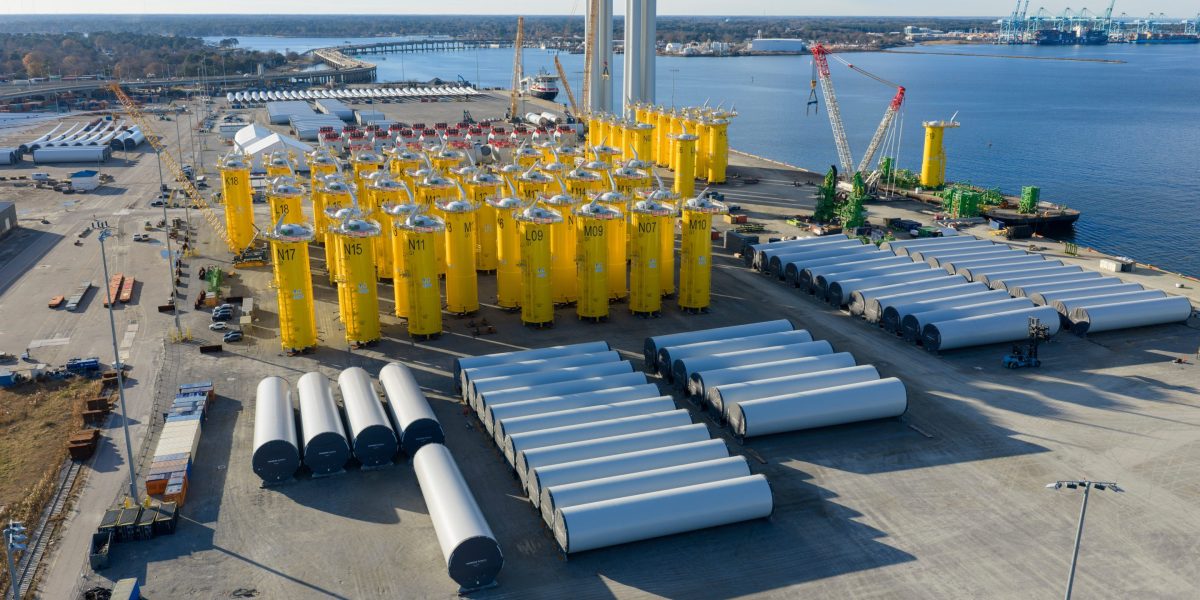
Dominion Energy Virginia sues over Trump order to halt offshore wind project, calling it ‘arbitrary and capricious’

Published

on


The developers of a Virginia offshore wind project are asking a federal judge to block a Trump administration order that halted construction of their project, along with four others, over national security concerns.

Dominion Energy Virginia said in its lawsuit filed late Tuesday that the government’s order is “arbitrary and capricious” and unconstitutional. The Richmond-based company is developing Coastal Virginia Offshore Wind, a project it says is essential to meet dramatically growing energy needs driven by dozens of new data centers.

The Interior Department did not detail the security concerns in blocking the five projects on Monday. In a letter to project developers, Interior’s Bureau of Ocean Energy Management set a 90-day period — and possibly longer — “to determine whether the national security threats posed by this project can be adequately mitigated.”

The other projects are the Vineyard Wind project under construction in Massachusetts, Revolution Wind in Rhode Island and Connecticut and two projects in New York: Sunrise Wind and Empire Wind. Democratic governors in those states have vowed to fight the order, the latest action by the Trump administration to hobble offshore wind in its push against renewable energy sources.

Dominion’s project has been under construction since early 2024 and was scheduled to come online early next year, providing enough energy to power about 660,000 homes. The company said the delay was costing it more than $5 million a day in losses solely for the ships used in round-the-clock construction, and that customers or the company would eventually bear the cost.

Dominion called this week’s order “the latest in a series of irrational agency actions attacking offshore wind and then doubling down when those actions are found unlawful.”

The Bureau of Ocean Energy Management didn’t immediately respond to an email seeking comment.

U.S. District Judge Jamar Walker set a hearing for 2 p.m. Monday on Dominion’s request for a temporary restraining order.

This story was originally featured on Fortune.com


Source link

Continue Reading

Business

Trump’s tariffs actually slashed the deficit from a record $136.4 billion to less than half that. Here’s what else they did

Published

on


Since returning to the White House in January, President Donald Trump has overturned decades of U.S. trade policy — building a wall of tariffs around what used to be a wide open economy.

His double-digit taxes on imports from almost every country have disrupted global commerce and strained the budgets of consumers and businesses worldwide. They have also raised tens of billions of dollars for the U.S. Treasury.

Trump has argued that his steep new import taxes are necessary to bring back wealth that was “stolen” from the U.S. He says they will narrow America’s decades-old trade deficit and bring manufacturing back to the country. But upending the global supply chain has proven costly for households facing rising prices. And the erratic way the president rolled out his tariffs — announcing them, then suspending or altering them before conjuring up new ones — made 2025 one of the most turbulent economic years in recent memory.

Here’s a look at the impact of Trump’s tariffs over the last year, in four charts.

Effective US tariff rate

A key number for the overall impact of tariffs on U.S. consumers and businesses is the “effective” tariff rate — which, unlike headline figures imposed by Trump for specific trade actions, provides an average based on the actual imports coming into the country.

In 2025, per data from the Yale Budget Lab, the effective U.S. tariff rate peaked in April. But it’s still far higher than the average seen at the start of the year. Before finalizing shifts in consumption, November’s effective tariff rate was nearly 17% — seven times greater than January’s average and the highest seen since 1935.

Tariff revenue vs America’s trade deficit

Among selling points to justify his tariffs, Trump has repeatedly said they would reduce America’s longstanding trade deficit and bring revenue into the Treasury.

Trump’s higher tariffs are certainly raising money. They’ve raked in more than $236 billion this year through November — much more than in years past. But they still account for just a fraction of the federal government’s total revenue. And they haven’t raised nearly enough to justify the president’s claim that tariff revenue could replace federal income taxes — or allow for windfall dividend checks for Americans.

The U.S. trade deficit, meanwhile, has fallen significantly since the start of the year. The trade gap peaked to a monthly record of $136.4 billion in March, as consumers and businesses hurried to import foreign products before Trump could impose his tariffs on them. The trade gap narrowed to $52.8 billion in September, the latest month for which data is available. But the year-to-date deficit was still running 17% ahead of January-September 2024.

Import shifts with America’s biggest trading partners

Trump’s 2025 tariffs hit nearly every country in the world — including America’s biggest trading partners. But his policies have had the biggest impact on U.S. trade with China, once the biggest source of American imports and now No. 3 behind Canada and Mexico. U.S. tariffs on Chinese imports now come to 47.5%, according to calculations by Chad Bown of the Peterson Institute for International Economics.

The value of goods coming into the U.S. from China fell nearly 25% during the first three-quarters of the year. Imports from Canada also dropped. But the value of products from Mexico, Vietnam and Taiwan grew year-to-date.

Market swings

For investors, the most volatile moments on the stock market this year arrived amid some of the most volatile moments for Trump’s tariffs.

The S&P 500, an index for the biggest public companies in the U.S., saw its biggest daily and weekly swings in April — and largest monthly losses and gains in March and June, respectively.

Need a recap of how Trump’s trade actions unfolded in 2025? See a timeline here.


Source link

Continue Reading

Trending

Copyright © Miami Select.