Connect with us

Business

Down Arrow Button Icon

Published

on


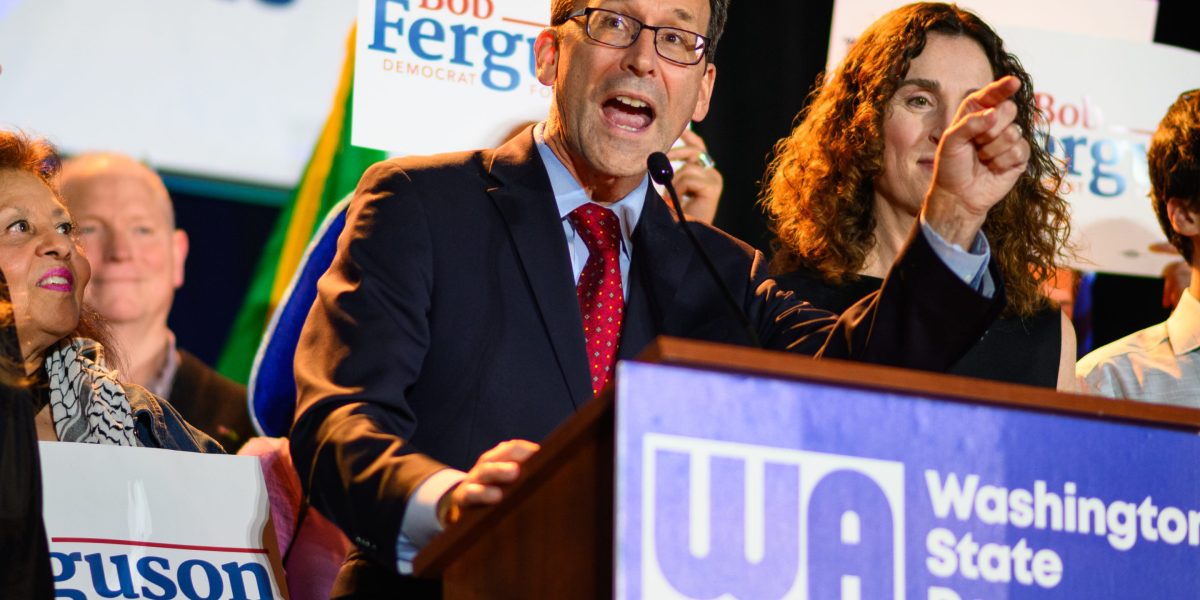
When Washington Governor Bob Ferguson proposed the state’s first income tax in modern history, he said the word “affordability” five times. 

Ferguson on Tuesday asked the legislature to craft a 9.9% tax on personal income over $1 million, which would revolutionize a state revenue system heavily reliant on sales and property tax. Although his fellow Democrats have for decades failed to push through an income tax, Ferguson said it’s “a different time right now.”

“We are facing an affordability crisis,” Ferguson said. “It is time to change our state’s outdated, upside-down tax system. To serve the needs of Washingtonians today, to make our taxes the more fair, millionaires should contribute toward our shared prosperity.”

Democrats across the US are increasingly exploring taxes as a way to capture the populist moment and address the country’s widening wealth gap. If “affordability” was the issue highlighted by Democrats who outperformed expectations in the off-year elections of 2025, the slogan next year could very well be “tax the rich.”

It’s an opening Democrats see as the Trump administration this year paired tax cuts for high earners with reductions in Medicaid and supplemental food assistance. Raising taxes on the wealthy could also help solve a fiscal problem for states dedicating more resources to plug the holes from federal cuts.

“We have a federal government that has gone into super-villain mode, seeming to deliberately take from the poor and middle class to give to the rich,” said Darien Shanske, a tax professor at UC Davis School of Law. “This unnecessary emergency is laying down a gauntlet for states: Will they let this suffering come to pass and, if not, how will they pay for the triage? Taxes on the best-off are not just fair but also efficient.”

Read more: Millionaire Tax That Mamdani Loves Fuels a $5.7 Billion Haul

Progressive tax advocates often point to Massachusetts’ 4% surtax on incomes over $1 million, which brought in roughly $5.7 billion in fiscal 2025, far exceeding revenue projections in its third year of collection. 

New York Mayor-elect Zohran Mamdani campaigned on raising the city’s income tax on millionaires by 2 percentage points to 5.9%, which critics said would lead to an exodus of wealthy people.

Colorado voters this year approved a measure to limit deductions for taxpayers earning at least $300,000. The revenue will fund a program providing free meals for all public school students. Colorado officials also advanced a ballot measure to change the state’s 4.41% flat rate to a graduated income tax, potentially raising more than $4 billion. That will likely go before voters in 2026. 

Michigan residents could also face a ballot initiative next year to change the state’s flat 4.25% tax rate to add a 5% surcharge on individuals earning more than $500,000 and couples making more than $1 million.

Romney’s Call

Even 2012 Republican Presidential candidate Mitt Romney has joined the call. Last week, the former US senator from Utah penned an essay in the New York Times calling for rich people to pay more, mostly in the form of closing loopholes the wealthy use to minimize tax obligations.

“It would help us avoid the cliff ahead,” Romney said, pointing to government funding shortfalls, “and might tend to quiet some of the anger that will surely grow as unemployed college graduates see tax-advantaged multibillionaires sailing 300-foot yachts.”

Most of the populist proposals coming from the states would raise taxes on income. But the tricky thing about some wealth is that it doesn’t come from a paycheck and thus is harder to tax. Even a levy on capital gains depends on a taxpayer selling assets to realize that increased value. 

For example, former Microsoft Chief Executive Officer Steve Ballmer’s net worth increased by $706.5 billion on Monday, according to the Bloomberg Billionaires Index. Even though his mansion sits across the lake from downtown Seattle, those gains wouldn’t be subject to an income tax. 

That’s why some Washington state Democrats are still pushing for the US’s first wealth tax on unrealized gains. Under a proposal passed by the state Senate last year, portfolios of some publicly traded asset classes worth at least $50 million would be taxed at 0.5%. 

Ferguson panned the wealth tax proposal last year, saying it would be irresponsible to balance the budget on a measure that would certainly face legal challenges. 

One of the most common warnings from tax opponents is that once legislators have a new tax mechanism, they’ll either increase the rate or lower the threshold at which it would apply. Ferguson in his income-tax proposal nodded to that concern, saying the $1 million level should increase with inflation and be included in the statute or perhaps even a constitutional amendment.

Read More: Vegas Lures Millionaires Fleeing Wealth Tax in Washington State

State taxes are also easier to avoid than federal taxes, because it’s relatively easy to move a primary residency. Washington used to attract taxpayers fed up with California’s high rates, but that has changed since the Evergreen State started taxing capital gains. Next year could be the year of the millionaire’s tax — in Washington state and across the US. 


Source link

Continue Reading

Business

When SNAP payments stopped, a fast-moving $50 cash program rushed in—and kept families fed

Published

on


Finances already looked tight for Jade Grant and her three children as she entered the year’s final months.

“Everyone’s birthday is back-to-back,” the 32-year-old certified nursing assistant said. “You have holidays coming up. You have Thanksgiving. Everything is right there. And then, boom. No (food) stamps.”

Grant is among the nearly 42 million lower-income Americans who get help buying groceries from the Supplemental Nutrition Assistance Program, or SNAP. When the federal shutdown began in October, she wasn’t worried about losing her benefits — she said she is used to government “foolishness.”

But circumstances got dicey when the budget impasse entered its second month and President Donald Trump took the unprecedented step of freezing November SNAP payments. With one child who eats gluten free and another with many allergies, specialty items already drove up her grocery bill. Now Grant wondered how she’d put food on the table — especially with her youngest’s 6th birthday approaching.

Then Grant logged into Propel, an app used by 5 million people to manage their electronic benefits transfers, where she saw a pop-up banner inviting her to apply for a relief program. Within a minute she’d completed a survey and about two days later she got a virtual $50 gift card.

The total didn’t come close to her monthly SNAP allotment. But the Palm Bay, Florida, resident said it was enough to buy a customized “ Bluey ” birthday cake for her son.

Nearly a quarter of a million families got that same cash injection from the nonprofit GiveDirectly as they missed SNAP deposits many need to feed their households. The collaboration with Propel proved to be the largest disaster response in the international cash assistance group’s history outside of COVID-19; non-pandemic records were set with the $12 million raised, more than 246,000 beneficiaries enrolled and 5,000 individual donors reached.

Recipients are still recovering from the uncertainty of last month’s SNAP delays. Company surveys suggest many are dealing with the long-term consequences of borrowing money in early November when their benefits didn’t arrive on time, according to Propel CEO Jimmy Chen. At a time when users felt the existing safety net had fallen through, they credit the rapid payments for buoying them — both financially and emotionally.

“It’s not a lot. But at the same time, it is a lot,” Grant said. “Because $50 can do a lot when you don’t have anything.”

A ‘man-made disaster’ forces partners to try something new

It’s not the first partnership for the antipoverty nonprofit and for-profit software company. They have previously combined GiveDirectly’s fast cash model with Propel’s verified user base to get money out to natural disaster survivors — including $1,000 last year to some households impacted by Hurricanes Milton and Helene.

“This particular incident with the shutdown we saw as akin to a natural disaster,” Chen said, “in the sense that it created a really sudden and really acute form of hardship for many Americans across the country.”

The scope differed this time. The “man-made disaster,” as GiveDirectly U.S. Country Director Dustin Palmer put it, was not geographically isolated. The benefits freeze impacted more people than they usually serve. SNAP costs almost $10 billion a month, Palmer said, so they never expected to raise enough money to replace the delayed benefits altogether.

But 5,000 individual donors — plus $1 million gifts from Propel and New York nonprofit Robin Hood, as well as other major foundations’ support — provided a sizable pot. Palmer found that the issue resonated more than he expected.

GiveDirectly reports that the median donation was $100. Palmer took that response as a sign the issue hit close for many Americans.

“You and I know SNAP recipients. Maybe we’ve been SNAP recipients,” Palmer said. “So that was not a disaster in Central Texas where I’ve never been, but something in our communities.”

The greatest question revolved around the total sum of each cash transfer. Should they reach more people with fewer dollars or vice versa? Los Angeles wildfire survivors, for example, got $3,500 each from a similar GiveDirectly campaign. But that’s because they wanted to provide enough to cover a month’s worth of lodging and transit to those who lost their houses.

They settled on $50 because Palmer said they wanted a “stopgap” that represented “a meaningful trip to the grocery store.” To equitably focus their limited resources on the that would be missing the most support, Palmer said they targeted families with children that receive the maximum SNAP allotment. Propel’s software allowed them to send money as soon as the app detected that a family’s benefits hadn’t arrived at the usual time of the month.

Recipients decided whether their prepaid debit cards arrived physically, which might allow them to take cash out of an ATM, or virtually, which could be used almost immediately. The split is usually pretty even, according to Palmer, but this time more than 90% of recipients went with the virtual option.

“To me, that speaks to the speed and need for people,” Palmer said. “Just saying, ‘Oh yeah, I just need food today. I don’t want to wait to get it mailed.’”

Recipients lost trust when closely watched benefits were disrupted

Dianna Tompkins relies on her SNAP balance to feed her toddler and 8-year-old child.

“I watch it like a hawk, honestly,” she said.

But she said she entered “panic mode” when she missed what is usually a $976 deposit last month. She’s a gig worker, completing DoorDash and Uber Eats orders when she finds the time.

Her pantry is always stocked with non-perishables — canned goods, pastas, sauces — in case her unreliable van stops working and she can’t get to the store. But she couldn’t risk running out as uncertainty continued over the shutdown’s length and future SNAP payments.

GiveDirectly’s $50 bought her milk and bread — not much but a “big help,” she said. Her local food pantries in Demotte, Indiana, had proven inconsistent. One week they gave far more than expected, she said, but the following week they were “so overwhelmed” that it almost wasn’t worth visiting.

She said it’s “scary” the government “can just decide to not feed so many people.”

“At least I have my safety net but not everybody’s lucky,” she said. “I’ve never trusted the government and that’s just a new solid reason why I don’t trust them.”

Chen, the Propel CEO, said his company’s research suggests that November’s freeze damaged many recipients’ confidence in the government. Even with SNAP funded through the next fiscal year, Chen said, many respondents are concerned about another shutdown.

“Now it’s introduced this seed of doubt for people that this really fundamental thing that they use to pay for food may not be there when they need it,” Chen said.

The gap persists for many. Propel estimates that just over half of SNAP recipients got their benefits late last month. GiveDirectly launched an additional “mop-up” campaign to distribute cash retroactively for more than 8,000 people still reeling.

The delay disrupted the financial balancing act that Grant had going. She put off payments for her electricity bill and car insurance.

“Government shuts down and that just throws everything completely off,” she said.

___

Associated Press coverage of philanthropy and nonprofits receives support through the AP’s collaboration with The Conversation US, with funding from Lilly Endowment Inc. The AP is solely responsible for this content. For all of AP’s philanthropy coverage, visit https://apnews.com/hub/philanthropy.


Source link

Continue Reading

Business

Former Obama economic advisor feels ‘a tiny bit bad’ for Trump on affordability crisis

Published

on


As President Donald Trump struggles to address Americans’ growing affordability concerns, he has gotten some sympathy from one of former President Barack Obama’s former top economists.

Jason Furman, Harvard Kennedy School of Government professor and former chair of the Council of Economic Advisers under Obama, told CNBC’s “Squawk Box” on Wednesday pessimistic consumers have overlooked gas prices that have remained affordable, making Trump’s job of addressing the affordability crisis more challenging.

Gas prices in December marked the lowest they’ve been all year, according to data from motor club AAA, with unleaded gasoline $0.18 cheaper nationally this year compared to last. National average prices reached their cheapest on Monday, hitting $2.85 a gallon. That hasn’t stopped consumer confidence falling to its lowest level since April, and approval ratings indicating more Americans disagree with how Trump is handling the economy.

“I’ve been puzzled,” Furman said. “When you’re in government, you’re told, politically, the one price that matters is the price of gasoline. That’s the one price that’s been great this year. And I sort of feel a tiny bit bad for President Trump that he doesn’t get any credit for that.”

Trump has continued to offer his own mixed signals on the affordability crisis, including saying in a primetime address last week he inherited an economic “mess” from the Biden administration, offering to cut checks for millions of military personnel for housing supplements, while simultaneously calling the economy the strongest it’s been. 

According to Furman, Trump also has a bit of a tough crowd: Consumers have been concerned about inflation and the price of groceries, which have increased nearly 30% over the past five years, making it more difficult to assuage economic anxieties, even when there are other optimistic signals.

“Consumers are just in this sort of, whatever the highest price is, is the price they’re going to focus on and be upset about,” he said. “And that’s a really hard problem to solve economically or politically.”

Mixed economic signals muddy K-shaped economy

Conflicting economic indicators extend beyond prices, Furman said. The U.S. saw its strongest economic growth in two years last quarter with a 4.3% GDP growth, exceeding past analysts’ estimates. Meanwhile, the unemployment rate creeped up to 4.6% in November, according to the Bureau of Labor Statistics, markedly higher than last November’s 4.2% and above 4%, which is considered reasonable.

“If all you had were the jobs numbers, we’d all be doing our recession probabilities right now—Is it 30%? Is it 50%? Is it 70%?” Furman questioned. “But then we have this GDP growth number, and that just gives us our boom probability.”

Unlike many economists who see a lopsided, K-shaped economy of the rich getting richer while the poor get poorer, Furman isn’t so sure. He noted that on top of some consistently low prices, such as gas, wage growth is still strong, a metric associated with increased spending and productivity. To be sure, data from the Federal Reserve Bank of Atlanta Fed indicates wage growth for the quartile of lowest-wage Americans went from a high of 7.5% in 2022 to about 3.5% today, its lowest in 10 years.

“I’m less convinced about this K-shaped recovery than other people are,” Furman said. “Everyone wants prices to be 25% lower. Nobody wants their wages to be 25% lower.”

Other economists, such as KPMG chief economist Diane Swonk, see the connection between economic growth, rising unemployment, and the K-shaped economy. Swonk told Fortune the strong GDP growth was indeed reflective of a K-shaped economy where—in addition to resilient consumer spending and skyrocketing corporate profits—businesses have learned to grow without hiring, padding margins without expanding their team, a trend that could be exacerbated by AI displacing jobs.

“We are seeing most of the productivity gains we’re seeing right now as really just the residual of companies being hesitant to hire and doing more with less,” she said.


Source link

Continue Reading

Business

Tricolor paid CEO $30 million in year before alleged fraud

Published

on


Tricolor Holdings founder Daniel Chu collected nearly $30 million in compensation in the year leading up to the subprime auto lender’s collapse amid alleged fraud, according to a lawsuit filed by the trustee overseeing the company’s liquidation.

Chu “defrauded Tricolor by using corporate funds to pay for lavish personal expenses and by forcing the company into paying him tens of millions of dollars in bonuses (on top of his executive salary),” trustee Anne Burns said in a court filing last week. That compensation was “premised on his ability to deliver exceptional financial results — results that were the product of the fraud.”

The payments helped finance what the trustee described as an extravagant lifestyle, including luxury homes in Dallas, Beverly Hills and Miami worth about $38 million combined, as well as private-jet travel and European vacations.

“Many of the allegations that have been made against Mr. Chu in recent days are inaccurate and seriously misguided, as will be clear when the real facts come out,” Matthew Schwartz, an attorney for Chu, said in a statement. “We look forward to a full and fair hearing in the courtroom.” 

US prosecutors charged Chu and the company’s former chief operating officer last week with running Tricolor through “systemic fraud.” Two other former executives have pleaded guilty to fraud charges.

Read More: Tricolor’s Excel Guy Failed to Fix Numbers in Alleged Fraud

Chu charged millions of dollars to his business American Express card over the years, the trustee alleged, including for skin revitalization treatment, vitamin infusions and dental work. He also frequented high-end restaurants including Nobu in New York and Carbone in Dallas, according to the filing.

He continued using corporate funds to pay for personal expenses even after it was clear to him the company was in financial distress, the trustee alleged. For instance, as late as August 2025 Chu charged $18,000 to his American Express card to pay for membership to Core Club, a social club in New York, according to the suit. 

In emails attached to the suit, Chu told an auditor and board members in 2023 that he was experiencing “over the top” stress, when questions arose over his personal spending. “So with respect to expenses for my family to accompany me on travel, household expenses like a nanny, or IV treatments, this is some of my context,” Chu wrote in one email.

“I do feel like I’ve exercised good judgment on these expenses,” Chu said in another email cited in the suit.

Compensation Fight

Chu pitched the board on compensation increases for years, citing the company’s revenue and sales growth since 2018, the trustee alleged.

In 2022, a consultancy retained by Tricolor’s board found Chu’s compensation to be in line with the average for private US companies. But Chu wanted to be paid on par with the 10th percentile of public companies, even though Tricolor wasn’t one.

The board pushed back, according to emails cited in the lawsuit. Chu called the compensation committee process “grossly mismanaged” and referred to one board member as a “top imbecile” for challenging the pay package, filings show.

Chu used his role as the sole manager of Tricolor’s majority shareholder to remove three board members that opposed his compensation requests, the trustee alleged.

Days after the board approved his compensation in February, Chu agreed to buy a ski chalet in Aspen, Colorado, for $25 million, according to the lawsuit. The deal collapsed after Tricolor filed to liquidate, with Chu forfeiting a $1.75 million deposit.

(Updates with detail on Core Club in seventh paragraph.)


Source link

Continue Reading

Trending

Copyright © Miami Select.