Connect with us

Business

Down Arrow Button Icon

Published

on


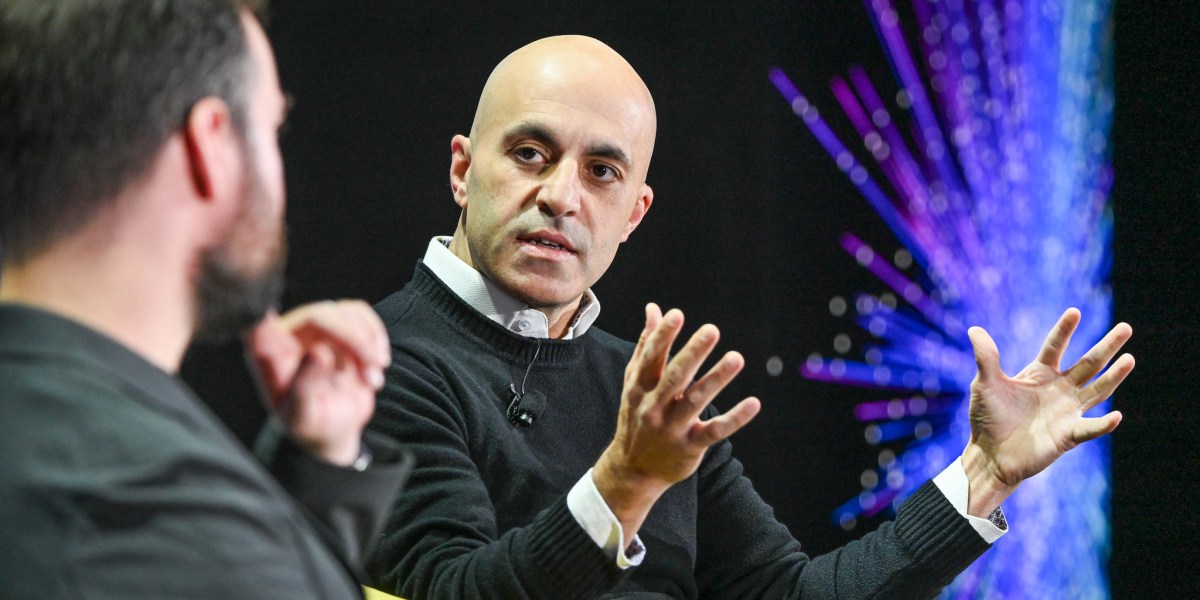
In a typically candid assessment of the current artificial intelligence landscape, the outspoken CEO of $134 billion software analytics firm Databricks, Ali Ghodsi, issued a stark warning regarding the ballooning valuations of AI startups that lack fundamental business metrics. Speaking at Fortune Brainstorm AI in San Francisco, Ghodsi blasted the trend of investors pouring capital into unproven companies, stating, “Companies that are worth, you know, billions of dollars with zero revenue, that’s clearly a bubble, right, and it’s, like, insane.” Ghodsi clarified that he sees a “huge bubble in many, many portions of the market.”

The vibes in the Valley are bad, in the opinion of Ghodsi, who holds a PhD in computer science. He said that even the investors fueling this frenzy are aware of the unsustainable nature of the market. In private conversations, he claimed, venture capitalists express exhaustion with the hype cycle, telling him, “Maybe I should just go on a break for, like, six months and come back and it’ll be, like, really financially good for me.”

Ghodsi said he agreed with the critique of circular financing among many players in the AI space, artificially inflating the market. Rather than viewing the bubble as near its popping point, Ghodsi predicts the “circular aspect” of the situation will deteriorate before it corrects. “I think like 12 months from now, it’ll be much, much, much worse.” Current market wobbles are actually a healthy signal for CEOs to “take a step back,” he added.

The IPO question and strategic patience

This skeptical view of the current market hype explains Databricks’ reluctance to rush toward an initial public offering (IPO), despite Ghodsi admitting to “flirting” with the idea. He highlighted that staying private at this point offers a strategic buffer against market volatility. He drew a sharp contrast between Databricks and competitors who rushed to go public during the 2021 boom, only to face severe corrections.

“In 2021, most of my peers, CEOs, they were like we got to IPO,” but by 2022, Ghodsi added, they were suddenly in cost-cutting mode, whereas Databricks was able to hired thousands of people. He emphasized that if a bubble does burst, remaining private would allow the company to continue investing in long-term AI utility rather than reacting to short-term stock fluctuations.

Real hurdles vs. market hype

While the venture market overheats, Ghodsi argued that the reality of enterprise AI adoption is being throttled by corporate inertia, rather than a lack of technology. He identified security concerns and data governance as the primary bottlenecks for large organizations.

Databricks, which per its name has many clients that hire it to sort through their data, has many customers 10 years old and older, and they’re all really held back on cyber concerns.

“The big thing holding you back” in that scenario, Ghodsi said, “is that you can’t actually do anything because you’re so worried about getting hacked.”

He said “AI lawyers,” or lawyers specializing in the emerging field of AI law, are now slowing down operations by scrutinizing regulations and model policies. Furthermore, he described the data architecture within most legacy organizations as “an absolute mess” resulting from 40 years of piling on software from different vendors, leaving data siloed and difficult to access—and a lot of work for Databricks to do.

Where the real value lies

Despite his warnings about the bubble, Ghodsi remained bullish on specific, high-utility AI applications, particularly “AI agents” and “vibe coding.” He revealed a surprising statistic: “For the first time we’re seeing over 80% of the databases that are being launched on Databricks are not being launched by humans but by AI agents.”

He argued that the foundation model layer—the technology provided by companies like OpenAI and Google—is becoming a commodity with low margins due to hyper-competitiveness. Instead, the real revenue potential lies in the application layer where agents perform specific work, such as drug discovery in healthcare or automated research in finance.

Ghodsi advised corporate leaders to cut through the internal politics stalling these advancements. Noting the “tussle” between executives fighting to be the “AI person,” he offered blunt advice: “Pick one person for your company” to lead the strategy, rather than creating a “three-headed monkey” of conflicting leadership.


Source link

Continue Reading

Business

The K-shaped economy is carrying a ticking time bomb into 2026

Published

on


The U.S. economy grew at a 4.3% annual rate in the third quarter, blowing past economists’ expectations and delivering the kind of headline that signals strength heading into the new year. Consumers went on an unusually strong spending tear while corporations cinched $166 billion in capital gains. President Donald Trump and his team wasted no time celebrating, taking a victory lap over those dour economists who had warned of doom and gloom, declaring the “Trump economic golden age is FULL steam ahead.”

Well, slow down, those dour economists replied. There’s something missing in this boom: the jobs. Hiring this year, at best, has stalled, and at worst has collapsed: unemployment has climbed to 4.6%, and even Fed Chair Jerome Powell has warned recent data may be overstating job gains. 

This is the puzzle economists are now trying to reconcile. In a typical recovery, strong GDP growth shows up first in hiring, then in paychecks, and finally in consumer spending. But in this quarter, it’s reversed: spending is here without jobs. So how does an economy grow at a 4.3% annual rate when households aren’t actually earning more, and in fact, still fighting sticky inflation?

“I’ve never seen anything like it,” KPMG’s chief economist Diane Swonk told Fortune. “To have this stagflation in the inflation and unemployment rate, and to not have it in growth is highly unusual, and something’s got to give.”

A tale of two economies

There are two parts of the story of how the economy arrived here. The first is that households are spending without income growth. Real disposable income was essentially flat in the third quarter—literally 0% growth. Americans did not gain purchasing power. Yet, they made up the difference through savings drawdowns, credit, or by absorbing costs they cannot avoid. The GDP report itself points to where that pressure is concentrated: mostly in services, and within services, healthcare was a leading driver.

Americans spent the most on healthcare last quarter since the Omicron wave of 2022, Swonk said. Outlays on outpatient care, hospital services, and nursing facilities rose at one of the fastest paces in years, reflecting aging demographics and higher medical prices, but also the growing use of costly GLP-1 weight-loss drugs, which continue to push up spending even after adjusting for inflation. 

This was not a classic discretionary splurge, then. It was spending families had little ability to defer. That distinction matters, because spending driven by necessity behaves very differently from spending driven by rising paychecks. When households are paying more for healthcare, insurance, child care, or elder care, they are not signaling confidence; rather, they are absorbing pressure. And with real disposable income flat, those costs are not being met by wage growth, but by thinner savings and deferred choices elsewhere, Swonk said. 

The problem, then, is when that pressure eases in early 2026 as tax refunds surge and withholding changes put more cash temporarily back into paychecks, the boost could act as a “sugar high”: a short-term lift to spending that does not fix the underlying problem of weak job creation and stagnant real income. 

“We will feel more broad-based gains as we get into 2026,” Swonk said, “but at what price?” 

The concern, she added, is that stimulus layered on top of already elevated service-sector inflation could make price pressures “stickier,” not relieve them.

The second part of the story—and the one most Fortune readers will already recognize—is that this economy is no longer moving as a single system. It is splitting into a “K-shape,” and what looks like resilience at the top increasingly masks fragility underneath.

The GDP report makes that divergence hard to miss. Alongside surging consumer spending, corporate profits from current production jumped by $166 billion in the third quarter, a dramatic acceleration from the prior period. At the same time, investment fell, led by a sharp drawdown in private inventories as businesses got rid of their pandemic-era hoarding. Businesses are not broadly expanding capacity, or hiring aggressively, or even hiring at all. They are extracting margins, managing costs, and in many cases waiting. They have learned how to grow without hiring, Swonk said.

“We are seeing most of the productivity gains we’re seeing right now as really just the residual of companies being hesitant to hire and doing more with less,” she said. “Not necessarily AI yet.” In other words, businesses are squeezing output from a fixed or shrinking workforce, not expanding payrolls to meet new demand.

The K-shaped economy, fully matured

On one side of that K are affluent households and asset holders, whose spending continues to be supported by strong equity markets in jubilation after an historic year of AI spending, elevated home values, and corporate profit growth. On the other side are workers and lower- and middle-income households, whose spending, as already mentioned, is increasingly shaped by constraint rather than confidence, accounting for the consistent “affordability crisis.” The headline GDP number combines both groups into a single figure, but the lived economy does not.

Swonk noted that recreational services—travel, leisure, premium experiences—remain a bright spot, but are overwhelmingly carried by higher-income households. Even there, the data reveals stress beneath the surface. Vacation activity in August, she said, was the second-lowest on record for that month, trailing only August 2020. Airlines and hotels are still filling premium seats, but that demand is increasingly concentrated at the top.

The danger, Swonk argued, is that these two engines behave very differently over time. Spending supported by asset appreciation can persist as long as markets cooperate. Spending driven by necessity, however, cannot. 

“When you’re carrying an economy by wealth effects and affluent households, as opposed to employment gains and generating new paychecks, you’re vulnerable if there’s any correction in equity markets,” Swonk said. She described how quickly that channel can reverse: foot traffic slows, discretionary spending pulls back, and high-end demand evaporates far faster than headline GDP data would suggest.

“When you divorce growth from employment gains, you’ve got a problem,” Swonk said. “And this is before the real effects of AI have even set in.”



Source link

Continue Reading

Business

The biggest Powerball jackpots in history—and where the winning tickets were sold

Published

on


The Powerball jackpot has grown to an estimated $1.7 billion for Wednesday night’s drawing after lottery officials said no ticket matched all six numbers drawn Monday night.

The U.S. has seen more than a dozen lottery jackpot prizes exceed $1 billion since 2016. Here is a look at the largest U.S. jackpots won and the places where the winning tickets were sold:

1. $2.04 billion, Powerball, Nov. 7, 2022. The winning ticket was sold at a Los Angeles-area gas station.

2. $1.787 billion, Powerball, Sept. 6, 2025. The winning tickets were sold in Missouri and Texas.

3. $1.765 billion, Powerball, Oct. 11, 2023. The winning ticket was sold at a liquor store in a tiny California mountain town.

4. $1.602 billion, Mega Millions, Aug. 8, 2023. The winning ticket was sold at a supermarket in Neptune Beach, Florida.

5. $1.586 billion, Powerball, Jan. 13, 2016. The winning tickets were sold at a Los Angeles-area convenience store, a Florida supermarket and a Tennessee grocery store.

6. $1.537 billion, Mega Millions, Oct. 23, 2018. The winning ticket was sold at a South Carolina convenience store.

7. $1.348 billion, Mega Millions, Jan. 13, 2023. The winning ticket was sold at a Maine gas station.

8. $1.337 billion, Mega Millions, July 29, 2022. The winning ticket was sold at a Chicago-area gas station.

9. $1.326 billion, Powerball, April 7, 2024. The winning ticket was sold at an Oregon convenience store.

10. $1.269 billion, Mega Millions, Dec. 27, 2024. The winning ticket was sold at a gas station in Northern California.


Source link

Continue Reading

Business

Utility CEO on the data center crunch: America’s ‘check engine light’ is on and ‘no one’s going to pay attention until it breaks down’

Published

on


The rapid proliferation of artificial intelligence and data centers is pushing the U.S. electrical grid into uncharted territory, prompting one of the nation’s top utility executives to issue a stark warning to regulators: The system is flashing warning signs that can no longer be ignored.

Calvin Butler, CEO of Exelon, the nation’s largest utility company by customer count, compared the current state of the U.S. energy grid to a vehicle being driven to the brink of failure, in conversation with Fortune‘s Executive Editorial Director Diane Brady at the Fortune Brainstorm AI conference in San Francisco.

“We are telling policy makers the warning lights are on,” Butler said. It’s like you’re driving your car, the check engine light is on, and you just don’t want to take it into the shop. “You’re like, I’m going to keep pushing this and no one’s going to pay attention until it breaks down,” Butler told Brady. From his perspective, he sees a malfunction as inevitable. “I’m telling you on that hottest day or that coldest day, you might have a supply crunch and people are going to suffer. I’m telling you, you have to fix it now.” 

Butler’s warning comes, of course, amidst a historic surge in electricity demand as AI usage gobbles up compute, which in turn gobbles up energy across the country. There’s a bit more to it than that, Butler said, with pressure coming from a “convergence” of factors, including the onshoring of manufacturing and the broader electrification of the economy.

“I’ve been in the utility industry for about 25 years … and probably the last four decades we have never had a moment of this amount of load growth,” Butler said.

The supply crunch

The crux of the problem, according to Butler, is a disconnect between rising demand and the incentives to build new power generation. Exelon, which spun off its generation business (Constellation Energy) three years ago, now operates as a regulated utility that delivers power but does not generate it.

Butler argued independent power producers currently lack the financial motivation to construct new power plants. “The independent power producers have no incentive to build anything new because they’re maximizing their assets,” he explained, allowing that this is a fair thing to do under current market conditions. But because producers are squeezing maximum revenue from existing infrastructure rather than expanding capacity, the risk of a shortfall is growing, on the one hand, and price hikes are also inevitable.

When asked for a prediction regarding electricity prices for the coming year, Butler offered no comforting ambiguities.

“I can tell you with certainty the prices are going to go up,” Butler said.

He pointed to market dynamics within the massive PJM Interconnection—a regional transmission organization serving 13 states and the District of Columbia—as a driver. State governors in the region previously implemented a price cap that saved customers roughly $3 billion, but as those caps face expiration or adjustment, the suppressed costs will likely resurface. (Pennsylvania Governor Josh Shapiro threatened in September that the state would go its “own way” if energy conditions don’t change.)

A conservative approach to tech

Despite the pressure to power the AI revolution, Butler emphasized that utility companies themselves should not be on the bleeding edge of technology adoption.

“You don’t want your utilities to be the leaders in technology … because when we lead and something goes wrong, bad things happen,” Butler said.

He added that Exelon prefers to be a “follower” rather than a laggard. (Butler didn’t mention the infamous name of Enron, the last major innovator in the energy space and also a famous blow-up 25 years ago.)

While Exelon uses AI for customer service and proactive grid maintenance, Butler said he remained cautious, particularly regarding cybersecurity. He highlighted the vulnerability of third-party suppliers, rating his comfort level with the supply chain’s security protocols as only a six or seven out of 10.

Building for resilience

To address the looming capacity issues, the industry plans to invest $1.1 trillion over the next five years. This includes massive infrastructure projects, such as a newly announced 765-kilovolt transmission line stretching 220 miles across Pennsylvania and West Virginia to improve reliability.

However, Butler reiterated that physical infrastructure alone won’t solve the problem if the policy framework ignores the “check engine” light. “We’re the backbone. We’re 5% of the economy, but we power the next 95%. And we have to get this right.”


Source link

Continue Reading

Trending

Copyright © Miami Select.