Connect with us

Business

Down Arrow Button Icon

Published

on


Good morning. It’s easy to assume China must have been crippled by the U.S. trade battle that reached a temporary truce when President Trump and President Xi met in October. But China’s trade surplus is at a record high of $1.08 trillion in the first 11 months of this year. Some of that is due to China doubling down on other markets: overall exports were up 6% in November over the previous year, even though exports to the U.S. were down 29%.

But part of it reflects the fact that U.S. companies didn’t go away.  I recently spoke with Stephan Tanda, CEO of AptarGroup, a $3.7 billion-a-year manufacturer of specialized packaging and delivery systems for pharma, beauty, and consumer companies, based in Crystal Lake, Illinois. He points out that China remains a key manufacturing hub with longstanding infrastructure and relationships that are central to the company’s regional supply chain. What’s more, he says the speed to market is an advantage that’s hard to replicate in their other innovation centers around the world.

“The amount of grit and sheer willpower is on a different scale,” said Tanda, noting that he now leverages Chinese talent to help his European plants develop product prototypes in six weeks vs. up to 18 months. “We need the China ecosystem to create the pilot mold. We may still want something made in France for luxury beauty products but a lot of innovation used to be China [producing] for China and now it’s China for the region, China for the world.”

Tanda does have the advantage that his products are not considered sensitive from a national defense perspective—”essential items but, yes, there’s not going to be a war waged over them”—and he echoes his U.S. peers in focusing much of his production on local needs, with more than half of his customer base for Chinese-made products coming from China. “It used to be you’d want the Western luxury brand but now you buy the Chinese brand because it’s just as good or better … It helps that we’ve been an early leader in automating our core processes and it’s much easier with AI.”

Added Tanda: “China is more capitalistic than any other country that I know in terms of real drive, hustling, making things work, iterating. For companies doing business, that’s what you compete with. And that means you become a much more competitive actor yourself to be successful in that environment. It helps us to stay sharp and get more competitive because if we can do it there, we can also learn it here.”

Contact CEO Daily via Diane Brady at diane.brady@fortune.com

Top news

Musk decision on electric doors preceded 15 deaths

Fifteen people have died in traffic accidents in which passengers or rescuers were unable to open the doors of burning Teslas because the electric door handles malfunctioned, keeping the doors closed, Bloomberg reports. The decision to make the handles all-electric was originally pushed by Elon Musk, the news service reported

White House halts all U.S. wind-power projects 

The Trump administration said it would stop leases for offshore wind projects due to “national security risks.” The Interior Department claimed wind turbines interfere with radar. “The clutter caused by offshore wind projects obscures legitimate moving targets and generates false targets in the vicinity of the wind projects,” the department said.

Larry Ellison vows $40 billion in son’s bid for Warner Bros.

Oracle cofounder Larry Ellison intervened to salvage his son David Ellison’s hostile takeover bid for Warner Bros. Discovery. David’s company, Paramount Skydance, announced the elder Ellison had provided a guarantee of $40.4 billion to finance the deal. David Ellison has proposed an all-cash offer of $108 billion. WBD’s board previously rejected that offer in favor one from Netflix for roughly $83 billion.

Trump names class of warships after himself

The U.S. Navy’s new “Trump-class” ships are part of a push to modernize the fleet. The president previously named the the F-47 stealth weapon system in a nod to himself as the 47th president. And he added his name to the Trump-Kennedy Center and the Donald J. Trump Institute of Peace.

AI spurs near-record amount of debt

U.S. companies have issued $1.7 trillion in new, investment-grade corporate debt this year, much of it to fuel funding for AI data center buildout. The record for debt issuance was set at $1.8 trillion in 2020 during the Covid pandemic, when companies borrowed heavily to tide themselves through the lockdowns. AI-related debt funding is expected to grow further in 2026, the FT reports.

iRobot cofounder points to China competition as one reason for recent bankruptcy

iRobot cofounder and former CEO Colin Angle revealed that intense competition from China was the reason the company filed for bankruptcy last week. He said that once the company’s vacuuming robot took off in the country, “China decided that this was a market of interest, and they were going to ensure that Chinese companies were advantaged to succeed there.”

Google’s “ultimate” search engine could soon arrive

It was 25 years ago that Google cofounder Larry Page predicted that “artificial intelligence would be the ultimate version of Google.” With the company’s Gemini model edging out competitors, the prediction could be close to coming true.

Gold price hits new record high

The price of gold hit $4,459.60 an ounce yesterday, setting a new record. Demand for the safe-have investment was fuelled by conflict over oil between the U.S. and Venezuela and Ukraine and Russia, the Fed’s lowering of interest rates and a collapse in the price of Bitcoin which, briefly, had appeared to be a candidate for “digital gold” status.

The markets

S&P 500 futures are up marginally this morning. The last session closed up 0.64%. STOXX Europe 600 was up 0.18% in early trading. The U.K.’s FTSE 100 was flat in early trading. Japan’s Nikkei 225 was flat. China’s CSI 300 was up 0.2%. The South Korea KOSPI was up 0.28%. India’s NIFTY 50 was flat. Bitcoin sunk to $87K.

Around the watercooler

Mitt Romney says the U.S. is on a cliff—and taxing the rich is now necessary ‘given the magnitude of our national debt’ by Dave Smith

Billionaire philanthropy’s growing divide: Mark Zuckerberg stops funding immigration reform as MacKenzie Scott doubles down on DEI by Ashley Lutz

Notorious crypto conman Sam Bankman-Fried has a prison passion project: giving legal advice to other inmates by Carlos Garcia

Former U.S. Secret Service agent says bringing your authentic self to work stifles teamwork: ‘You don’t get high performers, you get sloppiness’ by Sydney Lake

CEO Daily is compiled and edited by Joey Abrams, Claire Zillman and Lee Clifford.


Source link

Continue Reading

Business

Hong Kong tops global IPO charts for the first time since 2019 for total funds raised, overtaking New York’s stock exchanges


Published

on


Hong Kong has reclaimed its spot at the top of global IPO charts for total funds raised—a position it last held in 2019. (This figure reflects the capital injected by investors during an IPO, and represents the difference in a company’s valuation pre- and post-IPO.)

In 2025, global IPO markets raised $158.4 billion across 1,227 deals, reflecting an 18% rise in funds raised, according to an outlook report by consulting firm KPMG

The Hong Kong stock exchange (HKEX) led the way, raising a total of HKD272.1 billion ($34.3 billion) in funds. This was a 210% increase from 2024, when it raised HKD88 billion ($11.3 billion). 

The New York and NASDAQ stock exchanges ranked 2nd and 3rd, raising a total of $20.3 billion and $19.2 billion respectively, the KPMG report found. 

According to the firm’s analysts, Hong Kong’s surge in IPO fundraising was driven by a record number of A+H listings—dual listings allowing companies to trade shares on both mainland Chinese stock exchanges (A-shares) and the HKEX (H-shares). They are especially popular among Chinese companies looking to Hong Kong’s market for the first leg of their global expansion.

As of Dec. 7, Hong Kong achieved an all-time high of more than 300 active IPO applications—including 92 active A+H listing applicants—and KPMG’s analysts believe that this upward trend will continue into 2026.

“Key global IPO markets have trended upwards in 2025 with Hong Kong’s threefold increase in funds raised, making it the largest single contributor to the global IPO market’s recovery, and reaffirming its status as a leading international financial center,” wrote Paul Lau, a partner and the head of capital markets and professional practice at KPMG China, in their outlook report.

Among Hong Kong’s active IPO applications, the lion’s share is from companies in the technology, media, and telecommunications sector—which made up 39% of applications.

The healthcare and life sciences sector came in second, constituting 21% of IPO applications. The industrial sector was a close third, with 18% of active applications.

A few blockbuster IPOs debuted on the HKEX this year, including China’s largest bubble-tea chain, Mixue, which raised $444 million, and AI firm Pony AI, which raised $860 million.

Chinese battery giant CATL also boasted a strong Hong Kong debut, raising $4.6 billion from investors—one of the world’s largest listings in 2025. 

KPMG’s Lau adds that in the next year he expects the pace of AI-related listings in the HKEX to accelerate, as the technology matures and is adopted more widely across different industries.

High-performing IPO markets

After the Hong Kong and U.S. stock exchanges was the National stock exchange of India, which came in fourth place, after raising $18.5 billion in funds. This was a drop from the $20.3 billion it accrued in 2024, which previously earned it the first place spot.

The Shanghai stock exchange maintained its position as the fifth most lucrative IPO market globally, raising $13.2 billion in 2025—up from $10.6 billion in 2024.

Additionally, the A-share market—mainland China’s stock market—posted steady gains in 2025, KPMG’s market watchers added, with positive growth projected to continue in the coming year.

“The 15th five-year plan (China’s national roadmap) deepens the reform for China’s capital markets, with inclusiveness and coordinated investment and financing at the core of market reforms,” wrote Irene Chu, a partner at KPMG, who also oversees the new economy and life sciences sector for the Hong Kong market. 

“As these strategic priorities take hold, we expect the authorities to prioritize and sustain their efforts to foster steady, high-quality growth in the A-share market for years to come,” she added.


Source link

Continue Reading

Business

Why coyotes won’t become the new wolves and what it has to do with moose and beaver

Published

on


Imagine a healthy forest, home to a variety of species: Birds are flitting between tree branches, salamanders are sliding through leaf litter, and wolves are tracking the scent of deer through the understory. Each of these animals has a role in the forest, and most ecologists would argue that losing any one of these species would be bad for the ecosystem as a whole.

Unfortunately – whether due to habitat loss, overhunting or introduced specieshumans have made some species disappear. At the same time, other species have adapted to us and spread more widely.

As an ecologist, I’m curious about what these changes mean for ecosystems – can these newly arrived species functionally replace the species that used to be there? I studied this process in eastern North America, where some top predators have disappeared and a new predator has arrived.

A primer on predators

Wolves used to roam across every state east of the Mississippi River. But as the land was developed, many people viewed wolves as threats and wiped most of them out. These days, a mix of gray wolves and eastern wolves persist in Canada and around the Great Lakes, which I collectively refer to as northeastern wolves. There’s also a small population of red wolves – a distinct and smaller species of wolf – on the coast of North Carolina.

The disappearance of wolves may have given coyotes the opportunity they needed. Starting around 1900, coyotes began expanding their range east and have now colonized nearly all of eastern North America.

Coyotes colonized most of eastern North America in the wake of wolf extirpation. Jensen 2025, CC BY

So are coyotes the new wolf? Can they fill the same ecological role that wolves used to? These are the questions I set out to answer in my paper published in August 2025 in the Stacks Journal. I focused on their role as predators – what they eat and how often they kill big herbivores, such as deer and moose.

What’s on the menu?

I started by reviewing every paper I could find on wolf or coyote diets, recording what percent of scat or stomach samples contained common food items such as deer, rabbits, small rodents or fruit. I compared northeastern wolf diets to northeastern coyote diets and red wolf diets to southeastern coyote diets.

I found two striking differences between wolf and coyote diets. First, wolves ate more medium-sized herbivores. In particular, they ate more beavers in the northeast and more nutria in the southeast. Both of these species are large aquatic rodents that influence ecosystems – beaver dam building changes how water moves, sometimes undesirably for land owners, while nutria are non-native and damaging to wetlands.

Second, wolves have narrower diets overall. They eat less fruit and fewer omnivores such as birds, raccoons and foxes, compared to coyotes. This means that coyotes are likely performing some ecological roles that wolves never did, such as dispersing fruit seeds in their poop and suppressing populations of smaller predators.
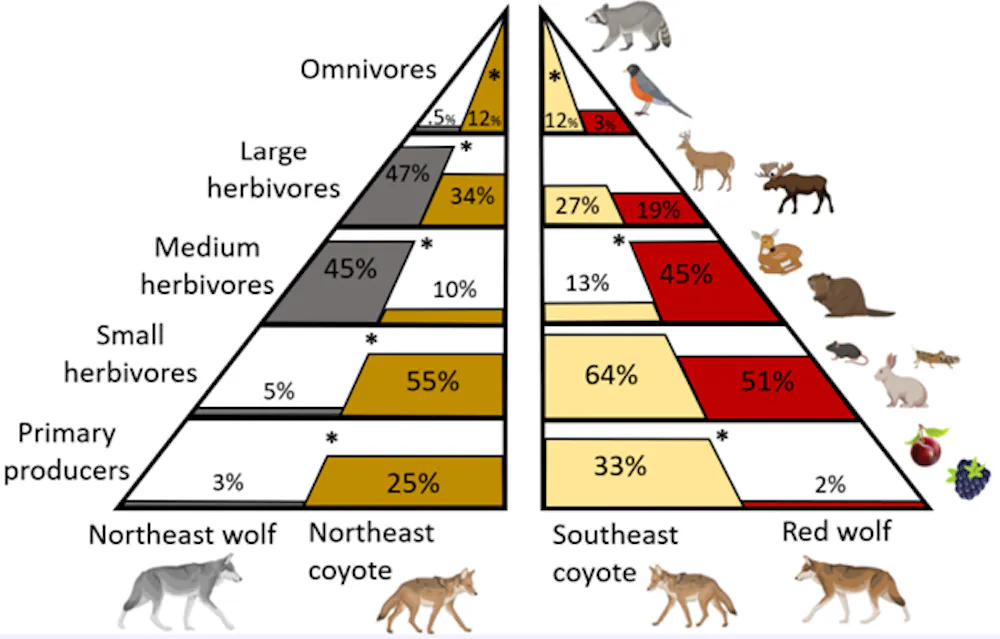
A diagram showing the diets of wolves and coyotes

Grouping food items by size and trophic level revealed some clear differences between wolf and coyote diets. Percents are the percent of samples containing each level, and stars indicate a statistically significant difference. Alex Jensen, CC BY

Killing deer and moose

But diet studies alone cannot tell the whole story – it’s usually impossible to tell whether coyotes killed or scavenged the deer they ate, for example. So I also reviewed every study I could find on ungulate mortality – these are studies that tag deer or moose, track their survival, and attribute a cause of death if they die.

These studies revealed other important differences between wolves and coyotes. For example, wolves were responsible for a substantial percentage of moose deaths – 19% of adults and 40% of calves – while none of the studies documented coyotes killing moose. This means that all, or nearly all, of moose in coyote diets is scavenged.

Coyotes are adept predators of deer, however. In the northeast, they killed more white-tailed deer fawns than wolves did, 28% compared to 15%, and a similar percentage of adult deer, 18% compared to 22%. In the southeast, coyotes killed 40% of fawns but only 6% of adults.

Rarely killing adult deer in the southeast could have implications for other members of the ecological community. For example, after killing an adult ungulate, many large predators leave some of the carcass behind, which can be an important source of food for scavengers. Although there is no data on how often red wolves kill adult deer, it is likely that coyotes are not supplying food to scavengers to the same extent that red wolves do.

Are coyotes the new wolves?

So what does this all mean? It means that although coyotes eat some of the same foods, they cannot fully replace wolves. Differences between wolves and coyotes were particularly pronounced in the northeast, where coyotes rarely killed moose or beavers. Coyotes in the southeast were more similar to red wolves, but coyotes likely killed fewer nutria and adult deer.

The return of wolves could be a natural solution for regions where wildlife managers desire a reduction in moose, beaver, nutria or deer populations.

Yet even with the aid of reintroductions, wolves will likely never fully recover their former range in eastern North America – there are too many people. Coyotes, on the other hand, do quite well around people. So even if wolves never fully recover, at least coyotes will be in those places partially filling the role that wolves once had.

Indeed, humans have changed the world so much that it may be impossible to return to the way things were before people substantially changed the planet. While some restoration will certainly be possible, researchers can continue to evaluate the extent to which new species can functionally replace missing species.

Alex Jensen, Postdoctoral Associate – Wildlife Ecology, North Carolina State University

This article is republished from The Conversation under a Creative Commons license. Read the original article.

The Conversation

This story was originally featured on Fortune.com


Source link

Continue Reading

Business

As AI investors fret over ROI, these startups attracted serious cash from customers in 2025
Published

on


The AI startups that customers will reliably shell out for are the ones that will ultimately survive and thrive. 

Seems obvious enough, but it bears repeating in the AI industry’s financial funhouse-mirror landscape. ARR remains far from trustworthy, as the SaaS-era metric has been getting watered down: In some cases, companies fold in pilot revenue and one-time deals, bolstering the appearance of stability. Meanwhile, there’s a lot of anxiety around what it means for an AI tool to offer true ROI. 

So I was intrigued by fintech Brex’s recent data outlining 2025’s 50 fastest-growing software vendors. The data is based on real spending, drawn from credit card and bill pay transactions from more than 35,000 anonymized Brex customers, that shows just who those customers are willing to pay for AI tools and services.

The data weighs recent months more heavily to select for companies that didn’t just soar and crash at the beginning of 2025. The data also filters out public companies and companies worth more than $30 billion, so it covers the category of companies I most worry about in a bubble burst—the unicorns valued, more or less, between $5 and $25 billion. Big enough to matter, but not too big to fail.

“The goal isn’t just ‘who grew the most,’ but rather it’s ‘who grew the most and is likely to keep growing,’” said Sumeet Marwaha, Brex’s head of data, via email.

The fastest-growing software vendor in 2025: Cursor, valued north of $29 billion, came in at number one. The king of the coding juggernauts, Cursor saw 1,000% year-over-year growth in spending among Brex customers. Marwaha said that Cursor saw “spend compounding every single month of 2025. No other vendor in our data did that. Not one.”

It wasn’t just Cursor—coding tools as a category put up a substantial showing in the top 50. Windsurf (acquired by Cognition after initially agreeing to a deal with OpenAI) came in at No. 6, Replit at No. 9, CodeRabbit at No. 15, and StackBlitz at No. 36. 

“This category basically didn’t exist two years ago,” Marwaha said. “Now there’s a paid, AI-powered coding environment that developers actually want and that managers are approving real budgets for.”

Marwaha said that the main factor in that rapid rise was “Friction. Or rather, the lack of it. Developers can run these tools locally. No IT approvals, no security reviews, no six-month procurement death march. Download it, use it, see the value immediately.”

Some other notable and surprising shoutouts: No. 2 was OpenRouter, a less well-known AI model marketplace, which saw 1,500% year-over-year spending growth on Brex. Other names drawing dollars at the infrastructure layer include Vast.ai (No. 11), Groq (No. 12), Supabase (No. 23), and Sentry(No. 33).

The natural question, just days before Christmas, is how this will all play out in 2026. Marwaha’s betting on visual AI. In 2025, AI video production tool provider Kling.ai came in at No. 3, while Ideogram and Runway made the list at No. 17 and No. 44 respectively. The idea is that these visual and video platforms could follow the no-friction coding tool playbook.

“The winners in 2026 won’t just be general-purpose generators,” Marwaha told Fortune. “They’ll be tools that nail a particular use case so well that teams can’t go back to the old way.”

See you tomorrow,

Allie Garfinkle
X:
@agarfinks
Email: alexandra.garfinkle@fortune.com
Submit a deal for the Term Sheet newsletter here.

Joey Abrams curated the deals section of today’s newsletter. Subscribe here.

Venture Deals

Kargo, a San Francisco-based developer of an AI-powered network designed to monitor inbound and outbound freight in the supply chain, raised $42 million in Series B funding. Avenir led the round and was joined by Linse Capital, Hearst Ventures, Lightbank, and others.

Truemed, an Austin, Texas-based telehealth marketplace, raised $34 million in Series A funding. Andreessen Horowitz led the round and was joined by Bessemer Venture Partners, Long Journey Ventures, BoxGroup, and Trust Ventures.

Private Equity

Integrated Power Services, backed by Searchlight Capital Partners, agreed to acquire TechPro Power Group, a Crofton, Md.-based group of power services companies. Financial terms were not disclosed.

Vitruvian Partners acquired Aquabyte, a San Francisco, Calif.-based developer of computer vision and machine learning software designed to improve efficiency in fish farming. Financial terms were not disclosed. 

Exits

Alphabet agreed to acquire Intersect, a San Francisco-based energy and data center infrastructure company, for $4.75 billion. The acquisition includes TPG Rise Climate’s stake in the company.

Sandbrook Capital agreed to acquire United Utility Services, a New Orleans, La. and Charlotte, N.C.-based utility services company, from Bernhard Capital Partners. Financial terms were not disclosed.

TPG agreed to acquire a majority stake in Conservice, a River Heights, Utah-based utility management company, from Advent International. Financial terms were not disclosed.


Source link

Continue Reading

Trending

Copyright © Miami Select.
