Connect with us

Business

Down Arrow Button Icon

Published

on


On a frigid day after Mass at St. Ann’s Catholic Church in rural Nebraska, worshippers shuffled into the basement and sat on folding chairs, their faces barely masking the fear gripping their town.

A pall hung over the room just as it hung over the holiday season in Lexington, Nebraska.

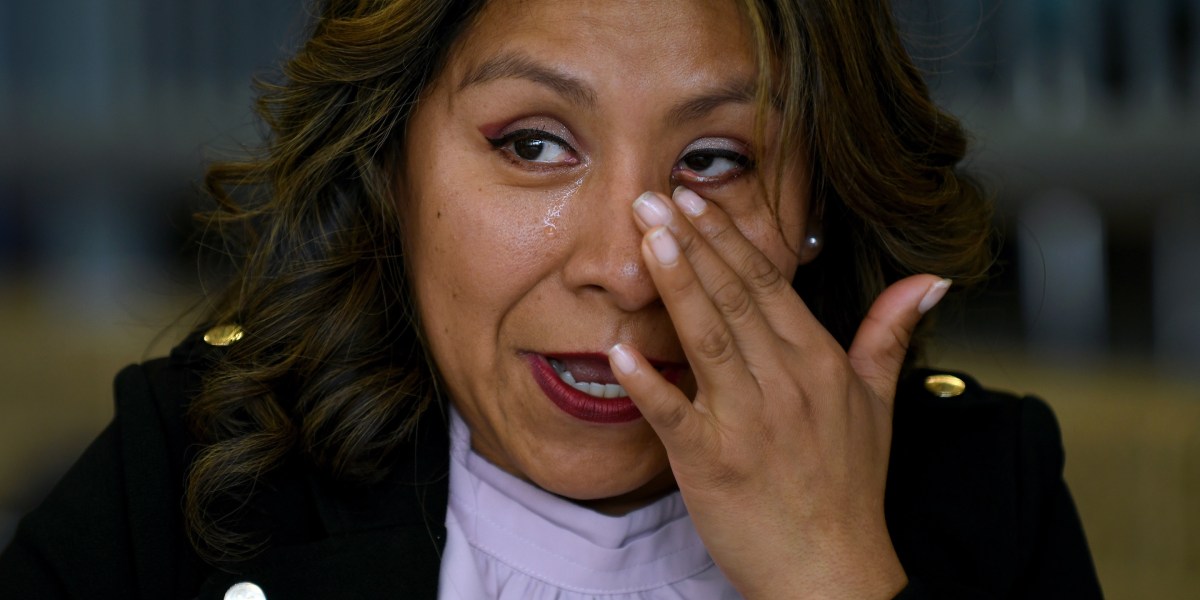
“Suddenly they tell us that there’s no more work. Your world closes in on you,” said Alejandra Gutierrez.

She and the others work at Tyson Foods’ beef plant and are among the 3,200 people who will lose their jobs when Lexington’s biggest employer closes the plant next month after more than two decades of operation.

Hundreds of families may be forced to pack up and leave the town of 11,000, heading east to Omaha or Iowa, or south to the meatpacking towns of Kansas or beyond, causing spinoff layoffs in Lexington’s restaurants, barbershops, grocers, convenience stores and taco trucks.

“Losing 3,000 jobs in a city of 10,000 to 12,000 people is as big a closing event as we’ve seen virtually for decades,” said Michael Hicks, director of the Center for Business and Economic Research at Indiana’s Ball State University. It will be “close to the poster child for hard times.”

All told, the job losses are expected to reach 7,000, largely in Lexington and the surrounding counties, according to estimates from University of Nebraska, Lincoln, shared with The Associated Press. Tyson employees alone will lose an estimated $241 million in pay and benefits annually.

Tyson says it’s closing the plant to “right-size” its beef business after a historically low cattle herd in the U.S. and the company’s expected loss of $600 million on beef production next fiscal year.

The plant’s closure threatens to unravel a Great Plains town where the American Dream was still attainable, where immigrants who didn’t speak English and never graduated high school bought homes, raised children in a safe community and sent them to college.

Now, those symbols of economic progress — mortgages and car payments, property taxes and tuition costs — are bills that thousands of Tyson workers won’t have an income to pay.

At St. Ann’s church, Gutierrez sat between her daughters and recalled being told of the plant closure just before Thanksgiving while she visited a college campus with her high school senior, Kimberly.

“At that moment, my daughter said she no longer wanted to study,” Gutierrez said. “Because where would we get the money to pay for college?”

A tear slipped down Kimberly’s cheek as she looked at her mother and then down at her hands.

‘Tyson was our motherland’

If you threw a dart at a map of the United States, Lexington — called “Lex” by locals — would be just about bullseye.

It’s easy to miss driving down Interstate 80, half hidden by barren hackberry trees, corn fields and pastures of Black Angus cattle, but a driver can spy the plant’s hulking industrial buildings pumping steam.

The plant opened in 1990 and was bought by Tyson 11 years later, attracting thousands of workers and nearly doubling the town’s population within a decade.

Many came from Los Angeles, then stricken by recession, including Lizeth Yanes, who initially hated what she called “a little ghost town.”

But soon Lexington flourished, with suburbs sprouting among bur oak and American elm trees. The downtown, a strip of cobblestone streets and brick buildings, has a Somali grocer that abuts a Hispanic bakery; locals attend over a dozen churches and several city recreation centers.

To this day, the plant creates the town’s rhythm as workers roll on and off the daily A, B and C shifts and fill restaurants, school pickup lines and the one-screen movie theater showing “Polar Express.”

“It took a long time for me to actually enjoy this little place,” said Yanes. “Now that I enjoy it, now I have to leave.”

The atmosphere inside the Tyson plant, where workers process as many as 5,000 head of cattle a day, laboring on slaughter floors, cleaning crews or trimming cuts of meat, feels “like a funeral,” she said.

“Tyson was our motherland,” said plant worker Arab Adan. The Kenyan immigrant sat in his car with his two energetic sons, who asked him a question he has no answer to: “Which state are we gonna go, daddy?”

The only thing Adan is set on is that his kids finish the school year in Lexington, where school officials say nearly half of students have a parent working for Tyson.

The school district, where at least 20 languages and dialects are spoken, has higher high school graduation and college attendance rates than the state and national average, and one of Nebraska’s biggest marching bands. Residents are proud of the diversity and the tightknit community, where young people return to raise families.

During Mass at St. Ann’s, parishioners gave the cash in their pockets to a fund for families in financial need, despite knowing they’ll be out of work next month. Afterward, Francisco Antonio ran through his future employment options with a sad smile.

After the plant closes on Jan. 20, the 52-year-old father of four said he’ll stay a few months in Lexington and look for work, though “now there’s no future.” He took off his glasses, paused, apologized and tried to explain his emotions.

“It’s home mostly, not the job,” he said, replacing his glasses with an embarrassed smile.

“We need another opportunity, job, here in Lex,” he said. “Otherwise Lex is gonna disappear.”

‘Tyson owes this community’

The domino effect could go something like this: If 1,000 families skip town, said economist Hicks — who wouldn’t be surprised if it were double that — seats would be left empty in schools, leading to teacher layoffs; there would be far fewer customers in restaurants, shops and other businesses.

Most of the customers at Los Jalapenos, a Mexican restaurant down the street from the plant, are Tyson workers. They fill booths after work and are greeted by owner Armando Martinez’s mustachioed grin and bellow of “Hola, amigo!”

Martinez’s grandson once told his grandfather that when he grows up he wants to work at Tyson. The child’s fifth-grade sister recently gathered with classmates to talk about the changes happening with their parents. Some were headed to California, others to Kansas. All were in tears.

If he can’t keep up with bills, the restaurant will close, but “there’s just nowhere we can go,” said Martinez, who undergoes dialysis for diabetes, has an amputated foot and prays for a miracle: that Tyson will change its mind.

He knows it’s unlikely. Asked by The Associated Press for comment about plans for the site, Tyson said in a statement that it “is currently assessing how we can repurpose the facility within our own production network.” It did not provide details, or say whether it plans to offer support to the community through the plant closure.

Many, including City Manager Joe Pepplitsch, are hoping Tyson puts the plant up for sale and a new company comes in bringing jobs. That isn’t a quick fix, requiring time, negotiations, renovations and no guarantee of comparable jobs.

“Tyson owes this community a debt. I think they have a responsibility here to help ease some of the impact,” he said, noting Tyson doesn’t pay city taxes due to a deal negotiated decades ago.

‘It’s not easy, at our age, to go back and start over’

Near the plant, at the Dawson County Fairgrounds, Tyson workers recently filled a long hall as state agencies — responding with the urgency of a natural disaster — offered information on retraining, writing a resume, filing for unemployment and avoiding scammers when selling homes.

Attendees’ faces were subdued, like listening to a doctor’s prognosis. “Your financial health is going to change,” they were told. “Don’t ignore the bank, they will not go away.”

Many of the older workers don’t speak English, haven’t graduated high school and aren’t computer savvy. The last application some filled out was decades ago.

“We know only working in meat for Tyson, we don’t have any other experience,” said Adan, the Kenyan immigrant.

Back at St. Ann’s, workers echoed that concern.

“They only want young people now,” said Juventino Castro, who’s worked at Tyson for a quarter-century. “I don’t know what’s going to happen in the time I have left.”

Lupe Ceja said she’s saved a little money, but it won’t last long. Luz Alvidrez has a cleaning gig that will sustain her for awhile. Others might return to Mexico for a time. Nobody has a clear plan.

“It won’t be easy,” said Fernando Sanchez, a Tyson worker for 35 years who sat with his wife. “We started here from scratch and it’s time to start from scratch again.”

Tears rolled down his wife’s cheeks and he squeezed her hand.


Source link

Continue Reading

Business

Bank of America’s Moynihan says AI’s economic benefit is ‘kicking in more’

Published

on


Bank of America Corp. Chief Executive Officer Brian Moynihan said that artificial intelligence is starting to have a bigger impact on the US economy.

“The AI investment’s been building during the year and is probably a bigger contributor next year and the years beyond,” Moynihan said Monday in a Bloomberg Television interview. “AI is kicking in more and more, and so it’s not all attributable to AI, but that’s having a marginal impact that’s pretty strong.”

Moynihan, who has led the bank for nearly 15 years, said the firm is predicting a strong economy for the US next year, with expected growth of 2.4%, up from about 2% in 2025. While the labor market has started to get softer, it appears that it’s more of a normalization for jobs, Moynihan said.

AI companies including OpenAI have been pulling in billions of dollars of funds in recent months as investors are eager to bet on the industry. But executives such as Amazon.com Inc. founder Jeff Bezos have warned that AI spending is an “industrial bubble” that could lead to lost investment, but will ultimately help society.

Moynihan said his bank sees relatively limited risk to the economy — including the impact on consumers and job losses — if the AI industry became too overheated and had to pull back, given that the sector is composed of a narrow group of companies.

“As a lender we look at the leverage on these projects and make sure we’re comfortable with that and the duration of the contract by the person who’s going to commit to use the data center,” Moynihan said.

The bank itself is also using artificial intelligence, he said in the interview. The company launched Erica, its agent bot, in 2018. Now, Erica can answer 700 questions, up from 200, Moynihan said.

Read More: Nvidia Looks Past DeepSeek and Tariffs for AI’s Next Chapter

“We’ll be applying more and more of automated intelligence — or augmented intelligence, as we call it, with a person using AI, using that to be more effective — and that’ll affect all the businesses,” Moynihan said.


Source link

Continue Reading

Business

Notorious crypto conman Sam Bankman-Fried has a prison passion project: giving legal advice to other inmates

Published

on


The founder of FTX has brought his entrepreneurial spirit behind bars. He has advised several high-profile inmates, like former Honduran president Juan Orlando Hernandez and rapper Sean Combs, according to reporting by the New York Times.

Bankman-Fried is currently serving 25 years in prison for misappropriating funds at the crypto exchange he founded, FTX, which was once valued at over $30 billion. The company’s collapse stands as the largest fraud in the crypto industry, and led to an extended period of stagnation for the sector. While in prison, Bankman-Fried has crossed paths with several celebrity inmates and is giving them his two cents on what they should do in court. 

He encouraged Hernandez to testify in his own defense during his trial in New York City in 2024. The strategy did not go according to plan as the former Honduran president was later sentenced to 45 years in prison for importing more than 400 tons of cocaine into the United States. Hernandez was released from prison earlier in December following a pardon from President Donald Trump. 

Another one of Bankman-Fried’s legal advisees was Sean Combs, more commonly referred to as Diddy. The two were cellmates at the Metropolitan Detention Center in Brooklyn, New York, and the crypto fraudster prepared the rapper for the prosecution’s strategy. The jury later found Combs not guilty of the most severe charges of racketeering and sex trafficking, but he was convicted of transportation for prostitution and was sentenced to four years in prison. 

On Twitter, several people questioned the logic of a convicted felon giving guidance to other inmates. One user quipped, “SBF might seem intelligent but clearly he lacks the fundamental qualities of a good lawyer, which is sober judgment, you know, being detail-oriented. This guy is an idiot.” And another user was even harsher in his criticism of Bankman-Fried’s latest hobby: “Why would anyone take legal advice from this obvious f___ dunce?”

During FTX’s rise, Bankman-Fried was very public about his alleged altruism and emphasized that he was doing the most possible good with his resources. His father, the Stanford law professor, Joseph Bankman, seems to think that spirit of benevolence is behind his helping other inmates: “Sam gave most of his income to charity every year he had income. Now all he has is his time to give,” he told The New York Times.

Join us at the Fortune Workplace Innovation Summit May 19–20, 2026, in Atlanta. The next era of workplace innovation is here—and the old playbook is being rewritten. At this exclusive, high-energy event, the world’s most innovative leaders will convene to explore how AI, humanity, and strategy converge to redefine, again, the future of work. Register now.


Source link

Continue Reading

Business

Billionaire Castel’s daughter seeks CEO ouster in bitter split

Published

on


An increasingly acrimonious dispute over the direction of French billionaire Pierre Castel’s drinks conglomerate burst into full public view after a pair of heirs demanded the group CEO’s resignation and organized a vote aimed at ousting him.

Romy Castel, daughter of the 99-year-old founder, and Alain Castel, his nephew, told Bloomberg News they deeply disagree with the way Chief Executive Officer Gregory Clerc is running the wine and beer conglomerate and the power they say he’s amassed. 

Clerc “is attempting to take control,” Romy Castel, 51, said in a telephone interview, referring to a move by the CEO earlier this month to remove Alain Castel from two company boards.

In a separate statement, Alain Castel, 65, questioned Clerc’s strategic vision and ability to effectively run the group, which has a workforce of 43,000.

“For me and my family, it has become vital that Mr. Clerc fully appreciate the situation and realize that his resignation is the best solution,” he said. 

The closely held Castel Group, which had sales of about €6.5 billion ($7.6 billion) last year from its globe-spanning wine, beer and agricultural operations, has been torn in recent months by internal strife that has pitted key members of the family against Clerc. As the first outsider to oversee operations within the secretive empire, the dispute highlights the risks of generational change within family-controlled companies. 

In a statement, the eponymous Castel Group said that Clerc rejects the family members’ claims and added that he remains focused on his mandate to develop and grow the company “within a framework of demanding and responsible governance.” 

The website of another company in the group, Castel Afrique, posted a message saying that the board of Castel Group had met in Luxembourg on Dec. 11 and backed Clerc. 

The acrimony is escalating at a time when the founder’s health has been faltering. Pierre Castel remained the public face of the businesses until a few years ago, and Clerc was named CEO in 2023 after serving as the founder’s tax lawyer in Switzerland. 

The extent of the Castel fortune and the group’s labyrinthine corporate structure came to light through a tax dispute that the billionaire lost on appeal. A Swiss federal court ruled in a July 2023 decision that the businessman had evaded taxes as a longstanding resident in the country. Castel was fined more than €350 million.

Tax Probe

While the Swiss legal procedure is over, a tax probe by French authorities is ongoing, according to Romy Castel. 

The power struggle within the conglomerate surfaced earlier this month when Alain Castel, who heads the wine arm of the group, Castel-Vins, said he was removed from the board of a Luxembourg-based holding company, D.F. Holding, as well as Cassiopee Pte. Ltd., a Singapore-based entity that is higher up in the corporate structure. Clerc has seats on both boards. 

D.F. Holding is wholly owned by Cassiopee, which is ultimately controlled by Investment Beverage Business Fund, also in the city state. 

In his statement, Alain Castel said “deep disagreement” with Clerc has been simmering since his arrival as CEO, adding that one trigger was a survey carried out that he claims hurt a number of projects. 

Romy Castel said she has convened an extraordinary general meeting in Singapore on Jan. 8 of Investment Beverage Business Management, or IBBM, the fund management vehicle, to seek Clerc’s removal as director. 

A recent filing for that company lists Romy Castel, a French national based in Switzerland, as a shareholder, alongside another of her father’s nephews, Michel Palu. The other shareholders on the list are from outside the family: Two former longstanding French executives, Guy de Clercq and Gilles Martignac, as well as CEO Pierre Baer.  

Alain Castel described Romy as a “majority shareholder” of IBBM. The filing shows her having a 24% stake.

With the two former executives as allies “I have the majority,” to remove Clerc, Romy Castel said in the interview. “I am very, very confident.”

Pierre Castel’s empire spans the wine business that started in France and includes chateaus, vineyards, the Nicolas brand of stores and online seller Vinatis. The much bigger brewing and soda operation is focused on Africa, with some 61 brands of beer. 

D.F. Holding, which includes both beer and wine operations, reported sales of €6.5 billion in 2024, little changed from the year before. Dividends paid to shareholders rose about eight-fold to €350 million compared with €43 million. 

Since Clerc came on board, the firm has consolidated results across a swath of Castel operations. These include factories in 22 African countries as well as sugar plantations, flour and distillery activities.

This year it warned about lower wine consumption in France, political tension in a number of African countries and the war in Ukraine.


Source link

Continue Reading

Trending

Copyright © Miami Select.