Business
Down Arrow Button Icon
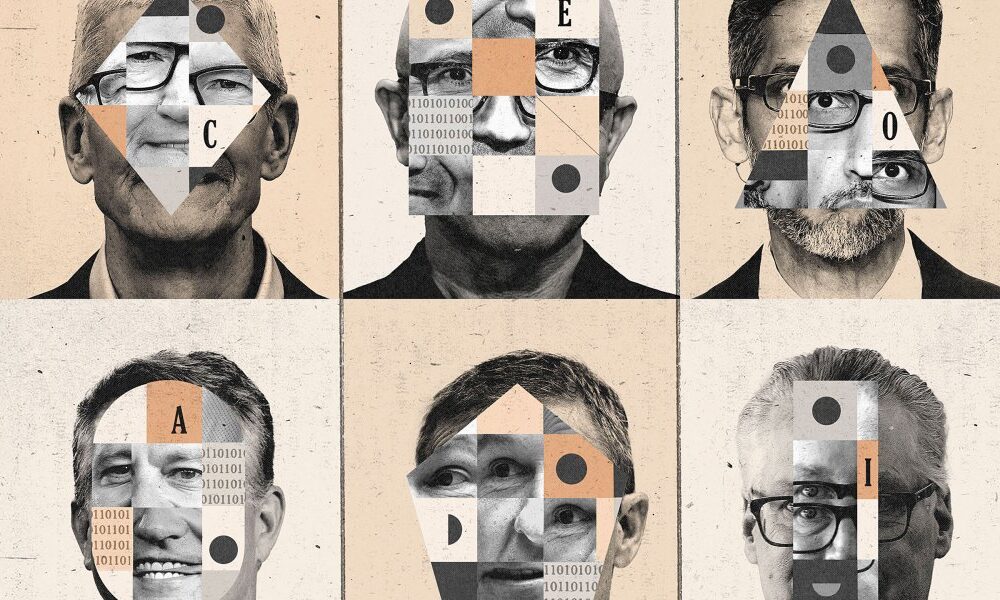
When Microsoft CEO Satya Nadella told employees in October that he was giving up running the tech company’s commercial businesses, he said that he was doing so to increase his focus on Microsoft’s technology work—and very specifically on AI. Nadella explained that Microsoft’s continued success would depend on equipping customers with new artificial intelligence capabilities to make it “the partner of choice for AI transformation.”
With that act, the 58-year-old Microsoft chief, whose 12 years in the corner office are an eternity by Fortune 500 standards, was telegraphing that mastery of AI was nonnegotiable. During Nadella’s extremely successful run, shares have risen 11-fold and Microsoft has joined the very tiny club of companies with valuations above $3 trillion. But he won’t remain relevant or effective if he doesn’t stay on top of AI and how it’s changing his industry—and neither, for that matter, will his peers in any industry.
This new reality is taking shape as several of the most high-profile Silicon Valley CEOs are extending their tenures into their second decades. They include 53-year-old Sundar Pichai (10 years at Google, six heading its more recently formed parent, Alphabet), and Apple’s 65-year-old Tim Cook (14 years as CEO). It’s becoming clearer that AI will play a major role in how much longer these CEOs remain at the top.
But elsewhere in tech, and across the Fortune 500, such long tenures will likely become increasingly rare—at least during the first waves of the AI boom. Indeed, the numbers are already beginning to shrink. The average global CEO tenure has declined to 7.2 years, below the highs of 8.4 years recorded in 2021 and 2023, according to leadership advisory firm Russell Reynolds. (Tech CEO tenures are roughly in line with the cross-industry average.) And that figure will likely continue to drift downward for a few years. The firm surmises that that’s because boards are closely monitoring CEO effectiveness and whether they respond to change with precision and adaptability, considerations AI is bringing to the fore. And those boards are quicker to act if performance lags.
“What we are seeing across the board is a desire for CEOs who bring more of a beginner’s mind and adaptability.”
Jason Baumgarten, Partner, Spencer Stuart
In addition to generating more churn, wider adoption of AI may also shake up the demographics of the CEO pool. Industry observers expect the next wave of CEOs to skew younger, as boards seek leaders who are fluent in AI. And CEOs may also need youth—or at least youthfulness—to help stave off burnout as AI generates a faster rate of change inside their companies.
“Between the compression of the disruption cycle and the risk that’s inherent, boards’ expectations for CEOs are that you’ve got to be an AI native,” says Chad Hesters, CEO of executive search firm Boyden. “You’ve got to understand this stuff, and you’ve got to understand it is not a gradual shift.”
It’s certainly not coincidental that longevity and AI success have gone hand in hand in Big Tech. Nadella, who comes from a product background, is blazing a trail and showing other longtime CEOs how to acknowledge and approach the rise of AI: Microsoft’s early investment in OpenAI, and its integration of ChatGPT with its Azure Cloud business, are hallmarks of his tenure.
Pichai, meanwhile, has turned Google from a laggard in generative AI to a major threat to ChatGPT, by OpenAI CEO Sam Altman’s own admission. Pichai has committed the company to an “AI-first” strategy, placing machine learning at the center of Google’s products, research, and infrastructure and making sure AI is never an afterthought.
As for Apple, many critics say that under Cook, it has fallen behind in the AI race. Several senior leaders left the company in the fourth quarter of 2025, and there is considerable speculation that Cook may be preparing to step aside. (Apple has declined to comment on reports about that speculation.)
Short horizons
The rise of AI has coincided with shrinking CEO tenures, as leaders race to adapt.
7.2 years
Average tenure of current CEOs in 2025, down 14% from 2023
15.8 years
Average tenure of the CEOs of the Magnificent Seven, as of December 2025
306
Number of S&P 500 earnings calls in Q4 2025 in which AI was mentioned
Sources: Russell Reynolds, Factset
Though elder statesmen by the relatively youthful standards of tech, Nadella and Pichai have figured out how to navigate a technology that is changing how business operates. It’s not about pure AI skills a computer scientist might possess, but rather about AI savvy and understanding how AI can help them, and the companies they lead, to compete.
After all, a tech CEO’s job is almost never focused on coding and the technical minutiae of AI, or of any other tech for that matter, but instead on taking the big-picture view and designing and implementing strategy. The job also calls for the perspective that comes with experience, the better to understand the nuances in the changes that AI may bring about in other elements of a business, such as data privacy and security.
Still, the urgency of CEOs needing AI-oriented sensibilities is hardly limited to tech companies. Indeed, every industry stands to be transformed by AI. In retail, AI will radically change business pillars like customer surveys and inventory management, while airlines will use it for such crucial tasks as optimal rescheduling of flights in case of a dramatic snowstorm, or predicting airplane component failures.
When Walmart and Target each recently introduced new CEOs— John Furner and Michael Fiddelke, respectively— both retailers touted the incoming chiefs’ ease with AI, a technology that is already changing how their customers shop. (Walmart recently moved its stock listing from NYSE to Nasdaq, to make its tech focus unmistakable.) Over in aviation, Delta Air Lines’ Ed Bastian earlier this year unveiled a generative-AI travel assistant, while United Airlines’ Scott Kirby claimed in June that his airline is “probably doing more AI than anyone.”
Companies certainly believe that investors care: A FactSet report in December found that during the most recent quarterly earnings season, the term “AI” was cited on 306 earnings calls conducted by S&P 500 companies, well above the five-year average of 136.
That said, older tech and legacy industry CEOs don’t necessarily need to fret if they lack the time or the aptitude to become AI insiders. They can survive, and even thrive, in the AI wave provided they show intellectual curiosity and adaptability, says Jason Baumgarten, partner at leadership advisory firm Spencer Stuart, who helps train CEOs and advises boards.
“What we are seeing across the board is a desire for CEOs who bring more of a beginner’s mind and adaptability, and not a rigorous pushback to ‘how it used to be,’” Baumgarten says.
More than ever, CEOs need to be thinking ahead to what their industry and their clients’ needs will look like in the very long term. “You can’t just ‘CEO’ your way through this and just delegate this,” says Fawad Bajwa, global AI, analytics, and data practice lead for Russell Reynolds. “You need to take charge of what this means, in terms of the possibilities and constraints and the potential risks.”
In an echo of the froth of the 1990s, when people understood the internet would dramatically change life but didn’t quite know how or how quickly, near-term anticipation has possibly outstripped the reality of what AI will ultimately deliver. Certainly the stock market has been bumpy lately, as investors try to figure out whether companies are spending too much on AI in the short run.
So CEOs will have to guard against getting carried away by the hype, and avoid making bets on initiatives whose utility isn’t relatively clear. “You’re going to be held accountable for delivering an ROI,” says Boyden’s Hesters.
That’s proved difficult so far: Indeed, the growing complexity of figuring out where AI can make an impact has helped fuel a recent uptick in the number of companies choosing co-CEO arrangements, says Christine Barton, a managing director and senior partner at Boston Consulting Group who leads its North American CEO advisory practice. “It’s a very tough set of skills to have in one individual,” Barton says. “Even if individuals have mastered the ability to blend those skills, are they really optimizing these very different parts of the brain?” In a related development, more companies have made their CTOs and CIOs more central to devising overall corporate strategy with the rest of the C-suite.
It’s not only Fortune 500 CEOs who will have to show ease and dexterity in the face of the AI revolution. Jeff Clavier, cofounder and board member of venture capital firm Uncork Capital, says he asks the CEOs of his portfolio startups to imagine what the fully AI-enabled version of their company and industry would look like—because, he tells them, for each of their companies there are another 10 startups that are gearing up for AI.
“The key characteristic for CEOs in an AI world is the ability to accept that fundamental changes will happen way, way faster than typical innovation curves,” Clavier says. He points to how ChatGPT, at just over three years of age, has changed so much. Every leader will have to accept the possibility that they may have to completely reinvent their business, in short order and regularly, in the AI era—in other words, to channel their inner Satya Nadella.
This article appears in the February/March 2026 issue of Fortune with the headline “AI is changing the CEO’s role—and could lead to a changing of the guard.”