Connect with us

Business

Down Arrow Button Icon

Published

on


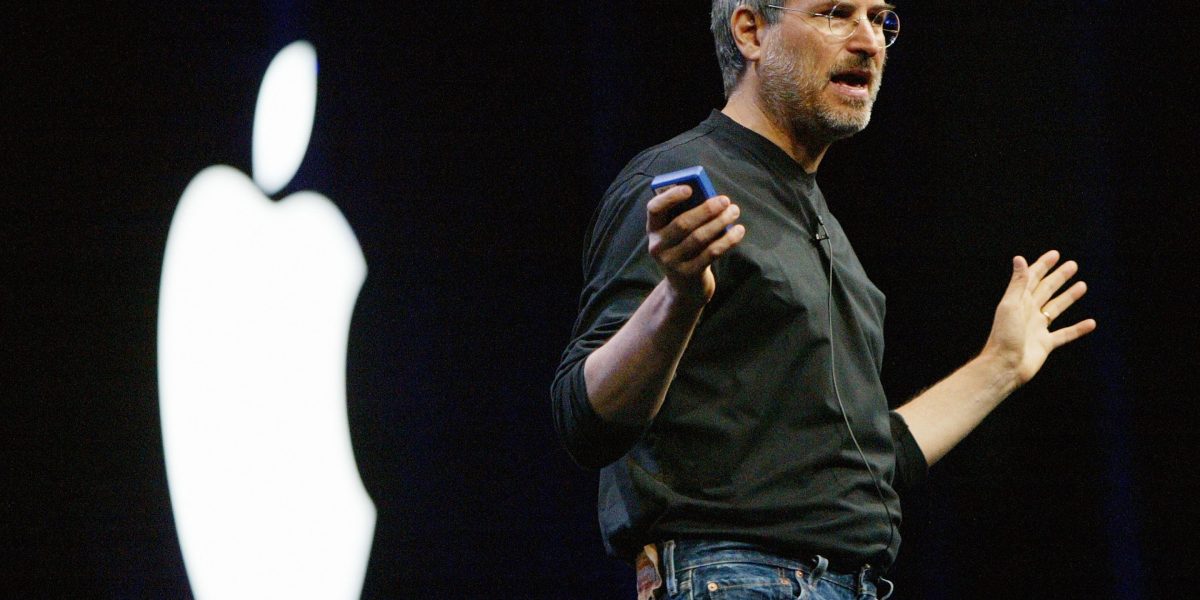
If it wasn’t for a Volkswagen bus and a calculator, Apple might never have existed. At the time, the late cofounder Steve Jobs was in his early twenties and strapped for cash, but hooked on the idea that everyone should be able to own a home computer. The only problem? Like many founders, he didn’t have enough money to bring his vision to life.

So Jobs sold off his Volkswagen bus while fellow cofounder Steve Wozniak got money for his programmable calculator, raising $1,300 to pay for the prototype’s parts. And the first Apple computer, the Apple I, was born on April Fools’ Day, 1976.

The sacrifice paid off: A local computer dealer placed a $50,000 order for 100 units soon after it launched, with the product mainly bought up by hobby enthusiasts. But it made the entrepreneurial duo enough money to create Apple II for the mass market—the first personal computer to include a keyboard and color graphics. A year after its 1977 debut, it made nearly $3 million. 

“I was worth about over $1 million when I was 23, and over $10 million when I was 24, and over $100 million when I was 25,” Jobs told PBS in 1996. “And it wasn’t that important, because I never did it for the money.”

The days of selling their belongings to fund their fledgling business was long behind them.

From college dropout to $10.2 billion net worth: Jobs’ path to Apple success

Jobs didn’t discover his passion for technology in a college class; at age 12, the entrepreneur had already found his true calling, and took a massive leap of faith to pursue his dreams. 

A young Jobs thumbed through the yellow pages, and hunted down the phone number of Hewlett-Packard cofounder Bill Hewlett, ringing him up for a favor. At the time, the tween was in need of spare parts to build a frequency counter. But what he received was far better than some nuts and bolts; Hewlett offered Jobs an internship at the iconic $21.4 billion tech company, where he serendipitously met a talented engineer: Wozniak. 

Together, the pair started their first business, illegally selling “blue boxes” that allowed users to make free, long-distance telephone calls. Jobs reminisced about those years in the early 1970s as a “magical” time in his life that sent him on the path to soon create Apple. 

“Experiences like that taught us the power of ideas,” Jobs said in the 1998 documentary Silicon Valley: A 100-Year Renaissance. “If we hadn’t … made blue boxes, there would have been no Apple.”

Jobs later enrolled at Reed College in Portland, Ore., but his days of higher education were short-lived. He dropped out after just one semester, inevitably working for legendary brand Atari as a technician and games designer at just 18 years old. That would be the last time Jobs worked under somebody else; just two years later, Apple I hit the market, and Jobs was well on his way to becoming one of the most visionary tech pioneers in modern history. 

Fast-forward five decades later, and Apple is the second most valuable company in the world. The business sits in fourth place on the Fortune 500, having sold more than 3 billion iPhones, and boasting more than 100 million Mac users globally. 

At the time of his passing in 2011, Jobs was estimated to be worth $10.2 billion. Although he had enough money to buy a whole fleet of luxury cars shortly after founding Apple, selling his Volkswagen proved to be a critical sacrifice in making it to the top.


Source link

Continue Reading

Business

The Epstein files are heavily redacted, including contact info for Trump, celebs, and bankers

Published

on


The highly anticipated Epstein files have so far landed with a thud as page after page of documents have been blacked out, with many nearly totally redacted.

While hundreds of thousands of documents have been released so far on the Justice Department’s site housing the information, there isn’t that much to see.

“Simply releasing a mountain of blacked out pages violates the spirit of transparency and the letter of the law,” Senate Minority Leader Chuck Schumer said in a statement. “For example, all 119 pages of one document were completely blacked out. We need answers as to why.”

That appeared to refer to a document titled “Grand Jury NY.” 

The data dump came late Friday, the deadline that Congress established last month for disclosing the trove of files, though other documents had already been released earlier by the DOJ, Congress and the Epstein estate.

One document listed thousands of names with their contact information redacted, including Donald Trump as well as Ivana and Ivanka Trump.

Numerous celebrities were also in that document, such as Rolling Stones singer Mick Jagger and the late pop idol Michael Jackson, who also appeared in photos with Epstein.

Former Senators John Kerry and George Mitchell were on the list as were Jes Staley, a former JPMorgan and Barclays executive, and Leon Black, a cofounder and former CEO of Apollo Global Management.

Appearing in the files doesn’t necessarily imply any wrongdoing as Epstein mingled in wider social circles and was ofter asked for charitable donations.

But Staley said he had sex with a member of Epstein’s staff, and Black was pushed out of Apollo over his Epstein ties, which Black maintains were for tax- and estate-planning services.

Numerous hotels, clubs and restaurants are listed too, plus locations simply described as “massage.” Banks included the now defunct Colonial Bank as well as Bear Stearns and Chemical Bank, which both eventually became part of JPMorgan.

Other entries fell under country categories like Brazil, France, Italy and Israel. Former Israeli prime ministers Ehud Olmert and Ehud Barak were on the list.


Source link

Continue Reading

Business

Epstein files: Trump, Clinton, Summers, Gates not returning any results in search bar

Published

on


The Justice Department released a massive trove of files related to the late sex trafficker Jeffrey Epstein on Friday, but the site housing the information was failing to turn up any results.

The data dump came on the deadline that Congress established last month for disclosing the highly anticipated information, though a top Justice official suggested that not all the documents would come out at once with more due in the coming weeks.

While President Donald Trump, former President Bill Clinton, former Treasury Secretary Larry Summers, Microsoft cofounder Bill Gates and scores of other powerful men have been linked to Epstein, their names failed to come up in a search of DOJ’s “Epstein Library.”

“No results found. Please try a different search,” the site says after queries for their names.

The site adds that “Due to technical limitations and the format of certain materials (e.g., handwritten text), portions of these documents may not be electronically searchable or may produce unreliable search results.”

However, Clinton also appears in photos that were released as does the late pop singer Michael Jackson. Other records were heavily redacted.

Deputy Attorney General Todd Blanche told Congress that the Justice Department had identified 1,200 victims of Epstein or their relatives and redacted materials that could reveal their identities, according to the New York Times.

Last month, an overwhelmingly bipartisan vote in Congress produced legislation to force the Trump administration to release the DOJ files, though emails and photos from Epstein’s estate had already come out.

One of the sponsors of that legislation, Rep. Ro Khanna, warned on Friday that if DOJ doesn’t show that it’s complying with the law, Congress could hold impeachment hearings for Attorney General Pam Bondi and Blanche.

Earlier on Friday, Blanche told Fox News that “several hundred thousand” pages would be released on Friday. “And then, over the next couple of weeks, I expect several hundred thousand more,” he added.

This story was originally featured on Fortune.com


Source link

Continue Reading

Business

Want a job in AI-era tech? Forget prestigious degrees—tech leaders want to see your GitHub projects and internships

Published

on


For decades, computer science has been sold as one of the surest paths to economic security. And leaders across politics and industry—from former President Bill Clinton and Secretary of State Marco Rubio to Steve Jobs and Bill Gates—have at times urged students not to overlook the field, framing coding skills as the secret to stable, high-paying jobs.

But as artificial intelligence rapidly reshapes the workplace, that promise is starting to look less certain.

A new survey of more than 200 engineering leaders, conducted by tech training nonprofit CodePath and shared exclusively with Fortune, shows entry-level tech hiring is slowing. More than one-third of respondents, 38%, said their company has reduced the number of entry-level hiring over the past year, and nearly 1 in 7 reported pausing Gen Z hiring altogether.

At the same time, 18% said hiring had stayed the same, and 8% reported an increase. Despite the overall slowdown, CodePath CEO Michael Ellison—a Y Combinator alum—argues telling people to avoid tech right now would be a mistake.

“That’s just kind of like taking crazy pills if you end up choosing not to invest in the tools that make you the most powerful—of telling computers what you want them to do in an age where computers are becoming exponentially more powerful,” Ellison told Fortune. “So to me, it’s like saying, ‘don’t learn how to use the internet.’”

Ellison’s argument reflects a broader shift in how computer science fits into the AI economy. As generative AI tools become more capable, understanding how software works—and how to direct, customize, and integrate AI systems—is increasingly seen as a foundational skill rather than a specialized one.

That demand is already showing up in the labor market. AI literacy topped LinkedIn’s list of the skills professionals are prioritizing and companies are hiring for right now. And a Lightcast analysis of more than 1.3 billion job postings in 2024 found roles advertising at least one AI or generative AI skill offered an average of $18,000 more in annual compensation that those that did not.

Notably, the majority of those roles were outside the tech sector. Some 51% of jobs requiring AI skills were in non-tech industries, up from 44% in 2022—a sign coding and AI fluency are becoming relevant far beyond Silicon Valley.

The new secret to landing a tech job

Still, slowing hiring doesn’t mean aspiring technologists should give up. Instead, the CodePath data suggests candidates may need to rethink what they emphasize—and what they leave off—when applying for tech roles.

When asked which signals matter most outside the interview process, engineering leaders indicated proof of real-world skills matter far more than formal credentials. Side projects or portfolios topped the list, cited by 38% of respondents, followed by internship experience (35%), and public code portfolios like GitHub (34%).

Traditional markers of achievement, by contrast, carried far less weight. Just 4% of leaders said credentialing programs were a top influence in hiring decisions, while only 23% cited a candidate degree or academic focus and 17% pointed to school prestige.

The shift away from pedigree suggests employers are seeking evidence candidates can actually do the work. Greater fluency with AI tools and frameworks was the most common skill expectation for early-career hires, followed by faster time to writing production-ready code and the ability to learn new tools or programming languages quickly.

And despite buzz about tech layoffs, job opportunities do still exist. The U.S. federal government, for example, recently announced it would be hiring about 1,000 new engineers, data scientists, and AI specialists. No degrees or work experience is required—and salaries will range from $150,000 to $200,000. Meta has also still been hiring young talent in recent weeks, with job postings for roles such as product software engineers.

Ellison’s advice for those seeking roles is simple: Opportunities are out there as long as you are willing to dig in deeper—and build a portfolio that hiring managers are looking for.

“People are rewarded for being aggressive and for going after what they want,” he said. It’s surprising the opportunities that are hidden in plain sight.”

This story was originally featured on Fortune.com


Source link

Continue Reading

Trending

Copyright © Miami Select.