Connect with us

Business

Down Arrow Button Icon

Published

on


For the past two-and-a-half decades, the mandate for global business leaders was relatively straightforward: grow the existing business, allocate capital efficiently, and implement technology to drive productivity. But Mohamed Kande, global chairman of PwC, speaking to Fortune in Davos, Switzerland, ahead of the World Economic Forum’s annual meeting, insisted that era is over. Kande argued that the CEO job has changed more in the past year than anything he’s seen over the last quarter-century.

“This is one of the most testing moments for leaders,” Kande told Fortune‘s Diane Brady, describing a new “tri-modal” mandate that requires executives to simultaneously run their current business, transform it in real time, and also build entirely new business models for the future. “I’ve not seen that in 25 years,” he said.

Despite this pressure, Kande’s message to the global business community is rooted in historical optimism. “Do not fear the future. It is unsettling. It is true. Every day something changes, but do not fear it,” he said, noting that all the uncertainty so stressful to executives has happened before, from tariffs, roughly 100 years ago, to the industrial revolution, even further back. “Eventually, something good will happen.” Kande allowed that he’s an optimist by nature, but he insisted that top leaders can adjust to this business climate.

The AI Execution Gap

Of course, a primary driver of this unsettling change is the rapid adoption of artificial intelligence (AI), as revealed in PwC’s 29th global CEO survey, “Leading Through Uncertainty in the Age of AI,” released at the onset of the annual meeting in Davos. Based on responses from 4,454 CEOs across 95 countries and territories, the survey reveals a stark disconnect between ambition and reality. Kande said the business community made huge strides from 2024 to 2025, going from asking themselves whether they can or should adopt AI to a point where “nobody is asking that question anymore. Everybody’s going for it.”

PwC’s survey finds, however, that only 10% to 12% of companies report seeing benefits on the revenue or cost side, while a staggering 56% say they are getting “nothing out of it.” This echoes the MIT study that shook markets in August with the finding that 95% of generative AI pilots were failing across the corporate sector.

Kande attributed this tension not to the technology itself, but to a lack of foundational rigor. “Somehow AI moves so fast … that people forgot that the adoption of technology, you have to go to the basics,” he explained, citing the need for clean data, solid business processes, and governance. PwC is finding that the companies that are seeing benefits from AI are “putting the foundations in place.” It’s about execution, not technology, he argued, and that comes down to good management and leadership.

The Confidence Paradox and U.S. Dominance

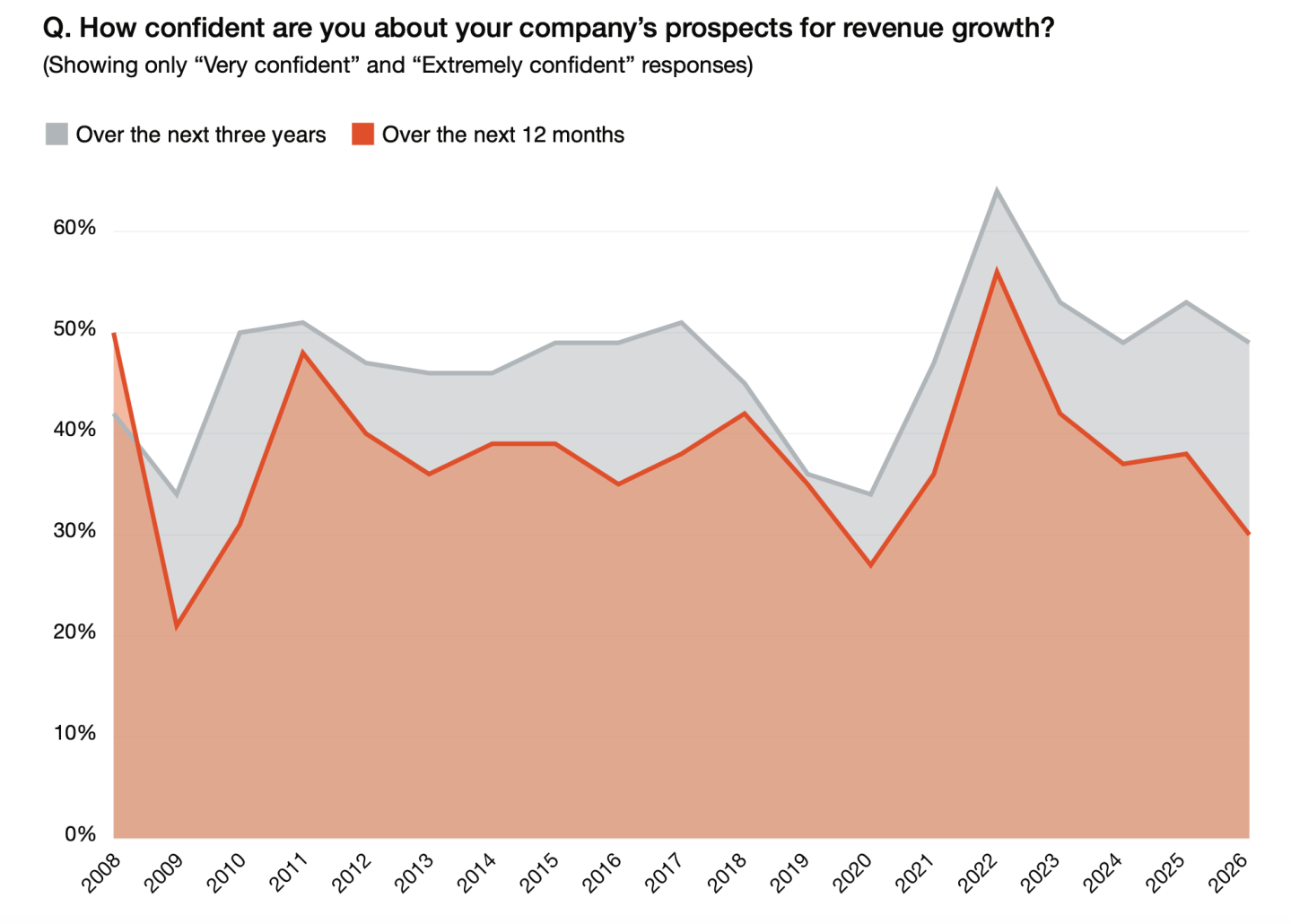
The uncertain environment has also created a paradox in business sentiment, Kande told Fortune. While CEOs express confidence in the global economy, only 30% have confidence that they can grow their own businesses. Kande questioned whether this hesitation stems from geopolitics, tariffs, technology, or a lack of leadership agility. The last 15 years, he noted, have been ones of solid growth and stable business models, making this time a real test for the C-suite. “This is one of the most testing moment for leaders, what we have today,” he said, because it requires the ability to change fast and adapt quickly without getting bogged down in day-to-day, tactical combat.

Only three in 10 CEOs were confident in PwC’s 29th survey about revenue growth over the next 12 months, down from 38% in 2025 and 56% in 2022, marking a five-year low in CEO confidence in their own revenue outlook. Another survey question may be more revealing, about CEO confidence in their company’s 12‑month revenue growth: this has fallen sharply over recent years, even as many leaders continue to pursue multiyear opportunities to reinvent their businesses through AI, innovation, and cross-sector expansion. 
The transformation of the CEO role is trickling down to the workforce, necessitating a reimagining of career paths. Kande warned that the traditional “apprenticeship model”—where entry-level employees learn by doing basic tasks—is being disrupted by AI. That classic career ladder, starting at the entry level, taught lots of expertise through hands-on learning, but this will have to be redesigned, going forward, to teach “system thinking” rather than task execution, as AI increasingly handles the latter.

Ultimately, Kande urges executives to look at the last 50 to 100 years rather than the last five to understand the current moment. Citing the infrastructure booms of the railroad era and the early internet, he said he believes the current wave of investment will birth the next age of innovation. The CEO survey’s framing of a coming “decade of innovation and industry reconfiguration” supports this long-term view, highlighting that companies generating more revenue from new sectors tend to enjoy higher profit margins and higher CEO confidence in future growth.

“I’m an optimist,” Kande concluded. Rather than being afraid of all of the changes that are happening now, he urged leaders to remember that people fear what they don’t understand, and the best remedy for that is to seek understanding. “That’s why I spend so much time learning now and traveling a lot, just to understand what’s happening and thinking about what can be done differently. That’s why I don’t fear AI.”

“I’ve seen change,” Kande said. “You’ve got to embrace it.”


Source link

Continue Reading

Business

Half of veterans leave their first post-military jobs in less than a year—This CEO aims to fix that
Published

on


Taking a career leap can be daunting, but all professionals inevitably have to face the music; most will change jobs or industries at some point, whether they want to or not. But for U.S. veterans exiting service and heading into civilian life, the transition has been especially difficult—and it’s an issue that’s intensifying their unemployment. That’s why financial services titan USAA is putting its money where its mouth is with a $500 million initiative to get members back on their feet. 

“What we created here since I took over as CEO is a completely revamped way of hiring our veterans and military spouses,” the company’s CEO, Juan C. Andrade, tells Fortune. “This is not just for the benefit of USAA—this is for the benefit of the military community.”

USAA launched its “Honor Through Action” program in 2025, committing half a billion dollars over the next five years to improve the careers, financial security, and well-being of its customers—many of whom are active military, veterans, or related to them. It’s the brainchild of Andrade, who stepped into the company’s top role in April last year. As someone who also left a longstanding career in the federal government, he understands the growing pains that come with an intimidating career pivot. And for thousands of USAA members, the situation is dire. 

Around half of veterans ditch their initial post-military jobs within the first year, according to the Department of Defense’s Transition Assistance Program, and USAA’s CEO believes a lack of thoughtful transition services is largely to blame. When colonels, generals, and sergeants leave behind their high-powered jobs, Andrade says some struggle to adapt both emotionally and skills-wise.

While businesses are required to re-employ former employees who return from military duty per U.S. federal law, those stepping into civilian roles for the first time often need a helping hand. And even before they exit the military, the careers of their partners tend to suffer. 

The jobless rate of military spouses has hovered around 22% over the past decade, according to Hiring Our Heroes. That’s more than four times higher than the 4.6% nationwide unemployment rate. When their partners need to relocate for a new duty assignment, spouses are 136% more likely to be unemployed within six months, according to a 2024 Defense Department survey.

This trend of low job retention among veterans and spouse joblessness can be detrimental to the financial and professional livelihoods of American military families. So Andrade is leading the charge to get them on payroll. Corporations like JPMorgan have ramped up ex-military resources, and services like Armed Forces YMCA have long been assisting veterans; But USAA’s CEO says the issue needs a more targeted approach.

“While there’s a lot of organizations that are very well-meaning and do some very good work, the approach has been fragmented,” Andrade explains. “The problem with private sector companies is [if they] have not had that experience of service, or if they don’t have a large population of employees that serve, it’s very difficult to understand the fact that they’ve lost their tribe. The fact that, in a lot of ways, they’ve lost their sense of belonging to something greater than self.”

USAA’s $500 million plan and new fellowship pathways

USAA already has several veteran employment initiatives on the docket this year. This March, the company tells Fortune it will host a nationwide U.S. Chamber of Commerce Foundation program, Hiring our Heroes, in San Antonio to connect on the issue. And in the coming months, USAA will host events with nonprofit and HR association SHRM to brainstorm the best ways to improve military hiring in the U.S.

In stride with Honor Through Action, USAA also launched two 18-month fellowship programs designed to transition military personnel into full-time company positions: Summit and Signal. In three six-month rotations, participants cycle through different parts of the financial services giant to find the best fit. The future leadership track, Summit, rotates fellows through departments including business strategy, operational planning, and product ownership. Starting anew can be isolating, so USAA is ensuring that military personnel are not walking these career paths alone—veterans are connected to mentors every step of the way.

“Those 18 months are incredibly important, because it goes to show you: What is it that you can do? How does a private company actually work? What is it that you do on a daily basis?” Andrade says. “They get one-on-one mentorship and support every step of the way with people that have already walked in their shoes and been successful, so all of that helps.”

And just like what other companies are looking for in white-collar talent, USAA places a special emphasis on AI-savvy workers. That’s where the Signal fellowship comes into play: the pathway targets applicants with tech know-how, cycling them between assignments including technical solutions and data processing. The CEO notes that the military community is teeming with tech skills, and some already come with prior training from U.S. Cyber Command roles. Aside from getting ex-military members back into work, Signal is also proving to be extremely beneficial for the business itself. 

“We’re always looking for people who have the expertise and skill sets in data science or data engineering,” Andrade continues. “As they retire from the Air Force, the Army, the Navy, we bring them into a specialized program focused on their skills and how they can help us from technology experience.”

Serving an overlooked population: veteran spouses struggling with joblessness

Even when they’re not deployed, U.S. military personnel are battling wars at home—depression, financial insecurity, and homelessness. But one group is often ignored in the fight: their spouses. The husbands and wives of military personnel face sky-high unemployment rates and long-term instability due to the nature of their partners’ jobs. But Andrade recognizes them as an overlooked and underutilized pool of professionals.

“Military spouses are an incredible source of talent—they’re literally the CFO and the CEO of their home,” USAA’s CEO says. “When their spouses are deployed, when there’s a permanent change of station for their spouse, they have to leave their job. And if they don’t have that flexibility, then you know that’s why the unemployment rate is so high.”

USAA is funneling its resources to get to the root of the issue; as part of the Honor Through Action initiative, the company tells Fortune it will host Military Spouse Advisory Councils in San Antonio this March. The mission is to help shape policy, programs, and resources to better serve the unique needs of military families. That same month, the business also plans to work with other organizations in funding Blue Star Families’ release of Military Spouse Employment Research with the aim of pinpointing actionable solutions to their raging unemployment. And reflecting internally, Andrade reports that USAA will continue to lead by example. 

“We can offer a lot of flexibility… Having that level of empathy and understanding becomes very critical,” he says. “This is where we hope—with Honor Through Action—to be able to help companies understand the value that [military spouses] have, but also why you need to treat them a little bit differently given their personal situation.”


Source link

Continue Reading

Business

Pinterest CEO: the Napster phase of AI needs to end

Published

on


In a few short years, artificial intelligence has transformed from what many viewed as a moonshot to the source of countless real-world benefits.

At Pinterest, for instance, we’re deploying AI to flip the script on social media, using it to more aggressively promote user well being rather than the alternative formula of triggering engagement by enragement. I believe AI can benefit our 600 million users for years to come and at a fraction the cost that many associate with the technology.

You don’t need to be a company with the size and scale of a Silicon Valley juggernaut to unlock the enormous economic benefits and innovation that AI could deliver. In fact, I have long argued that AI can be far more democratized than it currently is, leading to an entirely new generation of entrepreneurial success stories.

To realize AI’s real potential, however, commonly held assumptions need to be challenged. This is the only way to address a widespread public trust problem that AI currently faces and create an AI ecosystem that leaves no one behind.

For starters, our fundamental view of access to essential tools must change. Although often viewed as a battle between the largest (and often costly) proprietary models, a community of accessible open-source models is thriving in 2026, leveling the playing field for entrepreneurs eager to usher in the next generation of innovation.. 

Additionally, creators and publishers are no longer powerless when it comes to protecting the value of their work from companies that attempt to use their information to train generative AI models. The Napster phase of AI needs to end – now is the time for a clear exchange of value that benefits content creators.

Finally, regulation can no longer be viewed as the enemy. Oversight protects users and provides an incentive for private companies to compete on safe and positive user experiences. 

Open Source: Blueprint for Next Batch of Big Companies  

To date, too much of the focus of AI is who is building the largest proprietary models. The race to build powerful models is profound, but the discussion needs to include far more emphasis on open source and its ability to spur innovation across the broad business community.  

Pinterest recently announced an important milestone that demonstrates the potential. In our quest to harness the power of AI, we were able to tap into available large-scale open-source models and achieve performance similar to proprietary models but at 90% less cost. This addresses the return-on-AI-investment headache that many CEOs are facing as they spend a fortune on off-the-shelf proprietary solutions that don’t yet offer commensurate savings. 

This is not a new phenomenon. For decades, open-source software has been an important accelerant to nascent industries. Many of today’s largest companies, including trillion-dollar market cap enterprises, wouldn’t exist if they had to rely on proprietary databases or operating systems. 

The next batch of world-changing companies should follow a similar blueprint. Otherwise, we risk seeing the proprietary software companies collect all the value and, as a result, stifle innovation and ultimately block AI’s long-term potential. 

  • Ownership Matters – Ditching AI’s Napster Era

Social media platforms like Pinterest live and die by users’ willingness to share creative and original ideas. 

Thankfully, humans feed the internet with a trove of new information every day. That information is inspired and validated by a level of creativity, reasoning, and work ethic that even the most advanced generative AI models do not possess. 

This presents large language models with a daunting learning curve that cannot be addressed without real-time access to this torrent of fresh ideas. That access should not be unfettered. 

When AI disregards ownership, content creators are less inclined to share their work and the public discourse suffers. When AI respects ownership, these originators can thrive, and the public gets better information. 

Currently, AI’s approach has resembled the old Napster pirating model – where music could be downloaded by tens of millions of internet users at no cost – than the iTunes or Spotify model – where publishers get compensated every time their work is accessed. 

The good news is there are several frameworks emerging that solve this problem. One is Cloudflare’s new model that allows content creators to choose whether and how GenAI companies use their content. Cloudflare’s tool works as a pay-per-crawl service, distinguishing GenAI crawlers that take information without sending much traffic back to creators, from search crawlers, which actually drive traffic back to the original source. 

Supporting Regulation that Protects and Promotes

As hard as it is to believe, standard installation of seatbelts were once considered “bad for business” by carmakers. That changed when crash test ratings created an incentive to do the right thing. The same can happen with standards in tech that protect users and promote responsible innovation. 

If you spend much time playing with AI, you’ll understand the need for regulations to stop a race to the bottom currently influencing the industry. No company should allow chatbots to have sexually explicit conversations with children, for instance. People, meanwhile, should be protected from bad actors attempting to use AI to manipulate their images or other information.

The question is what does meaningful regulation look like?

The App Store Accountability Act is one example of where immediate progress could be made. By making the app store a one-stop shop for age verification and parental consent, we can create consistent protections from the very moment a device is first turned on. 

Additionally, Pinterest envisions a world where social media companies and AI companies are competing on their safety records. To do this, the industry will need baseline regulations that focus on outcomes and leave space for companies to innovate in how to exceed those basic expectations.

The opinions expressed in Fortune.com commentary pieces are solely the views of their authors and do not necessarily reflect the opinions and beliefs of Fortune.


Source link

Continue Reading

Business

Trump says he wants Greenland because he was rejected for a Nobel Peace Prize last year

Published

on


U.S. President Donald Trump linked his aggressive stance on Greenland to last year’s decision not to award him the Nobel Peace Prize, telling Norway’s prime minister that he no longer felt “an obligation to think purely of Peace,” two European officials said Monday.

Trump’s message to Jonas Gahr Støre appears to ratchet up a standoff between Washington and its closest allies over his threats to take over Greenland, a self-governing territory of NATO member Denmark. On Saturday, Trump announced a 10% import tax starting in February on goods from eight nations that have rallied around Denmark and Greenland, including Norway.

Those countries issued a forceful rebuke. But British Prime Minister Keir Starmer sought to de-escalate tensions on Monday. While the White House has not ruled taking control of the strategic Arctic island by force, Starmer said he did not believe military action would occur.

“I think this can be resolved and should be resolved through calm discussion,” he said.

Still, the American leader’s message to Gahr Støre could further fracture a U.S.-European relationship already strained by differences over how to end the nearly four-year war in Ukraine, previous rounds of tariffs, military spending and migration policy.

In a sign of how tensions have increased in recent days, thousands of Greenlanders marched over the weekend in protest of any effort to take over their island. Greenland Prime Minister Jens-Frederik Nielsen said in a Facebook post Monday that the tariff threats would not change the their stance.

“We will not be pressured,” he wrote.

Meanwhile, Naaja Nathanielsen, Greenland’s minister for business, minerals, energy, justice and equality, told The Associated Press that she was moved by the quick response of allies to the tariff threat and said it showed that countries realize “this is about more than Greenland.”

“I think a lot of countries are afraid that if they let Greenland go, what would be next?”

Trump sends a message to the Norwegian leader

According to two European officials, Trump’s message to Gahr Støre read in part: “Considering your Country decided not to give me the Nobel Peace Prize for having stopped 8 Wars PLUS, I no longer feel an obligation to think purely of Peace, although it will always be predominant, but can now think about what is good and proper for the United States of America.”

It concluded: “The World is not secure unless we have Complete and Total Control of Greenland.”

The officials, who were not authorized to comment publicly and spoke on condition of anonymity, said it had been forwarded to multiple European ambassadors in Washington. PBS first reported on the content of Trump’s note.

U.S. Treasury Secretary Scott Bessent defended the president’s approach in Greenland during a brief Q&A with reporters in Davos, Switzerland, which is hosting the World Economic Forum meeting this week.

“I think it’s a complete canard that the president would be doing this because of the Nobel,” Bessent said, immediately after saying he did not “know anything about the president’s letter to Norway.”

Bessent insisted Trump “is looking at Greenland as a strategic asset for the United States,” adding that “we are not going to outsource our hemispheric security to anyone else.”

The White House did not respond to questions about the message or the context for Trump sending it.

Gahr Støre confirmed Monday that he had received a text message the day before from Trump but did not release its contents.

The Norwegian leader said Trump’s message was a reply to an earlier missive sent on behalf of himself and Finnish President Alexander Stubb, in which they conveyed their opposition to the tariff announcement, pointed to a need to de-escalate, and proposed a telephone conversation among the three leaders.

“Norway’s position on Greenland is clear. Greenland is a part of the Kingdom of Denmark, and Norway fully supports the Kingdom of Denmark on this matter,” the Norwegian leader said in a statement. “As regards the Nobel Peace Prize, I have clearly explained, including to president Trump what is well known, the prize is awarded by an independent Nobel Committee and not the Norwegian Government.”

He told TV2 Norway that he hadn’t responded to the message, but “I still believe it’s wise to talk,” and he hopes to talk with Trump in Davos this week.

The Norwegian Nobel Committee is an independent body whose five members are appointed by the Norwegian Parliament.

Trump has openly coveted the peace prize, which the committee awarded to Venezuelan opposition leader María Corina Machado last year. Last week, Machado presented her Nobel medal to Trump, who said he planned to keep it though the committee said the prize can’t be revoked, transferred or shared with others.

Starmer says a trade war is in no one’s interest

In his latest threat of tariffs, Trump indicated they would be retaliation for last week’s deployment of symbolic numbers of troops from the European countries to Greenland — though he also suggested that he was using the tariffs as leverage to negotiate with Denmark.

European governments said that the troops traveled to the island to assess Arctic security, part of a response to Trump’s own concerns about interference from Russia and China.

Starmer on Monday called Trump’s threat of tariffs “completely wrong” and said that a trade war is in no one’s interest.

He added that “being pragmatic does not mean being passive and partnership does not mean abandoning principles.”

Six of the eight countries targeted are part of the 27-member European Union, which operates as a single economic zone in terms of trade. European Council President Antonio Costa said Sunday that the bloc’s leaders expressed “readiness to defend ourselves against any form of coercion.” He announced a summit for Thursday evening.

Starmer indicated that Britain, which is not part of the EU, is not planning to consider retaliatory tariffs.

“My focus is on making sure we don’t get to that stage,” he said.

Denmark’s defense minister and Greenland’s foreign minister are expected to meet NATO Secretary-General Mark Rutte in Brussels on Monday, a meeting that was planned before the latest escalation.

___

Associated Press writers Josh Boak in West Palm Beach, Florida; Emma Burrows in Nuuk, Greenland; and Bill Barrow in Atlanta contributed to this report.


Source link

Continue Reading

Trending

Copyright © Miami Select.