Connect with us

Business

Down Arrow Button Icon

Published

on


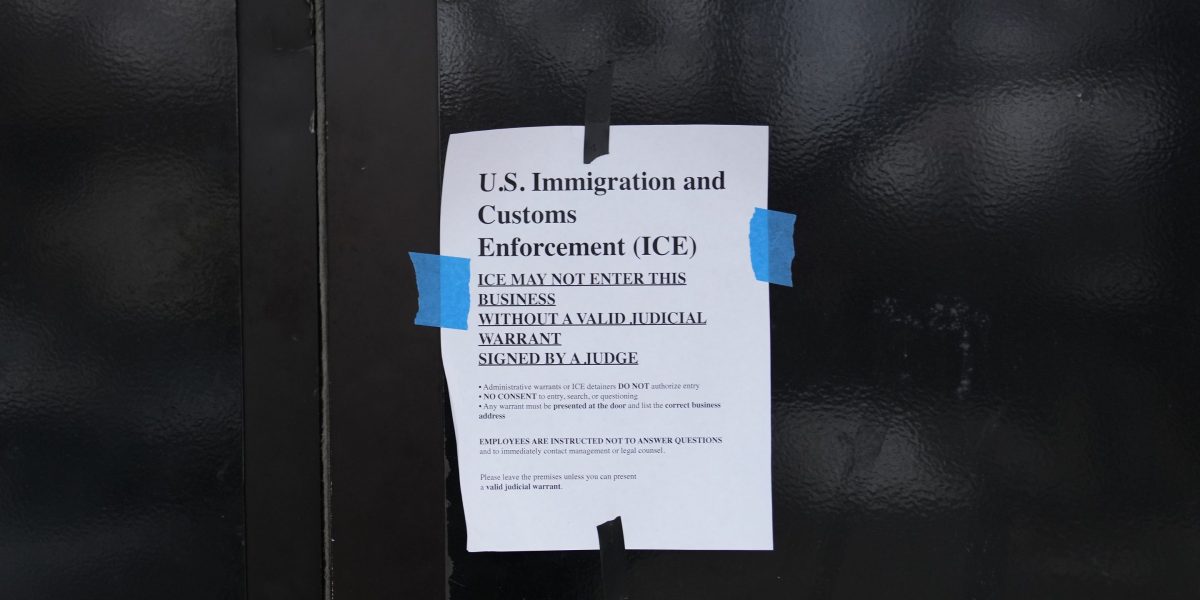
Rows of businesses stood shuttered inside a sprawling complex of Somali businesses on a recent afternoon.

Karmel Mall in south Minneapolis contains more than a hundred small businesses in suites offering everything from clothing and food to insurance and accounting services. On Thursday, the noisy hallways inside lay quiet, save for occasional chatter between neighboring vendors. The smell of fried food still wafted from the bakeries, the central heating hummed and the sound of Quran recitation flowed quietly from some shops.

But many sellers sat alone in their clothing stores, waiting for the occasional customer to walk by. Everyone is afraid of federal immigration agents, business owners said. Sellers and customers, citizens and noncitizens. Some don’t bother opening shop because they aren’t expecting any customers.

“It’s been like this for three weeks now,” said Abdi Wahid, who works at his mom’s convenience store in the mall. “Everywhere it’s all been closed up, all the stores.”

Karmel Mall is an economic hub for the area’s Somali population, which is the largest in the U.S. But it also features housing, a mosque and Quran classes, serving as a robust community center for the area.

The economic impact of the Trump administration’s “Operation Metro Surge” stretches beyond the Somali community: many immigrants are on edge, afraid to go to work or leave their homes amid the immigration crackdown.

But President Donald Trump has made the Somali community a special target of his deportation rhetoric after a recent government fraud case in Minnesota included a number of Somali defendants. Since December, Trump has made numerous jabs at the community, calling them “garbage” and saying “they contribute nothing.”

Wahid said early afternoons at the family business once meant 15 to 20 customers. These days, it’s tough to get one.

Wahid is a citizen, but he said the fear extends beyond just immigrants. Citizens are also scared of coming in, especially following the killing of Renee Good and the ICE raid at Roosevelt High School in south Minneapolis.

“I think that caused a lot of people to not even want to come,” he said, because they could be targeted “just because of their race.”

Homeland Security assistant secretary Tricia McLaughlin said in a statement that law enforcement uses “reasonable suspicion” to make arrests under the fourth amendment.

“A person’s immigration status makes them a target for enforcement, not their skin color, race or ethnicity,” she said.

Upstairs, Bashir Garad runs Safari Travel & Accounting Services. Not only has the crackdown in Minneapolis meant he’s lost almost all his customers, but his existing clients are cancelling upcoming trips because they’re worried they won’t be let back into the country.

“They see a lot of unlawful things going on in the city,” he said. “They look at something bad, and then they think some bad things may happen to them.” The majority of his clients are East African, and nearly all are U.S. citizens. They still hesitate to travel.

“The government is not doing the right thing,” he said. “If there’s a criminal, there’s a criminal. Regardless, there are ways to find the criminal, but to marginalize the community’s name, and a whole people, that is unlawful.”

Ibrahim Dahiye, who sells electronics, said winter always used to be slow, “but now it’s totally different. No one comes here. All the stores are closed, few are open.”

Since the crackdown began, Dahiye said his business is down $20,000 monthly, and he’s now pooling funds to make rent.

He said he’s lost most of his customers. His employees are too scared to come to work. He tapped his jacket pocket, saying he keeps his passport on him at all times.

“I don’t know what we can do,” Dahiye said. “We believe in Allah, but we can’t do anything.”


Source link

Continue Reading

Business

Down Arrow Button Icon

Published

on


President Donald Trump’s feud with NATO over his plans to take over Greenland has precipitated an existential crisis for the alliance that Russia is celebrating.

On Saturday, Trump announced tariffs targeting NATO countries that deployed troops to the semi-autonomous Danish territory, until a “Deal is reached for the Complete and Total purchase of Greenland.”

That drew cheers from Kirill Dmitriev, Russian Vladimir Putin’s envoy for investment and economic cooperation. Meanwhile, the European Union is weighing options to retaliate.

“Collapse of the transatlantic union,” he posted on X. “Finally—something actually worth discussing in Davos.”

NATO has been a key supporter of Ukraine as it fights off Russia’s invasion, which began nearly four years ago. And while Trump has previously sparked trade tension with Europe, NATO allies have helped maintain U.S. support for Kyiv, though he has often withheld it.

The current tariff battle, however, threatens irreparable harm to the alliance, representing its worst schism in its nearly 80-year history.

If Trump’s trade war jeopardizes NATO’s assistance for Ukraine, it could relieve pressure on Russia’s economy, just as more signs emerge that Putin’s war machine is stifling growth. GDP for 2025 is expected to show a 1% gain or less, and 2026 is headed for a similar crawl. That’s after spurts of more than 4% in 2023 and 2024.

“The Russian people are increasingly feeling the effects of the Kremlin’s continued prioritization of the Russian defense industrial base,” the Institute for the Study of War said in a recent analysis.

Weapons makers and other suppliers are booming as the Kremlin funnels investments and loans to those industries. But the rest of the economy is suffering.

For example, ISW pointed out that rising wages are fueling inflation as the war causes labor shortages while defense and civilian firms compete for workers. Soaring inflation forced Russia’s central bank to lift interest rates to shy-high levels that have only recently started to come down.

And in the second half of last year, several major Russian civilian manufacturers switched to four-day workweeks and announced layoffs due to falling demand.

As borrowing costs jump, Russian civilians are struggling to buy homes. On top of high prices, the value-added tax rate has gone up to help pay for the Ukraine war while Western sanctions and low crude oil prices have diminished Moscow’s revenue from energy exports.

“ISW continues to assess that increased Western economic pressure on Russia, along with helping Ukraine maintain and even increase pressure on the battlefield, remains critical to changing Putin’s calculus and forcing Putin to face more serious tradeoffs between continuing to pursue his maximalist war aims and sacrificing the quality of life of the Russian people,” the analysis said.

The assessment follows evidence of increasing strain in throughout the private sector, including the financial system.

Russian data show unpaid wages nearly tripled in October from a year ago to more than $27 million, with furloughs and shorter workweeks becoming more common. As a result, more consumers are having trouble servicing their loans. 

“A banking crisis is possible,” a Russian official told the Washington Post recently on condition of anonymity. “A nonpayments crisis is possible. I don’t want to think about a continuation of the war or an escalation.”

Given the headwinds, the warning wasn’t the first of its kind. In June, Russian banks raised red flags on a potential debt crisis as high interest rates weigh on borrowers’ ability to service loans.

Also that month, the head of the Russian Union of Industrialists and Entrepreneurs warned many companies were in “a pre-default situation.”

And in September, Sberbank CEO German Gref, one of Russia’s top banking chiefs, said the economy was in “technical stagnation,” following his warnings in July and August that growth was close to zero.

The Center for Macroeconomic Analysis and Short-Term Forecasting, a state-backed Russian think tank, said last month the country could face a banking crisis by next October if loan troubles worsen and depositors pull out their funds, according to the Post.

“The situation in the Russian economy has deteriorated markedly,” wrote Dmitry Belousov, head of the think tank, in a note seen by the Financial Times. “The economy has entered the brink of stagflation for the first time since early 2023.”


Source link

Continue Reading

Business

EU mulls responding to Trump by reviving €93 billion tariff move

Published

on


European Union member states are discussing several options for how to respond to President Donald Trump’s latest tariff threat, including imposing retaliatory levies on €93 billion ($108 billion) of US goods, according to people familiar with the talks.

EU ambassadors met Sunday evening in Brussels as they tried to devise a joint response to Trump’s announcement that he would put 10% tariffs on eight European countries on Feb. 1 in relation to their actions in Greenland.

Among the other options being discussed is using a powerful tool known as the anti-coercion instrument, added the people, who asked not to be identified discussing sensitive conversations. French President Emmanuel Macron suggested on Sunday the bloc should consider using that new tool, although France backed away from using it in the past after Trump threatened to retaliate.

Last year, the EU had approved retaliatory tariffs on €93 billion of US products but suspended their implementation after the two sides reached a trade pact. European lawmakers suggested over the weekend that they will hold off on approving that trade pact, citing Trump’s latest move. 

The Financial Times reported earlier on the discussions over reviving retaliatory tariffs.

This story was originally featured on Fortune.com


Source link

Continue Reading

Business

BlackRock’s Rick Rieder bid for Fed chair is gaining traction

Published

on


The candidacy of BlackRock’s Rick Rieder to be the next Federal Reserve chair has gained late momentum, people familiar with the matter say, as President Donald Trump weighs congressional blowback in his bid to put a friendlier face at the head of the central bank.

Trump’s interview Thursday with Rieder went well, the people said, speaking on condition of anonymity to discuss the private deliberations.

Key senators such as Republican Banking Committee member Thom Tillis have warned that Trump’s Fed picks will get more scrutiny after the Justice Department subpoenaed the Fed last week over statements by Chair Jerome Powell related to a renovation project at the bank’s headquarters. But Powell, whose term expires in May, contends the criminal probe is a pretext to punish him for not cutting rates quickly enough.

Read More: Fed Served With DOJ Subpoenas; Powell Vows to Stand Firm 

Trump, asked Friday about the selection process, said he had a candidate in mind, while declining to name him. “I think I have it — in my mind, done,” he said.

The search is now a four-man race, some of the people said, among Rieder, National Economic Council Director Kevin Hassett, Fed Governor Christopher Waller and former governor Kevin Warsh, the people said.

Read More: The Turbulent Forces Reshaping The Fed This Year

Hassett was an early frontrunner and continued to be until Trump said this week he may not want to lose Hassett from his current role. It’s not clear if it was a signal of a shifting internal deliberation, or an offhand remark.

“Nobody knows who President Trump will choose for the Fed, except President Trump himself. As the president recently said, he will announce his final decision soon,” White House Press Secretary Karoline Leavitt said in a written statement Saturday.

The decision to subpoena the Fed a week ago sparked a wave of backlash, including a pledge by Tillis — who sits on the committee that would first consider a nominee — to oppose any Fed nomination until the matter is resolved. 

Rieder, BlackRock’s chief investment officer of global fixed income, is viewed as potentially easier to confirm, some of the people said. A spokesperson for BlackRock declined to comment on Rieder’s status.

Hiring data released earlier this month suggested the labor market remained fragile at the end of the year, and the outlook for hiring is guarded. Economists see another year of limited job opportunities and cooling pay gains, likely exacerbating voters’ affordability concerns going into this year’s midterm elections.

Fed officials cut rates three consecutive times at the end of 2025, but have signaled they’re in no rush to lower them again until they see more data on inflation and the labor market. Policymakers are expected to hold rates steady at their next meeting on Jan. 27-28.

Rieder has called the Fed’s independence “critical,” but has also echoed Treasury Secretary Scott Bessent in saying the central bank could be more “innovative” in how it uses its balance sheet.


Source link

Continue Reading

Trending

Copyright © Miami Select.