
Business
Down Arrow Button Icon
A 911 call about a man resembling “the CEO shooter.” Body-camera footage of police arresting Luigi Mangione and pulling items from his backpack, including a gun that prosecutors say matches the one used to kill UnitedHealthcare CEO Brian Thompson, and a notebook they have described as a “manifesto.” Notes about a “survival kit” and “intel checkin,” and testimony about his statements behind bars.
A three-week pretrial hearing on Mangione’s fight to exclude evidence from his New York murder case revealed new details about his December 2024 arrest in Altoona, Pennsylvania, steps prosecutors say he took to elude authorities for five days, and what he may have revealed about himself after he was taken into custody.
The hearing ended Thursday. Mangione watched from the defense table as prosecutors called 17 witnesses, many of them police officers and other personnel involved in his arrest. Mangione’s lawyers called none. Judge Gregory Carro said he won’t rule until May 18, “but that could change.”
Mangione, 27, an Ivy League graduate from a wealthy Maryland family, has pleaded not guilty to state and federal murder charges. The pretrial hearing was in the state case, where he faces the possibility of life in prison, but his lawyers are trying to exclude evidence from both cases. Federal prosecutors are seeking the death penalty. He is due back in court for a hearing in that case on Jan. 9. Neither trial has been scheduled.
Here are some of the things we learned from Mangione’s pretrial hearing:
Body cameras give a close-up look at Mangione’s arrest
The public got an extensive, even exhaustive view of how police in Altoona, about 230 miles (370 kilometers) west of Manhattan, conducted Mangione’s arrest and searched his backpack after he was spotted eating breakfast at McDonald’s.
While there were quirky moments and asides — about holiday music, a hoagie and more — the point of the hearing was to help the judge assess whether Mangione voluntarily spoke to police and whether the officers were justified in searching his property before getting a warrant.
For the first time, body-worn camera video of Mangione‘s arrest was played in court and excerpts from one were made public. Previously, only still images had been released. Taken from multiple officers’ cameras, the footage put ears and eyes on the critical moments surrounding his arrest, along with an incongruously cheerful soundtrack: “Jingle Bell Rock” and other Christmas tunes on the restaurant’s sound system.
Officers on the witness stand were quizzed about what they said and did as Mangione went from noshing on a hash brown to being led away in handcuffs, as well as what they perceived, where they were standing and how they handled evidence after bringing him to a police station.
Mangione’s lawyers argue that none of the results of the search nor statements he made to police should be mentioned at his trial, which has yet to be scheduled. Prosecutors disagree. Carro didn’t hint at his conclusion. He invited both sides to submit written arguments and said he planned to study the body-camera video before issuing a written decision.
Differing views of Mangione’s statements and bag search
Mangione’s lawyers noted that one officer said “we’ll probably need a search warrant” for the backpack, but his colleagues had already rifled through it and later searched the bag again before getting a warrant.
Prosecutors emphasized an Altoona police policy, which they said is rooted in Pennsylvania law, that calls for searching the property of anyone who is being arrested. The two sides also amplified some contrasting signals, in officers’ words and actions, about their level of concern about whether the backpack contained something dangerous that could justify a warrantless search.
The officer searching the bag, Christy Wasser, testified that she was checking for a bomb. But Mangione’s lawyers pointed out that police didn’t clear the restaurant of customers — some were seen on body-camera footage walking to a bathroom a few feet away — and that she stopped her initial search almost immediately after finding a loaded gun magazine wrapped in a pair of underwear.
The find appeared to confirm officers’ suspicions that Mangione was the man wanted for Thompson’s killing.
“It’s him, dude. It’s him, 100%,” officer Stephen Fox was heard saying on body-worn camera video, punctuating the remark with expletives as Wasser held up the magazine.
Mangione gave police a fake name and a reason to arrest him
Mangione’s statements to police prior to his arrest matter mainly because, as shown on body-worn camera video, he initially gave officers a fake name — Mark Rosario — and a phony New Jersey driver’s license bearing that name. He eventually acknowledged the ruse and gave his real name after police ran the ID through a computer system and couldn’t get a match.
The fake name promptly gave Altoona police a reason to arrest him and hold him for New York City police. “If he had provided us with his actual name, he would not have committed a crime,” Fox testified. An NYPD lieutenant testified that the Rosario name matched one the suspected shooter used to purchase a bus ticket to New York and gave at a Manhattan hostel.
Mangione told police early on he didn’t want to talk, but officers engaged him for almost 20 minutes before a supervisor urged Fox to inform him of his right to remain silent. It happened after Mangione had admitted to lying about his name and said he “clearly shouldn’t have.”
An important factor in whether suspects have to be informed of their right to stay silent — known as a Miranda warning — is whether they are in police custody.
Prosecutors elicited testimony from officers suggesting Mangione could have believed he was free to leave when he gave the false name. But one of the first officers to encounter Mangione testified that he “was not free to leave until I identified who he was” — though Mangione wasn’t told that, and body camera video showed multiple officers standing between him and the restaurant door.
911 caller: Customers concerned ‘he looks like the CEO shooter’
For the first time, the public heard the 911 call that drew police to the Altoona McDonald’s, ultimately leading to Mangione’s arrest.
The restaurant’s manager told a dispatcher: “I have a customer here that some other customers were suspicious of that he looks like the CEO shooter from New York. They’re just really upset and they’re like coming to me and I was like, ‘Well, I can’t approach them, you know.’ ”
The woman, whose name was edited out of the recording played in court and omitted from the version released to the public, said she first tried calling a non-emergency number, but no one answered. Then she called 911.
“It’s not really an emergency,” she told the dispatcher at the start of the call.
The manager said Mangione was wearing a medical mask and a beanie pulled down on his forehead, leaving only his eyes and eyebrows visible. She said she searched online for a photo of the suspect for comparison.
A hoagie reward and getting ‘the ball rolling’ with the NYPD
At first, Altoona police officers were skeptical that Thompson’s killer might be in their city, a community of about 44,000 people about midway between Pittsburgh and Harrisburg.
Patrolman Joseph Detwiler, the first officer to arrive at McDonald’s, sarcastically responded “10-4” when a dispatcher asked him to check on the manager’s 911 call, a police supervisor testified.
The supervisor, Lt. Tom Hanelly Jr., testified that he texted Detwiler a reminder to take the call seriously and offered to buy the officer his favorite hoagie — a large turkey from local sandwich shop Luigetta’s — if he nabbed “the New York City shooter.”
Though, Hanelly acknowledged on the witness stand, “it seemed preposterous on its face.”
Hanelly said he read up on the shooting as he drove to McDonald’s and searched for a direct line “to get the ball rolling” with NYPD investigators. He ended up calling a New York City 911 call taker.
“We’re acting off a tip from a local business here, we might have the shooter,” Hanelly said in a recording played in court.
The call taker asked what shooter he was talking about. Hanelly then clarified, “the UHC shooter” and said he “matches the photos that your department put out.”
Hanelly said an NYPD detective called him back about 45 minutes later.
Mangione in court: Pumping his fist and scribbling notes
Mangione stayed active throughout the hearing, taking notes, reading documents, conferring with his lawyers and occasionally looking back toward his two-dozen or so supporters in the courtroom gallery.
He watched intently as prosecutors played a surveillance video of the killing and security and body-worn camera footage of his interactions with Altoona police. He pressed a finger to his lips and a thumb to his chin as he watched footage of two police officers approaching him at the McDonald’s.
He gripped a pen in his right hand, making a fist at times, as prosecutors played the 911 call.
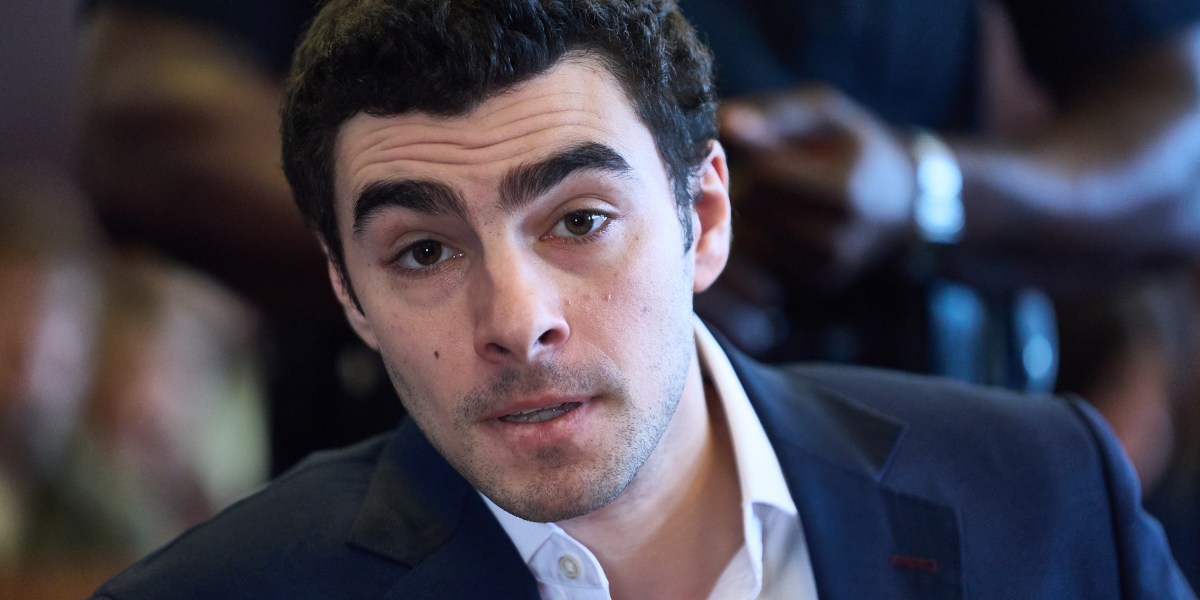
Mangione arrived to court each morning from a federal jail in Brooklyn, where he has been held since shortly after his arrest. He was given permission to wear regular clothes — a gray or dark blue suit and various button-down shirts — instead of jail garb and had his hands uncuffed throughout the proceedings.
One day, he pumped his fist for photographers. Another day, he shooed away a photographer he felt had gotten too close to him.
A backpack full of ‘goodies,’ including to-do lists and travel plans
Along with the gun and notebook, police officers said Mangione’s backpack was stuffed with food, electronics and notes including to-do lists, a hand-drawn map and tactics for surviving on the lam — items Altoona Police Sgt. Eric Heuston described as “goodies” that might link him to the killing.
‘Keep momentum, FBI slower overnight,’ said one note. ‘Change hat, shoes, pluck eyebrows,’ said another.
One note said to check for “red eyes” from Pittsburgh to Columbus, Ohio or Cincinnati (“get off early,” it reads). The map showed lines linking those cities, and noted other possible destinations, including Detroit and St. Louis.
Other items found on Mangione or in his bag included a pocketknife, driver’s license, passport, credit cards, AirPods, protein bar, travel toothpaste and flash drives.
Mangione talked behind bars, prison officers say
Before he was moved to New York City, Mangione was held under close watch in a special housing unit at a Pennsylvania state prison, SCI Huntingdon, about 19 miles (31 kilometers) west of Altoona.
Correctional officer Matthew Henry testified that Mangione made an unprompted comment to him that he had a backpack with a 3D-printed pistol and foreign currency when he was arrested.
Correctional officer Tomas Rivers testified that Mangione asked him whether the news media was focused on him as a person or on the crime of Thompson’s killing. He said Mangione told him he wanted to make a public statement.
Rivers said Mangione was in the special housing unit in part because the facility’s superintendent had said he “did not want an Epstein-style situation,” referring to Jeffrey Epstein’s suicide at a Manhattan federal jail in 2019.