Connect with us

Politics

Donald Trump says the U.S. has secured $17 trillion in new investments. The real number is likely much less
Published

on


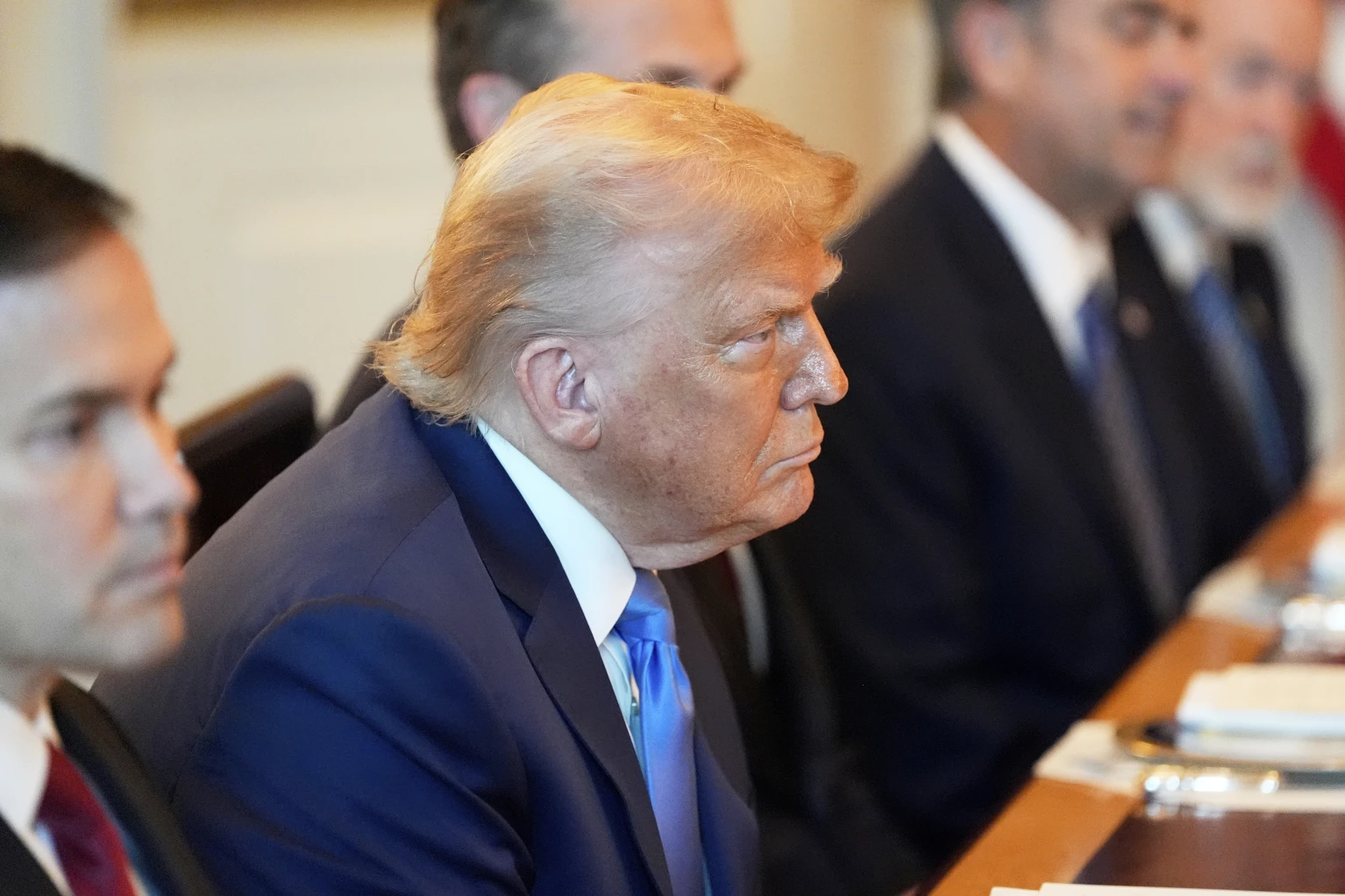
The economic boom promised by President Donald Trump centers on a single number: $17 trillion.

That’s the sum of new investments that Trump claims to have generated with his tariffs, income tax cuts and aggressive salesmanship of CEOs, financiers, tech titans, Prime Ministers, Presidents and other rulers. The $17 trillion is supposed to fund new factories, new technologies, more jobs, higher incomes and faster economic growth.

“Under eight months of Trump, we’ve already secured commitments of $17 trillion coming in,” the President said in a speech last month. “There’s never been any country that’s done anything like that.”

But based on statements from various companies, foreign countries and the White House’s own website, that figure appears to be exaggerated, highly speculative and far higher than the actual sum. The White House website lists total investments at $8.8 trillion, though that figure appears to be padded with some investment commitments made during Joe Biden’s presidency.

The White House didn’t lay out the math after multiple requests as to how Trump calculated $17 trillion in investment commitments. But the issue goes beyond Trump’s hyperbolic talk to his belief that the brute force of tariffs and shaming of companies can deliver economic results, a strategy that could go sideways for him politically if the tough talk fails to translate into more jobs and higher incomes.

Just 37% of U.S. adults approve of Trump’s handling of the economy, according to a September poll by The Associated Press-NORC Center for Public Affairs. That’s down from a peak of 56% in early 2020 during Trump’s first term — a memory he relied upon when courting voters in last year’s election.

Adam Posen, President of the Peterson Institute of International Economics, said the public commitments announced by Trump do represent a “meaningful increase” — but one that amounts to hundreds of billions of dollars, not trillions. Even then, that comes with long-term costs as countries might be less inclined to invest with the U.S. after being threatened to do so.

“It is a national security mistake because you’re turning allies into colonies of a sort — you’re forcibly extracting from them things that they don’t see as entirely in their interest,” Posen said. “Twisting the arms of governments to then twist the arms of their own businesses is not going to get you the payoff you want.”

Trump banking on foreign countries making good on promises

The Trump administration is betting that tariffs are an effective tool to prod other countries and international companies to invest in the United States, a big stick that other administrations failed to wield. Trump’s pitch to voters is that he will play a role in directly managing the investment commitments made by foreign countries — and that the allocation of that money starting next year will revive what has been a flagging job market.

“The difference between hypothetical investments and ground being broken on new factories and facilities is good leadership and sound policy,” said White House spokesman Kush Desai.

The White House said that Japan will invest $1 trillion, largely at Trump’s direction. The European Union will commit $600 billion. The United Arab Emirates made commitments of $1.4 trillion over 10 years. Qatar pledged $1.2 trillion. Saudi Arabia intends to pony up $600 billion, India $500 billion and South Korea $450 billion, among others.

The challenge is the precise terms of those investments have yet to be fully codified and released to the public, and some numbers are under dispute, potentially fuzzy math or, in the case of Qatar, more than five times the annual gross domestic product of the entire country. The White House maintains that Qatar is good for the money because it produces oil.

South Korea already has misgivings about its investment commitment, which is $100 billion lower than what the White House claims, after immigration agents raided a Hyundai plant under construction in Georgia and arrested Korean citizens. There are also concerns that an investment that large without a better way to exchange currencies with the U.S. could hurt South Korea’s economy.

“From what I’ve seen, these commitments are worth about as much as the paper they’re not written down on,” said Jared Bernstein, who was the Chairman of the Council of Economic Advisers in the Biden White House.

As for the $600 billion committed by European companies, that’s based on those businesses having “expressed interest” and having stated “intentions” to do so through 2029 rather than an overt concession, according to European Union documents.

Still too soon to see any investment impact in overall economy

So far, there has yet to be a notable boost in business investment as a percentage of U.S. gross domestic product. As a share of the overall economy, business investment during the first six months of Trump’s presidency has been consistently bouncing around 14%, just as it was before the pandemic.

But economists also note that Trump is double-counting and relying on investments that were initially announced during the Biden administration or investments that were already likely to occur because of the artificial intelligence build out.

For example, the White House lists a $16 billion investment by computer chipmaker Global Foundries. But of that sum, more than $13 billion was announced during the Biden administration and supported by $1.6 billion in grants by the 2022 CHIPS and Science Act, as well as other state and federal incentives.

Similarly, the White House is banking on $200 billion being invested by the chipmaker Micron, but at least $120 billion of that was announced during the Biden era.

‘The tariffs played a big role’

For their part, White House officials largely credit Trump’s tariffs — like those imposed on Oct. 1 on kitchen cabinets, large trucks and pharmaceutical drugs — for forcing companies to make investments in the U.S., saying that the risk of additional import taxes if countries and companies fail to deliver on their promises will ensure that the promised cash comes into the economy.

On Tuesday, Pfizer CEO Albert Bourla endorsed this approach after his pharmaceutical drug company received a three-year grace period on tariffs and announced $70 billion in investments in the U.S.

“The President was absolutely right,” Bourla said. “Tariffs is the most powerful tool to motivate behaviors.”

“The tariffs played a big role,” Trump added.

___

Republished with permission of The Associated Press.


Source link

Continue Reading

Politics

Early voting underway for Miami Mayor’s runoff between Eileen Higgins, Emilio González

Published

on


Early voting is underway in Miami as former County Commissioner Eileen Higgins and former City Manager Emilio González enter the final stretch of a closely watched Dec. 9 mayoral runoff.

The two candidates rose from a 13-person field Nov. 4, with Higgins winning about 36% of the vote and González taking 19.5%. Because neither surpassed 50%, Miami voters must now choose between contrasting visions for a city grappling with affordability, rising seas, political dysfunction and rapid growth.

Both promise to bring more stability and accountability to City Hall. Both say Miami’s permitting process needs fixing.

Higgins, a mechanical engineer and eight-year county commissioner with a broad, international background in government service, has emphasized affordable housing — urging the city to build on public land and create a dedicated housing trust fund — and supports expanding the City Commission from five to nine members to improve neighborhood representation.

She also backs more eco-friendly and flood-preventative infrastructure, faster park construction and better transportation connectivity and efficiency.

She opposes Miami’s 287(g) agreement with U.S. Immigration and Customs Enforcement, calling recent enforcement “inhumane and cruel,” and has pledged to serve as a full-time mayor with no outside employment while replacing City Manager Art Noriega.

González, a retired Air Force colonel, former Director of U.S. Citizenship and Immigration Services and ex-CEO of Miami International Airport, argues Miami needs an experienced administrator to fix what he calls deep structural problems.

He has made permitting reform a top priority, labeling the current system as barely functioning, and says affordability must be addressed through broader tax relief rather than relying on housing development alone.

He supports limited police cooperation with ICE and wants Miami to prepare for the potential repeal of homestead property taxes. Like Higgins, he vows to replace Noriega but opposes expanding the commission.

He also vows, if elected, to establish a “Deregulation Task Force” to unburden small businesses, prioritizing capital investments that protect Miamians, increasing the city’s police force, modernizing Miami services with technology and a customer-friendly approach, and rein in government spending and growth.

Notably, Miami’s Nov. 4 election this year might not have taken place if not for González, who successfully sued in July to stop officials from delaying its election until 2026.

The runoff has drawn national attention, with major Democrats like Democratic National Committee Chair Ken Martin, Arizona U.S. Rep. Ruben Gallego and Orange County Mayor-turned-gubernatorial candidate Jerry Demings and his wife, former Congresswoman Val Demings, backing Higgins and high-profile Republicans like President Donald Trump, Gov. Ron DeSantis and U.S. Sen. Rick Scott lining up behind González.

For both parties, Miami’s outcome is seen as a bellwether heading into a volatile 2026 cycle, in a city where growth, climate challenges and governance failures remain top concerns for nearly 500,000 residents.

Higgins, a 61-year-old Democrat who was born in Ohio and grew up in New Mexico, entered the race as the longest-serving current member of the Miami-Dade Commission. She won her seat in a 2018 Special Election and coasted back into re-election unopposed last year.

She chose to vacate her seat three years early to run for Mayor.

She worked for years in the private sector, overseeing global manufacturing in Europe and Latin America, before returning stateside to lead marketing for companies such as Pfizer and Jose Cuervo.

In 2006, she took a Director job with the Peace Corps in Belize, after which she served as a foreign service officer for the U.S. State Department under President Barack Obama, working in Mexico and in economic development areas in South Africa.

Since filing in April, Higgins raised $386,500 through her campaign account. She also amassed close to $658,000 by the end of September through her county-level political committee, Ethical Leadership for Miami. Close to a third of that sum — $175,000 — came through a transfer from her state-level PC.

She also spent about $881,000.

If elected, Higgins would make history as Miami’s first woman Mayor.

González, a 68-year-old born in Cuba, brought the most robust government background to the race. A U.S. Army veteran who rose to the rank of colonel, he served as Miami City Manager from 2017 to 2020, CEO of Miami International Airport (MIA) from 2013 to 2017 and as Director of Citizenship and Immigration Services at the U.S. Department of Homeland Security under President George W. Bush.

In private life, he works as a partner at investment management firm RSMD Investco LLC. He also serves as a member of the Treasury Investment Council under the Florida Department of Financial Services.

Since filing to run for Mayor in April, he raised nearly $1.2 million and spent about $1 million.

Election Day is Tuesday.


Source link

Continue Reading

Politics

Paul Renner doubles down on Cory Mills critique, urges more Republicans to join him

Published

on


Mills was a day-one Byron Donalds backer in the gubernatorial race.

A former House Speaker and current candidate for Governor is leading the charge for Republicans as scandal swirls around a Congressman.

Saying the “evidence is mounting” against Rep. Cory MillsPaul Renner says other candidates for Governor should “stand up and be counted” and join him in the call for Mills to leave Congress.

Renner made the call earlier this week.

But on Friday, the Palm Coast Republican doubled down.

He spotlighted fresh reporting from Roger Sollenberger alleging that Mills’ company “appears to have illegally exported weapons while he serves in Congress, including to Ukraine,” that Mills failed to disclose conflicts of interest, “tried to fistfight other Republican members of Congress, and lied about his party stature to bully other GOP candidates out of primaries that an alleged romantic interest was running in,” and lied about his conversion to Islam.

The House Ethics Committee is already probing Mills, a New Smyrna Beach Republican, over allegations of profiting from federal defense contracts while in Congress. More recently, the Committee expanded its work to review allegations that he assaulted one ex-girlfriend and threatened to share intimate photos of another.

Other candidates have been more reticent in addressing the issue, including Rep. Byron Donalds.

“When any other members have been involved and stuff like this, my advice is the same,” said Donalds, a Naples Republican. “They need to actually spend a lot more time in the district and take stock of what’s going on at home, and make that decision with their voters.”

The response came less than a year after Mills, a New Smyrna Beach Republican, spoke at the launch of Donalds’ gubernatorial campaign.

___

Staff writer Jacob Ogles contributed reporting.


Source link

Continue Reading

Politics

Eileen Higgins brings out starpower as special election campaign nears close

Published

on


Prominent Democrats will be on hand at a number of stops.

Former Miami-Dade Commissioner Eileen Higgins is enlisting more big names as support at early vote stops ahead of Tuesday’s special election for Mayor, including a Senate candidate, a former Senate candidate, and a current candidate for Governor.

During her canvass kickoff at 10 a.m at Elizabeth Virrick Park, Higgins will appear with U.S. Senate Candidate Hector Mujica.

Early vote stops follow, with Higgins solo at the 11 a.m. show-up at Miami City Hall and the 11:30 at the Shenandoah Library.

From there, big names from Orlando will be with the candidate.

Orange County Mayor and candidate for Florida Governor Jerry Demings and former Congresswoman Val Demings will appear with Higgins at the Liberty Square Family & Friends Picnic (2 p.m.), Charles Hadley Park (3 p.m.), and the Carrie P. Meek Senior and Cultural Center (3:30 p.m.)

Higgins, who served on the County Commission from 2018 to 2025, is competing in a runoff for the city’s mayoralty against former City Manager Emilio González. The pair topped 11 other candidates in Miami’s Nov. 4 General Election, with Higgins, a Democrat, taking 36% of the vote and González, a Republican, capturing 19.5%.

To win outright, a candidate had to receive more than half the vote. Miami’s elections are technically nonpartisan, though party politics frequently still play into races.


Source link

Continue Reading

Trending

Copyright © Miami Select.