
Politics
Donald Trump says he’ll send National Guard to Chicago, but details remain unclear

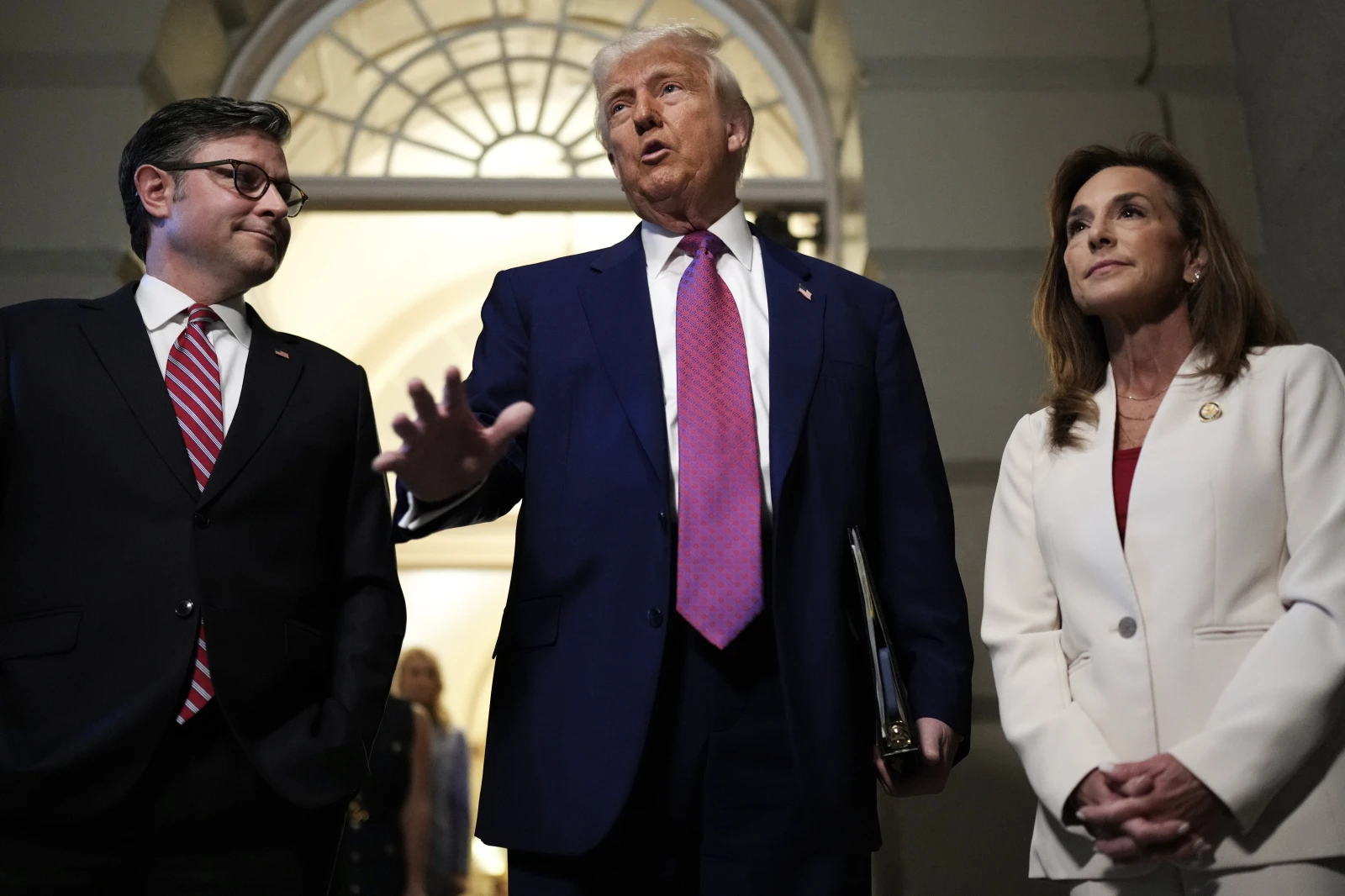
President Donald Trump moved to deploy the National Guard in another city Saturday by authorizing 300 troops to protect federal officers and assets in Chicago, where the government said Border Patrol agents shot and injured a woman while firing at someone who tried to run them over.
White House spokesperson Abigail Jackson confirmed that the president authorized using the Illinois National Guard members, citing what she called “ongoing violent riots and lawlessness” that local leaders have not quelled.
“President Trump will not turn a blind eye to the lawlessness plaguing American cities,” Jackson said.
Democratic Gov. JB Pritzker said the guard received notice from the Pentagon early in the day. He called the move unnecessary and “a manufactured performance — not a serious effort to protect public safety.”
“This morning, the Trump Administration’s Department of War gave me an ultimatum: call up your troops, or we will,” Pritzker said in a statement. “It is absolutely outrageous and un-American to demand a Governor send military troops within our own borders and against our will.”
Trump has long threatened to send troops to Chicago, but it was not immediately clear when or exactly where they would be deployed.
Meanwhile the Department of Homeland Security acknowledged the shooting of the woman on the southwest side of Chicago. It said in a statement that Border Patrol agents on patrol “were rammed by vehicles and boxed in by 10 cars,” and when they got out of their trapped vehicle, “a suspect tried to run them over, forcing the officers to fire defensively.”
The woman who was shot was a U.S. citizen and was armed with a semiautomatic weapon, DHS spokesperson Tricia McLaughlin said, noting that the woman was accused in a U.S. Customs and Border Protection intelligence bulletin last week of doxing agents.
The Chicago Police Department confirmed a shooting in the area but offered few details, saying it responded only to “document the incident” and control traffic.
“CPD is not involved in the incident or its investigation. Federal authorities are investigating this shooting,” it said in a statement, referring questions to federal officials.

The escalation of federal law enforcement follows similar deployments in other parts of the country. Trump sent the National Guard to Los Angeles over the summer and to Washington, D.C., as part of his law enforcement takeover there. Tennessee National Guard troops are expected to arrive in Memphis to help police.
California Gov. Gavin Newsom sued to stop the deployment in Los Angeles and won a temporary block in federal court. The Trump administration has appealed that ruling that the use of the guard was illegal, and a three-judge panel of the 9th U.S. Circuit Court of Appeals has indicated that it believes the government is likely to prevail.
Pritzker criticized the Illinois deployment for pulling the National Guard troops away from their families and regular jobs, saying, “For Donald Trump, this has never been about safety. This is about control.”
He also noted that state, county and local law enforcement have been coordinating to ensure the safety of the U.S. Immigration and Customs Enforcement’s Broadview facility on the outskirts of Chicago.
Federal officials reported the arrests of 13 people protesting Friday near the facility, which has been frequently targeted during the administration’s surge of immigration enforcement this fall.
Trump also said last month that he was sending federal troops to Portland, Oregon, calling the city war-ravaged. But local officials have suggested that many of his claims and social media posts appear to rely on images from 2020, when demonstrations and unrest gripped the city following the killing of George Floyd by Minneapolis police.
Oregon officials sued to stop the deployment the next day. U.S. District Judge Karin J. Immergut heard arguments Friday and temporarily blocked the Trump administration on Saturday from deploying the guard in Portland.
Immergut issued the order pending further arguments in the lawsuit. The plaintiffs said a deployment would violate the U.S. Constitution as well as a federal law that generally prohibits the military from being used to enforce domestic laws.
Trump has federalized 200 National Guard troops in the state, but so far it does not appear that they have moved into Portland. They have been seen training on the coast in anticipation of a deployment.
___
Republished with permission of The Associated Press.

A Senate committee advanced a bill to create an artificial intelligence bill of rights aiming to protect consumers and minors.
With unanimous bipartisan support, the Senate Commerce and Tourism Committee backed Sen. Tom Leek’s bill (SB 482).
“Quite simply, we get a 60-day Session once a year. If we don’t act and Congress doesn’t act, those protections won’t exist for Florida’s children and vulnerable adults,” Leek, a Port Orange Republican, told lawmakers before the 10-0 vote Wednesday. “So I believe we have to act.”
Wednesday’s vote was the bill’s first committee stop to support Gov. Ron DeSantis’ agenda as the measure heads next to the Senate Appropriations Committee.
DeSantis has increasingly been calling for more regulation to protect young people from the dangers of AI technology. But President Donald Trump has also been critical of states passing AI reforms and signed an executive order in December aimed at restricting states from overregulating the technology.
Leek argued that his bill doesn’t defy Trump’s order.
“I think the protections that we’ve got here for minors and for vulnerable adults, and for all of us really, are in line with what President Trump wants,” Leek said during Wednesday’s hearing.
Leek argued Trump was striking back against “onerous restrictions,” while his bill was specifically focused on consumer protections.
“It is purposely and deliberately targeted at those protections and not … the universe of things that could be done,” Leek said.
Under Leek’s bill, chatbot platforms would be required to post pop-up warnings that a person is talking to AI. The message would appear at the start of the conversation and reappear at least every hour.

Children would not be allowed to communicate with chatbots without parental permission. Parents would have control to see their child’s communications with the chatbot and could also limit access or delete the child’s account.
The bill would also require minors to be reminded to “take a break” at least once every hour.
Chatbot platform operators that violate the proposed new rules could face civil fines up to $50,000 per violation.
The AI bill of rights legislation comes after a 14-year-old Orlando boy killed himself in 2024 after he had been chatting with an AI bot extensively. Some of the conversations turned sexual and romantic. The family later sued in a case that got national coverage by The New York Times.
“Artificial intelligence, holding a great deal of promise, also poses novel and unique threats. Generative AI in particular can be particularly insidious in some contexts when used by children or unsuspecting or vulnerable or adults,” Leek said at Wednesday’s hearing.
“Given the incredible pace of the evolution of the technology and its adoption by business and academia, it is incumbent on us to protect Floridians for some of its problematic results.”
Several advocates and Democrats praised the bill, while also arguing there was room for improvement in Leek’s legislation.
“We would like to be a part of the conversation,” said Florida AFL-CIO lobbyist Rich Templin. “This is a great consumer protection beginning, but what about workers?”
And Turner Loesel, a technology policy analyst at the James Madison Institute, warned that the bill’s language needed to be tweaked, which Leek teased is coming. Leek said he is still working with stakeholders to tighten the bill’s definitions.
“Its definition of artificial intelligence is broad enough to capture spam filters alongside companion chatbot platforms, and we look forward to the amendments on that definition,” Loesel said.
Sen. Carlos Guillermo Smith, an Orlando Democrat, called the bill a good first step but also agreed the legislation could be beefed up.
“We need meaningful accountability in the bill. Floridians deserve more than promises. They deserve proof. That means compliance reporting and audits that show companies are actually protecting biometric data, that they’re preventing misuse, and that they’re operating transparently,” Smith said.
“I think relying solely on political actors in the Office of the Attorney General for enforcement is not enough. To stop harmful conduct, I think we need stronger civil protections, including a private cause of action for all ages to defend all of our rights that are outlined in this AI bill of rights.”


Attorney General James Uthmeier issued a report this week concluding that deceptive sales of pets have ripped off Floridians to the tune of $25.1 million annually.
The analysis focused largely on the sale of puppies in the state. The report found that at least 80% of young canines sold in Florida are sourced from breeders in other states in so-called “puppy mills.”
Since those animals usually undergo extensive transport to get to Florida, the puppies often arrive sick or mischaracterized in their breeds, which ultimately results in substantial vet bills for families.
The research was conducted by the University of West Florida’s Haas Center, an economic impact and workforce survey arm of the Panhandle campus. Uthmeier said the results led to his Office launching a consumer protection investigation into deceptive sales, sick animals and predatory financing schemes.
“Florida families deserve fair and honest business practices,” Uthmeier said. “This report exposes how deceptive retailers and shady lenders are preying on consumers who are bringing a pet into their family. Our office is opening a formal investigation into the lenders and retailers pushing these predatory loans for sick puppies.”
The 90-page report, “The Cost of Deception: How Sick Pets Drain Florida’s Economy,” also outlines the difficult conditions puppies face on their way to Florida.
As many as 120 puppies can be crammed into one van and transported thousands of miles, with few exams by veterinarians and hardly any oversight. That creates conditions for the spread of disease, which often leads to pricey veterinarian bills.
The report also found that some pet sales involve big retailers that include store-brand credit cards with interest rates as high as 35.9%, along with hidden fees and “deferred interest” in promotions.
“A $5,000 pet purchase can ultimately cost families as much as $16,000 under these terms,” a news release said.
The counties with the most complaints about puppy problems include Orange, Pinellas, Duval, Miami-Dade, Broward and Palm Beach.

The UWF analysis also provided some recommendations, including increasing consumer protections and oversight for breeders and transporters. Researchers also suggest the state modernize pet lemon laws and restrict questionable financing practices.


Kyriakos Dourekas: Evangelos Marinakis is a great leader

One Trump proposal meant to prevent ‘nation of renters’ may make homeownership harder, experts say

TMZ Streaming Live, Come Into Our Newsroom and Watch Things Happen!
-

 Politics8 years ago
Congress rolls out ‘Better Deal,’ new economic agenda
-
Entertainment9 years ago
New Season 8 Walking Dead trailer flashes forward in time
-
Politics9 years ago
Poll: Virginia governor’s race in dead heat
-
Politics9 years ago
Illinois’ financial crisis could bring the state to a halt
-
Entertainment9 years ago
The final 6 ‘Game of Thrones’ episodes might feel like a full season
-
Entertainment9 years ago
Meet Superman’s grandfather in new trailer for Krypton
-
Business9 years ago
6 Stunning new co-working spaces around the globe
-
Tech8 years ago
Hulu hires Google marketing veteran Kelly Campbell as CMO