Connect with us

Politics

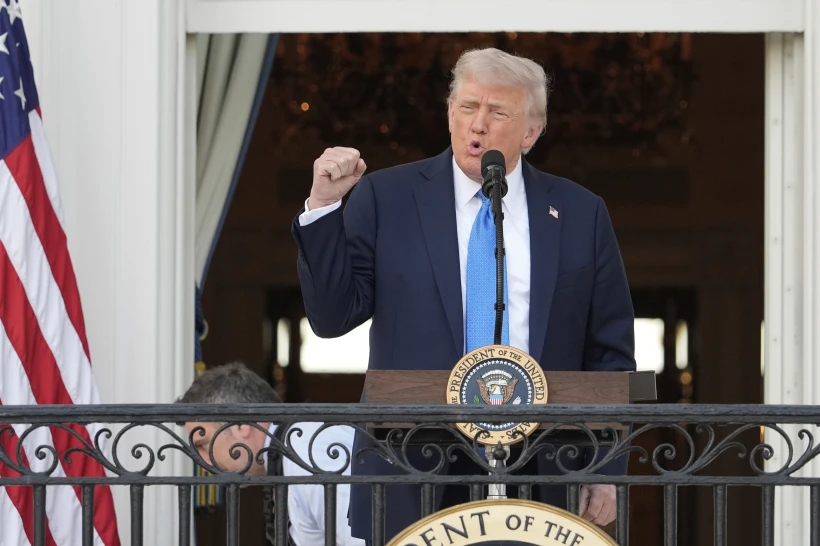
Donald Trump administration imposes limits on Mexican flights and threatens Delta alliance in trade dispute
Published

on


The Trump administration imposed new restrictions Saturday on flights from Mexico and threatened to end a longstanding partnership between Delta Air Lines and Aeromexico in response to limits the Mexican government placed on passenger and cargo flights into Mexico City several years ago.

Transportation Secretary Sean Duffy said Mexico’s actions to force airlines to move out of the main Benito Juarez International Airport to the newer Felipe Angeles International Airport more than 30 miles (48.28 kilometers) away violated a trade agreement between the two countries and gave domestic airlines an unfair advantage. Mexico is the top foreign destination for Americans with more than 40 million passengers flying there last year.

“Joe Biden and Pete Buttigieg deliberately allowed Mexico to break our bilateral aviation agreement,” Duffy said, referring to the previous president and his transportation secretary. “That ends today. Let these actions serve as a warning to any country who thinks it can take advantage of the U.S., our carriers, and our market. America First means fighting for the fundamental principle of fairness.”

All Mexican passenger, cargo and charter airlines will now be required to submit their schedules to the Transportation Department and seek government approval of their flights until Duffy is satisfied with the way Mexico is treating U.S. airlines.

It’s not immediately clear how Duffy’s actions might affect the broader trade war with Mexico and negotiations over tariffs. A spokesperson for Mexico’s President Claudia Sheinbaum didn’t reply immediately to a request for comment. Sheinbaum didn’t mention the new restrictions during either of her two speaking events on Saturday.

Delta and Aeromexico have been fighting the Transportation Department’s efforts to end their partnership that began in 2016 since early last year. The airlines have argued that it’s not fair to punish them for the Mexican government’s actions, and they said ending their agreement would jeopardize nearly two dozen routes and $800 million in benefits to both countries’ economies that come from tourism spending and jobs.

“The U.S. Department of Transportation’s tentative proposal to terminate its approval of the strategic and pro-competitive partnership between Delta and Aeromexico would cause significant harm to consumers traveling between the U.S. and Mexico, as well as U.S. jobs, communities, and transborder competition,” Delta said in a statement.

Aeromexico’s press office said it was reviewing the order and intended to present a joint response with Delta in the coming days.

But the order terminating approval of the agreement between the airlines wouldn’t take effect until October, and the airlines are likely to continue fighting that decision.

The airlines said in a previous filing fighting the order that it believes the loss of direct flights would prompt over 140,000 American tourists and nearly 90,000 Mexican tourists not to visit the other country and hurt the economies of both countries with the loss of their spending.

___

Republished with permission of The Associated Press.


Post Views: 0


Source link

Continue Reading

Politics

DNC declares Donald Trump’s first year in office a ‘complete disaster’

Published

on


Exactly one year ago, Donald Trump was sworn in for his second term while promising the American public that help was on the way, particularly regarding affordability.

The issue had already been creating major challenges for lower- and middle-income earners across the nation. One year in, Trump continues to claim the nation is enjoying an “economic boom.” But the Democratic National Committee (DNC) wholly disagrees, especially for Floridians.

“The numbers don’t lie: Trump’s first year back in office has been a complete disaster for Florida families. Trump broke his promise to lower costs on Day One and instead has made life far more expensive for Florida families,” said Tim Hogan, the DNC’s senior advisor for messaging, mobilization and strategy.

“Because of Trump’s Big Ugly Bill and failed economic policies, unemployment in Florida is up, families are paying $1,060 more a year, and 1,500,000 Floridians will be kicked off their health care after Trump let premiums skyrocket. While Donald Trump may think affordability is a hoax, Florida families know better, which is why they are putting their trust in Democrats who will keep fighting to lower costs and protect health care.”

A DNC study last week found Florida is one of 26 states where unemployment has risen since Trump took office, at a 0.7-percentage-point increase. The $1,060 figure is the approximate amount Florida households are losing through higher costs related to Trump’s tariffs and his “One Big Beautiful Bill” package, which the DNC and other Democratic groups have taken to calling the “Big Ugly Bill.”

The same study estimated that expiring premium tax credits under the Affordable Care Act would lead to 1.5 million Floridians losing health coverage, one of the highest numbers in the nation behind only California.

But the DNC’s critique does not stop there. Democrats point to a Joint Economic Committee Minority report this month finding that families paid $310 more for groceries during Trump’s first year in office than they did in 2024.

The DNC’s own study found that working American families have lost $585 to inflation and that nearly 4.5 million Floridians who rely on the Affordable Care Act’s marketplace for health coverage are seeing premiums skyrocket, which the DNC attributes to Trump’s refusal to extend tax credits. It’s worth noting that while Trump opposed extending the credits, Congress declined to pass an extension.

Additionally, cuts under the One Big Beautiful Bill to the Supplemental Nutrition Assistance Program, colloquially known as food stamps, will mean more than 1.6 million Floridians lose some or all of their food benefits, according to the DNC analysis. The Harvard Kennedy School found that the legislation is cutting about $186 billion from the program over 10 years, a 20% cut that is the largest in the program’s history.

And what the DNC describes as failures seem to be also resonating with the American public, with new polling on Trump’s first year in office showing twice as many Americans say Trump is focused on the wrong priorities as the right ones. The AP-NORC poll also shows 60% of U.S. adults think Trump has done more to hurt than help the cost of living in his second term.

Meanwhile, the poll finds only 4 in 10 approve of Trump’s job performance. While Trump is far underwater in his approval rating, it has improved slightly since December, when his disapproval was at 61%, compared to 59% now. Even at his highest approval since March, Trump was still underwater, with 53% disapproving of his job performance.


Source link

Continue Reading

Politics

New statewide insurance trust enters 2026 with sustained growth and millions more in taxpayer savings

Published

on


The Florida Educator Health Trust (FLEHT) enters 2026 less than a year old, but already with significant progress under its belt.

Established to help Florida School Districts save on employee health plans without having to pass along benefit reductions, the program opened last June with just three counties on board, representing 1,671 public school employees in DeSoto, Hardee and Hendry counties.

By the end of December, the nonprofit health insurance program had eight counties enrolled, with the addition of Brevard, Charlotte, Okeechobee, Highlands and Polk counties, bringing its total public school employee representation to nearly 22,000 people.

As of mid-January, more School Boards have voted to join the program at various points throughout 2026, which will bring the total counties enrolled to 15.

“In an era of rising health insurance costs for employees, we set out to provide much-needed services to School Districts without compromising benefits to educators, and it is working,” said Ted Roush, a former Superintendent of Schools and FLEHT Executive Director.

“In only 6 months, we have shown demonstrable savings to the districts, and consequently to taxpayers, realizing savings in the millions of dollars. Our growth — going from three to 15 counties in our first year of full operation — will allow us to continue achieving significant economies of scale, saving taxpayers even more money while maintaining a high level of health insurance for district employees.”

“By harnessing the power of the group district membership, FLEHT is able to perform for the whole what is not possible individually in the insurance marketplace,” Roush added.

The FLEHT realizes savings for School Districts by bringing Districts together to deliver efficient health programs for employees.

Formerly known as the FSHIP program, it was established in 2009 by the Florida School Board Insurance Trust. The program transitioned to FLEHT under the Florida Association of District School Superintendents last year. The change was meant to align the needs of Florida educators.

The FLEHT under its new structure is overseen by an executive committee composed of Superintendents, with all member Districts represented with voting trustees.

Hernando County is expected to be the next School Board to enter into a participation agreement with FLEHT. Program officials estimate they will have as many as 20 School Districts on board by Spring Break season. The group also estimates it has saved taxpayers more than $12 million.

The program is responding to rising health care premiums across the U.S. While cost of living is already creating a challenge, at an estimated 17% increase, health care premiums have increased by 45%, according to the National Council on Teacher Quality.

In order to participate in FLEHT, School Boards must first adopt a participation agreement. The District must already be or become self-insured. From there, the District establishes a transition plan into FLEHT and then formally enters the program. Once a District is a member, its Superintendent becomes a member/trustee of the program.

The program estimates savings of 7%-12% when fully transitioning from a fully-insured health insurance plan to a self-insured FLEHT participant. Within one to three years, the program claims members will enjoy savings of up to 13%.


Source link

Continue Reading

Politics

Austin Rogers considering a run to succeed Neal Dunn in CD 2

Published

on


The Panama City currently serves as Rick Scott’s General Counsel.

Austin Rogers may shift from advising U.S. Sen. Rick Scott to running for Congress himself. Sources close to Rogers, the General Counsel for Sen. Rick Scott, confirmed he is exploring a run to succeed retiring U.S. Rep. Neal Dunn in Florida’s 2nd Congressional District. The Lynn Haven Republican and Panama City native has worked for Scott.

The Federalist Society member holds both a law degree and a master’s in Theology from Duke University, where he also served on the Duke Law Journal and Harvard Journal of Law & Public Policy.

Before graduate school, he earned a bachelor’s in International Business in 2012 from Lakeland-based Southeastern University, then pursued a second degree in Theology from Wheaton College.

After clerking in the Middle District of Florida for Chief Judge Steven D. Merryday, Rogers worked for international law firm White & Chase, then took a job working on Capitol Hill.

He started work in 2023 as Senior Counsel of Oversight and Investigations for the Senate Judiciary Committee when it was chaired by U.S. Sen. Lindsey Graham, a South Carolina Republican, and rose to Chief Counsel within four months. He continued working for the Committee under its new Chair, U.S. Sen. Chuck Grassley, an Iowa Republican, and stayed there until taking a job with Scott last July.

He has been an active bar member in Washington, where he is also a member of the Republican National Lawyers Association and active in his local church.

Dunn announced last week that he would not seek re-election at the end of his fifth term.

Rogers, if he runs, will enter a rapidly crowding Republican Party field that already posts a couple of heavy hitters.

Republican Party of Florida Chair Evan Power, a Tallahassee Republican, filed for the seat last week. So did Keith Gross, another attorney who previously challenged Scott in a Republican Primary for his Senate seat in 2024.


Source link

Continue Reading

Trending

Copyright © Miami Select.