Connect with us

Business

Dominion Energy Virginia sues over Trump order to halt offshore wind project, calling it ‘arbitrary and capricious’

Published

on


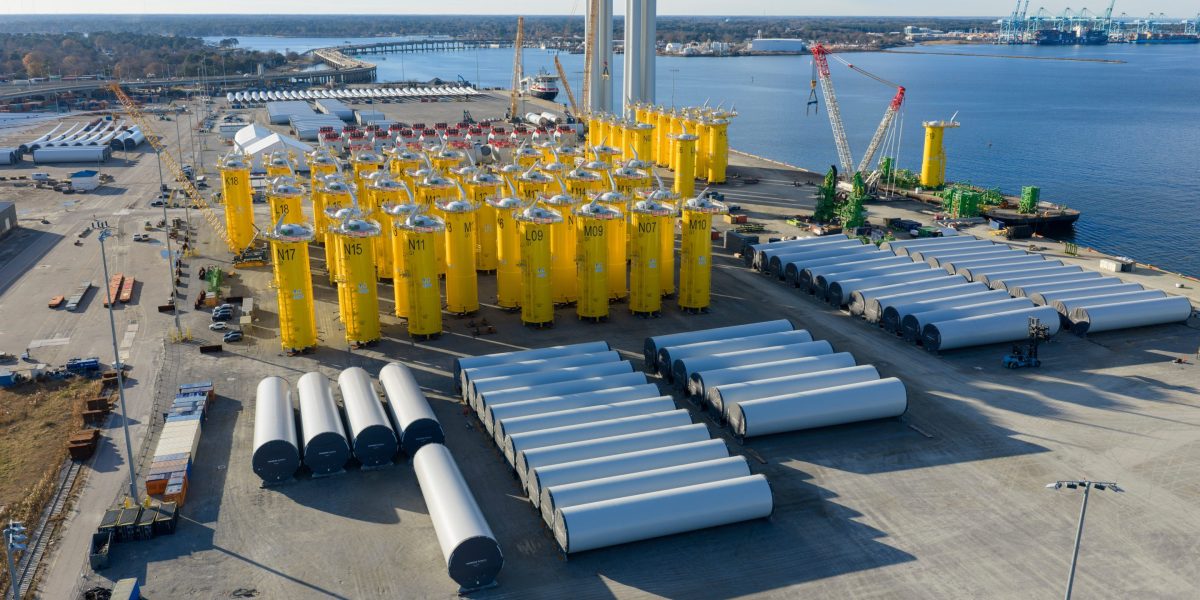
The developers of a Virginia offshore wind project are asking a federal judge to block a Trump administration order that halted construction of their project, along with four others, over national security concerns.

Dominion Energy Virginia said in its lawsuit filed late Tuesday that the government’s order is “arbitrary and capricious” and unconstitutional. The Richmond-based company is developing Coastal Virginia Offshore Wind, a project it says is essential to meet dramatically growing energy needs driven by dozens of new data centers.

The Interior Department did not detail the security concerns in blocking the five projects on Monday. In a letter to project developers, Interior’s Bureau of Ocean Energy Management set a 90-day period — and possibly longer — “to determine whether the national security threats posed by this project can be adequately mitigated.”

The other projects are the Vineyard Wind project under construction in Massachusetts, Revolution Wind in Rhode Island and Connecticut and two projects in New York: Sunrise Wind and Empire Wind. Democratic governors in those states have vowed to fight the order, the latest action by the Trump administration to hobble offshore wind in its push against renewable energy sources.

Dominion’s project has been under construction since early 2024 and was scheduled to come online early next year, providing enough energy to power about 660,000 homes. The company said the delay was costing it more than $5 million a day in losses solely for the ships used in round-the-clock construction, and that customers or the company would eventually bear the cost.

Dominion called this week’s order “the latest in a series of irrational agency actions attacking offshore wind and then doubling down when those actions are found unlawful.”

The Bureau of Ocean Energy Management didn’t immediately respond to an email seeking comment.

U.S. District Judge Jamar Walker set a hearing for 2 p.m. Monday on Dominion’s request for a temporary restraining order.

This story was originally featured on Fortune.com


Source link

Continue Reading

Business

Silver prices continue soaring as debt and geopolitical fears send precious metals to new records

Published

on


As markets reopened Friday after the Christmas holiday, U.S. stocks were little changed, but precious metals saw plenty of action.

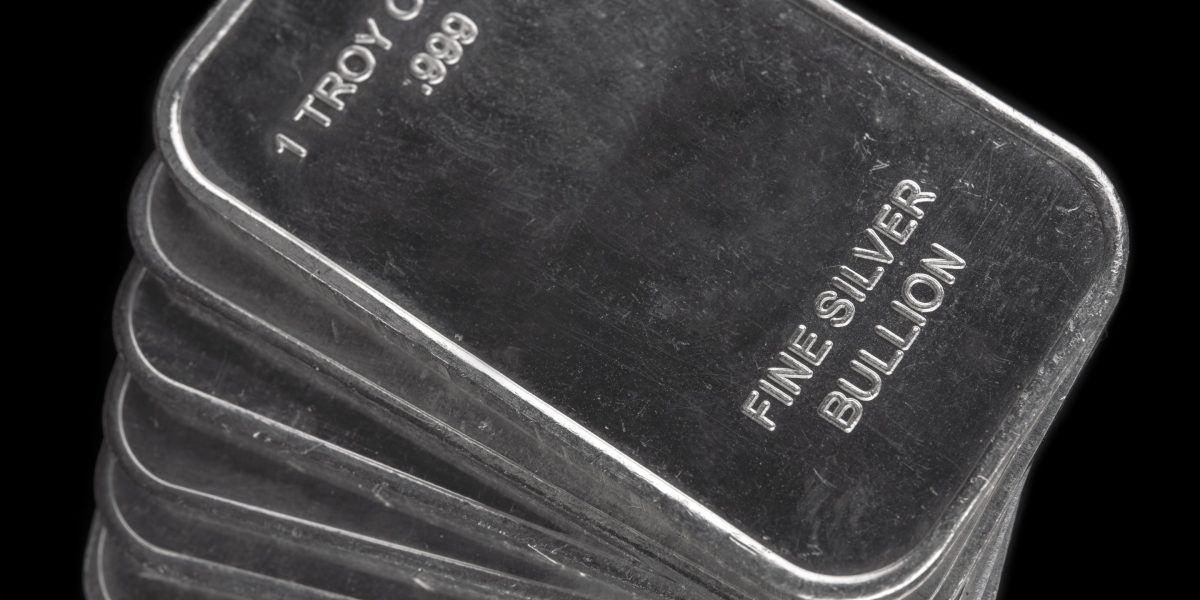
Silver prices jumped 9.6% to top $78 per ounce for the first time ever. Gold rose 1.3% to a fresh record of $4,561 per ounce, and platinum surged 10.5% to its own high, while palladium leapt 13%.

So far this year, silver has spiked 169%, platinum has shot up 172%, and palladium has soared 124%—all easily beating gold’s year-to-date gain of 73% as well as Nvidia’s 42% pop and the S&P 500’s 18% advance.

The latest rally came after the U.S. launched strikes on Islamic State targets in Nigeria on Thursday, adding to other geopolitical tensions.

Earlier in the week, the Trump administration continued to pile on more pressure on Venezuela by targeting additional oil tankers, squeezing a key source of revenue for the Maduro regime.

Meanwhile, the Pentagon sent large numbers of special-operations aircraft, troops and gear into the Caribbean, sources told the Wall Street Journal.

The extra military assets join a flotilla of Navy ships that has been building up in the region for months, while President Donald Trump hints that U.S. attacks will soon expand from suspected drug boats to targets on land.

With the threat of a new regional conflict breaking out, investors have sought out safe-havens. At the same time, debt worries have made precious metals appear safer than other assets like the dollar and yen.

Robin Brooks, a senior fellow at the Brookings Institution, said in Substack post on Sunday that the so-called debasement trade has roared back, pointing out that precious metals began galloping higher after Fed Chairman Jerome Powell hinted at rate cuts over the summer.

“First, this trade is clearly triggered by Fed easing and related worries about debt monetization,” Brooks wrote. “After all, Chair Powell’s dovish speech at Jackson Hole on Aug. 22 and the latest Fed rate cut on Dec. 10 were big catalysts for precious metals to take off.”

As the U.S. and other top economies hurtle toward increasingly unsustainable levels of debt, investors fear that those governments will let inflation run hotter and erode the value of their bonds to lighten the burden, rather than reining in deficits.

This debasement trade isn’t just showing up in precious metals, Brooks added, noting that countries with low levels of public debt such as Switzerland or Sweden have seen their currencies move in tandem with gold and silver prices.

“It’s noteworthy that Sweden is so much in focus. The Krona has traditionally been a highly volatile currency that didn’t have safe haven attributes. The debasement trade is changing that,” he explained.

Similarly, market veteran Ed Yardeni attributed the surge in precious metals to concerns about excess stimulative effects of U.S. monetary and fiscal policies next year.

That’s as Wall Street expects more rate cuts from the Federal Reserve, which is also buying bonds again, while consumers will start to notice Trump’s tax cuts. Trump has also teased the possibility of “tariff dividend” checks, though Congress would have to approve them.

“In any event, the federal budget deficit could balloon significantly during the first four months of 2026, which might prompt the Bond Vigilantes to raise Treasury bond yields, causing a stock market correction,” Yardeni said in a note on Monday.


Source link

Continue Reading

Business

Anduril founder Palmer Luckey is among the U.S. defense execs and companies sanctioned by China over arms sales to Taiwan

Published

on


Beijing imposed sanctions on Friday against 20 U.S. defense-related companies and 10 executives, a week after Washington annoucned large-scale arms sales to Taiwan.

The sanctions entail freezing the companies’ assets in China and banning individuals and organizations from dealing with them, according to the Chinese foreign ministry.

The companies include Northrop Grumman Systems Corporation, L3Harris Maritime Services and Boeing in St. Louis, while defense firm Anduril Industries founder Palmer Luckey is one of the executives sanctioned, who can no longer do business in China and are barred from entering the country. Their assets in the East Asian country have also been frozen.

The announcement of the U.S. arms-sale package, valued at more than $10 billion, has drawn an angry response from China, which claims Taiwan as its own and says it must come under its control.

If approved by the American Congress, it would be the largest-ever U.S. weapons package to the self-ruled territory.

“We stress once again that the Taiwan question is at the very core of China’s core interests and the first red line that must not be crossed in China-U.S. relations,” the Chinese foreign ministry said in a statement on Friday. “Any company or individual who engages in arms sales to Taiwan will pay the price for the wrongdoing.”

The ministry also urged the U.S. to stop what it called “the dangerous moves of arming Taiwan.”

Taiwan is a major flashpoint in U.S.-China relations that analysts worry could explode into military conflict between the two powers. China says that the U.S. arms sales to Taiwan would violate diplomatic agreements between China and the U.S.

China’s military has increased its presence in Taiwan’s skies and waters in the past few years, holding joint drills with its warships and fighter jets on a near-daily basis near the island.

Under the American federal law, the U.S. is obligated to assist Taiwan with its self-defense, a point that has become increasingly contentious with China. Beijing already has strained ties with Washington over trade, technology and other human rights issues.

This story was originally featured on Fortune.com


Source link

Continue Reading

Business

U.S. launches strikes against Islamic State group in Nigeria after attacks target Christians

Published

on


President Donald Trump said the United States launched a “powerful and deadly” strike against forces of the Islamic State group in Nigeria, after spending weeks accusing the West African country’s government of failing to rein in the targeting of Christians.

In a Christmas evening post on his social media site Thursday, Trump did not provide details or mention the extent of the damage caused by the strikes in the northwestern state of Sokoto.

A Defense Department official, who insisted on anonymity to discuss details not made public, said the U.S. worked with Nigeria to carry out the strikes and that they’d been approved by Abuja.

Nigeria’s Ministry of Foreign Affairs said the cooperation included exchange of intelligence and strategic coordination in ways “consistent with international law, mutual respect for sovereignty and shared commitments to regional and global security.”

The Associated Press could not confirm the extent of the strikes’ impact.

Nigeria fights several armed groups

Nigeria is battling multiple armed groups, including at least two affiliated with IS, an offshoot of the Boko Haram extremist group known as the Islamic State West Africa Province in the northeast, and the less-known Lakurawa group prominent in the northwestern states, where the gangs use large swathes of forests as hideouts.

Security analysts said the target of the U.S. strikes could be the Lakurawa group, which in the last year has increasingly become lethal in the region, often targeting remote communities and security forces.

“Lakurawa is a group that is actually controlling territories in Nigeria, in Sokoto state and in other states like Kebbi,” said Malik Samuel, a Nigerian security researcher at Good Governance Africa. “In the northwest, there has been the incursion of violent extremist groups that are ideologically driven,” he said, blaming the incursion on the near absence of the state and security forces in hot spots.

Violence affecting Nigerians

Trump said the airstrikes were launched against IS militants “who have been targeting and viciously killing, primarily, innocent Christians.” Residents and security analysts have said Nigeria’s security crisis affects both Christians, predominant in the south, and Muslims, who are the majority in the north.

“Terrorist violence in any form, whether directed at Christians, Muslims or other communities, remains an affront to Nigeria’s values and to international peace and security,” the Nigerian Ministry of Foreign Affairs said.

Nigeria’s government has previously said in response to Trump’s criticisms that people of many faiths, not just Christians, have suffered attacks at the hands of extremist groups.

US measures affecting Nigeria

Trump ordered the Pentagon last month to begin planning for potential military action in Nigeria to try and curb what he called Christian persecution. The State Department recently announced it would restrict visas for Nigerians and their family members involved in killing Christians there.

And the U.S. recently designated Nigeria a “country of particular concern” under the International Religious Freedom Act.

Trump said U.S. defense officials had “executed numerous perfect strikes, as only the United States is capable of doing” and added that “our Country will not allow Radical Islamic Terrorism to prosper.”

Nigeria’s population of 220 million is split almost equally between Christians and Muslims. The country has long faced insecurity from various fronts, including Boko Haram, which seeks to establish its radical interpretation of Islamic law and has also targeted Muslims it deems not Muslim enough.

But attacks in Nigeria often have varying motives. There are religiously motivated ones targeting both Christians and Muslims, clashes between farmers and herders over dwindling resources, communal rivalries, secessionist groups and ethnic clashes.

The U.S. security footprint has diminished in Africa, where military partnerships have either been scaled down or canceled. U.S. forces likely would have to be drawn from other parts of the world for any larger-scale military intervention in Nigeria.

Trump has nonetheless kept up the pressure as Nigeria faced a series of attacks on schools and churches in violence that experts and residents say targets both Christians and Muslims.

Defense Secretary Pete Hegseth posted Thursday night on X: “The President was clear last month: the killing of innocent Christians in Nigeria (and elsewhere) must end.”

Hegseth said that U.S. military forces are “always ready, so ISIS found out tonight — on Christmas” and added, “More to come…Grateful for Nigerian government support & cooperation” before signing off, “Merry Christmas!”

This story was originally featured on Fortune.com


Source link

Continue Reading

Trending

Copyright © Miami Select.