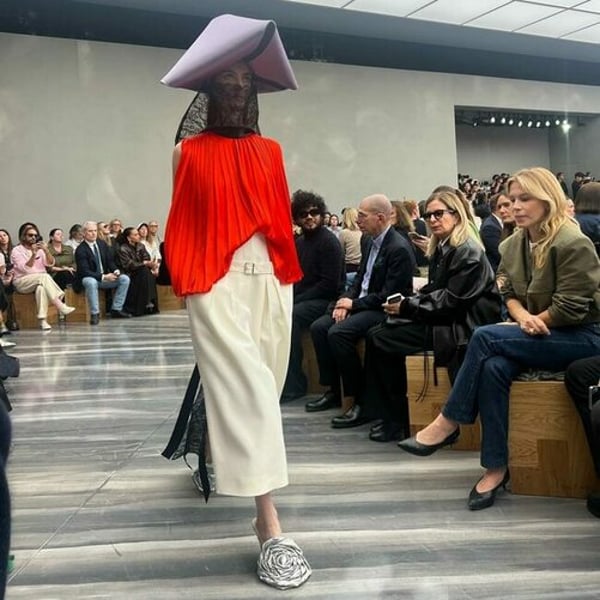
In a season of debuts, the biggest so far was at Dior on Wednesday, where Jonathan Anderson debuted in women’s wear spectacularly with a novel new vision of the house’s famed New Look.
Dior – Women’s Spring/Summer 2026 runway show – FashionNetwork.com
Or new looks rather, as Anderson riffed on many of Monsieur Dior’s earliest creations, and over a dozen Bar jackets, though very much on his own terms.
The show space set—created by film director Luca Guadagnino and Stefano Baisi, for whom Anderson dressed the lead actors in his tennis movie “Challengers”—was centered around an inverted pyramid. Like previous Dior shows, the show tent was built on top of the largest fountain inside the Tuileries.
Kicking off the action not with clothes, but with a punchy agit-prop video shot by one of Anderson’s heroes, documentarist Adam Curtis, whose noted documentary “Hypernormalisation” ‘really changed my life. It’s about how society got to where we are today,’ explained Anderson in a pre-show morning preview.
The video proved to be excellent—a Zoo TV-worthy mash-up of Dior’s historic highlights: Monsieur Dior looking stern; Gianfranco Ferré at a fitting; John Galliano in a space suit; and a brilliant compendium of great shows with clips from classic movies where Dior dressed stars like Marlene Dietrich. It produced a huge roar of applause.
Anderson then opened with a striking new dress, made of two lengths of silk tied into two large knots, sculpted over an interior structure—setting the scene for a highly experimental show.
Dior – Women’s Spring/Summer 2026 runway show – FashionNetwork.com
He showed multiple versions of the Bar jacket: elongated as in the original, though paired with his Dior menswear multi-pleat cargo shorts; or undulating and ruffled at the back so it stuck out; or cut large into a bulky coat. Think hybrid Bar jacket. Or what Jonathan termed “expanding the proposition into a different kind of universe.”
The Northern Irish-born designer also played with lots of jersey or cashmere knits, combining some with bunches of fabric hydrangeas—an abstract version of which had already been seen at the Toronto Film Festival on Anya Taylor-Joy, who sat front row. He also lifted a few ideas from his menswear debut with some superb fracks: Edwardian-style shirts and cargo shorts. His fabrics were often blends of classic Dior, like silk mohair, with JW’s traditional cotton twill.
In a heavy-duty front row, LVMH patron and Dior owner Bernard Arnault sat chatting happily with Brigitte Macron on his left and Charlize Theron on his right. However, the biggest photo pop was Johnny Depp in a Dior gray suit and a gangster hat.
Like in his Dior menswear debut in June, he played a lot with the neckline, discovering an early ’60s Saint Laurent high lace collar—a radical look and a collar that cascaded down the back to the floor.
Considering the Curtis video, Anderson explained: “In a weird way… it was what my brain was like for the last two months. You know, Dior is big. The brand is big, and ultimately, the imagination of the brand in the public eye is big. There are films about Dior, there are documentaries about it, and there are books on it. And I think there is this weight. In a weird way, it is sometimes nearly like there is a fantasy in it that is cinematic. If you look at how Dior worked with Hitchcock and Marlene Dietrich, there’s this like campness.”
Lovers of fine hats will also adore this show—taking the Bar hat and turning it on itself, or cutting others into tricorns like aircraft wings, or revamping nun’s cornets. He also scored with a new triangular bag tied with a little knot that is named Cigale.
Quite frankly, one key reason Anderson got the job at Dior was his remarkable success at Loewe, LVMH’s leading Spanish label, with the Puzzle bag—the best-selling bag in Harrods by all accounts. He will be expected to produce a hit leather bag at Dior, something the brand has not really delivered since launching the Lady D and Saddle some two decades ago.
Dior – Women’s Spring/Summer 2026 runway show – FashionNetwork.com
In his pre-show preview for Italian and Irish editors, Anderson was disarmingly honest. Asked what his biggest challenge was on entering Dior, he responded: “I am not a couture designer.”
Pleading for patience to develop his vision before boards featuring all 75 looks, Anderson added: “There’s this thing about dressing up, by the kind who revere fashion. So, I think over the next while we will play with this tension. And try to work out where Dior can go, because it cannot happen tomorrow or today. It’s not going to happen today. And it’s going to take time to kind of work out where the new type of tension within it is.”
That tension also exists in Curtis’ most famous documentary “Hypernormalisation.” A skillful montage of newsreel footage of recent history and conspiracy theories, it is certainly thought-provoking. It suggests that nothing ever changes politically anymore, as a cabal of politicians, rich corporate owners, and technological utopians now control the world via antidepressant drugs and social media—constructing a “fake world” to control global citizens.
A somewhat odd choice for a fashion movie, given it’s an industry that is meant to be all about change. And given that Anderson’s patron is Europe’s richest man.
All told, after a week in Milan where four debutant designers at major houses mainly played quite safe, it was impressive to witness how many risks Anderson was prepared to take at Dior. He does not lack guts. Was it a huge hit? Perhaps not, but it is a fascinating work in progress.
With fashion weeks having kicked off in earnest this month, the world’s top buyers are gathering their thoughts about what they expect affluent shoppers to snap up come AW26 collections arriving in-store and Simon Longland, director of fashion buying at London’s Harrods, is among them.
Just back from the Milan menswear shows, he highlighted the importance of timeless fashion.
“Milan menswear has always lived between two opposing forces: Fashion with a capital ‘F’, and quiet luxury rooted in sartorial tradition and timelessness,” he explained.
“This season, more than ever, the balance of the schedule leaned firmly towards the latter. The result was a Milan season defined by quality, cut, cloth and craft. There was a palpable sense that product integrity and the final customer were front and centre. Less noise, fewer theatrics—but a stronger, more coherent message around what modern luxury menswear looks like today: thoughtful, considered, and built to last.”
He hailed big names including Polo’s Purple Label, Zegna, Prada, Brioni and Dunhill both for the impact of the shows or presentations and the looks they included.
“This season, the strongest ‘shows’ were the ones that felt complete: a clear point of view, real product conviction, and a wardrobe that moves the customer forward,” he said. “Ralph Lauren’s return to Milan brought scale and theatre, but crucially it was backed by wearable, elevated classics that translate beautifully across Polo through Purple Label.
“Zegna delivered that modern luxury sweet spot—quiet confidence, investment dressing, and a proposition built on longevity and wardrobe building rather than novelty.
“And Prada was Prada in the best way: intellectually sharp, slightly disruptive, and refreshingly anti-‘power uniform’—a collection that challenged the idea of what contemporary menswear authority looks like.
Longland thought the best presentation was Brioni “because it understood the moment: craftsmanship, ease, and a sense of journey—luxury that doesn’t shout, it lasts”.
But he also liked Dunhill, calling it “a masterclass in mood and restraint—an incredibly precise take on British elegance, with the kind of tonal sophistication that customers immediately understand”.
As for the season’s top trends so far. In tailoring, he noted “a confident split: either slouchy, relaxed tailoring (softened shoulders, easier proportions), or clean, slim, sharply tailored lines for the customer who wants refinement without volume. Prada and the broader conversation around modern tailoring really underlined this shift”.
He also thought co-ords and tonal dressing were significant with “head-to-toe dressing in shades of one colour now a key styling language—particularly in neutrals and ‘quiet’ hues. It reads modern, premium, and effortless”.
Colour-wise, Longland called out the colours of nature: greens, greys, browns—earthy, mineral, and outdoors-referenced tones “that feel calm, grounded, and timeless”.
And as for materials, leather nd suede were crucial and could be found “everywhere in a more refined register—often softer, more tactile, and less overtly aggressive. It’s about texture, depth and longevity rather than statement”.
On the key item front, Longland’s backing bomber jackets that have “continued to evolve—less ‘street’, more luxury wardrobe essential: cleaner finishes, elevated fabrics, and styling that works over tailoring as easily as with casual trousers”.
And he sees a jacket or coat in “beautifully supple suede, ideally in chocolate brown or charcoal” as a “must-have” for the season. Why? “It perfectly encapsulates the season’s mood—luxurious yet understated, timeless yet modern, and endlessly versatile within a contemporary wardrobe”.
The Who’s Next trade show, held in Hall 7 of the Parc des Expositions (Paris XV) from January 17 to 19, put accessory brands centre stage. Eyewear, jewellery of every kind, bags, mittens, and headwear – buyers were spoilt for choice. Among these brands, a few caught the eye of FashionNetwork.com.
Italian Okkia and its affordable eyewear
Founded in 2016, this Italian brand specializes in affordable eyewear. – Okkia
Founded in 2016, Okkia is an Italian brand offering affordable eyewear, from prescription frames to sunglasses. It is exhibiting at Who’s Next for the first time, with ambitious international plans. Its attractive pricing — €25 for prescription glasses, €27 for sunglasses and €40 for both — helped it sell one million units in 2025. Already widely distributed across Europe, the brand is also present in the United States, several Latin American countries, Turkey and the Maldives. It now aims to establish itself in countries such as Australia, where it is not yet present, and to strengthen its global footprint. This year will see the launch of two new lines for Okkia, as well as a collaboration with Italian designer Seletti.
Lumielle Aurora 1896 holds umbrella licences for a number of brands, including Agnès b. – Lumielle Aurora 1896
Japanese premium umbrella brand Lumielle Aurora 1896 marked its second appearance at the show, having made its debut last September. The brand is seeking a foothold in European stores — a strategy only recently set in motion — but is, for now, hampered by its pricing. Made in Japan from textiles produced in-house in the Niigata region, these umbrellas, with wooden or bamboo handles, have so far found limited traction in Europe. Lumielle Aurora 1896 has, therefore, developed a more affordable line, presented at the show alongside parasols for hot weather. Aurora has also owned Tokyo Hat since 2007, a brand of caps and other headwear featured across several stands. With a more contemporary offer, Tokyo Hat hopes to win over retailers with a younger clientele and a taste for creative fashion.
The timeless Le Béret Français and Le Bonnet Français
Le Béret Français regularly benefits from French lifestyle trends – Le Béret Français
Le Béret Français and its recently acquired subsidiary, Le Bonnet Français, were also in attendance this January. Le Béret Français, which holds the Entreprise du Patrimoine Vivant (EPV) label, aims to maintain its positive growth trajectory, particularly buoyed in recent years by the Rugby World Cup in France and the Paris 2024 Olympic and Paralympic Games. With €1 million in annual sales, the company nevertheless faces strong competition from other brands, whose product quality is not always on a par with its own, made in Bayonne from French wool. Even so, Le Béret Français can boast sales to a wide range of partners, including department stores, milliners and even museums, whose end consumers are very diverse.
Who’s Next also boasted a broad line-up of exhibitors, including Naked Wolfe and its colourful shoes, Zen Collective and its Buddhist bracelets, and Hinterveld and its thick mohair scarves.
A year-and-a-half after his fellow co-founder, Max Svärdh, stepped back, Albin Johansson is now doing the same at Axel Arigato, the label they founded together in 2014. In June 2024, the Swedish brand, renowned for its sneakers and chic streetwear, announced the appointment of Jens Werner as creative director, a role previously overseen by Max Svärdh.
Axel Arigato boutique – Axel Arigato
At that time, Johansson remained CEO of the brand, in which the investment firm Eurazeo took a majority stake in 2020. However, in early 2026, the company—which reportedly exceeded SEK 1 billion in turnover in 2024 (over €90 million)—appointed Frédéric Serrant to the role. He brings more than 16 years’ experience in international leadership roles across Asia and Latin America, gained at Adidas, the sports and lifestyle giant.
This expertise is expected to help Axel Arigato enter a new phase after years of expansion. The brand operates more than 15 standalone stores in major Scandinavian cities, as well as in key cities such as London, Paris, New York, Dubai and Berlin. It is also present in numerous department stores worldwide. However, this expansion has also eroded its margins, and the company has had to refine its strategy to limit operating losses.
“I am sincerely impressed by the remarkable work done so far to make Axel Arigato such a strong, distinctive and inspiring brand. It truly reflects the talent, passion and commitment of the teams, and I’m convinced that the brand’s potential is enormous. I look forward to joining the team, learning alongside them and writing the next chapters of the Axel Arigato story together,” commented Serrant, in a LinkedIn post.
Johansson will remain chairman of the board of directors.
This article is an automatic translation. Click here to read the original article.