The hunt is on. After unveiling its Spring/Summer 2026 collection on the runway to open Milan Women’s Fashion Week on September 23, Diesel is set to launch, later that evening, a life-sized interactive urban game. Conceived as a treasure hunt open to all by creative director Glenn Martens, it channels his trademark playful spirit and his drive to democratise fashion.
The brand launches an egg hunt before Easter – Diesel
Participants will be invited to set off in search of looks from the just-unveiled collection by Glenn Martens, scattered across Milan inside large transparent eggs. Everyone can take part in this unique egg hunt free of charge; simply register for the Diesel Egg Hunt on the brand’s website.
Each player will receive a dynamic map guiding them to the different looks. The first to arrive will be rewarded with personalised pieces from next spring’s collection, head-to-toe denim looks and the iconic 1DR-Dome bag, Diesel said in a press release. Piazza Beccaria, in the centre of Milan, will serve as the meeting point for curious onlookers, players and guests, with live music, a bar and entertainment to keep the evening going.
Last season, the label owned by Renzo Rosso’s Italian fashion group OTB organised an unprecedented event dedicated to street art, bringing together graffiti artists from around the world in Milan for an entire day to create a vast canvas to serve as the backdrop for its fashion show.
With this new interactive, playful and original initiative, Diesel reaffirms its image as a non-conformist brand. It brings the brand even closer to the wider public, while drawing attention at a time when Milan will be in the spotlight.
This article is an automatic translation. Click here to read the original article.
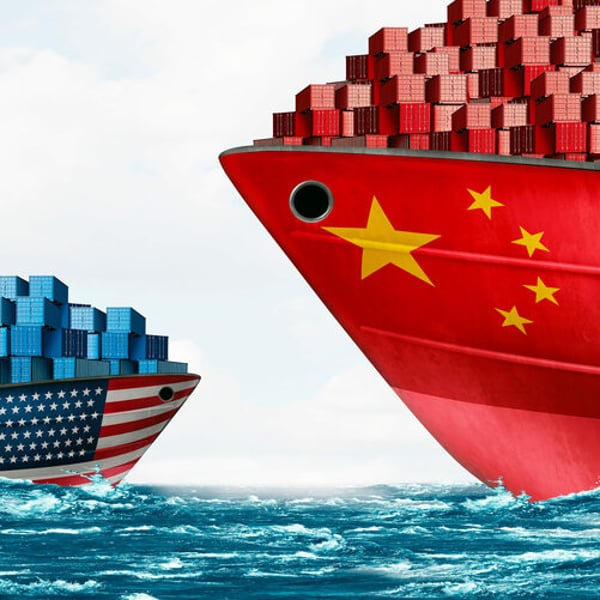
Donald Trump’s new tariffs have not curbed US textile and apparel imports, which held steady at $80.5 billion over the first three quarters. While China, the country’s leading supplier, saw shipments fall by 27% over the period, buyers simply shifted their orders to other Asian countries.
Shutterstock
The publication of these figures was delayed until December by the “shutdown,” which saw the US federal government shut down amid bitter budget negotiations. The consequences of the all-out tariff stand-off launched by the White House in April were widely anticipated; they can now be quantified.
China, the trade adversary singled out by Donald Trump, exported “only” $14.3 billion of textiles and apparel to the US market over nine months. This represents a 27% decline over the January to September period, yet China remains the US’s leading supplier.
Above all, China’s decline masks an acceleration in US orders from its direct competitors. Imports of textiles and apparel from South-East Asia rose by 15.9% to $24.3 billion.
A reshaping of US sourcing
Donald Trump sought to curb the influx of foreign production. In the end, the US president merely succeeded in shifting its origin slightly. To offset the new tariffs, US buyers turned to other countries that were sometimes less heavily taxed and, above all, offered lower production costs.
Vietnam, the US’s second-largest supplier of textiles and apparel, posted a 14.6% increase. In the ranking of suppliers, Vietnam is followed by India, up 10%, and, above all, Bangladesh, with a surge of 18.2%. Strong gains were also recorded by Cambodia (+25.8%), Indonesia (+12.9%), and Pakistan (+9.3%).
Imports from the USMCA area (US, Mexico, and Canada), where political tensions were high, remained broadly stable (-0.9%) at $3.8 billion, of which $3 billion came from Mexican production.
Europe holds steady
The European Union, the seventh-largest supplier of textiles and apparel to the US, posted a modest 1.9% increase to $4.04 billion worth of goods. This is a notable improvement on the 2.6% decline recorded in 2024.
Italy, at $1.9 billion, was stable over nine months, as was Portugal at $469 million. Germany accelerated by 9.3% to $373 million, while France rose by 2.2% to $330 million.
In the Euromed region, US customs figures show a 6.6% drop for Turkish goods, to $1.7 billion. Egypt was up 16.4% to $1.1 billion, while Morocco was down 16% to $177 million and Tunisia up 8.2% to $81 million.
Trends that began in January
This slowdown is all the more evident in light of the figures recorded in 2024. At that time, China exported $26 billion worth of textiles and apparel to the US, an increase of 3.5% that exceeded the total growth of American imports in this field (+2.6%).
After the election of Donald Trump and ahead of “Liberation Day”, the April 2 event marking the announcement of new tariffs, panic gripped US buyers. In the first quarter, they suddenly accelerated their textiles and apparel imports by 9.4% compared with the January to March 2024 period.
China captured only 3.6% of this increase, whereas other countries less targeted by Washington benefited far more from the situation. These included Vietnam (+14%), India (+20%), Bangladesh (+25%), Indonesia (+20%), Cambodia (+15.8%), and Pakistan (+10.5%).
This article is an automatic translation. Click here to read the original article.
Just a stone’s throw from the bustle of Paris’ Les Halles, Ementa’s new boutique at 11, rue Montmartre gleams in green. The brand, ‘driven by friendship,’ has been revealing itself there, beyond its stained-glass doorway, since its official opening on December 6. It marks a new milestone for founders Emídio Silva, Nikita Gorev, and Raphael Castilho, whose adventure began amid Portugal’s markets.
Ementa opened its first boutique outside Portugal in Paris – Ementa
Born directly from the skateboarding world, Ementa launched in 2007. The three friends, then students at Academia da Amadora near Lisbon, shared the dream of creating their own label, inspired by the sponsor pieces from their sporting circle. They knew little about running a business, but that didn’t stop them. They took out a loan and financed production of their first thousand T-shirts.
A retail turning point beginning in 2021
By 2021, time had passed, but Ementa remained active. That year, an opportunity arose to open its first boutique at LX Factory in the Portuguese capital. The shop was fitted out almost entirely in the DIY spirit cherished by its founders. Around six months later, Ementa opened a second brick-and-mortar shop on Rua da Boavista, near Cais do Sodré, again in Lisbon.
The majority of its production is based in Portugal – Ementa
The third shop opened in 2023: Ementa’s flagship in Chiado, a lively district in southern Lisbon. ‘This project represented a far greater challenge than the previous ones,” the brand notes. “In 2024, we opened a boutique dedicated to collaborations with artists and exclusive collections, located right next to our first boutique at LX Factory,” it continues. The time then seemed ripe for Ementa to venture beyond the capital. On August 10, 2024, it inaugurated its fifth boutique, on Rua Sá da Bandeira in Porto- a ‘major challenge’ for the brand.
A mid-range positioning
This retail journey culminates today with the Paris opening. The brand also works with 27 stockists in total, including seven in France, one in Italy, two in Germany, and two in the Netherlands, with the remainder in Portugal. Its products are therefore available in several European countries. “Our aim is to be represented by avant-garde stockists with a sophisticated image and clear objectives,” says the brand.
Ementa draws inspiration from the world of skateboarding – Ementa
Drawing on its skateboarding heritage, the Portuguese brand’s offer spans a wide range of ready-to-wear pieces, including jackets, jumpers, screen-printed sweatshirts and T-shirts, cropped polo shirts, corduroy trousers, jeans, and accessories. As a lifestyle brand, Ementa also offers plenty of scarves, socks, sunglasses, caps, a few pieces of jewellery, and bags. Its prices sit below those of brands such as Palace Skateboards and Drôle de Monsieur, even though the majority of its production takes place in northern Portugal.
Ementa now aims to maintain a rhythm of a drop every fortnight, to bridge the gap between its autumn-winter and spring-summer collections. The brand hopes to continue its retail adventure with new openings, strengthening its existing boutiques, and international expansion.
This article is an automatic translation. Click here to read the original article.
As the European Union prepares to impose a €3 levy on small non-EU parcels valued at under €150, the French Senate wants to increase the proposed national charge from €2 to €5. E-commerce organisation Fevad says this would be a mistake that could cost France half a billion euros and is urging lawmakers to change course.
Shutterstock
The Fédération française de la vente en ligne, which backs the French flat-rate tax proposal, is campaigning for the national levy to remain aligned with those of its neighbours. Several countries, including Belgium, the Netherlands, and Italy, are preparing their own €2 taxes on small non-EU parcels. In Fevad’s view, France would be shooting itself in the foot by falling out of step with neighbouring markets.
“To circumvent the new €5 French tax, non-EU platforms such as Shein and Temu will have little difficulty routing their small parcels destined for the French market via neighbouring countries where they already have logistics infrastructure, notably Belgium,” the federation says.
Fevad also points out that a €5 tax would cost France more than €500 million in lost revenue, due to parcels being redirected to port and airport hubs in neighbouring countries rather than in France.
A temporary European tax
This stance comes just days after the EU adopted a €3 EU-wide levy on non-EU parcels under €150. The measure will come into force on 1 July, but it will be temporary.
This flat-rate tax, irrespective of the parcel’s value, will apply pending the introduction of standard parcel taxation, which will then follow the usual tariff rules for personal consumer goods.
“While this is a step in the right direction towards levelling the playing field between EU-based and non-EU-based businesses, companies will also need clear operational arrangements to ensure legal certainty and to adapt their compliance models and internal IT systems in time,” says Luca Cassetti, secretary general of the European confederation Ecommerce Europe, of which Fevad is a founding member.
This article is an automatic translation. Click here to read the original article.