Connect with us

Business

Deutsche Bank on ‘the summer AI turned ugly’: ‘more sober’ than the dotcom bubble, with som troubling data-center math
Published

on


Deutsche Bank analysts have been watching Amazon Prime, it seems. Specifically, the “breakout” show of the summer, “The Summer I Turned Pretty.” In the AI sphere, analysts Adrian Cox and Stefan Abrudan wrote, it was the summer AI “turned ugly,” with several emerging themes that will set the course for the final quarter of the year. Paramount among them: The rising fear over whether AI has driven Big Tech stocks into the kind of frothy territory that precedes a sharp drop.

The AI news cycle of the summer captured themes including the challenge of starting a career, the importance of technology in the China/U.S. trade war, and mounting anxiety about the impact of the technology. But in terms of finance and investing, Deutsche Bank sees markets “on edge” and hoping for a soft landing amid bubble fears. In part, it blames tech CEOs for egging on the market with overpromises, leading to inflated hopes and dreams, many spurred on by tech leaders’ overpromises. It also sees a major impact from the venture capital space, boosting startups’ valuations, and from the lawyers who are very busy filing lawsuits for all kinds of AI players. It’s ugly out there. But the market is actually “more sober” in many ways than the situation from the late 1990s, the German bank argues.

Still, Wall Street is not Main Street, and Deutsche Bank notes troubling math about the data centers sprouting up on the outskirts of your town. Specifically, the bank flags a back-of-the-envelope analysis from hedge fund Praetorian Capital that suggests hyperscalers’ massive data center investments could be setting up the market for negative returns, echoing past cycles of “capital destruction.”

AI hype and market volatility

AI has captured the market’s imagination, with Cox and Abrudan noting, “it’s clear there is a lot of hype.” Web searches for AI are 10 times as high as they ever were for crypto, the bank said, citing Google Trends data, while it also finds that S&P 500 companies mentioned “AI” over 3,300 times in their earnings calls this past quarter.

Stock valuations overall have soared alongside the “Magnificent Seven” tech firms, which collectively comprise a third of the S&P 500’s market cap. (The most magnificent: Nvidia, now the world’s most valuable company at a market cap exceeding $4 trillion.) Yet Deutsche Bank points out that today’s top tech players have healthier balance sheets and more resilient business models than the high flyers of the dotcom era.

By most ratios, the bank said, valuations “still look more sober than those for hot stocks at the height of the dot-com bubble,” when the Nasdaq more than tripled in less than 18 months to March 2000, then lost 75% of its value by late 2002. By price-to-earnings ratio, Alphabet and Meta are in the mid-20x range, while Amazon and Microsoft trade in the mid-30x range. By comparison, Cisco surpassed 200x during the dotcom bubble, and even Microsoft reached 80x. Nvidia is “only” 50x, Deutsche Bank noted.

Those data centers, though

Despite the relative restraint in share prices, AI’s real risk may be lurking away from its stock-market valuations, in the economics of its infrastructure. Deutsche Bank cites a blog post by Praetorian Capital “that has been doing the rounds.” The post in “Kuppy’s Korner,” named for the fund’s CEO Harris “Kuppy” Kupperman, estimates that hyperscalers’ total data-center spending for 2025 could hit $400 billion, and the bank notes that is roughly the size of the GDP of Malaysia or Egypt. The problem, according to the hedge fund, is that the data centers will depreciate by roughly $40 billion per year, while they currently generate no more than $20 billion of annual revenue. How is that supposed to work?

“Now, remember, revenue today is running at $15 to $20 billion,” the blog post says, explaining that revenue needs to grow at least tenfold just to cover the depreciation. Even assuming future margins rise to 25%, the blog post estimates that the sector would require a stunning $160 billion in annual revenue from the AI powered by those data centers just to break even on depreciation—and nearly $480 billion to deliver a modest 20% return on invested capital. For context, even giants like Netflix and Microsoft Office 365 at their peaks brought in less than a fraction of that figure. Even at that level, “you’d need $480 billion of AI revenue to hit your target return … $480 billion is a LOT of revenue for guys like me who don’t even pay a monthly fee today for the product.” Going from $20 billion to $480 billion could take a long time, if ever, is the implication, and sometime before the big AI platforms reach those levels, their earnings, and presumably their shares, could take a hit.

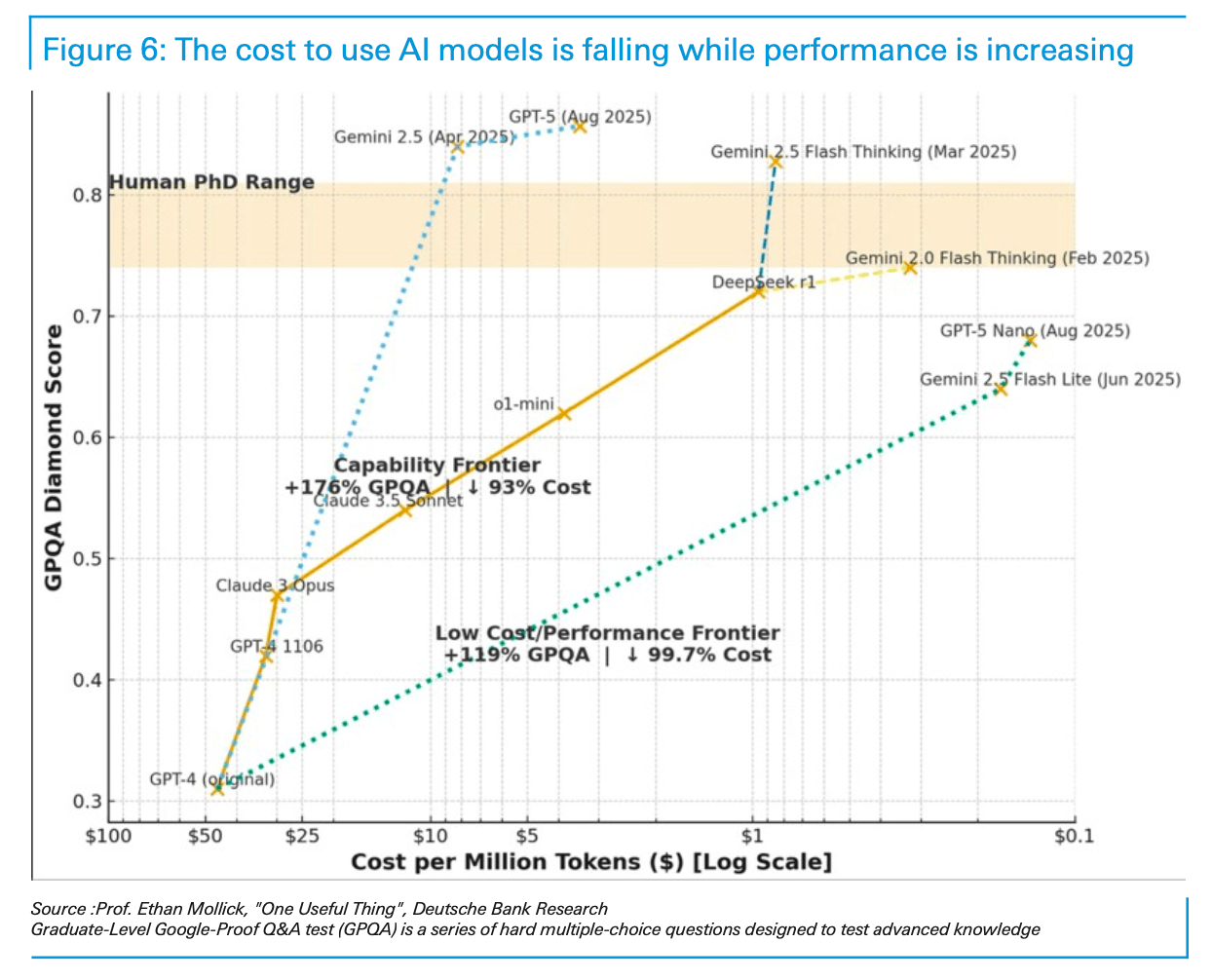
Deutsche Bank itself isn’t as pessimistic. The bank notes that the data-center buildout is producing a greatly reduced cost for each use of an AI model, as startups are reaching “meaningful scale in cloud consumption.” Also, consumer AI such as ChatGPT and Gemini is growing fast, with OpenAI saying in August that ChatGPT had over 700 million weekly users, plus 5 million paying business users, up from 3 million three months earlier. The cost to query an AI model (subsidized by the venture capital sector, to be sure) has fallen by around 99.7% in the two years since the launch of ChatGPT and is still headed downward.
Echoes of prior bubbles

Praetorian Capital draws two historical parallels to the current situation: the dotcom era’s fiber buildout, which led to the bankruptcy of Global Crossing, and the more recent capital bust of shale oil. In each case, the underlying technology is real and transformative—but overzealous spending with little regard for returns could leave investors holding the bag if progress stalls.

The “arms race” mentality now gripping the hyperscalers’ massive capex buildout mirrors the capital intensity of those past crises, and as Praetorian notes, “even the MAG7 will not be immune” if shareholder patience runs out. Per Kuppy’s Korner, “the megacap tech names are forced to lever up to keep buying chips, after having outrun their own cash flows; or they give up on the arms race, writing off the past few years of capex … Like many things in finance, it’s all pretty obvious where this will end up, it’s the timing that’s the hard part.”

This cycle, Deutsche Bank argues, is being sustained by robust earnings and more conservative valuations than the dotcom era, but “periodic corrections are welcome, releasing some steam from the system and guarding against complacency.” If revenue growth fails to keep up with depreciation and replacement needs, investors may force a harsh reckoning—one characterized not by spectacular innovation but by a slow realization of negative returns.

Fortune Global Forum returns Oct. 26–27, 2025 in Riyadh. CEOs and global leaders will gather for a dynamic, invitation-only event shaping the future of business. Apply for an invitation.


Source link

Continue Reading

Business

Hegseth likens strikes on alleged drug boats to post-9/11 war on terror

Published

on


Defense Secretary Pete Hegseth defended strikes on alleged drug cartel boats during remarks Saturday at the Ronald Reagan Presidential Library, saying President Donald Trump has the power to take military action “as he sees fit” to defend the nation.

Hegseth dismissed criticism of the strikes, which have killed more than 80 people and now face intense scrutiny over concerns that they violated international law. Saying the strikes are justified to protect Americans, Hegseth likened the fight to the war on terror following the Sept. 11, 2001 attacks.

“If you’re working for a designated terrorist organization and you bring drugs to this country in a boat, we will find you and we will sink you. Let there be no doubt about it,” Hegseth said during his keynote address at the Reagan National Defense Forum. “President Trump can and will take decisive military action as he sees fit to defend our nation’s interests. Let no country on earth doubt that for a moment.”

The most recent strike brings the death toll of the campaign to at least 87 people. Lawmakers have sought more answers about the attacks and their legal justification, and whether U.S. forces were ordered to launch a follow-up strike following a September attack even after the Pentagon knew of survivors.

Though Hegseth compared the alleged drug smugglers to Al-Qaida terrorists, experts have noted significant differences between the two foes and the efforts to combat them.

Hegseth’s remarks came after the Trump administration released its new national security strategy, one that paints European allies as weak and aims to reassert America’s dominance in the Western Hemisphere.

During the speech, Hegseth also discussed the need to check China’s rise through strength instead of conflict. He repeated Trump’s vow to resume nuclear testing on an equal basis as China and Russia — a goal that has alarmed many nuclear arms experts. China and Russia haven’t conducted explosive tests in decades, though the Kremlin said it would follow the U.S. if Trump restarted tests.

The speech was delivered at the Reagan National Defense Forum at the Ronald Reagan Presidential Foundation and Institute in California, an event which brings together top national security experts from around the country. Hegseth used the visit to argue that Trump is Reagan’s “true and rightful heir” when it comes to muscular foreign policy.

By contrast, Hegseth criticized Republican leaders in the years since Reagan for supporting wars in the Middle East and democracy-building efforts that didn’t work. He also blasted those who have argued that climate change poses serious challenges to military readiness.

“The war department will not be distracted by democracy building, interventionism, undefined wars, regime change, climate change, woke moralizing and feckless nation building,” he said.


Source link

Continue Reading

Business

US debt crisis: Most likely fix is severe austerity triggered by a fiscal calamity

Published

on


One way or another, U.S. debt will stop expanding unsustainably, but the most likely outcome is also among the most painful, according to Jeffrey Frankel, a Harvard professor and former member of President Bill Clinton’s Council of Economic Advisers.

Publicly held debt is already at 99% of GDP and is on track to hit 107% by 2029, breaking the record set after the end of World War II. Debt service alone is more than $11 billion a week, or 15% of federal spending in the current fiscal year.

In a Project Syndicate op-ed last week, Frankel went down the list of possible debt solutions: faster economic growth, lower interest rates, default, inflation, financial repression, and fiscal austerity. 

While faster growth is the most appealing option, it’s not coming to the rescue due to the shrinking labor force, he said. AI will boost productivity, but not as much as would be needed to rein in U.S. debt.

Frankel also said the previous era of low rates was a historic anomaly that’s not coming back, and default isn’t plausible given already-growing doubts about Treasury bonds as a safe asset, especially after President Donald Trump’s “Liberation Day” tariff shocker.

Relying on inflation to shrink the real value of U.S. debt would be just as bad as a default, and financial repression would require the federal government to essentially force banks to buy bonds with artificially low yields, he explained.

“There is one possibility left: severe fiscal austerity,” Frankel added.

How severe? A sustainable U.S. debt trajectory would entail elimination of nearly all defense spending or almost all non-defense discretionary outlays, he estimated.

For the foreseeable future, Democrats are unlikely to slash top programs, while Republicans are likely to use any fiscal breathing room to push for more tax cuts, Frankel said.

“Eventually, in the unforeseeable future, austerity may be the most likely of the six possible outcomes,” he warned. “Unfortunately, it will probably come only after a severe fiscal crisis. The longer it takes for that reckoning to arrive, the more radical the adjustment will need to be.”

The austerity forecast echoes an earlier note from Oxford Economics, which said the expected insolvency of the Social Security and Medicare trust funds by 2034 will serve as a catalyst for fiscal reform.

In Oxford’s view, lawmakers will seek to prevent a fiscal crisis in the form of a precipitous drop in demand for Treasury bonds, sending rates soaring.

But that’s only after lawmakers try to take the more politically expedient path by allowing Social Security and Medicare to tap general revenue that funds other parts of the federal government.

“However, unfavorable fiscal news of this sort could trigger a negative reaction in the US bond market, which would view this as a capitulation on one of the last major political openings for reforms,” Bernard Yaros, lead U.S. economist at Oxford Economics, wrote. “A sharp upward repricing of the term premium for longer-dated bonds could force Congress back into a reform mindset.”


Source link

Continue Reading

Business

The $124 trillion Great Wealth Transfer is intensifying as inheritance jumps to a new record

Published

on


Nearly $300 billion was inherited this year as the Great Wealth Transfer picks up speed, showering family members with immense windfalls.

According to the latest UBS Billionaire Ambitions Report, 91 heirs inherited a record-high $297.8 billion in 2025, up 36% from a year ago despite fewer inheritors.

“These heirs are proof of a multi-year wealth transfer that’s intensifying,” Benjamin Cavalli, head of Strategic Clients & Global Connectivity at UBS Global Wealth Management, said in the report.

Western Europe led the way with 48 individuals inheriting $149.5 billion. That includes 15 members of two “German pharmaceutical families,” with the youngest just 19 years old and the oldest at 94.

Meanwhile, 18 heirs in North America got $86.5 billion, and 11 in South East Asia received $24.7 billion, UBS said.

This year’s wealth transfer lifted the number of multi-generational billionaires to 860, who have total assets of $4.7 trillion, up from 805 with $4.2 trillion in 2024.

Wealth management firm Cerulli Associates estimated last year that $124 trillion worldwide will be handed over through 2048, dubbing it the Great Wealth Transfer. More than half of that amount will come from high-net-worth and ultra-high-net-worth people.

Among billionaires, UBS expects they will likely transfer about $6.9 trillion by 2040, with at least $5.9 trillion of that being passed to children, either directly or indirectly.

While the Great Wealth Transfer appears to be accelerating, it may not turn into a sudden flood. Tim Gerend, CEO of financial planning giant Northwestern Mutual, told Fortune’s Amanda Gerut recently that it will unfold more gradually and with greater complexity

“I think the wealth transfer isn’t going to be just a big bang,” he said. “It’s not like, we just passed peak age 65 and now all the money is going to move.”

Of course, millennials and Gen Zers with rich relatives aren’t the only ones who sat to reap billions. More entrepreneurs also joined the ranks of the super rich.

In 2025, 196 self-made billionaires were newly minted with total wealth of $386.5 billion. That trails only the record year of 2021 and is up from last year, which saw 161 self-made individuals with assets of $305.6 billion.

But despite the hype over the AI boom and startups with astronomical valuations, some of the new U.S. billionaires come from a range of industries.

UBS highlighted Ben Lamm, cofounder of genetics and bioscience company Colossal; Michael Dorrell, cofounder and CEO of infrastructure investment firm Stonepeak; as well as Bob Pender and Mike Sabel, cofounders of LNG exporter Venture Global.

“A fresh generation of billionaires is steadily emerging,” UBS said. “In a highly uncertain time for geopolitics and economics, entrepreneurs are innovating at scale across a range of sectors and markets.”


Source link

Continue Reading

Trending

Copyright © Miami Select.