Connect with us

Business

Denmark and Greenland agree to form working group over the future of the territory

Published

on


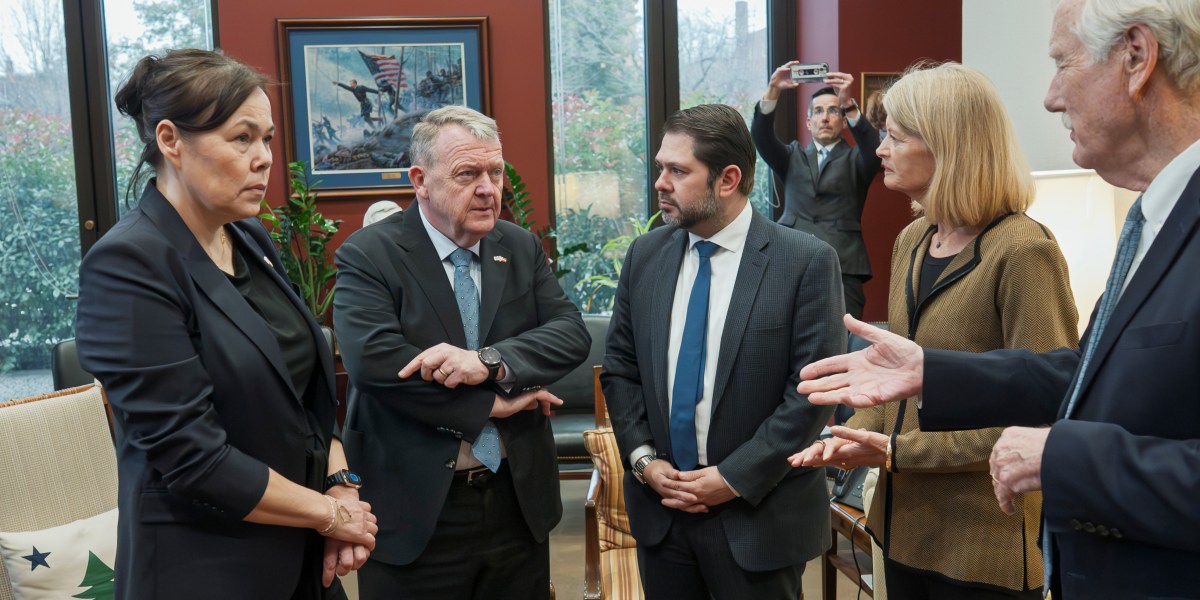
A top Danish official said Wednesday that a “fundamental disagreement” over Greenland remains with President Donald Trump after holding highly anticipated White House talks with Vice President JD Vance and Secretary of State Marco Rubio.

The two sides, however, agreed to create a working group to discuss ways to work through differences as Trump continues to call for a U.S. takeover of the semiautonomous territory of NATO ally Denmark.

“The group, in our view, should focus on how to address the American security concerns, while at the same time respecting the red lines of the Kingdom of Denmark,” Danish Foreign Minister Lars Løkke Rasmussen told reporters after joining Greenland’s foreign minister, Vivian Motzfeldt, for the talks. He added that it remains “clear that the president has this wish of conquering over Greenland.”

Trump is trying to make the case that NATO should help the U.S. acquire the world’s largest island and says anything less than it being under American control is unacceptable.

Denmark, meanwhile, announced plans to boost the country’s military presence in the Arctic and North Atlantic as Trump tries to justify his calls for a U.S. takeover of the vast territory by repeatedly claiming that China and Russia have their designs on Greenland, which holds vast untapped reserves of critical minerals.

The president did not take part in Wednesday’s meeting. In an Oval Office exchange with reporters following the talks, he reiterated his commitment to acquiring the territory.

“We need Greenland for national security,” Trump said. He added: “We’ll see how it all works out. I think something will work out.”

Before the meeting, Trump took to social media to make the case that “NATO should be leading the way” for the U.S. to acquire the territory.

“NATO becomes far more formidable and effective with Greenland in the hands of the UNITED STATES,” Trump wrote. “Anything less than that is unacceptable.”

NATO Secretary General Mark Rutte has sought to keep an arms-length away from the dispute between the most important power and the other members of the 32-country alliance unnerved by the aggressive tact Trump has taken toward Denmark.

Both Løkke Rasmussen and Motzfeldt offered measured hope that the talks were beginning a conversation that would lead to Trump dropping his demand of acquiring the territory and create a path for tighter cooperation with the U.S.

“We have shown where our limits are and from there, I think that it will be very good to look forward,” Motzfeldt said.

Denmark bolstering presence in Arctic

In Copenhagen, Danish Defense Minister Troels Lund Poulsen announced an increase in Denmark’s “military presence and exercise activity” in the Arctic and the North Atlantic, “in close cooperation with our allies”.

Poulsen said the stepped-up military presence was necessary in a security environment in which “no one can predict what will happen tomorrow.”

“This means that from today and in the coming time there will be an increased military presence in and around Greenland of aircraft, ships and soldiers, including from other NATO allies,” Poulsen said.

Other NATO allies were arriving in Greenland along with Danish personnel, he said. Poulsen declined to name the other countries contributing to an increased Arctic presence, saying that it is up to the allies to announce their own participation.

The new security commitments, at least those publicized by Greenland’s allies, appeared modest.

Germany said it would send 13 personnel this week to Greenland “to explore the framework for potential military contributions” on the island. Sweden announced Wednesday it was sending an unspecified number of personnel to Greenland for military exercises. And two Norwegian military personnel also were being sent to Greenland to map out further cooperation with allies, the country’s defense minister, Tore O. Sandvik, told newspaper VG.

NATO is also looking at how members can collectively bolster the alliance’s presence in the Arctic, said a NATO official who was not authorized to comment publicly and spoke on condition of anonymity. The official added there’s consensus “that security in the High North is a priority.”

Greenlanders want the US to back off

Greenland is strategically important because, as climate change causes the ice to melt, it opens up the possibility of shorter trade routes to Asia. That also could make it easier to extract and transport untapped deposits of critical minerals which are needed for computers and phones.

Trump says Greenland is also “vital” to the United States’ Golden Dome missile defense program. He also has said he wants the island to expand America’s security and has repeatedly cited what he says is the threat from Russian and Chinese ships as a reason to control it.

“If we don’t go in, Russia is going to go in and China is going to go in,” Trump argued anew Wednesday. “And there’s not a thing that Denmark can do about it, but we can do everything about it.”

But experts and Greenlanders question that claim, and it has become a hot topic on the snow-covered main street in Greenland’s capital, where international journalists and camera crews have descended as Trump continues his takeover talk.

“The only Chinese I see is when I go to the fast food market,” heating engineer Lars Vintner said. He said he frequently goes sailing and hunting and has never seen Russian or Chinese ships.

In interviews, Greenlanders said the outcome of the Washington talks didn’t exactly evince confidence that Trump can be persuaded.

“Trump is unpredictable,” said Geng Lastein, who immigrated to Greenland 18 years ago from the Philippines.

Maya Martinsen, 21, said she doesn’t buy Trump’s arguments that Greenland needs to be controlled by the U.S. for the sake maintaining a security edge in Arctic over China and Russia. Instead, Martinsen said, Trump is after the plentiful “oils and minerals that we have that are untouched.”

Greenland “has beautiful nature and lovely people,” Martinsen added. “It’s just home to me. I think the Americans just see some kind of business trade.”

Denmark has said the U.S., which already has a military presence, can boost its bases on Greenland. The U.S. is party to a 1951 treaty that gives it broad rights to set up military bases there with the consent of Denmark and Greenland.

Løkke Rasmussen and Motzfeldt, along with Denmark’s ambassador to the U.S., planned to meet later Wednesday with senators from the Arctic Caucus. A bipartisan delegation of U.S. lawmakers is also heading to Copenhagen this week to see Danish and Greenlandic officials.

Both Løkke Rasmussen and Motzfeldt said while they remain at loggerheads with Trump, it remains critical to keep talking.

“It is in everybody’s interest — even though we disagree — that we agree to try to explore whether it is doable to accommodate some of the concerns while at the same time respecting the integrity of the Danish kingdom’s territory and the self-determination of the Greenlandic people,” Løkke Rasmussen said.

___

Burrows reported from Nuuk, Greenland and Ciobanu from Warsaw, Poland. Associated Press writers Stefanie Dazio and Geir Moulson in Berlin, Lisa Mascaro, Aamer Madhani and Will Weissert in Washington and Catherine Gaschka in Paris contributed to this report.


Source link

Continue Reading

Business

Trump is sorry for deporting college student who flew home to surprise her family for Thanksgiving, but is still deporting her

Published

on


The Trump administration apologized in court for a “mistake” in the deportation of a Massachusetts college student who was detained trying to fly home to surprise her family for Thanksgiving, but still argued the error should not affect her case.

Any Lucia Lopez Belloza, a 19-year-old Babson College freshman, was detained at Boston’s airport on Nov. 20 and flown to Honduras two days later. Her removal came despite an emergency court order on Nov. 21 directing the government to keep her in Massachusetts or elsewhere in the United States for at least 72 hours.

Lopez Belloza, whose family emigrated from Honduras to the U.S. in 2014, is currently staying with grandparents and studying remotely. She is not detained and was recently visiting an aunt in El Salvador.

Her case is the latest involving a deportation carried out despite a court order. Kilmar Abrego Garcia was deported to El Salvador despite a ruling that should have prevented it. The Trump administration initially fought efforts to bring him back to the U.S. but eventually complied after the U.S. Supreme Court weighed in. And last June, a Guatemalan man identified as O.C.G. was returned to the U.S. after a judge found his removal from Mexico likely “lacked any semblance of due process.”

At a federal court hearing Tuesday in Boston, the government argued the court lacks jurisdiction because lawyers for Lopez Belloza filed their action several hours after she arrived in Texas while en route out of the country. But the government also acknowledged it violated the judge’s order.

In court filings and in open court, government lawyers said an Immigration and Customs Enforcement deportation officer mistakenly believed the order no longer applied because Lopez Belloza had already left Massachusetts. The officer failed to activate a system that alerts other ICE officers that a case is subject to judicial review and that removal should be halted.

“On behalf of the government, we want to sincerely apologize,” Assistant U.S. Attorney Mark Sauter told the judge, saying the employee understands “he made a mistake.” The violation, Sauter added, was “an inadvertent mistake by one individual, not a willful act of violating a court order.”

In a declaration filed with the court Jan. 2, the ICE officer also admitted he did not notify ICE’s enforcement office in Port Isabel, Texas, that the removal mission needed to be canceled. He said he believed the judge’s order did not apply once Lopez Belloza was no longer in the state.

The government maintains her deportation was lawful because an immigration judge ordered the removal of Lopez Belloza and her mother in 2016, and the Board of Immigration Appeals dismissed their appeal in 2017. Prosecutors said she could have pursued additional appeals or sought a stay of removal.

Her lawyer, Todd Pomerleau, countered that she was deported in clear violation of the Nov. 21 order and said the government’s actions deprived her of due process. “I was hoping the government would show some leniency and bring her back,” he said. “They violated a court order.”

U.S. District Judge Richard Stearns said he appreciated the government acknowledging the error, calling it a “tragic” bureaucratic mistake. But appeared to rule out holding the government in contempt, noting the violation did not appear intentional. He also questioned whether he has jurisdiction over the case, appearing to side with the government in concluding the court order had been filed several hours after she had been sent to Texas.

“It might not be anybody’s fault, but she was the victim of it,” Stearns said, adding at one point that Lopez Belloza could explore applying for a student visa.

Pomerleau said one possible resolution would be allowing Lopez Belloza to return to finish her studies while he works to reopen the underlying removal order.

This story was originally featured on Fortune.com


Source link

Continue Reading

Business

One year after Bill Gates surprised with the choice to close his foundation by 2045, he’s cutting staff jobs

Published

on


The Gates Foundation announced Wednesday that it will spend a record $9 billion in 2026, maximizing its spending in key areas such as global health. At the same time it will begin reducing the number of staff positions it has by as much as 500 over five years. This announcement comes in the wake of last year’s surprise decision to shutter the foundation in 2045.

The planned layoffs mark another major shift for one of the largest and most influential foundations in the world at a time when many of its long-term priorities, such as addressing poverty and improving global health, have been undermined by cuts in U.S. government spending by the Trump administration.

Bill Gates said last year that the foundation would spend $200 billion over the next 20 years and then close as part of his plan to give away the bulk of his wealth. This week, he and other members of the foundation’s board approved the largest budget in the foundation’s history, topping last year’s budget of $8.74 billion. With that new dollar amount, the foundation will increase budgets for several programs, including women’s health, vaccine development, polio eradication, AI, and U.S. education.

The board also approved a proposal to cap operating costs — including staff, salaries, infrastructure required to run the organization, facilities, and travel expenses — at no more than $1.25 billion, or approximately 14% of the foundation’s budget. To meet that goal, the grantmaker will cut up to 500 of its 2,375 staff positions by 2030, including some open roles that may remain unfilled. The effort to reduce the staff count along with other expenses will be done incrementally and reviewed annually rather than coming in “a big wave,” foundation CEO Mark Suzman told the Chronicle of Philanthropy in an interview.

“We will do this thoughtfully, carefully, and systematically,” he said. “We’ll be recalibrating it every year. That 500-person target is a maximum target. I very much hope that we won’t have to do it as large as that number.”

Spending money prudently

Suzman said he and other board members felt the operating costs cap was necessary. If left unchecked, the foundation’s operating expenditures, currently around 13% of the budget, were projected to approach 18% by the end of the decade, Suzman said. The board wants to ensure that the foundation is spending money prudently and with a focus on maximizing the dollars spent and resources provided to the people the foundation serves, he said.

The Gates Foundation is also the world’s largest foundation to decide to close, and many in philanthropy have wondered how its leaders will go about planning an exit strategy, said Elizabeth Dale, acting executive director and Frey Foundation Chair for Family Philanthropy at Grand Valley State University’s philanthropy center. She works with a group of about 20 foundations that are spending down their endowments. Sunsetting a foundation with the massive wealth of the Gates Foundation is unprecedented and will likely require strong strategic planning, Dale said before the release of the new budget and staffing details.

“My sense is that they spent the last year really trying to home in on their priorities and their strategy,” she said.

What’s next

Many of the foundation’s core areas of work and achievement over the past decades have suffered due to humanitarian aid cuts from the United States and other countries last year, making philanthropic support more critical. In a recent blog post, Bill Gates noted that the “world went backwards” last year when it comes to child deaths, with the number going up for the first time this century, from 4.6 million in 2024 to 4.8 million in 2025.

“The next five years will be difficult as we try to get back on track and work to scale up new lifesaving tools,” Gates wrote. “Yet I remain optimistic about the long-term future.” In an effort to address that backsliding, the foundation is expected to accelerate spending in three priority areas over the next two decades: maternal and child health, infectious disease prevention, and poverty reduction, Suzman said. It also is expected to increase some grant sizes over time, though not across the board.

In the same post, Gates also discussed the challenges that artificial intelligence poses, warning that the technology could disrupt the job market and be misused by “bad actors” if more attention isn’t paid to how it’s developed, governed, and deployed.

At the same time, Gates has championed AI adoption. The foundation was among a coalition of funders that last July pledged to offer $1 billion in grants and investments to help develop AI tools for public defenders, social workers, and other frontline workers in the United States over the next 15 years. And, Suzman noted, AI is one of the foundation’s portfolio areas that will continue to expand.

The foundation also is expanding its footprint in India and Africa. Earlier this week, it announced the creation of a new Africa and India Offices Division. Staff on the HIV and tuberculosis teams at Gates Foundation headquarters in Seattle also will be downsized as that work largely shifts to offices in Africa, he said.

20 more years to go

Though the foundation has announced plans to close, Suzman continues to remind people internally and externally that 20 years is still a significant amount of time for the Gates Foundation to operate and make an impact.

“We are moving into what I believe is going to be the most impactful period of the Gates Foundation in its history,” he said. “We’ve learned a huge amount over the last quarter century. We’ve built expertise, credibility, and partnerships. We now have a set of goals that are allowing us to focus with greater intentionality.”

____

Stephanie Beasley is fellowship director and a senior writer at the Chronicle of Philanthropy, where you can read the full article. This article was provided to The Associated Press by the Chronicle of Philanthropy as part of a partnership to cover philanthropy and nonprofits supported by the Lilly Endowment. The Chronicle is solely responsible for the content. For all of AP’s philanthropy coverage, visit https://apnews.com/hub/philanthropy.


Source link

Continue Reading

Business

Americans have been quietly plundering Greenland for over 100 years, since a Navy officer chipped fragments off the Cape York iron meteorite

Published

on


The Army also imagined hundreds of miles of rail lines buried inside Greenland’s ice sheet. On Project Iceworm’s tracks, atomic-powered trains would move nuclear-tipped missiles in snow tunnels between hidden launch stations – a shell game covering an area about the size of Alabama.

In the end, Project Iceworm never got beyond a 1,300-foot (400-meter) tunnel the Army excavated at Camp Century. The soft snow and ice, constantly moving, buckled that track as the tunnel walls closed in. In the early 1960s, first the White House, and then NATO, rejected Project Iceworm.

A U.S. Army truck with railroad wheels sits on a 1,300-foot-long track beneath the snow at Camp Century, Greenland. This is the closest the military got to realizing Project Iceworm. Robert W. Gerdel Papers, Ohio State University

In 1966, the Army abandoned Camp Century, leaving hundreds of tons of waste inside the ice sheet. Today, the crushed and abandoned camp lies more than 100 feet (30 meters) below the ice sheet surface. But as the climate warms and the ice melts, that waste will resurface: millions of gallons of frozen sewage, asbestos-wrapped pipes, toxic lead paint and carcinogenic PCBs.

Who will clean up the mess and at what cost is an open question.

Greenland remains a tough place to turn a profit

In the past, the American focus in Greenland was on short-term gains with little regard for the future. Abandoned bases, scattered around the island today and in need of cleanup, are one example. Peary’s disregard of the lives of local Greenlanders is another.

History shows that many of the fanciful ideas for Greenland failed because they showed little consideration of the island’s isolation, harsh climate and dynamic ice sheet.

Large rusted construction trucks and some fuel drums.

World War II-vintage trucks abandoned at a U.S. airfield in east Greenland were still there decades later. Posnov/Moment via Getty Images

Trump’s demands for American control of the island as a source of wealth and U.S. security are similarly shortsighted. In today’s rapidly warming climate, disregarding the dramatic effects of climate change in Greenland can doom projects to failure as Arctic temperatures climb.

Recent floods, fed by Greenland’s melting ice sheet, have swept away bridges that had stood for half a century. The permafrost that underlies the island is rapidly thawing and destabilizing infrastructure, including the critical radar installation and runway at Thule, renamed Pituffik Space Base in 2022. The island’s mountain sides are crashing into the sea as the ice holding them together melts.

The U.S. and Denmark have conducted geological surveys in Greenland and pinpointed deposits of critical minerals along the rocky, exposed coasts. However, most of the mining so far has been limited to cryolite and some small-scale extraction of lead, iron, copper and zinc. Today, only one small mine extracting the mineral anorthosite, which is useful for its aluminum and silica, is running.

It’s the ice that matters

The greatest value of Greenland for humanity is not its strategic location or potential mineral resources, but its ice. https://www.youtube.com/embed/9lnP0Rjb2E0?wmode=transparent&start=0 A NASA animation of satellite data shows Greenland’s ice sheet mass losses between 2002 and 2023, measured in meters of water equivalent in the ice.

If human activities continue to heat the planet, melting Greenland’s ice sheet, sea level will rise until the ice is gone. Losing even part of the ice sheet, which holds enough water to raise global sea level 24 feet in all, would have disastrous effects for coastal cities and island nations around the world.

That’s big-time global insecurity. The most forward-looking strategy is to protect Greenland’s ice sheet rather than plundering a remote Arctic island while ramping up fossil fuel production and accelerating climate change around the world.

Paul Bierman, Professor of Natural Resources and Environmental Science, University of Vermont

This article is republished from The Conversation under a Creative Commons license. Read the original article.

The Conversation


Source link

Continue Reading

Trending

Copyright © Miami Select.