Connect with us

Business

Democratic Congressman Suozzi’s $50,000 stock sale took advantage of a loophole in Congressional disclosure rules 

Published

on


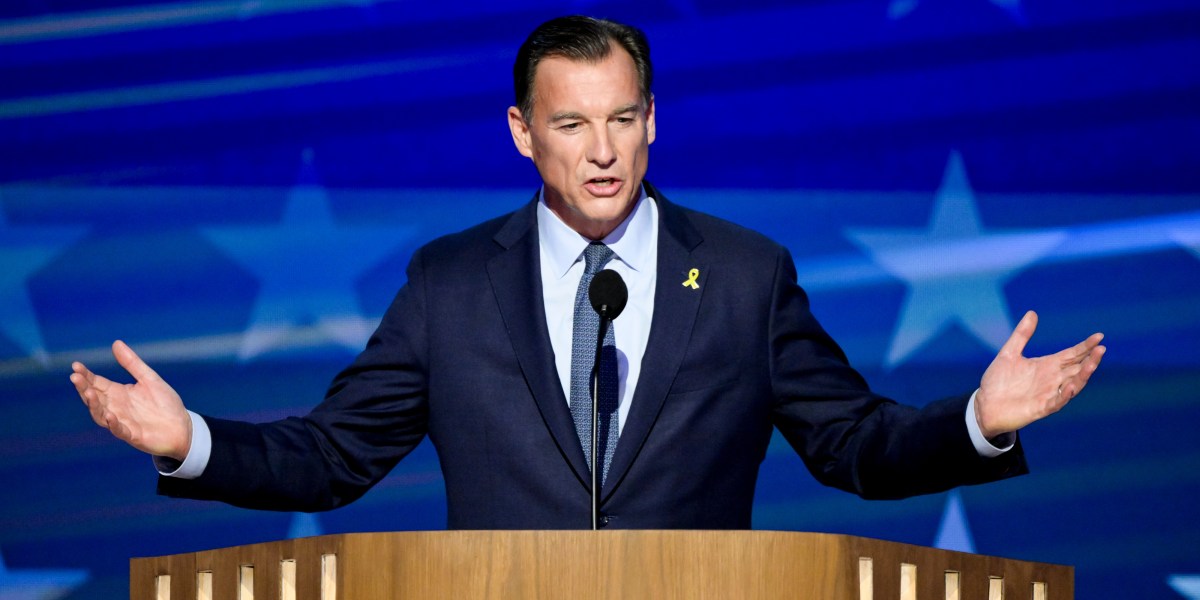
WASHINGTON — When Rep. Tom Suozzi (D-N.Y.) sold a chunk of his personal stock holdings two days before President Donald Trump’s “Liberation Day” tariff announcements in April, the transaction appeared to be yet another routine financial move for someone Congress itself once investigated for his often opaque trading habits.

But Suozzi’s March 31 sale of up to $50,000 worth of Global Industrial Co. stock is notable for what it’s not: The congressman has never publicly disclosed owning the stock, prompting the question of how a federal lawmaker can sell a security he doesn’t appear to own in the first place.

The answer? Suozzi simply didn’t disclose his Global Industrial Co. stock, which he obtained more than two years ago, because of an apparent loophole in federal law—a loophole recently closed by Congress to address stock situations precisely like Suozzi’s, according to a Fortune review of federal documents and interviews with government officials.

Suozzi’s mysterious stock trade comes at a time when a bipartisan coalition in Congress are agitating to ban federal lawmakers from trading stocks altogether. They cite what they regard as abuses of a financial disclosure law known as the Stop Trading on Congressional Knowledge Act. Suozzi has violated the STOCK Act’s disclosure provision on four different occasions earlier this decade, according to media reports.

House Speaker Mike Johnson (R-La.), House Minority Leader Hakeem Jeffries (D-N.Y.) and even President Donald Trump have offered support, in principle, for a congressional stock-trade ban.

Suozzi’s congressional office told Fortune the congressman has done nothing wrong by not yet reporting his Global Industrial Co. stock ownership, arguing that he followed congressional rules that applied to him when he last filed mandatory personal financial disclosures in 2024.

“Congressman Suozzi has complied completely with the rules of House Ethics,” Suozzi Chief of Staff Matt Fried told Fortune.

Suozzi’s latest stock saga began in June 2023.

That month, according to Securities and Exchange Commission records, Suozzi received $50,000 worth of restricted, unvested stock in Global Industrial Co., while serving as a “non-management director” of the company after leaving Congress earlier that year following a failed campaign for governor of New York.

Later that year, Suozzi decided to run in a special election for New York’s 3rd Congressional District seat, which Rep. George Santos (R-N.Y.) vacated after the House of Representatives expelled him amid a swathe of federal criminal charges on which he was later csentenced to more than seven years in prisononvicted.

When Suozzi filed a mandatory candidate financial disclosure report on January 12, 2024, he did not disclose his stock in Global Industries Co. The company markets industrial and repair products through various e-commerce websites. Nor did he disclose it in two subsequent financial disclosures, in August and September of 2024, after he won his congressional seat in February 2024. The three financial disclosures applied to Suozzi’s personal financial activity during 2023.

Fried explained that Suozzi’s Global Industries Co. stock “had not vested and had no value” when Suozzi filed his personal financial disclosure in January 2024. Because House Committee on Ethics financial disclosure rules at the time did not specifically address unvested stock holdings, Suozzi did not disclose his Global Industries Co. stock holding, Fried said.

However, Suozzi’s Global Industries Co. stock did vest at some point between Suozzi’s financial disclosure on Jan. 12, 2024, and his swearing-in to Congress on Feb. 28, 2024, Fried said.

The Global Industries Co. stock “will be reflected” when Suozzi discloses his 2024 personal financial activity in a document that must be filed by August 2025, Fried said. In May, Suozzi requested, and received, a 90-day extension to file it., Fried said.

When the House Committee on Ethics released updated disclosure rules earlier this year, it included new language directly addressing the kind of situation Suozzi finds himself in, although it doesn’t appear to apply to members of Congress retroactively.

“You are required to disclose for yourself, your spouse, or dependent children your participation in a restricted stock plan if the value of stock was more than $1,000 at the end of the reporting period or earned more than $200 in income during the reporting period,” the House guidance reads. “Provide the name of the unvested stock (vested stock should be disclosed on a separate line item), value, type of income and amount.”

Tom Rust, chief counsel for the House Committee on Ethics, declined to comment.

“These disclosure requirements are important because they’re the only sort of ethical obligation members of Congress have been willing to impose on themselves,” said Walter Shaub, a former director of the U.S. Office of Government Ethics. “If they’d finally pass the long-languishing stock trading ban to uphold the bedrock ethical principle of avoiding conflicts of interest, they wouldn’t have to worry about these disclosures.”

In 2021, NPR reported — citing research from the Campaign Legal Center, a nonpartisan watchdog group — that Suozzi failed to properly disclose about 300 financial transactions.

Separately, Business Insider reported that Suozzi — on three different occasions in March, May and December of 2022 — violated the STOCK Act by waiting months or years past a federal deadline to disclose dozens of additional stock trades. 

“Quite frankly, we have a lot going on in Congress. I have a lot of other stuff going on. And it’s just not—ethics is a big priority for me. But the—some of the formalities are not necessarily something I make a priority of,” Suozzi told the independent Office of Congressional Ethics in 2022 during its investigation of his stock trading practices, while noting a financial adviser directed his trades.

The Office of Congressional Ethics’s board unanimously referred Suozzi to the House Committee on Ethics, writing that there was “substantial reason to believe” Suozzi had failed to properly disclose hundreds of personal stock trades. 

But the House Committee on Ethics, which members of Congress themselves constitute, unanimously concluded in July 2022 that there “was not clear evidence” that Suozzi committed a “knowing or willful” violation of the STOCK Act. The committee declined to penalize him.

In his second stint as a congressman, Suozzi is a member of the House Committee on Ways and Means, which is responsible for tax-writing, revenue-raising and other core government financial functions. He sits on the committee’s oversight and tax subcommittees, as well.

Fried, Suozzi’s chief of staff, said Suozzi backs the Bipartisan Restoring Faith in Government Act of 2025, one of several pending bills that, if passed, would ban or otherwise limit members of Congress from trading individual stocks.

On May 5, Suozzi became a co-sponsor of the bill, which is also sponsored by 10 other ideologically diverse lawmakers ranging from Reps. Brian Fitzpatrick (R-Pa.) to Alexandria Ocasio-Cortez (D-N.Y.).

When Suozzi sold his Global Industrial Co. stock on March 31, it was trading around $22 per share — down from about $27 a share when he obtained it in June 2023.

It’s the only stock trade Suozzi has reported making this year after reporting making just a handful last year.

“The congressman has made a point of not buying or selling stock since his new term began in January,” Fried said. “This was his only trade. It was done to raise money to pay fees to his financial adviser. This stock was sold because it was the only stock in which he had no capital gains.”

Dave Levinthal is a Washington, D.C.-based investigative journalist. Dave previously worked as editor-in-chief of Raw Story, deputy editor at Business Insider and as an editor or reporter at the Center for Public Integrity, Politico, OpenSecrets and the Dallas Morning News. He has also written for The Atlantic, TIME, Rolling Stone, Columbia Journalism Review, the Daily Beast, NOTUS and The Ankler.


Source link

Continue Reading

Business

Hero bystander who tackled Bondi gunman praised by Trump, Ackman

Published

on


A bystander who rushed and disarmed one of the Bondi Beach attackers has won praise from leaders around the world, including US President Donald Trump and hedge fund billionaire Bill Ackman, who announced a reward program for community heroes.

Extraordinary footage of the civilian’s actions began circulating on social media on Sunday, shortly after two men, later identified as a father and son, started shooting into a crowd gathered to celebrate the first day of Hanukkah. The massacre has left at least 16 people dead in the worst terrorist attack in Australia’s history. 

Read More: Sixteen People Killed in Bondi Beach Hanukkah Terror Attack 

In the mobile-phone video, which has not been verified by Bloomberg News, one of the attackers is standing near a tree and firing. A few meters away, a crouched man emerges from behind a parked car. He grabs the shooter from behind and wrestles the weapon from his hands. Local media named the bystander as Ahmed el Ahmed, a 43-year-old father-of-two from south Sydney. He was shot twice and is being treated in the hospital, according to reports.

He was also soon lauded for his feat. Trump said at the White House that Ahmed had saved many lives and expressed “great respect” for him. In Sydney, New South Wales Premier Chris Minns went further, describing Ahmed’s wrestle with the shooter as “the most unbelievable scene I’ve ever seen.”

“That man is a genuine hero and I’ve got no doubt there are many, many people alive tonight as a result of his bravery,” Minns said at a press conference late Sunday.

Australian Prime Minister Anthony Albanese also praised Ahmed, and other bystanders who helped treat victims in the immediate aftermath of the shooting. 

“People rushing towards danger to show the best of the Australian character,” Albanese told reporters Monday. “That’s who we are, people who stand up for our values.” 

Pershing Square Capital Management’s founder Ackman called Ahmed  “a brave hero” and said his hedge fund firm would establish a reward program for people who had carried out similar acts.

The top donor to a gofundme page set up for the “hero” who tackled the shooter is listed as William Ackman, who gave $99,999. More than $170,000 has been raised so far. 

Salesforce Inc. Founder and Chief Executive Officer Marc Benioff also expressed his gratitude for Ahmed in a post on X.


Source link

Continue Reading

Business

A ‘new era’ in the housing market is about to begin as affordability finally improves

Published

on


Next year should mark a shift in the housing market after years of largely being frozen in place, according to Mike Simonsen, chief economist at top residential real estate brokerage Compass.

Home sales flatlined amid unaffordable conditions after rising demand collided with tepid supply growth, pushing up home prices. Would-be buyers became so discouraged that demand cooled and remains slow.

Prices are now becoming more favorable for house hunters, a trend that should continue in 2026 and change the narrative in the housing market.

“In the next era, that story flips. So sales are starting to move higher, but prices are capped or maybe down. Incomes are rising faster than prices, and so affordability improves for the first time in a bunch of years,” Simonsen told CNBC on Friday. “It’s not a dramatic improvement, but it’s the start of the new era.” 

His view echoes a recent report from Redfin, which also cited stronger income and weaker homes prices as it predicted a “Great Housing Reset” in 2026.

In addition to potential buyers giving up on finding an affordable home, sellers have been giving up on finding someone willing to buy at the price they want.

As a result, the number of homes that were withdrawn from the market jumped this year. In June, these so-called delistings shot up 47% from a year earlier.

Simonsen said listing withdrawals tend to be owner-occupied homes, meaning they could be latent demand as well as supply. That’s because two transactions would be needed: owners want to buy a new home but must sell their current one.

“In an environment where conditions improve a little bit, we actually estimate that that’s a representation of shadow demand—people that want to move, people that have delayed moves for maybe four years now,” he said, adding that there are about 150,000 such homeowners.

His housing market outlook for a new era of improving affordability doesn’t depend on a steep drop in mortgage rates. In fact, a plunge might spur so much demand that prices would overheat.

Simonsen expects rates to stay in the low-6% range, allowing sales to grow while also keeping home prices in check as more inventory comes on the market.

The price environment is already showing auspicious signs for prospective buyers. More than half of U.S. homes have dropped in value over the last year, but homeowners can still sell with a net gain as values are up a median 67% since their home’s last sale, accordion to data from Zillow.

And a separate report fromZillow found that homebuyers are getting record-high discounts. While the typical individual discount remains $10,000, desperate sellers are increasingly offering multiple reductions as muted demand leaves homes on the market for longer. As a result, the cumulative price cut in October hit $25,000.

“Most homeowners have seen their home values soar over the past several years, which gives them the flexibility for a price cut or two while still walking away with a profit,” Zillow Senior Economist Kara Ng said in a statement last month. “These discounts are bringing more listings in line with buyers’ budgets, and helping fuel the most active fall housing market in three years. Patient buyers are reaping the rewards as the market continues to rebalance.”


Source link

Continue Reading

Business

Attacker who killed US troops in Syria was a recent recruit to security forces

Published

on


A man who carried out an attack in Syria that killed three U.S. citizens had joined Syria’s internal security forces as a base security guard two months earlier and was recently reassigned amid suspicions that he might be affiliated with the Islamic State group, a Syrian official told The Associated Press Sunday.

The attack Saturday in the Syrian desert near the historic city of Palmyra killed two U.S. service members and one American civilian and wounded three others. It also wounded three members of the Syrian security forces who clashed with the gunman, interior ministry spokesperson Nour al-Din al-Baba said.

Al-Baba said that Syria’s new authorities had faced shortages in security personnel and had to recruit rapidly after the unexpected success of a rebel offensive last year that intended to capture the northern city of Aleppo but ended up overthrowing the government of former President Bashar Assad.

“We were shocked that in 11 days we took all of Syria and that put a huge responsibility in front of us from the security and administration sides,” he said.

The attacker was among 5,000 members who recently joined a new division in the internal security forces formed in the desert region known as the Badiya, one of the places where remnants of the Islamic State extremist group have remained active.

Attacker had raised suspicions

Al-Baba said the internal security forces’ leadership had recently become suspicious that there was an infiltrator leaking information to IS and began evaluating all members in the Badiya area.

The probe raised suspicions last week about the man who later carried out the attack, but officials decided to continue monitoring him for a few days to try to determine if he was an active member of IS and to identify the network he was communicating with if so, al-Baba said. He did not name the attacker.

At the same time, as a “precautionary measure,” he said, the man was reassigned to guard equipment at the base at a location where he would be farther from the leadership and from any patrols by U.S.-led coalition forces.

On Saturday, the man stormed a meeting between U.S. and Syrian security officials who were having lunch together and opened fire after clashing with Syrian guards, al-Baba said. The attacker was shot and killed at the scene.

Al-Baba acknowledged that the incident was “a major security breach” but said that in the year since Assad’s fall “there have been many more successes than failures” by security forces.

In the wake of the shooting, he said, the Syrian army and internal security forces “launched wide-ranging sweeps of the Badiya region” and broke up a number of alleged IS cells. The interior ministry said in a statement later that five suspects were arrested in the city of Palmyra.

A delicate partnership

The incident comes at a delicate time as the U.S. military is expanding its cooperation with Syrian security forces.

The U.S. has had forces on the ground in Syria for over a decade, with a stated mission of fighting IS, with about 900 troops present there today.

Before Assad’s ouster, Washington had no diplomatic relations with Damascus and the U.S. military did not work directly with the Syrian army. Its main partner at the time was the Kurdish-led Syrian Democratic Forces in the country’s northeast.

That has changed over the past year. Ties have warmed between the administrations of U.S. President Donald Trump and Syrian interim President Ahmad al-Sharaa, the former leader of an Islamist insurgent group Hayat Tahrir al-Sham that used to be listed by Washington as a terrorist organization.

In November, al-Sharaa became the first Syrian president to visit Washington since the country’s independence in 1946. During his visit, Syria announced its entry into the global coalition against the Islamic State, joining 89 other countries that have committed to combating the group.

U.S. officials have vowed retaliation against IS for the attack but have not publicly commented on the fact that the shooter was a member of the Syrian security forces.

Critics of the new Syrian authorities have pointed to Saturday’s attack as evidence that the security forces are deeply infiltrated by IS and are an unreliable partner.

Mouaz Moustafa, executive director of the Syrian Emergency Task Force, an advocacy group that seeks to build closer relations between Washington and Damascus, said that is unfair.

Despite both having Islamist roots, HTS and IS were enemies and often clashed over the past decade.

Among former members of HTS and allied groups, Moustafa, said, “It’s a fact that even those who carry the most fundamentalist of beliefs, the most conservative within the fighters, have a vehement hatred of ISIS.”

“The coalition between the United States and Syria is the most important partnership in the global fight against ISIS because only Syria has the expertise and experience to deal with this,” he said.

Later Sunday, Syria’s state-run news agency SANA reported that four members of the internal security forces were killed and a fifth was wounded after gunmen opened fire on them in the city of Maarat al-Numan in Idlib province.

It was not immediately clear who the gunmen were or whether the attack was linked to the Saturday’s shooting.


Source link

Continue Reading

Trending

Copyright © Miami Select.