Connect with us

Business

Delta CEO Ed Bastian rejected a mentor’s advice for how to run the $38 billion airline

Published

on


Don’t expect to spot Delta Air Lines CEO Ed Bastian lingering at the front of the boarding line—he’s usually nowhere near it.

“I’m terrible,” Bastian admitted during an offstage interview last week at the Fortune Global Forum in Riyadh, Saudi Arabia. “I’m one of the last people to get on board the flight, and our team’s always rushing to make sure that I’m there because planes will not wait for me.”

Bastian, 68, has spent nearly a decade at the helm of America’s most profitable airline, steering the Fortune 500 giant through crises from 9/11 and bankruptcy to the COVID-19 pandemic. After joining Delta in 1998, Bastian rose through six leadership roles before becoming CEO in 2016, but did not observe all of the advice he received for how to be the top boss. 

“The worst advice I ever received was [from] a former mentor who told me when I became CEO, I needed to create a unique identity, something that people couldn’t find me,” Bastian said. “He told me I’ll never have a moment of peace because I was too public.” 

Bastian listened, but chose not to follow the recommendation: “I thanked him for that, and I did not do that.”

Now, Bastian says his inbox is flooded with thousands of emails per day, and he often spends flights reading through customer feedback. He likens himself to a “point guard” directing traffic to resolve issues.

“I only have one email, only have one phone, and as a result of that, I’m always in touch with our people, our customers, our community,” he said. However, customers often don’t believe they’re actually communicating with the real Bastian himself. 

“They’ll think I’m some kind of fancy bot, and they’ll respond, ‘Wow, you’ve got a great agentic device there,’” he joked. “I say, ‘No, it’s me. I’m bored on a Saturday afternoon, just clearing out my inbox.’”

Even in person, Delta passengers are often surprised to see the chief executive seated in economy, eagerly awaiting Biscoff cookies and a Coke Zero from the snack cart.

“Many times when I travel, I’m sitting in coach,” Bastian said. “It’s always interesting because customers come back and say, ‘Why are you back here?’ And I say, ‘That’s about what my ticket could afford,’ and [I’m] usually next to the restroom.” To be sure, Bastian’s current compensation package is about $27 million, but airline executives do sometimes have to travel coach when premium seats are sold out. 

Delta’s people-first strategy

Fresh off a strong third-quarter earnings release with $15.2 billion in record September revenue, Bastian told Fortune Editor-in-Chief Alyson Shontell on stage Delta’s success hinges not on planes or technology, but on its people.

“In our business, everyone focuses on the airline, the aircraft, the technology, the airports, the amazing destinations we get to,” he said. “But it’s the staff that bring it to life.”.

After announcing the Atlanta-based carrier’s first-ever direct flights between the U.S. and Riyadh alongside Riyadh Air CEO Tony Douglas, Bastian added he “obsesses” over his 100,000 employees “so that they can then go do the amazing work that our customers deserve.” 

“If your people don’t feel that love and respect and care, they’re never going to be able to give you the service that you expect,” Bastian said.

The strategy has paid off: Delta ranks No. 15 on the Fortune 100 Best Companies to Work For, and No. 70 on this year’s Fortune 500 list as the most profitable U.S. airline, ahead of peers like American, United, and Southwest. 

But Bastian’s people-first approach extends beyond philosophy. Long before he became CEO, the former chief financial officer helped design one of corporate America’s most generous profit-sharing programs in 2007. After emerging from a 19-month bankruptcy, Delta pledged to distribute billions of dollars in bonuses back to its workforce for every year that it hit its targets. In 2024, the employee share totaled $1.4 billion, amounting to around 10% of base pay.

“Rewarding our people is fundamental to who we are at Delta,” Bastian wrote in a February statement announcing the payouts. “It’s always my No. 1 priority to take care of the Delta team.”

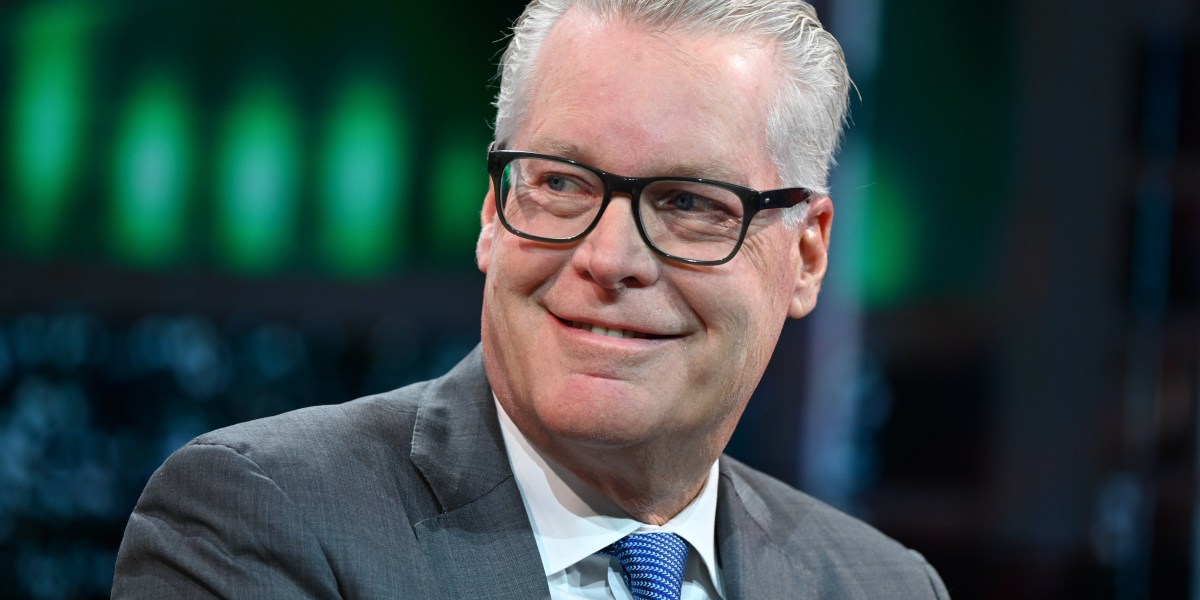
Delta CEO Ed Bastian joined Fortune Editor-in-Chief Alyson Shontell and Riyadh Air CEO Tony Douglas at the Fortune Global Forum on October 27, 2025.

Stuart Isett for Fortune

Delta CEO’s leadership advice 

Offstage at the Fortune Global Forum, Bastian, the longest-serving chief executive among major U.S. airlines, also reflected on his career journey and offered advice for the next generation of leaders: “Leadership is not a popularity contest.” 

“We all want to be liked, we all want to be loved,” he said. “But leadership involves also making hard choices, hard decisions with a lot of respect and confidence.”

Earlier this year, Bastian confirmed to Fortune’s Shawn Tully that Delta’s board has named an internal candidate as his successor, marking the first time he publicly disclosed this contingency plan, but emphasized he still has “a number of years to go,” adding, “This is not a swan song.” 

But of all the business advice he’s received over the years, Bastian says his most impactful wisdom came from his late mother: “She told us, growing up, you’ve got two ears and one mouth, use them accordingly.”

He explained that in business, leaders often focus on sending messages rather than listening: “We don’t take enough time to learn, to listen, to be able to make sure we understand each other.”

For Bastian, it’s a vital skill to form better relationships and fuel personal and professional growth. 

“You learn a lot more,” he said. “That curiosity really is one of the hallmarks, I believe, of my career.”



Source link

Continue Reading

Business

Jensen Huang says AI bubble fears are dwarfed by ‘largest infrastructure buildout in human history’

Published

on


Pushing back against growing skepticism regarding the sustainability of artificial intelligence spending, Nvidia CEO Jensen Huang argued against the mountain backdrop of Davos, Switzerland, that high capital expenditures are not a sign of a financial bubble, but rather evidence of “the largest infrastructure buildout in human history.”

Speaking in conversation with BlackRock CEO Larry Fink, the interim co-chair of the World Economic Forum, Huang detailed an industrial transformation that extends far beyond software code, reshaping global labor markets and driving unprecedented demand for skilled tradespeople. While much of the public debate focuses on the potential for AI to replace white-collar jobs, Huang pointed to an immediate boom in blue-collar employment required to physically construct the new computing economy.

“It’s wonderful that the jobs are related to tradecraft, and we’re going to have plumbers and electricians and construction and steel workers,” Huang said. He noted the urgency to erect “AI factories,” chip plants, and data centers has radically altered the wage landscape for manual labor. “Salaries have gone up, nearly doubled, and so we’re talking about six-figure salaries for people who are building chip factories or computer factories,” Huang said, emphasizing the industry is currently facing a “great shortage” of these workers.

Ford CEO Jim Farley has been warning for months about the labor shortage in what he calls the “essential economy,” exactly the type of jobs mentioned by Huang in Davos. Earlier this month, Farley told Fortune these 95 million jobs are the “backbone of our country,” and he was partnering with local retailer Carhartt to boost workforce development, community building, and “the tools required by the men and women who keep the American Dream alive.” 

It’s time we all reinvest in the people who make our world work with their hands,” Farley said.

In October, at Ford’s Pro Accelerate conference, Farley shared that his own son was wrestling with whether to go to college or pursue a career in the trades. The Ford CEO has estimated the shortage at 600,000 in factories and nearly the same in construction.

Huang dismisses bubble fears

Fink brought up the bubble talk for a good reason: Fear of a popping bubble gripped markets for much of the back half of 2025, with luminaries such as Amazon founder Jeff Bezos, Goldman Sachs CEO David Solomon, and, just the previous day in Davos, Microsoft CEO Satya Nadella, warning about the potential for pain. Much of this originated in the underwhelming release of OpenAI’s GPT-5 in August, but also the MIT study that found 95% of generative AI pilots were failing to generate a return on investment. “Permabears” such as Albert Edwards, global strategist at Société Générale, have talked about how there’s likely a bubble brewing—but then again, they always think that.

Huang, whose company became the face of the AI revolution when it blew past $4 trillion in market capitalization (a bar recently reached by Alphabet on the positive release of its Gemini update), tackled these fears in conversation with Fink, arguing the term misdiagnoses the situation. Critics often point to the massive sums being spent by hyperscalers and corporations as unsustainable, but Huang countered the appearance of a bubble happens because “the investments are large … and the investments are large because we have to build the infrastructure necessary for all of the layers of AI above it.”

Huang went deeper on his food metaphor, describing the AI industry as a “five-layer cake” requiring total industrial reinvention, with Nvidia’s chips a particularly crunchy part of the recipe. The bottom layer is energy, followed by chips, cloud infrastructure, and models, with applications sitting at the top. The current wave of spending is focused on the foundational layers—energy and chips—which creates tangible assets rather than speculative vapor. Far from a bubble, he described a new industry being built from the ground up.

“There are trillions of dollars of infrastructure that needs to be built out,” Huang said, noting that the world is currently only “a few 100 billion dollars into it.”

To prove the market is driven by real demand rather than speculation, Huang offered a practical “test” for the bubble theory: the rental price of computing power as seen in the price of Nvidia’s GPU chips.

“If you try to rent an Nvidia GPU these days, it’s so incredibly hard, and the spot price of GPU rentals is going up, not just the latest generation, but two-generation-old GPUs,” he said. This scarcity indicates established companies are shifting their research and development budgets—such as pharmaceutical giant Eli Lilly moving funds from wet labs to AI supercomputing—rather than simply burning venture capital.

Beyond construction and infrastructure, Huang addressed the broader anxiety regarding AI’s impact on human employment. He argued AI ultimately changes the “task” of a job rather than eliminating the “purpose” of the job. Citing radiology as an example, he noted that despite AI diffusing into every aspect of the field over the last decade, the number of radiologists has actually increased. Because AI handles the task of studying scans infinitely faster, doctors can focus on their core purpose: patient diagnosis and care, leading to higher hospital throughput and increased hiring.

Fink reframed the issue, based on Huang’s pushback. “So what I’m hearing is, we’re far from an AI bubble. The question is, are we investing enough?” Fink asked, positing that current spending levels might actually be insufficient to broaden the global economy.

Huang appeared to say: not really. “I think the the opportunity is really quite extraordinary, and everybody ought to get involved. Everybody ought to get engaged. We need more energy,” he said, adding the industry needs more land, power, trade, scale and workers. Huang said the U.S. has lost its workforce population in many ways over the last 20-30 years, “but it’s still incredibly strong,” and in Europe, pointing around him in Switzerland, he saw “an extraordinary opportunity to take advantage of.” He noted 2025 was the largest investment year in venture capital history, with $100 billion invested around the world, mostly on AI natives.”

Huang concluded by emphasizing this infrastructure buildout is global, urging developing nations and Europe to engage in “sovereign AI” by building their own domestic infrastructure. For Europe specifically, he highlighted a “once-in-a-generation opportunity” to leverage its strong industrial base to lead in “physical AI” and robotics, effectively merging the new digital intelligence with traditional manufacturing. Far from a bubble, he seemed to be saying, this is just the beginning.


Source link

Continue Reading

Business

Nearly 400 millionaires and billionaires are demanding Davos leaders to tax them more: ‘Tax us. Tax the super rich.’

Published

on


While the wealthiest business leaders from U.S. president Donald Trump to Nvidia CEO Jensen Huang touch down in the Swiss town of Davos to discuss the state of the world, a cohort of the ultra-rich are already sounding the alarm. Hundreds of millionaires and billionaires released an open letter in time for the World Economic Forum, calling on leaders attending the conference to fight raging wealth inequality with taxes. 

“Millionaires like us refuse to be silent. It is time to be counted. Tax us and make sure the next fifty years meet the promise of progress for everyone,” the letter stated

“Extreme wealth has led to extreme control for those who gamble with our safe future for their obscene gains. Now is the time to end that control and win back our future.”

So far, nearly 400 millionaires and billionaires across 24 countries have signed the letter condemning extreme wealth, including the likes of Hollywood actor Mark Ruffalo, Disney heirs Abby and Tim Disney, and real estate developer Jeffrey Gural.

The open letter is part of a “Time to Win” campaign, led by wealth redistribution organizations including Patriotic Millionaires, Millionaires for Humanity, and Oxfam. It criticized global oligarchs with riches who have “bought up” democracies, exacerbated poverty, stifled tech innovation, dampened press freedom, and overall, “accelerated the breakdown of our planet.” After all, 77% of millionaires from G20 nations think extremely wealthy individuals buy political influence, and 71% believe those with riches can significantly influence elections, according to a poll conducted for Patriotic Millionaires.

The Time to Win wealthy signatories offer a simple solution: “Tax us. Tax the super rich.”

“As millionaires who stand shoulder to shoulder with all people, we demand it,” the open letter continued. “And as our elected representatives—whether it’s those of you at Davos, local councillors, city mayors, or regional leaders—it’s your duty to deliver it.

Stars and billionaires are calling out the super-rich for being ungenerous 

As the world mints hundreds of thousands of millionaires yearly and billionaire wealth soars to record highs, some leaders can’t stand to stay quiet. Celebrities and the ultra-rich haven’t just sent a message to money-hoarders with the Time to Win letter—some have even called out billionaires in person, questioning their existence. 

“If you’re a billionaire, why are you a billionaire? No hate, but yeah, give your money away, shorties,” Eilish said onstage last year at the WSJ Magazine Innovator Awards with Meta mogul Mark Zuckerberg, worth $214 billion, in attendance. 

Even the most philanthropic members of the ultra-rich club are wary of their peers’ lack of charity. Billionaires have started their own initiatives like Warren Buffett, Melinda French Gates, and Bill Gates’ The Giving Pledge, which attracted more than 250 billionaires who pledged to donate at least half of their wealth during their lifetimes, or in their wills. But efforts have largely fallen short. Last year, French Gates admitted that the signatories haven’t given enough; And in a letter to shareholders, Buffett fessed up to the fact that billionaires aren’t following through. 

“Early on, I contemplated various grand philanthropic plans. Though I was stubborn, these did not prove feasible,” Buffett wrote. “During my many years, I’ve also watched ill-conceived wealth transfers by political hacks, dynastic choices, and, yes, inept or quirky philanthropists.”

Billionaire and millionaire wealth is on the rise 

There’s more people rolling in riches than ever before, and it’s fueling an equity crisis at the bottom of the economic ladder. 

In 2024 alone, the U.S. minted 379,000 new millionaires—over 1,000 millionaires every day—as the proportion of Americans in the ultrawealthy club swelled by 1.5%, according to a 2025 report from investment bank UBS. This cohort held about $107 trillion in total wealth at the end of that year: more than four times the amount they owned at the turn of the millennium. 

In 2000, there were only 13.27 million everyday millionaires, but by the end of 2024, the group swelled to 52 million people worldwide. 

While it might appear that eye-watering riches are spreading out to a larger number of individuals, it’s mainly concentrating at the top. America’s top 20% household earners—averaging a net worth of $4.3 million—accounted for about 71% of the U.S.’s total wealth at the end of 2024, according to 2025 data from the Federal Reserve. 

Meanwhile, the bottom half of American households, averaging about $60,000 in wealth, owned just 2.5% of the country’s wealth. For the vast majority of U.S. citizens, joining the millionaire club—and even more so, the billionaire club—is a total pipe dream.


Source link

Continue Reading

Business

Trump fast tracks ‘three-week’ nuclear approval for big tech to fuel AI race

Published

on


President Donald Trump offered Silicon Valley an extraordinary deal on Wednesday: Build your own nuclear power plants to fuel AI, and his administration will approve them in just three weeks.

Speaking at the World Economic Forum in Davos, Switzerland, Trump addressed a room of tech executives struggling with an aging U.S. electrical grid.

“I came up with the idea,” Trump said. “You people are brilliant. You have a lot of money. You can build your own electric generating plants.”

Trump talked for about 10 minutes about energy in his speech, making it clear Trump views a straining electric grid as a central economic risk of 2026. As artificial intelligence pushes electricity demand to record highs, the administration is framing power shortages as an existential threat to growth and national security. Slashing approval timelines, Trump argued, is a necessary response to an energy system he said he believes is fundamentally unprepared for the AI era.

“We needed more than double the energy currently in the country just to take care of the AI plants,” Trump said. 

The proposal marks a radical departure from the traditional Nuclear Regulatory Commission (NRC) process, which historically requires four to five years for environmental and design approvals as well as rigorous site selection. Trump claimed that while tech leaders initially “didn’t believe him,” he assured them the government would deliver approvals for oil and gas plants in just two weeks, with nuclear projects following in three.

Trump said he wasn’t “a big fan” of nuclear power before, but now sees it as a newly viable solution due to safety improvements. 

“The progress they’ve made with nuclear is unbelievable,” he said. “We’re very much into the world of nuclear energy, and we can have it now at good prices and very, very safe.” 

While the potential upcoming wave of small modular nuclear reactors (SMR) could receive regulatory approvals in less than two years, there is little basis for going through an approval process with the Nuclear Regulatory Commission in closer to three weeks, and such an expedited process would trigger widespread concerns about safety and environmental risks.

Trump also touted a new energy alliance with Venezuela, noting the U.S. secured 50 million barrels of oil last week following the “end of an attack” on the nation that led to the deposition of President Nicolás Maduro. He said the new cooperation between the two nations would make Venezuela “fantastically well” while driving U.S. gasoline prices toward $2.00 a gallon.

Gasoline prices are the main inflationary measure by which costs have fallen during the first year of the new Trump administration. But they’re nowhere close to $2.00 per gallon. The national average for a gallon of regular unleaded is $2.76 per gallon this week, down 32 cents from a year ago, primarily because of rising OPEC oil production.

But Trump drew a sharp contrast with Europe’s energy landscape. Trump mocked the “Green New Scam,” citing a 64% spike in German electricity prices and the “catastrophic” decline of energy production in the United Kingdom. He targeted the North Sea and the proliferation of wind farms, which he labeled “losers” that “kill the birds.”

“Stupid people buy” wind farms, Trump laughed.


Source link

Continue Reading

Trending

Copyright © Miami Select.