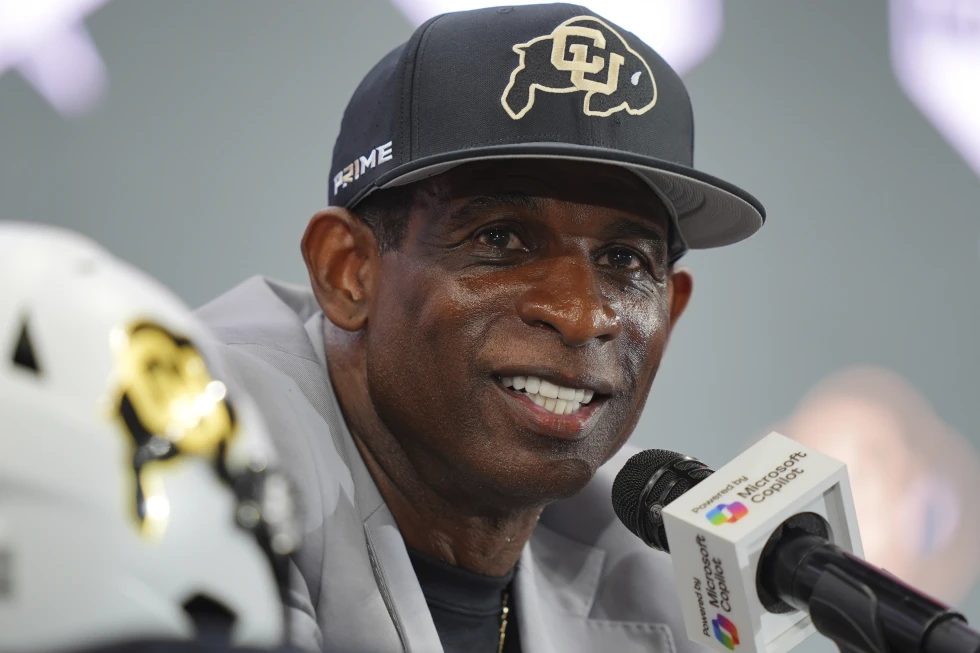
Deion Sanders bladder cancer cured but his lifestyle changes won’t keep him from coaching Colorado
In a nationally televised news conference Monday morning from the University of Colorado coach Deion Sanders announced that he has been diagnosed with an aggressive form of bladder cancer. However, after surgery, his oncologist believes he has been cured, so he intends to coach this season.
At the press conference Dr. Janet Kukreja, the director of urologic oncology at the CU Cancer Center/UCHealth University of Colorado Hospital, stated that Sanders underwent bladder removal as part of his surgical treatment.
“It was dynamic. It was tough. It wasn’t a cakewalk. It wasn’t easy,” said Sanders, who arrived to his news conference wearing a cowboy hat and overalls along with sunglasses, which he took off after getting choked up. “That was a fight, but we made it.”
After being diagnosed with an aggressive form of bladder cancer, Sanders underwent surgery earlier this year to remove his bladder. Instead of relying solely on a urostomy bag, doctors constructed a new bladder using parts of his intestines. This technique reduces the risk of rejection and allows for more natural urinary function, although it still requires significant lifestyle adjustments.
“The bad side of this cancer is that if it does progress to the muscle, the rate of metastasis is about 50%,” Dr. Kukreja said during the press conference. “Only about 10% people live more than five years, even with our current medical treatment if it metastasized. We’ve very lucky to have found it at this stage where I can say the word cure, because I don’t use that word lightly as a cancer doctor.”
Coach Sanders appeared a few pounds lighter but seemed to be in good spirits. He was his usual chatty self, talking very candidly about his surgery and the experience he went through. As always, Sanders was frank and open in his remarks about this life-changing ordeal.
Sanders said it’s been “a whole change” getting used to life without a bladder and the difficulty he’s been having using the bathroom, now that he’s depending on a urostomy bag.
“Slowly but surely, I built myself back up,” Coach Prime said. “I’m able, I’m strong. it has been a tremendous journey and I’m truly thankful that god is so good. God is so good, you have no idea. You have no idea how good god has been for me to be here. You have no idea.”
Despite his cancer scare, there was never any doubt he would return to Boulder to coach the Buffaloes from the sidelines once again. Before the press conference, he spoke with his team, reconnecting and assuring them he was ready to prepare for another season.
“I was always going to coach again,” Sanders said. “I wasn’t about to be running down to the hospital every week with everything I had going on. I didn’t want that. I thought, okay, can they bring one of the machines to the office? The doctor would just look at me like I was crazy. Is he like this when he coaches? But we made it work, so if you see a porta-potty on the sidelines, don’t be alarmed.”
This will be the first season in his coaching career without one of his sons on the team. Sanders’ son Shedeur was drafted by the Cleveland Browns, and his other son Shilo signed as an undrafted free agent with the Tampa Bay Buccaneers. Another standout from last year’s team, 2025 Heisman winner Travis Hunter, has also moved on, joining the Jacksonville Jaguars.
This year’s Buffaloes team faces a quarterback battle for the starting job with Shedeur gone. The competition is wide open between Liberty transfer Kaidon Salter and true freshman Julian Lewis. Meanwhile, questions linger on defense after losing Hunter.
This could very well be the most challenging season of Sanders career, but the good news will be on the sidelines coaching. Colorado opens the season at home Friday August 29th against Georgia Tech on ESPN.
Bucs Head Coach Todd Bowles Opens Up to Dan Sileo: Cutdown Day, Baker Mayfield, and Buccaneers Legacy
Todd Bowles walked into the postgame press conference knowing the truth: his future in Tampa Bay now rides on the final three games of the season. The Buccaneers blew a 28–14 fourth‑quarter lead and handed the Atlanta Falcons a 29–28 win, a collapse that mirrored the team’s month‑long freefall. Bowles didn’t hide his frustration, and his message hit harder than any hit delivered on the field.
Mike Evans returned from a broken clavicle and played like a man determined to drag the Buccaneers forward. He caught six passes for 132 yards, drew multiple penalties, and showed visible disgust as he walked off the field after the loss. Bowles praised him with purpose.
“He played winning football. He cares,” Todd Bowles said. “He’s one of the guys that cares. He gave his heart. He gave his all.”
Todd Bowles didn’t need to say the rest out loud. His tone made it clear: not enough players match Evans’ urgency. When pressed on who lacks that edge, Bowles backtracked, but the message already landed.
“They all care. It’s just a matter of execution,” Bowles said. “There’s nobody out there trying to mess it up. But at some point you’ve got to get it right. This is a player‑driven team in the last four or five weeks. You’ve got to execute. They’ve got to hold each other accountable.” (Reporting supported by NFL.com’s transcript of Bowles’ comments NFL and USA Today’s coverage of his postgame remarks USA TODAY.)
Mayfield Takes the Blame and Challenges the Locker Room
Baker Mayfield didn’t dodge responsibility. He threw a late interception and owned it immediately. He also echoed Bowles’ challenge to the roster.
“We have talent. Talent doesn’t get you anything,” Mayfield said. “Doing the work and executing on game day does. We didn’t do that.”
Mayfield didn’t sugarcoat the stakes.
“We have to win out to get to the playoffs. To win the division, we have to win out. If the guys don’t handle this the right way, then we have a much deeper issue.
What’s Working: The Run Game Shows Life
The Buccaneers produced 88 yards on 22 carries and created opportunities to control the clock. They didn’t lean on the run game enough, especially with a late lead. The ground attack gave them balance, but Bowles and the offense never fully committed to it.
What Needs Help: The Defense Collapses Again
The defense failed in every critical moment. Tampa Bay couldn’t pressure the quarterback, couldn’t cover tight ends, and couldn’t tackle in space. Atlanta faced third‑and‑28, gained 14 yards, and then converted fourth‑and‑14 on the game‑winning drive — a sequence that defined the night.
The Bucs surrendered 365 passing yards and recorded only one sack on an immobile Kirk Cousins. The numbers matched the eye test: the defense broke when it mattered most.
Stock Up: Mike Evans
Evans returned with fire, production, and leadership. His 132 yards and emotional edge set the tone. He played like a captain trying to save a season.
Stock Down: The Offensive Line
The offensive line allowed five sacks and constant pressure. The unit never settled, and its struggles disrupted the rhythm of the offense throughout the night.
Injuries Continue to Pile Up
The Buccaneers lost CB Zyon McCollum (hip) during the game. LG Ben Bredeson remained out after landing on injured reserve. DB Tykee Smith (neck/shoulder), LB SirVocea Dennis (hip), TE Cade Otton (knee), and CB Benjamin Morrison (hamstring) all missed the matchup.
Next Steps: A Season on the Brink
Tampa Bay travels to Carolina next, while the Panthers play at New Orleans on Sunday. The Buccaneers still control their playoff path, but control means nothing if they can’t finish games.
The Final Word: Bowles and the Bucs Still Hold Their Fate — But Time Is Running Out
The Buccaneers created this crisis, but they also hold the power to escape it. Bowles’ future, the team’s playoff hopes, and the direction of the franchise all hinge on the final three games. The ship hasn’t sunk yet. The question now is simple:
Under the bright lights of Jazz at Lincoln Center’s Appel Room, the New York Athletic Club formally presented the 2025 Heisman Memorial Trophy to Indiana quarterback Fernando Mendoza. The redshirt junior from Miami stood at the podium on December 13, 2025, visibly emotional as he became the first Cuban American and the first Hoosier in history to win college football’s most prestigious award. The ceremony marked a defining moment not only for Mendoza but for Indiana University football as a whole.
Mendoza’s journey to the Heisman was nothing short of remarkable. In his first season as Indiana’s starting quarterback after transferring from California, he guided the Hoosiers to a perfect 13-0 record and their first Big Ten Championship since 1967. His statistics were equally impressive: – 2,980 passing yards – 33 touchdown passes (nation’s best) – 71.5% completion rate – Only six interceptions
These numbers not only shattered school records but also placed Mendoza among the elite quarterbacks in college football. His ability to deliver in clutch moments—such as Indiana’s 13-10 victory over Ohio State in the Big Ten title game—cemented his reputation as a leader and playmaker.
The Voting and Competition
The Heisman race featured a competitive field, including Vanderbilt’s Diego Pavia, Ohio State’s Julian Sayin, and Notre Dame’s Jeremiyah Love. Mendoza, however, claimed 2,362 first-place votes, outdistancing his rivals by a wide margin. His victory also ended a long drought for the Big Ten, making him the first conference quarterback to win the award since Ohio State’s Troy Smith in 2006.
In his acceptance speech, Mendoza thanked his teammates, coaches, and community, saying: “If you told me as a kid in Miami that I would be here on stage holding this prestigious trophy, I would have laughed or cried, just like I am now. I accept this award with humility and gratitude.”
Indiana’s Rise to National Prominence
Indiana’s football program, long considered an underdog in the Big Ten, has now ascended to the pinnacle of college football. Mendoza’s leadership has transformed the Hoosiers into the No. 1 seed in the College Football Playoff, earning them a quarterfinal matchup in the Rose Bowl on January 1, 2026. The team’s offensive surge under Mendoza broke program records for touchdowns and points, signaling a new era for Indiana football.
Closing Thoughts: Mendoza and the CFP Playoffs
As Fernando Mendoza hoisted the Heisman Trophy in New York City, he not only etched his name into college football history but also carried the hopes of an entire program into the postseason. Indiana, undefeated and brimming with confidence, now turns its attention to the College Football Playoff, where Mendoza’s arm and leadership will be tested against the nation’s best. For the Hoosiers, the Heisman is more than an individual honor—it is a symbol of their arrival on the national stage, with Mendoza at the helm of a team chasing a championship.
Sports Talk in Baltimore, MD – In front of a sellout crowd of 75,000 at M&T Bank Stadium in Baltimore, the Navy Midshipmen rallied from a 16-10 deficit in the fourth quarter to edge the Army Black Knights 17-16 as the two did battle for the 126th time in one of the most storied rivalries in American sports. Played under sunny skies with temperatures in the high 30s and a brisk wind rolling off the Chesapeake Bay, the game was a showcase of tradition, honor, and fierce competition. The Army–Navy Game is more than just football—it is a celebration of service academies, their cadets and midshipmen, and the enduring pageantry that makes this matchup one of the most unique rivalries in sports history. Navy’s narrow victory added another unforgettable chapter to a contest that has captivated generations.
The game began with Navy marching 75 yards on its opening possession, capped by Blake Horvath’s 5-yard touchdown run to seize a 7-0 lead. Army answered in the second quarter with a steady drive finished by Cale Hellums to tie the score, then added a 45-yard field goal just before halftime to carry a 13-7 advantage into the locker room. Early in the third quarter, Justin Weaver intercepted Horvath and nearly returned it for a touchdown, setting up another Army field goal that stretched the margin to 16-7. Navy clawed back with a field goal to make it 16-10, but the decisive moment came midway through the fourth quarter. Facing fourth-and-goal from the 8, Horvath lofted a strike to Eli Heidenreich in the end zone, completing the comeback and giving Navy a 17-16 lead. Army had one final chance in the closing minutes, but Navy’s defense held firm, and Alex Tecza’s late first down sealed the victory. The win capped Navy’s season at 10-2, while Army finished 6-6, their missed extra point looming as the difference in a game defined by razor-thin margins.
Florida’s Deep Military Connection to the Rivalry
While the game was played in Baltimore, its significance resonates strongly in Florida. The Sunshine State is home to 23 military bases, including MacDill Air Force Base in Tampa, where both U.S. Central Command (CENTCOM) and U.S. Special Operations Command (SOCOM) are headquartered. Florida also boasts one of the largest veteran populations in the nation, with over 1.5 million retired military members living across the state. For Floridians, the Army–Navy Game is more than a spectacle—it is a deeply personal event, reflecting the service and sacrifice of countless men and women who call Florida home. The rooting interest extends far beyond alumni, touching families and communities tied to the military presence in the state.
More Than Just a Game: A Historic Rivalry
The Army–Navy Game dates back to 1890, making it one of the oldest and most revered rivalries in college football. Over the decades, the matchup has symbolized the spirit of competition and camaraderie between two branches of the U.S. military. From iconic moments like the “instant classic” finishes to the unforgettable flyovers and march-ons, the game embodies tradition unlike any other. It is a contest where the outcome matters deeply to the academies, but the shared respect between Army and Navy players underscores the larger mission they will one day serve together.
Navy’s Victory and Brotherhood Beyond the Field
Navy’s 17-16 triumph in Baltimore was hard-fought, with highlights including a late defensive stand that sealed the win. Yet, as the final whistle blew, the rivalry’s true meaning came into focus. Both teams stood together, singing each other’s alma maters, a tradition that symbolizes unity and respect. While Navy celebrated victory, the players from both sides will soon stand shoulder to shoulder as brothers in arms, defending the nation together. That bond makes the Army–Navy Game not only one of the most unique rivalries in sports but also a powerful reminder of service, sacrifice, and shared destiny.