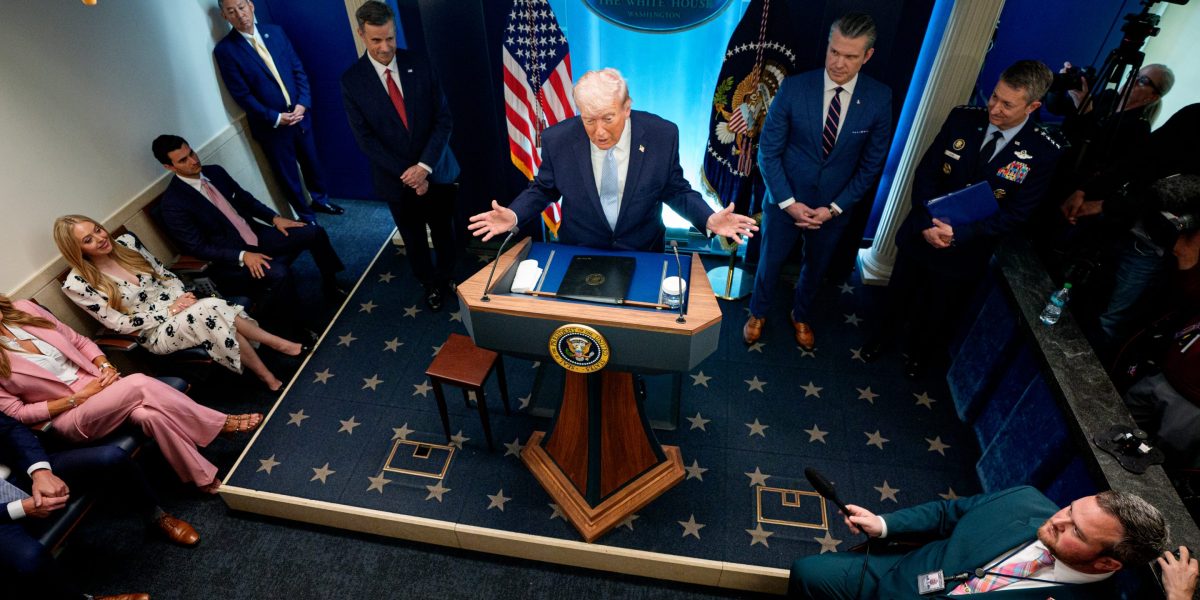
What I didn’t anticipate was the pessimism and concern. Coming from four top executives whose companies stand to gain the most from federal spending, it’s a window into deeper concerns about the economy. The optimism about AI-enabled productivity gains is real, as is the support for the president’s priorities when it comes to innovation and strengthening America’s military. The concerns:
Is this level of spending sustainable? My colleague Shawn Tully argues that it is not: “If the expenditures blowout happens, and the rosy assumptions needed to offset the new outlays fail to materialize, America will edge even closer to a fiscal cataclysm prompted by a ruinous rise in interest expense.” With a $39 trillion national debt and public opposition to the attacks on Iran, opposition could come from several fronts: “We’re in a volatile and dangerous time right now,” one executive told me on Monday, prior to the ceasefire. “You need stable commitments, a stable economy with sustainable growth, to invest at this scale.”
Are these priorities strategic? Like CEOs in other industries, those working in defense have fallen in and out of favor in this administration. There were the budget cuts that forced leaders like Booz Allen Hamilton CEO Horacio Rozanski to lay off staff, the relationships damaged by DOGE, the attacks on specific companies, and the executive order earlier this year that limits stock buybacks and pay at defense companies. Among some CEOs, there’s a feeling that the decision-making is personal and beyond their control. “I don’t want to wake up and see me or my company showing up in some Truth Social post,” one executive told me last night. “You build these partnerships over many years; the hope is that it doesn’t matter which party is in power … I wouldn’t make that assumption right now.”
Is the world a safer place? Like many Fortune 500 companies, major defense contractors also do business with U.S. allies. Along with facing increased cyber-attacks amid the war, they’re facing lost deals in Europe and the repercussions of the U.S. going it alone. “The stereotype is that defense companies want to go to war, but that’s not true … It’s very different when you’re mobilizing against a threat or keeping the nation safe.” And, when it comes to waging war, the speed of AI is even more disconcerting, with one executive telling me he’s equally concerned about the Pentagon’s ban on Anthropic’s technology as he is about the capabilities of AI and how it’s being developed by potential adversaries like China: “Warfare is going to change,” he said, adding that “it’s hard to know” how.
Contact CEO Daily via Diane Brady at diane.brady@fortune.com
Top leadership news
War in Iran could alter economic order in the long term…
Even if the war in Iran ends for good soon, economists say it has already reshaped the global economic order, with lasting effects on energy markets and inflation. Johns Hopkins economist Steve Hanke told Fortune that the conflict benefits resource-hungry powers like Russia and China while leaving the U.S. more exposed.
… and air travel in the short-term
The head of the International Air Transport Association warned reporters that jet fuel shortages could persist for months even if Iran reopens the Strait of Hormuz, because refining capacity has been heavily disrupted. Airlines are already responding, with some raising checked-bag fees and fares.
How to look at the AI revolution
George Mason University economist Alex Tabarrok told Fortune that a world with 40% unemployment because of AI and a world with a three-day workweek are essentially the same scenario. He argues that the transition will be slow, but the “difference between catastrophe and wonderland” will be “how society chooses to distribute the gains.”
The markets
S&P 500 futures are down 0.15% this morning. The last session closed up 0.62%. The STOXX Europe 600 was up 0.22% in early trading. The U.K.’s FTSE 100 was up 0.36% in early trading. Japan’s Nikkei 225 was up 1.84%. China’s CSI 300 was up 1.54%. Hong Kong’s Hang Seng was up 0.55%. South Korea’s KOSPI was up 1.40%. India’s NIFTY 50 is up 0.95% today. Bitcoin was steady at $72K.
Around the watercooler
‘I hate working 5 days’: Zoom CEO says traditional work schedules are becoming obsolete—and predicts a 3-day workweek by 2031 by Preston Fore
The U.S. government is spending $88 billion a month in interest on national debt—equal to spending on defense and education combined by Eleanor Pringle
The world’s 500 richest people made more than a quarter trillion yesterday as volatile markets react to fragile Iran war ceasefire by Jacqueline Munis
Only five ships crossed the Strait of Hormuz Thursday, far below Iran’s pledge as negotiations begin by Eva Roytburg
Nutella jumps on the best product placement money can’t buy: A trip to the far side of the Moon by Catherina Gioino
CEO Daily is curated and edited by Joey Abrams, Claire Zillman, and Lee Clifford.