
Fashion
Deeny’s dozen: The 12 best shows in international runway season

Published
October 9, 2025
This was clearly the most important season this century, with some 15 designer debuts at major marques. Here, in alphabetical order, is my personal pick for the dozen best shows of the four-week international fashion runway season. Four of my favorites were by debutants; half of them are by female designers.
Alaïa: Azzedine Mulier connects perfectly
Full marks for such simple but brilliant staging. Models marched around two flattened tennis-court-size LED screens showing giant close-ups of female beauty, all reflected off a dropped mirrored ceiling. Designer Pieter Mulier showed sleek cocktails in technical fibers, silk, or ribbed knits with inserted transparent breastplates and diagonal fringes. Hyper-skillful draping with V-shape skirts in layers and folds of cotton and silk jersey, or a black leather perfecto with displaced shoulders that morphed into a grand gown. The power of founder Azzedine’s voluptuous aesthetic combined with Mulier’s precision and punch.
Bottega Veneta: Putting the Bottega back into BV

Few designers exploited their new atelier as spectacularly as Louise Trotter in her Bottega Veneta debut, putting the Bottega right back into BV with super-lightweight leather looks — trenches, cloaks, and blazers for men; off-the-shoulder dresses and paneled gowns for women. All detailed with intreccio — collars, sleeves, lapels, trim, and woven belts. Cinematic, Edwardian, and the best new tailoring of the season.
Chanel: Enter the new Chanel universe

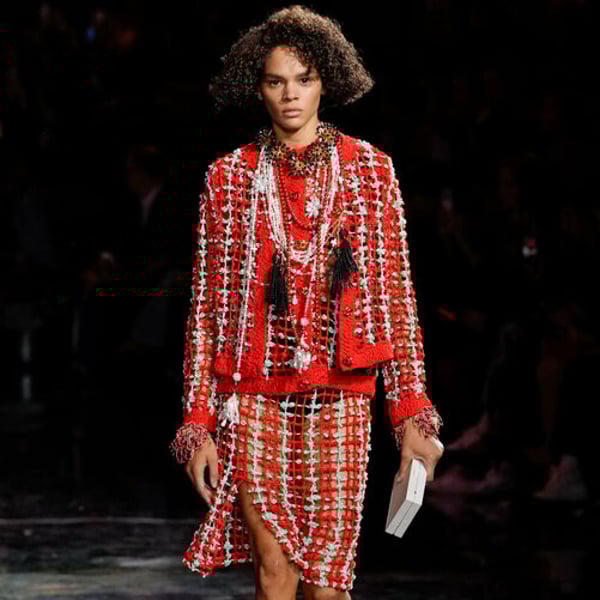
Bold, gutsy, ingenious, often beautiful and curiously risqué, the debut collection by Matthieu Blazy was the undoubted hit of the season. Blazy practically reinvented the classic Chanel suit with a new knee-length wrap skirt made with pockets, generally left frayed and finished in filigrees of gold. And instead of just wool bouclé, it came in impossibly airy plaids, windowpane checks, or stiff denim. Disrupting codes: conceptual double-sized camellia brooches, woven pearl necklaces, Coco’s beloved wheat embroidered into organza tops. Plus, Matthieu’s magnificent Solar System set of giant gas-filled, internally illuminated planets brought Chanel back to the glory days of Karl Lagerfeld. Little wonder he got the season’s biggest ovation by far.

No one can ever fault Jonathan Anderson for lacking guts. His debut women’s wear show for Dior turned the brand upside down, knocked a decade off its clientele, repeatedly mined Monsieur Dior’s New Look, and suddenly made Dior very cool again. His show-opening mash-up video, a history of Dior as a unique cultural living monument by documentarist Adam Curtis, was sensational, setting the stage for Anderson’s visual stream-of-consciousness show. Rarely in fashion history has a designer so boldly twisted a house’s codes — in particular Monsieur’s legendary Bar jacket. The result was the most thought-provoking collection of the decade, never mind this season.
Diotima: Carnival clobbers colonialism

Colonialism and Caribbean culture’s fight back against that evil via the tradition of Carnival was the theme of this intriguing Diotima collection. Active sport meets couture: hooded sleeveless mesh tops and pants finished by a layered skirt in shards of chiffon; or fab crepe lapel-free redingotes, asymmetrically worn on cast with J’Ouvert pre-dawn street festival makeup with daubs of silver mud. Epic, unusual, path-breaking, and New York’s most beautiful surprise.
Giorgio Armani: Talk about an adieu

Leave it to Giorgio to go out on a high with brilliantly fresh, light, and contemporary tailoring in the final collection he designed. Presented posthumously 24 days after his passing in the neo-classical courtyard of the Pinacoteca di Brera, Milan’s greatest museum, which opened its first-ever fashion exhibition — dedicated to Armani, of course — right after the show. Fashion’s greatest tailor cut beautiful pajama suits for men and breezy tunics and boleros for women, inventing new dhoti pants and deconstructing blazers. Made in supremely light silks, dry linens, and printed cottons, in the colors of his island home in sunny Pantelleria — burnt sand, lava, stone, and sea blue. A beautiful swansong by the defining designer of the past half-century.
Givenchy: Welcome to the new seduction

There is a new, refined sense of seduction in fashion this season. The best dark and diabolical version comes from Givenchy. Tough-chic black leather — bat-wing leotards, wicked little black dresses, or men’s coat dresses cut décolleté. Crisp and clean tailoring: statuesque white double-breasted pantsuits or designer Sarah Burton’s reinvention of Givenchy’s signature Bettina blouse as an officer’s shirt or aristo chemise. In a word, the most coherent wardrobe in Paris.
Khaite: Dark underbelly beauty

Imperfection as highly wearable artistic fashion. Everything a tad twisted or distorted — from strict leather elongated fisherman jackets to urban double-breasted blazers. Everything cut a tiny bit off-kilter. Including New York’s best set: an all-black pond and broken-up glaciers covered in mist. “The dark underbelly of America has always fascinated me,” confessed designer Catherine Holstein. Independent female chic at its best.
Louis Vuitton: A multi-cultural proposition

Like its inspiration — the apartment of Anne of Austria, the Sun King’s mother — a highly eclectic collection blending kicky fabric tops, tapestry details, carpet-fabric shoes, and 18th-century-style brushed silk gowns. All the way to leggings cut like britches, shirts with aristocratic six-inch collars, lace demoiselle gowns, or scarlet satin bouffant bubble coats. In short, the most experimental and path-breaking collection in Paris.
Prada: Double winner

In case one had forgotten, Miuccia Prada is still the biggest game in Milan when it comes to fashion direction, élan, and overall chic, as Prada’s latest collection usefully reminded us. A collection starring nearly-there bras that fluttered slightly and were exposed within cut-out tops, dresses, and even aprons. Miuccia and Raf whipped up all manner of dirndls, wraps, bubble, or gathered skirts and dresses, alternating sheer fabrics and crumpled materials like technical taffeta — unquestionably the fabric of the season. Suggesting a racy soirée hostess, then revolutionizing the whole aesthetic 12 days later in her paean to the apron at Miu Miu. In a season obsessed with debutants, Miuccia remarkably emerged as the most influential designer again.
Simone Rocha: Disgruntled debutantes rule

Disgruntled debutantes in sateen georgette, floral jacquards, and silk organzas cut into crinolines, Venetian tailcoats, or hoop skirts. Refined organza crinolines embroidered with tiny flowers combined rebelliously with silver sequin bras or oversized trapeze dresses plastered with huge fabric flowers. The season’s best example of a designer pushing the envelope on her own codes.
Versace: Pop historicism

At Versace, Dario Vitale debuted with a love letter to founder Gianni. Held inside the historic Pinacoteca Ambrosiana, the clothes harked back to the 1970s and Gianni’s happy days in 1980s Miami, with bright South Beach colors — lime green, pomegranate, or ultraviolet — looser, forgiving tailoring and multiple very short shorts for men recalling the body-beautiful bluster of early Versace. That said, no debutant took more risks than Vitale, whose gutsy volumes, steamy, revealing details, and raw cast of models knocked a decade off the Versace customer.
Copyright © 2025 FashionNetwork.com All rights reserved.

Fashion
Industry experts explore the opportunities and pitfalls of e-commerce exports at ‘Welcome on Board’
Published
December 11, 2025
“Testing the market digitally” has almost become a cliché. Where brands once opted for a selection of retailers or even a first store, digital is now seen as a gateway to international markets. But while online activity can be managed from the domestic market, turning it into a profit centre means sidestepping a few pitfalls. This was highlighted by Mathieu Grodner, president of Simone Pérèle, who shared his experience, alongside experts Rémy Daguillard of Stellae and Basile Ricordel of Global-e, at the Welcome on Board event, organised by the various federations and professional committees for economic development both in the fashion sector and dedicated to exports.
For the head of the premium lingerie brand, digital provided a complementary solution to its international brick-and-mortar presence. “We approached digital with our own platform,” said the grandson of the brand’s founder. “The question was how to develop our digital business in a way that was profitable, efficient, and compelling for our end customer. We were fortunate to have existing logistics flows in place to deliver a high-quality service to our customers wherever they are. We started with our core markets, the US and Australia, before expanding into other regions. You have to be able to adapt to different geographical areas and, increasingly, to the international context.”
Practically speaking, the brand had to deploy tools to clearly identify where its customers are located and offer an appropriate response in terms of language, currency, payment methods, taxes, customs duties, and even local logistical complexities.
“The complexity lies in removing all the barriers to purchase that may exist on the website,” said Rémy Daguillard, Stellae’s president for France, a logistics specialist for premium and luxury brands. “The aim is to ensure that the end consumer, whom you may have across the world, can enjoy the same customer experience as if your brand were domestic or local.”
“I would add that the question is not necessarily to sell everywhere in the world. Obviously that’s possible. Rather, can you do it and be profitable?” added Basile Ricordel, commercial director at Global-e, who recalls observing the digital expansion of the American brand Surface to Air. “E-commerce was seen as an El Dorado. But products were being shipped and customs duties and taxes were miscalculated. There was the issue of packaging, the choice of transport provider, or even the failure to take returns into account… In the end, costs can quickly stack up.”
Beware of hidden costs
The specialists emphasise that this accumulation rapidly erodes margins- and can even tip the business into the red. They therefore urge brands to scrutinise customs duties and taxes to avoid paying them several times over, and to right-size packaging to the actual dimensions of products, thereby reducing costs. They also recommend creating a returns collection point in certain markets to consolidate weekly or monthly returns and thus lower unit transport costs.
While e-commerce is a window into global markets, they nevertheless recommend a step-by-step approach to deployment. At Global-e, the company leverages its data to target potential markets in line with each brand’s needs. “We have insights into best practices, consumer habits, and macroeconomic trends, with the aim of improving conversion,” said Basile Ricordel. “In fact, given the international context, the US market is perhaps more complicated at the moment. Hence the idea of redirecting that investment budget towards other markets, such as Japan right now. But the idea is to focus on five to ten countries that warrant investment and work to generate margin.”
For his part, Rémy Daguillard also urges brands to avoid endless laundry lists and to take local and geopolitical realities into account. “Obviously, e-commerce in Russia right now is going to be tricky. But there are areas that aren’t closed and that require understanding. Mexico, for example, is a dynamic market for luxury goods, but it has specific features to take into account, with hidden costs.” The executive recounts the misadventure of customers who have to slip an extra note to couriers to be able to collect their parcels. “You can devise your best model; these things happen, and France doesn’t have the same norms as Mexico, Brazil, or Australia.”
“You can’t be adventurous on all fronts,” confirmed Mathieu Grodner, who pointed out that digital represents 20% of his business today. “You can’t be the best in every territory, and we’ve learned that the hard way. But we’re striving to be increasingly homogeneous worldwide, because today you can no longer claim to be an international brand if you have too much disparity, whether in your prices or in your offering.”

This prioritisation appears to be a key point, particularly in a geopolitical context that has been especially unstable in recent years, with the episode over US customs duties a notable flashpoint. The abolition of the de minimis exemption, which since 2016 had allowed brands to send parcels to the US without paying duties or taxes on products valued at under $800, has significantly disrupted export strategies for the US market.
“The question of the American market has indeed been top of mind for all our clients, who have been trying to adapt as best they can since August 29 to taxes and customs duties, particularly with the abolition of the de minimis rule. Since we developed a model that allows customs duties to be paid on the transfer price, this has reduced the impact,” said Rémy Daguillard.
“Throughout the debate on tariffs, brands were worried about how they would be affected,” agreed Basile Ricordel. “Questions are being asked about products made in Europe, but some brands also have products made in China. Brands are wondering whether they should hold local stock. And that raises questions such as appointing a fiscal representative… all while seeking the best option to avoid eroding profitability in the US.”
Opportunities therefore remain in the US, as in other markets, but the unstable economic and geopolitical context is prompting brands to take greater precautions when rolling out their digital business into new markets.
This article is an automatic translation.
Click here to read the original article.
Copyright © 2025 FashionNetwork.com All rights reserved.


Pucci charts a course for Sicily

Trump slams Fed’s third-straight rate cut as ‘too small,’ saying he wishes it was twice as large

Industry experts explore the opportunities and pitfalls of e-commerce exports at ‘Welcome on Board’
-

 Politics8 years ago
Congress rolls out ‘Better Deal,’ new economic agenda
-
Entertainment8 years ago
New Season 8 Walking Dead trailer flashes forward in time
-
Politics8 years ago
Poll: Virginia governor’s race in dead heat
-
Entertainment8 years ago
The final 6 ‘Game of Thrones’ episodes might feel like a full season
-
Entertainment8 years ago
Meet Superman’s grandfather in new trailer for Krypton
-
Politics8 years ago
Illinois’ financial crisis could bring the state to a halt
-
Business8 years ago
6 Stunning new co-working spaces around the globe
-
Tech8 years ago
Hulu hires Google marketing veteran Kelly Campbell as CMO