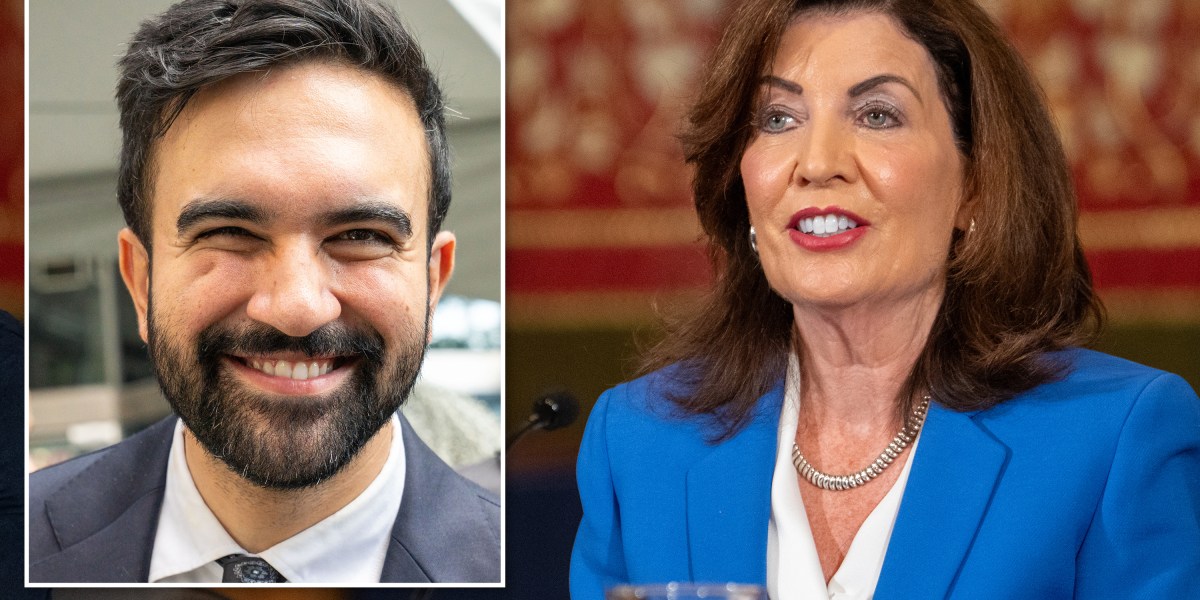
Writing in The New York Times‘ opinion section, Hochul said that while she and Mamdani diverged on some issues, they came together on the importance of addressing the affordability crisis in the city and across the state.
Just four days earlier, Hochul had sat down with Bloomberg TV and sung a very different tune. Calling herself a “staunch capitalist,” she said she would sit down soon with Mamdani and make some things clear. “The city of New York, as powerful and mighty as it is, is still a subdivision of the state, so any tax increase has to come across my desk first.” Mamdani, of course, campaigned on tax increases including a new tax on millionaires and an increase in the state’s corporate tax rate.
“In our conversations,” Hochul wrote in the Times, “I heard a leader who shares my commitment to a New York where children can grow up safe in their neighborhoods and where opportunity is within reach for every family,” wrote Hochul, a Democrat who served alongside Mamdani’s mayoral rival, former Gov. Andrew Cuomo, after winning two elections as lieutenant governor. In June, Mamdani shocked observers by convincingly trouncing Cuomo in the Democratic primary. “I heard a leader who is focused on making New York City affordable — a goal I enthusiastically support,” Hochul added.
The stunning success of Mamdani, a 33-year-old self-described democratic socialist, in the race for New York City mayor has exposed divisions within the Democratic Party as it struggles to repair its brand more than half a year into Donald Trump’s presidency. Hochul’s endorsement is the latest sign that Democratic leaders who had been skeptical of Mamdani’s liberal views are beginning to consolidate around him.
Mamdani thanked Hochul for the boost, saying it’s a sign “our movement is growing stronger.”
“Governor Hochul has made affordability the centerpiece of her work. I look forward to fighting alongside her to continue her track record of putting money back in New Yorkers’ pockets and building a safer and stronger New York City where no one is forced to leave just so they can afford to raise a family,” Mamdani said in a statement Sunday night. “I’m grateful to the Governor for her support in unifying our party — as well as the work she’s done standing up to President Trump, securing free lunch meals for our kids, and expanding access to childcare.”
In recent weeks, the other candidates in the race — former Gov. Andrew Cuomo, incumbent Mayor Eric Adams and Republican Curtis Sliwa — have intensified their criticism of Mamdani over his platform and past statements ahead of the city’s general election in November. President Donald Trump himself thinks Mamdani is likely to win, as he said over the weekend, while he has criticized Sliwa as “not exactly prime time,” including his well-known penchant for adopting rescue cats.
Hochul said another reason she decided to back Mamdani was his vow that he would make sure the New York Police Department had the resources it needs to keep the city’s streets and subways safe.
“I urged him to ensure that there is strong leadership at the helm of the N.Y.P.D. — and he agreed,” Hochul wrote.
Mamdani, who is leading in the polls, has not been endorsed by some prominent Democrats, including Chuck Schumer and Hakeem Jeffries, the minority leaders in the U.S. Senate and House.
U.S. House Republican Leadership Chairwoman Elise Stefanik, a New York congresswoman, said Hochul’s endorsement is a sign that the governor is moving left to shore up falling poll numbers.
“At the exact moment when New Yorkers are looking for strong leadership from their Governor with a majority opposing Zohran Mamdani, Kathy Hochul embraces this raging Communist who will destroy New York making it less affordable and more dangerous — once again putting criminals and communists first, and New Yorkers LAST,” Stefanik said in a Sunday statement.
Mamdani soundly defeated Cuomo in the Democratic primary. Cuomo has since relaunched his campaign as an independent. Adams, a Democrat, skipped the primary to run as an independent in November. Sliwa ran unopposed in the Republican primary.
Hochul served as lieutenant governor to Cuomo and replaced him after he stepped down in 2021 following a barrage of sexual harassment allegations. He denied wrongdoing during the campaign, maintaining that the scandal was driven by politics.