
Fashion
Davii and Pé de Chumbo present catwalk shows at a decommissioned former metro station in Milan
Published
September 29, 2025
On Saturday, September 27, the Luso-Brazilian label Davii and Pé de Chumbo—the brand of Portuguese designer Alexandra Oliveira, who handcrafts unique textiles for her exclusive pieces—unveiled their spring-summer 2026 collections at the Major Virtual Tunnel, a decommissioned metro station that is establishing itself as an avant-garde venue and, for the first time, hosted presentations connected to Milan Fashion Week.
Davii and Pé de Chumbo presented their collections at the invitation of Portugal Fashion, as part of the official calendar of presentations in the Italian capital of fashion and design, thus marking “the second stop on Portugal Fashion’s international calendar, after London and before the debut of its own showroom in Paris, confirming the consistency of the project’s internationalisation strategy,” the Porto runway organisation explained in a statement.
“Between Davii’s architectural and conceptual precision and Pé de Chumbo’s artisanal identity, Portugal Fashion presented two complementary visions that attested to the richness of the national ecosystem,”

As part of the official Milan calendar, the two labels, representative of the excellence of Made in Portugal, staged different moments of ‘catwalk performance’, with Davii showing its proposals at 3:15 pm and 4:30 pm, and Pé de Chumbo performing at 4:00 pm and 5:15 pm, “creating a dynamic in which Portuguese fashion asserted itself in an immersive register and in direct dialogue with journalists, buyers and industry professionals,” the note continued.
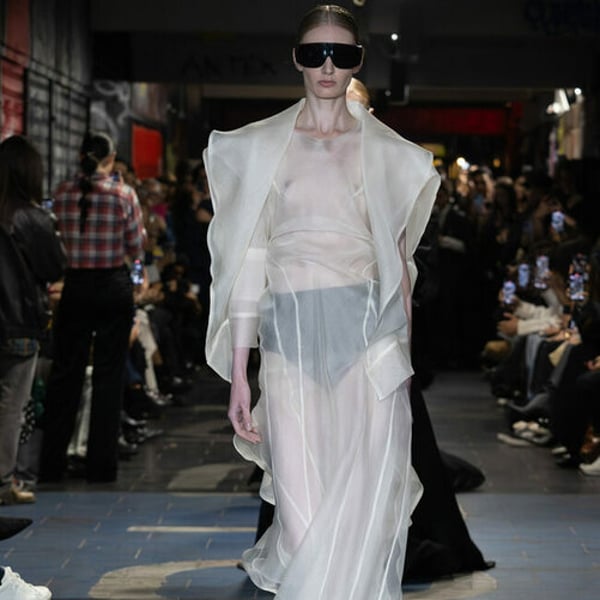
Davii opted for black and white in veiled monochrome looks, cut in light, diaphanous fabrics that evoked, at once, the bittersweet aura of Vestal Virgins from Classical Antiquity, intertwined with medieval warriors and contemporary Amazons, and asserted that women’s power goes far beyond the femininity and sensuality imposed by male-dominated societies.

The Brazilian designer based in Portugal—now with a foothold in Italy and China, where he divides his time—brought to his work the beauty and strong character of those thoughtful, ancestral women with clear ideas who acted discreetly, in silence and almost anonymously, echoing figures such as “Lady with an Ermine” and “La Belle Ferronière”, masterpieces by Leonardo da Vinci that mark the dawn of the Renaissance in Italy.
Entitled “Reimagined Forms”, his new collection explores a contemporary avant-garde with deep roots—the most forward-thinking of every era—through an aesthetic that merges with the organic, fluid forms of nature. Davii combines neoprene, silk organza and leather in these sculptural, ethereal pieces that define the brand, reaffirming its position in the realm of contemporary conceptual experimentation.

Pé de Chumbo, for its part, makes its debut on the official Milan calendar with the “Femme” collection, also in
tribute to this “feminine duality that has balanced power and fragility, courage and sensuality”, the press release noted.
The collection favoured “intricate lace worked in robust yarns, references to corsets and daring cuts” in pieces that “evoke memory and tradition”, while also unfolding into bold silhouettes suggested by these singular, novel materials—without neglecting the dictates of fashion, especially those of the 1980s and 1990s—and the aesthetics, legacy and savoir-faire of northern Portugal, while drawing on a broader palette of neutral tones and vibrant, metallic colours.

“True to its identity, the brand asserted itself through the artisanal manipulation of raw materials and by controlling the entire production process in its own factory, a distinctive element on the international scene,” show notes continued.
According to Mónica Neto, director of Portugal Fashion: “Milan has been a strategic platform for Portugal fashion to assert itself. This edition reinforced that role, with Davii and Pé de Chumbo underlining the consistency of our presence on the official calendar and demonstrating the creative and productive vitality that makes Made in Portugal a trusted reference in the global market,” she concluded.

This article is an automatic translation.
Click here to read the original article.
Copyright © 2025 FashionNetwork.com All rights reserved.