
Politics
David Jolly holds narrow edge over Jerry Demings in latest poll of Democratic Governor Primary


Former U.S. Rep. David jolly holds a narrow lead in the Democratic Primary for Governor, according to a new poll.
A new Mason-Dixon poll of registered Democrats shows 23% would support Jolly if a Primary were held today. By comparison, 19% favor Orange County Mayor Jerry Demings. The remaining 58% of voters list themselves as undecided.
Pollsters conducted the phone survey of 400 registered Democratic voters Jan. 8-13.
While Jolly holds the edge, it falls within the poll’s 5% margin of error.
Both candidates have been campaigning for months. Jolly filed for Governor in June last year, while Demings threw his hat in the ring in November.
But a majority of Democrats remain unfamiliar with either candidate.
Pollsters also measured favorability ratings for both candidates. About 55% didn’t recognize Jolly’s name, while 60% were unfamiliar with Demings.
Both remain above water among voters who are familiar with them.
About 19% of voters have a favorable view of Jolly, who has appeared regularly on MS Now, formerly MSNBC. Only 4% of respondents had a negative view of Jolly, while 22% recognized him but considered themselves neutral about him.
As for Demings, 15% of Democrats hold a positive view, according to the poll, compared to just 2% with negative feelings about him. Another 23% of respondents said they knew who Demings was but felt neutral about him as a candidate.

The Primary for Governor, scheduled for Aug. 18, will be open to only registered Democrats.
Democrats hope for a strong backlash to President Donald Trump’s policies in the 2026 Midterms. But it could be an uphill race for Democrats as Florida Republicans continue to grow their edge in voter registrations in the Sunshine State.
The last Governor’s race without an incumbent running was in 2018, when Republican Ron DeSantis won by a recount margin over Democrat Andrew Gillum. But DeSantis won re-election in 2022 by a landslide.
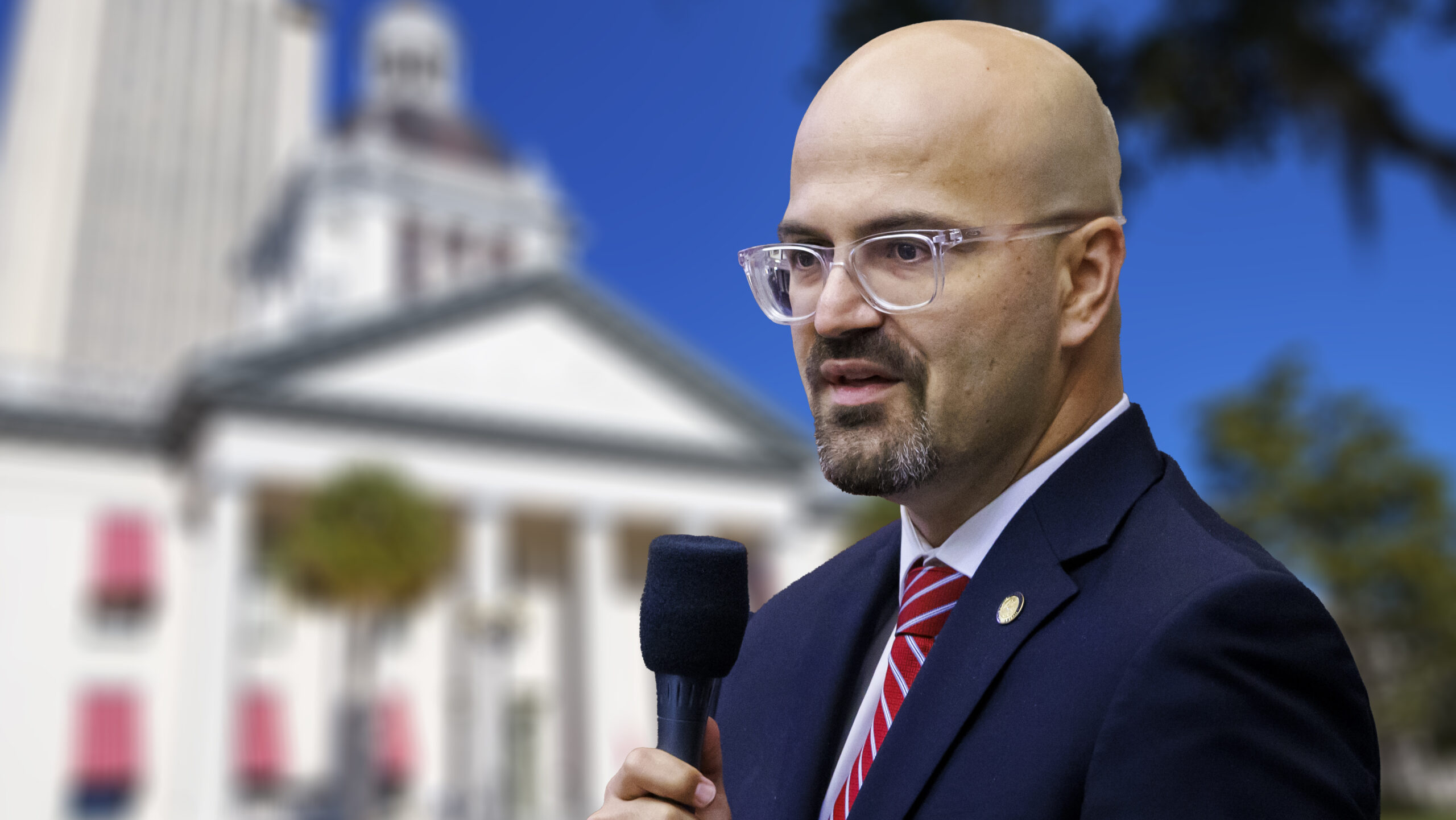
Miami Lakes Republican Rep. Tom Fabricio is bringing a package of policy proposals both new and familiar into the 2026 Legislative Session.
Some cover widely publicized issues, such as property taxes and affordability. Others center on more under-the-radar concerns, from red tape in day-to-day government transactions to a renewed push for what he calls constitutional clarity in Florida’s classrooms.”
“This Legislative Session will, yet again, be an opportunity to do the work of the people,” Fabricio said in a statement.
On affordability, Fabricio is carrying legislation (SB 1184, HB 6027) with Doral Republican Sen. Ana Maria Rodriguez to tighten rules around homestead portability, the system that lets many homeowners carry forward accumulated property tax savings when they move from one primary residence to another.
Fabricio described the measure as an attempt to match state law to the promise 64% of voters thought they were approving when they OK’d the provision in 2008. He called it a “technical fix.”
If passed, the measure would simply change references from an “immediate prior homestead” to a “prior homestead,” while keeping the same Save Our Homes portability calculation formulas and $500,000 cap.
That minor alteration would allow a homeowner’s portability calculation to be based on a previous qualifying homestead within an existing three-year window, rather than only the most recent homestead, which could help people who had an intervening non-homestead situation — like renting — to still transfer their Save Our Homes benefit.
“By tightening the rules around Homestead portability, this bill ensures that homeowners can actually carry their hard-earned property tax savings with them when they move, just as voters intended,” he said.
Fabricio is also pitching what he describes as a government-modernization bill targeting something most Floridians encounter far more often than tax policy: renewing their car registration.
He and Rodriguez also filed twin bills (SB 982, HB 841) to require renewals to be recorded electronically and eliminate the requirement for yellow registration decals to be placed on a vehicle’s license plate.

That small change, which Miami-Dade County Tax Collector Dariel Fernandez called for, is already policy in states like Connecticut, Pennsylvania and Vermont, and it’s estimated to save Miami-Dade alone $2.5 million yearly.
Fabricio said it’s an overdue departure from outdated processes.
“This legislative proposal … would overhaul and streamline an ancient technology by cutting outdated red tape,” he said, adding that the switch would improve government efficiency “while also saving taxpayers time and money.”
Another measure (SB 416, HB 115) Fabricio is again sponsoring with Miami Springs Republican Sen. Bryan Ávila would tackle a persistent problem in northwest Miami-Dade and southwest Broward: property damage due to limestone blast mining.
The two lawmakers have tried for years to give property owners a clear route to compensation when nearby quarry activities damage their homes, with little to no attention from leadership in the Legislature.
Taking note of this inaction, including a complete snubbing in both chambers last Session, Fabricio’s home city voted to sue Florida over the state’s ban on lawsuits against limestone mining operators.
Like its past iterations, this year’s version of the legislation would establish a path for compensation for residents whose homes sit within 3 miles of limestone quarries, while also setting standards for how claims are evaluated and paid.
It’s “about fairness,” Fabricio said.
“These repeat explosions have caused significant damage to South Florida properties,” he said, “and this bill will serve as a compromise to mining operations and relief for affected residents.”
Rounding out Fabricio’s priority slate is an education-focused proposal built around an explicit pledge to state and federal charters.
The bill (HB 147) would require teachers and administrative personnel in public schools — from prekindergarten to the college level — to take an oath to protect and defend the Florida Constitution and the U.S. Constitution.
Fabricio said the proposed mandate, which Jacksonville Republican Sen. Clay Yarborough is carrying in the upper chamber (SB 430), is meant to underscore the foundational role the documents play in civic life.
“Florida’s Constitution and the U.S. Constitution are the backbone of our republic,” he said. “It’s critical that those entrusted with educating our children respect and uphold the principles that define our nation and our state, and that they protect those constitutional values across classrooms in the Sunshine State.”
The 2026 Legislative Session began Tuesday and is scheduled to run until March 13.
Politics
Building Commission overturns critical recommendation, putting homeowners, governments at risk

The Florida Building Commission (FBC) has overturned a recommendation from the Florida Plumbing Technical Advisory Committee (TAC) aimed at strengthening the Florida Building Code to clarify a technical definition that certain contractors have exploited to use a flawed and non-compliant pipe repair method known as CIPP “gapping.”
The TAC recommendation confirmed that only continuous cured-in-place pipe (CIPP) installations — with no “gaps” left at branch or service connections — meet Florida Building Code standards. The decision protected future condominium and commercial property owners who choose to use CIPP as a cost-effective rehabilitation solution and also gave support to legal warranty claims by thousands of Florida property owners who are being identified as CIPP “gapping” victims suffering from premature pipe failures and deficiencies caused by the CIPP “gapping” installation shortcut.
Without the recommendation, homeowners will continue facing financial harm, local governments will be susceptible to enforcement challenges, and the state risks increased litigation.
The “gapping method” involves leaving unlined sections of aged, corroded pipe where branch lines connect, rather than creating a fully sealed, continuous CIPP liner. Over time, these gaps can cause leaks, blockages, and hidden structural damage — leaving owners with expensive repair bills for work they previously paid to rehabilitate.
Despite those recommendations, which had support from affected property owners and Authority Having Jurisdiction (AHJ) building officials, the FBC overturned the decision at its meeting Dec. 9 by a 9-5 vote.
Critics of the vote argue the FBC’s decision creates continued confusion and inconsistency in how existing building codes related to CIPP material installation are interpreted and enforced in Florida. Additionally, its failure to support thoroughly vetted TAC recommendations exposes property owners to failures associated with non-compliant “gapped” CIPP installations, leaving homeowners at risk of paying for repairs on work that may not meet the performance standards required by material manufacturers, Florida law or American Society for Testing Materials (ASTM) standards. The decision also jeopardizes warranty protections consumers rely on.
Legally, the vote not to uphold TAC recommendations also undermines the intent of legislation (SB 4-D) passed in 2022, which calls for accurate assessment and code-compliant remediation of aging cast iron drainage systems. With inspections mandated under the legislation now well underway and ongoing, more deficiencies associated with “gapped” installations are being discovered, increasing the likelihood of building system failures and costly litigation.
And perhaps worse, the decision contradicts expert consensus, which defines “continuous” as having no “gaps” in CIPP material coverage.
AHJ representatives who attended the meeting last month expressed concern that the action will prolong confusion and rob residents of protections the recommendations were designed to ensure.
And one of the speakers supporting the TAC recommendations at the December meeting was from the Highland Towers Condominium Association speaking on behalf of “gapping” victims, underscoring threats to finances and safety without implementation.

Pipeline Technologies, Inc. founder Michael Wilson and his company have been leading the fight for CIPP installation clarification for more than a decade. In 2015, Wilson secured a Declaratory Statement from the State affirming that continuous CIPP was the only code-compliant method, requiring a permit to ensure proper inspection oversight and consumer protection. Still, inconsistent enforcement allowed some contractors to continue using shortcuts, leaving many property owners vulnerable.
The TAC recommendations would have put an end to that, ensuring that any CIPP system showing material gaps during a final video inspection will automatically fail — giving building officials statewide a clear and straightforward way to enforce the code and prevent future consumer exploitation.
Wilson is now re-committing to continuing efforts to work with state and local AHJ officials to establish uniform statewide interpretation and understanding of existing CIPP code requirements.


Poll shows Byron Donalds remains frontrunner in GOP Primary for Governor

AI will infiltrate the industrial workforce in 2026—let’s apply it to training the next generation, not replacing them

eBay Circular Fashion Fund returns with $300k looking for innovative eco firms in Europe, North America
-

 Politics8 years ago
Congress rolls out ‘Better Deal,’ new economic agenda
-
Entertainment8 years ago
New Season 8 Walking Dead trailer flashes forward in time
-
Politics9 years ago
Poll: Virginia governor’s race in dead heat
-
Politics8 years ago
Illinois’ financial crisis could bring the state to a halt
-
Entertainment8 years ago
The final 6 ‘Game of Thrones’ episodes might feel like a full season
-
Entertainment8 years ago
Meet Superman’s grandfather in new trailer for Krypton
-
Business8 years ago
6 Stunning new co-working spaces around the globe
-
Tech8 years ago
Hulu hires Google marketing veteran Kelly Campbell as CMO