Connect with us

Politics

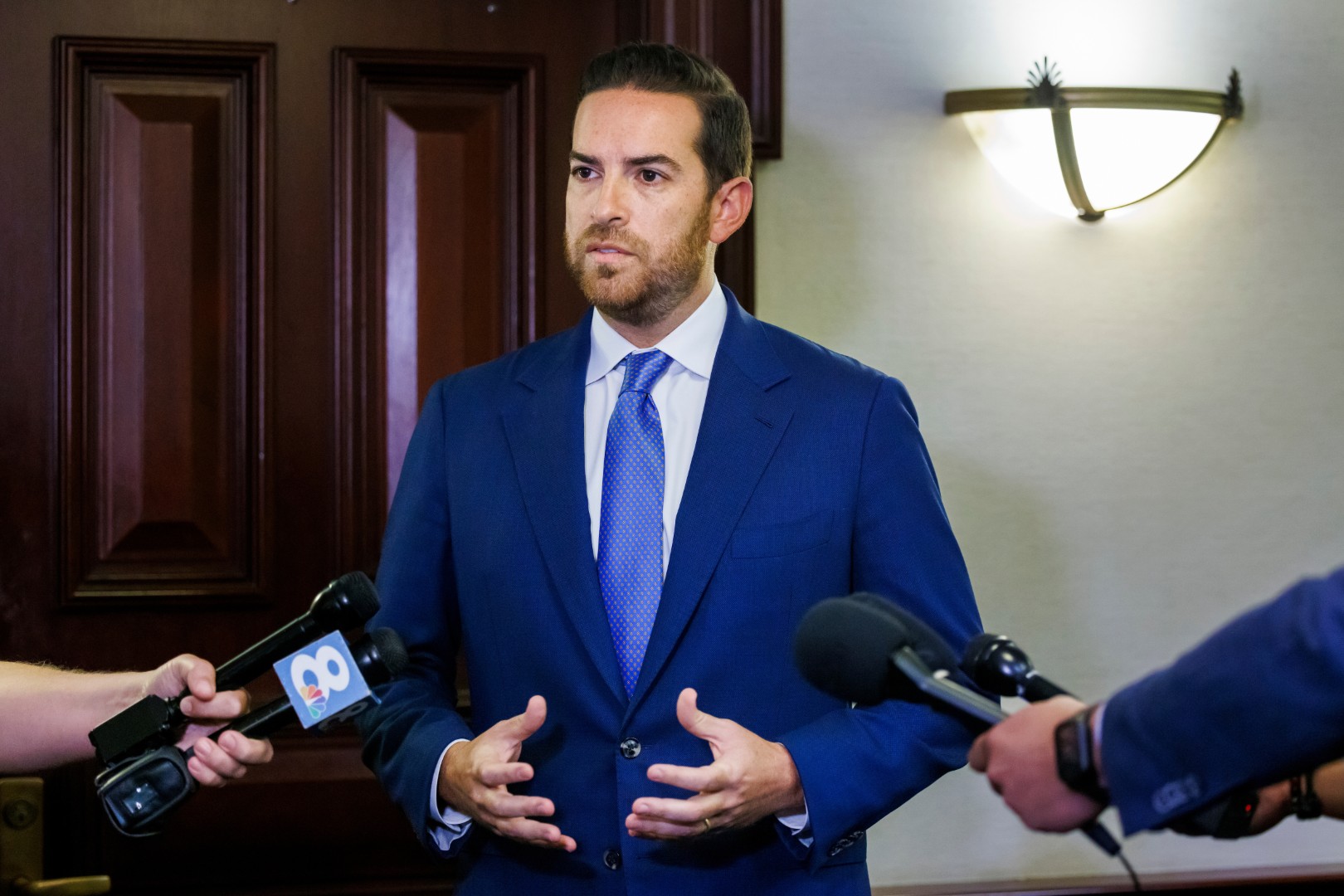
Daniel Perez predicts ‘fiscally conservative’ Session, remains bullish on property taxes
Published

on


House Speaker Daniel Perez, presiding over his second and final Session with the gavel in hand, is predicting a “fiscally conservative” Legislative Session that responds to a three-year outlook that’s not, as he describes it, as rosy as some would like.

That means a potentially tight budget where lawmaker pet projects may not get the deference they once enjoyed.

Nevertheless, Perez said he believes it “will be a productive Session,” and he’s not backing down on what has become the banner issue for the upcoming 60 days: property taxes.

Gov. Ron DeSantis has called for a Special Session to be held after the Regular Session to address the property tax issue. Senate President Ben Albritton has also said his chamber is not currently working on the issue as lawmakers await further guidance from the Governor.

But Perez is full steam ahead.

“The House has said from the beginning, we agree with the Governor when he stated almost a year ago that we needed to abolish or diminish property taxes,” Perez told Florida Politics. But Perez lamented that the Governor himself has still not offered details of his own plan.

While DeSantis has said he wants property taxes eliminated entirely and has said his proposed budget will include funds to cover lost revenue for local governments in cash-strapped rural communities, he has offered few other details.

Perez and the House, meanwhile, initially proposed eight possible amendments to appear on the 2026 General Election ballot. Four of those cleared the State Affairs Committee earlier this month. All would protect the portion of property taxes used to fund public schools.

One would eliminate all other property taxes, while another would allow homeowners to transfer their accumulated Save Our Homes benefit to a new primary residence with no portability caps or restrictions on home value. A third measure would exempt seniors from paying non-school-related property taxes on their homesteaded properties, while the fourth would provide an additional $200,000 to the homestead exemption for those maintaining multiperil property insurance.

The Legislature could approve all, some or none of the proposals. If approved in the House and Senate, voters would then weigh in at the ballot box in November.

“Maybe our proposals could be tweaked. Maybe some are great. Maybe some are not that great. But we at least got the process started,” Perez said.

While there has been much speculation about Perez’s legislative agenda on property taxes being a slight to the Governor, he reiterated his stance that the House is not the sole source for good ideas. If the Governor announces his own proposal and both chambers approve, he is happy to see that move.

“The Governor deserves a lot of credit for starting this conversation,” Perez said. “We’re happy to consider that and move as soon as possible.”

The 2025 Legislative Session doesn’t seem all that far in the past, likely because it went weeks into overtime. No one, Perez said, is particularly keen on seeing that happen again. But that doesn’t mean he’ll slack off.

“I want Session to end on time just as much as anyone else. However, I’m not going to rush Session,” he said.

The budget will boil down to simple conservative principles, Perez explained. Perez aims to stop what he describes as wasteful spending and ensure future legislative leadership doesn’t face budget shortfalls.

“The three-year outlook isn’t as joyous as people believe,” he said, adding that he wants “to leave the state better than we found it.”

Perez is hoping DeSantis agrees.

“I’d love to see the Governor’s recommendation be a little more conservative than it was last year,” he said.

To be sure, it is not.

Perez spoke to Florida Politics just hours before DeSantis released his recommended budget for the next fiscal year. It clocks in at $117 billion, more than $1 billion higher than his recommended budget was for the current fiscal year. The Legislature’s approved budget came in at $115 billion, about a half-billion less than DeSantis had pitched and $1.5 billion less than the prior year’s budget.

Perez had proposed a much smaller budget for the current fiscal year, at just shy of $113 billion, offering a hint at what may come ahead of the 2026 Session. There was plenty of daylight between Perez and his Senate counterpart, Senate President Ben Albritton, who had pitched a more than $117 billion budget.

Perez doesn’t anticipate there being as big of a gap between the two leaders’ this year, however. And budget chiefs for both chambers agree.

Sen. Ed Hooper, who will lead the upper chamber’s budget process again this year, told Florida Politics he has been in regular communication with Rep. Lawrence McClure, the House budget chief. Hoope said both are acutely aware of a three-year budget outlook Hooper described as being more like around 2018, in pre-COVID days, when the budget only barely approached triple-digit billions.

He added that he expects to adjust the budget downward anywhere from $1 billion to $4 billion compared to the current fiscal year.

Perez, meanwhile, also said to watch for talks to reignite regarding a budget stabilization fund. DeSantis vetoed a plan to invest $750 million into a rainy day fund.

“We believe that that’s our responsibility and we’re going to look at that again,” Perez said, adding that he doesn’t want to “leave future legislative bodies between a rock and a hard place” if budget outlooks become constrained.

That’s already happened to some degree. The expected cuts to the next fiscal year budget are in large part due to federal funds drying up from the COVID years.


Source link

Continue Reading

Politics

After mural crackdown, St. Pete installs 11 Pride-inspired bike racks

Published

on


There is a little more Pride on the streets of St. Pete, following the installation of 11 Pride-inspired bike racks in honor of Pride street murals that were removed earlier this year.

The City of St. Petersburg installed rainbow bike racks in the Grand Central District along Central Avenue and 25th Street. The intersection was the site of one of five prominent street murals removed in St. Pete during a statewide crackdown on street art, including artwork representing LGBTQ+ Pride and Black history. 

An executive order from Gov. Ron DeSantis led the removal effort. The Florida Department of Transportation completed it overnight at St. Pete’s expense, prompting Mayor Ken Welch to call for creative ways to honor the artwork’s importance to the community.

Welch and the City Council have debated what that would look like in subsequent discussions, but the bike racks represent one step toward honoring the neighborhood’s lost mural. The mural was iconic, decorating the intersection with brightly colored stripes in the colors of the progressive Pride flag, drawn just steps from a popular LGBTQ+ nightclub and other safe spaces for the community. Funding for the project was through the City’s long-standing public bike rack program.

Welch’s Chief of StaffJordan Doyle Walsh, told City Council members in an email that the bike rack installation is only one component of the ongoing response to the erasure of the street art.

The other murals removed include the Black History Matters mural on 9th Avenue South, despite protests from two local pastors, Revs. Andy Oliver and Benedict Atherton-Zeman were arrested for sitting on the mural and later released. The Fluid Structures mural located at the University of South Florida St. Pete campus, the Common Ground mural, and the Crux mural in Child’s Park were also removed.

“We were excited that there was consensus around one of the Administration’s proposed actions discussed during the previous (Committee of the Whole) meeting and other forums regarding City and community response,” Walsh said in the email.

“We intend that this small gesture of inclusion and celebration will be a symbol of our resolve to not be silenced,” he said. “We thank City Council for supporting and collaborating on this effort and we look forward to working with you and the community as we move forward together.”

___

Janelle Irwin Taylor of Florida Politics contributed to this report.


Source link

Continue Reading

Politics

Public weighs in on potential end to some school vaccine mandates

Published

on


In Panama City on Friday, state officials heard arguments for and against potential revisions to Florida Administrative Code Rule 64D-3.046.

Proposed changes, which are backed by Gov. Ron DeSantis and Surgeon General Joseph Ladapo, include expanding opt-out provisions to include religious exemptions for personal and philosophical reasons, and removal of requirements to vaccinate for Varicella (chickenpox), Haemophilus influenzae type b (Hib), and Hepatitis B (Hep B) for schools as well as Pneumococcal conjugate (PCV15/20) for day care students.

Arguments abounded both to eliminate mandates and to protect the current requirements.

Susan Sweetin of the National Vaccine Information Center, appearing in her personal capacity, fought back tears as she said she was coerced into having her son get the Hep B vaccine, or else his pediatrician wouldn’t see him.

Cynthia Smith, a nurse, said she suffered hearing loss from childhood vaccines that impacted her work in school as a child and now in professional environments.

“This is not about being anti-medicine,” Smith said, arguing for “medical freedom.”

Larry Downs Jr. argued against MMR vaccines, saying that there’s no “measles outbreak” in America, as he said people don’t need a “permission slip from Big Daddy Government” to shun shots.

“What about the measles outbreak? How many (outbreaks) come from these shots from these injections? This is nonsense. The default setting should be freedom. You should not have to get a religious or personal objection,” Downs said.

Rick Frey attributed two of his child relatives’ “non-verbal” states to vaccines before attacking pediatricians.

“It’s obviously about freedom, but it’s also about the children that these pediatricians damage because they get paid to vaccinate these kids. And they’re here being paid, and they’re here to ensure that they’ll still make their money to get their bonus, to do this stuff. It’s just wrong on so many levels, and the smug way that they sit back there and act like they’re above all of us makes me want to throw up, to be honest with you,” Frey said.

Michelle Posey, a School Board candidate in Sarasota who also leads the local Turning Point USA chapter, said she didn’t want either side “demonizing” the other before expressing her own concerns.

“I have never, in my life, known of a product that is both safe and effective, and a miracle worker, and yet it requires a marketing campaign, a marketing blitz, immunity for those that build it, and some kind of incentive for those who inject it,” Posey said, arguing against mandates.

Dr. Frederick S Southwick, an Infectious Disease Specialist with decades of experience, spoke to the impact of bacterial meningitis.

“If you are ending that vaccine, it’s going to cause tremendous damage and cost the state $50 to $80 million,” he said.

Danielle Carter, the President of the Florida Academy of Family Physicians, argued that scientific evidence didn’t support the removal of vaccines, that they have reduced infections while facilitating “herd immunity.”

Joseph Harmon, representing the Conference of Catholic Bishops, criticized the proposed rule as “an improper expansion of what’s allowed by statute” and advocated no change.

Lewis Jennings spoke for NAACP chapters around the state when he condemned the proposal as a “direct threat to public health, equity, and civil rights.”

Jamie Schanbaum, who survived meningitis, described the consequences of the disease over the last 17 years since she had it.

“I’ve accumulated millions of dollars in hospital bills, months of physical therapy, and occupational therapy, not to mention I had my leg re-amputated last year. That was a good time. How about re-learning to use my hands, feed myself, wipe myself? This is the reality of what it’s like to survive something like this. And if I want to go and do any sport, I have to pay $30,000 just for the legs.”


Source link

Continue Reading

Politics

Florida Board of Governors confirms Moez Limayem as USF’s next president

Published

on


The Florida Board of Governors on Friday unanimously confirmed Moez Limayem as the University of South Florida’s (USF) ninth President.

Limayem served as the Lynn Pippenger Dean of the Muma College of Business at USF for 10 years before becoming President of the University of North Florida (UNF) in 2022. He was named the sole finalist for the job in September and won unanimous approval from the USF Board of Trustees in October. His confirmation now ensures his return to the University in early 2026.

“I am so energized, humbled, honored and excited by the biggest professional honor in my life,” Limayem said in a video posted on X. I would like to take this opportunity to thank our Board of Trustees, our Board of Governors, our amazing faculty, staff and students, and all my friends in the Tampa Bay community. I cannot wait to work with all of you to take this University to the highest possible level. And, as always, Go Bulls.”

Limayem’s time at UNF included significant enrollment gains, a record first-year retention rate, and job placement outcomes that rank among the best in the state. UNF welcomed the largest incoming class in its history this Fall and reached its highest total enrollment since the school opened in 1972.

Florida Trend also recognized him, as well as the Jacksonville Business Journal and the National Academy of Inventors; Limayem was recently inducted into the First Coast Business Hall of Fame.

Together, we will write the University of South Florida’s next chapter as a national model of excellence that transforms lives and strengthens Florida’s intellectual, economic and civic landscapes,” Limayem said in a statement. “I am also deeply appreciative of President Rhea Law’s commitment to elevating USF academically and reputationally. Her impact has strengthened this institution and positioned us for continued excellence.”

Before joining UNF, Limayem oversaw significant fundraising successes at USF. He secured more than $126 million in private donations, including a $25 million gift from Pam and Les Muma in 2014 that at the time was the largest individual donation in school history.

Earlier in his career, Limayem served as associate dean for research and graduate programs at the University of Arkansas’ Sam M. Walton College of Business and held the Edwin and Karlee Bradberry Chair in information systems. He earned his MBA and doctorate from the University of Minnesota.

His wife, Alya, is a UNF biology faculty member and a researcher who holds multiple U.S. patents. She was named a Senior Member of the National Academy of Inventors last year and recognized as a 2024 Rising Star of the Academy of Science, Engineering and Medicine of Florida. The couple has two children.

“Moez Limayem has an extensive record of academic and executive leadership in higher education,” Board of Governors Chair Brian Lamb said. “USF’s recognition as an AAU institution and continuous climb in national rankings underscores their commitment to improving student outcomes and advancing workforce development in Florida. President Limayem will drive this momentum forward with strong stewardship and vision.”

Other Board members voiced similar support during Friday’s meeting. 

“I’ve been close to him with his efforts at UNF and working with him very closely,” Board member Aubrey Edge said. “He’s a wonderful selection, and he’ll do a great job, and I couldn’t congratulate him more.”

Board member Ken Jones echoed the sentiment.

“Just an outstanding leader,” Jones said. “Moez is going to stand on the shoulders of great people and also do great things and I’m excited to work with him.”


Source link

Continue Reading

Trending

Copyright © Miami Select.