Politics
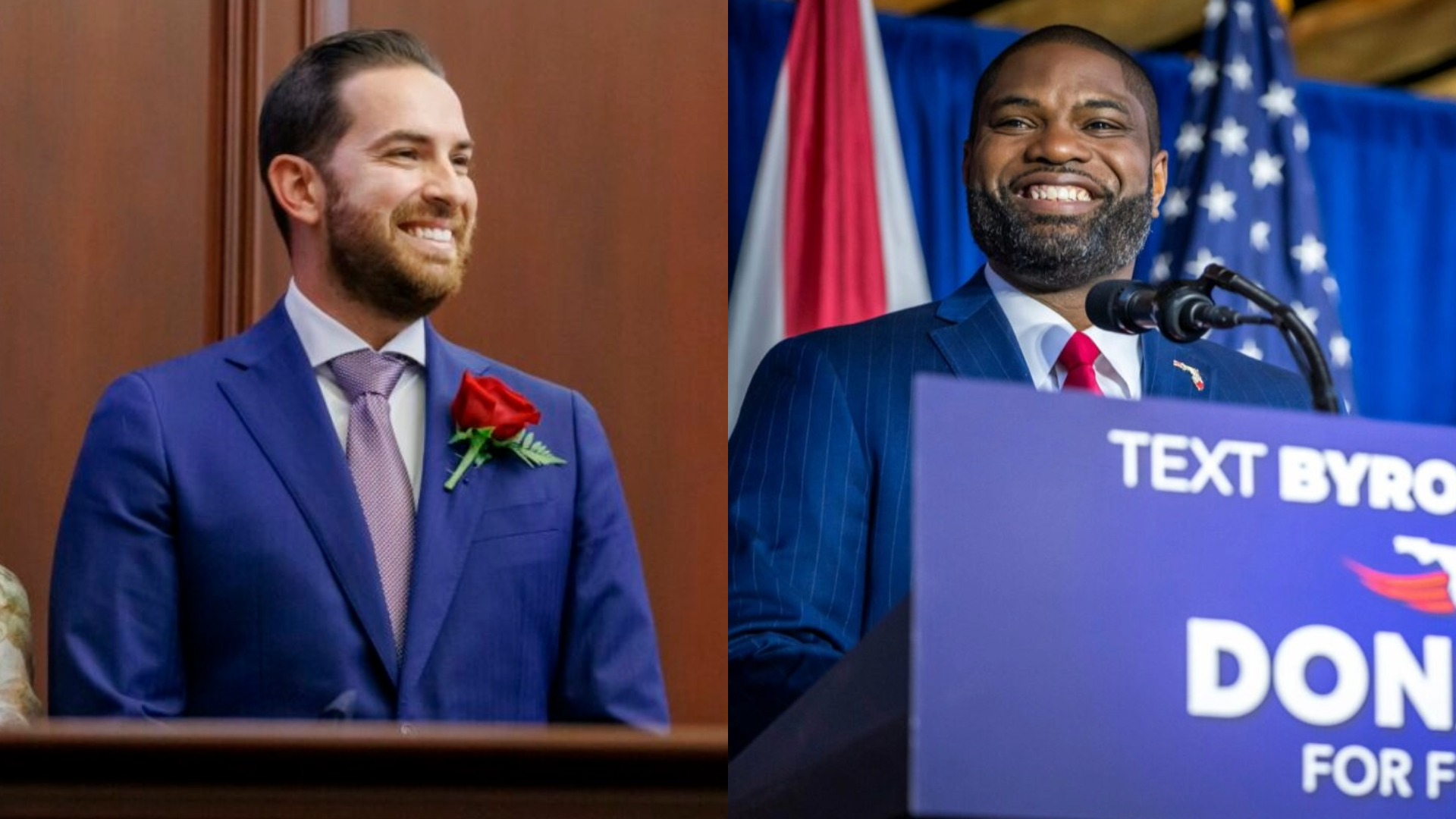
Daniel Perez leads 63 House members in endorsing Byron Donalds for Governor
Published
2 months agoon
By
May Greene
More than half the Florida House, including House Speaker Daniel Perez, has endorsed U.S. Rep. Byron Donalds’ bid for Governor.
On Wednesday morning, Donalds’ campaign announced 63 state Representatives had announced their support for the Naples Republican. That includes a handful of lawmakers, many based in Southwest Florida, who had issued announcements shortly after Donalds launched his campaign. The majority just now formally jumped on the Donalds’ train.
That includes Perez, though he already signaled his sentiments last month when political committees under his control gave $1 million to Donalds’ campaign. Perez noted President Donald Trump was the first to endorse Donalds, and most Republicans in the House are now following his lead.
“President Trump endorsed Byron Donalds for Governor for the same reason that Floridians will overwhelmingly elect him to serve as our next Governor,” Perez, a Miami Republican, said. “He will fight for our families and our state. He will make Florida government work for our people, not for himself. I am excited to endorse a true conservative champion to be our next Governor.”
Reps. Jennifer Canady, a Lakeland Republican in line for Speaker in 2028, and Mike Rendondo, who is set to wield the gavel in 2030, also now back Donalds.
“Byron Donalds is exactly the kind of leader Florida needs, a man of conviction and courage who will fight for families, protect our freedoms, and stand up for what’s right. Byron has always understood that strong schools, safe communities, and parental rights are the foundation of a thriving Florida. As a mom, a teacher, and a conservative, I know Byron will defend those values and ensure that every child in our state has the opportunity to succeed. I’m proud to support Byron Donalds for Governor,” Canady said.
Added Redondo, “Byron Donalds is a bold, America First conservative who will take Florida to new heights. He’s tough on crime, committed to securing our borders, and focused on making Florida more affordable for families and seniors. I’m proud to stand with Byron Donalds for Governor because he’s the Trump-endorsed conservative fighter we need to keep Florida thriving.”
In total, some 75% of the Republican caucus in the House now supports Donalds, who currently faces former House Speaker Paul Renner. That includes several members of leadership who served with Renner.
“Byron Donalds is a principled conservative who leads with courage, conviction, and integrity. He shares our commitment to growing Florida’s economy, protecting our freedoms, and backing the men and women of law enforcement who keep our communities safe,” said House Majority Leader Tyler Sirois, a Merritt Island Republican. “Byron understands what it takes to build a stronger Florida for working families, and he’ll always put our state and our people first. I’m proud to support Byron Donalds for Governor because he is a leader who will fight every day to keep Florida free, strong, and prosperous.”
The full list of endorsements includes: Reps. Shane Abbott; Jon Albert; Adam Anderson; Alex Andrade; Jessica Baker; Webster Barnaby; Yvette Benarroch; Dean Black; Omar Blanco; Erika Booth; David Borrero; Adam Botana; Nathan Boyles; Robbie Brackett; James Buchanan; Demi Busatta; Canady; Hillary Cassel; Nan Cobb; Bill Conerly; Wyman Duggan; Tiffany Esposito; Richard Gentry ; Anne Gerwig; Mike Giallombardo; Karen Gonzalez Pittman; Sam Greco; Griff Griffits; Jeff Holcomb; Berny Jacques; Kim Kendall; Traci Koster; Vicki Lopez; Fiona McFarland; Lauren Melo; Monique Miller; Jim Mooney; Danny Nix; Vanessa Oliver; Toby Overdorf; Bill Partington; Perez; Jenna Persons-Mulicka; Rachel Plakon; Susan Plasencia; Juan Carlos Porras; Redondo; Alex Rizo; Will Robinson; Michelle Salzman; Judson Sapp; Jason Shoaf; Sirois; David Smith; John Snyder; Paula Stark; Kevin Steele; Josie Tomkow; Dana Trabulsy; Chase Tramont; Kaylee Tuck; Susan Valdes; and Meg Weinberger.

You may like
Politics
Christine Hunschofsky proposes limits on AI companion chatbots to protect kids from self-harm
Published
19 minutes agoon
December 19, 2025By
May Greene
Rep. Christine Hunschofsky is pushing for regulations on emotionally responsive “companion chatbots,” arguing that rapid advances in artificial intelligence demand clearer rules to protect minors and vulnerable users.
Hunschofsky, a Parkland Democrat, recently filed legislation (HB 659) to impose disclosure, safety and reporting requirements for AI systems designed to provide humanlike companionship.
The bill’s focus is on self-harm prevention. If passed, the measure would prohibit operators from allowing companion chatbots to interact with users unless their platforms maintain evidence-based, publicly posted protocols to detect and respond to suicidal ideation.
If a user expresses such thoughts, the system would have to direct users to the 988 Suicide and Crisis Lifeline. Chatbots would also be barred from discussing suicide or self-harm.
“Increasingly, we are seeing heartbreaking cases where young people form deep emotional bonds with AI companions that end up pushing them further toward self-harm,” Hunschofsky said in a statement.
“These companion chatbots blur the lines to the point that people can’t tell the difference between a human and AI.”
There have been several cases in the past couple of years where interactions with chatbots tragically exacerbated the suicidal ideation of impressionable youths.
There was 14-year-old Sewell Setzer of Orlando, whose mother says he developed an intense attachment to a chatbot and the program’s responses worsened his mental state leading up to his death. Similar cases have arisen in California and Colorado.
HB 659, which pends a Senate companion, would mandate prominent disclosures clarifying that companion chatbots are AI-generated, not human, along with warnings that they may be unsuitable for some minors.
Platforms would also be required to offer both anonymous and standard age verification options.
For users known to be minors, HB 659 would require even more explicit disclosures that the user is interacting with artificial intelligence, default reminders at least every three hours encouraging breaks from continued interaction and measures preventing the chatbot from generating sexually explicit visual material or encouraging sexually explicit conduct.
Beginning July 1, 2027, operators would have to submit annual reports to the Department of Legal Affairs detailing how often their platforms issued 988 referrals and describing their suicide-prevention and content-restriction systems. The reports would be prohibited from including personal or identifying user information.
Violations would be treated as unfair or deceptive acts under Florida’s consumer-protection laws and enforced by the Attorney General. Companies would be given 30 days to cure alleged violations before enforcement action.
Hunschofsky’s measure comes amid discord between Florida and President Donald Trump’s administration on how to best proceed with AI regulation. DeSantis has pushed back against claims that a recent executive order Trump signed limits Florida’s ability to regulate AI.
Executive orders cannot preempt states, the Governor said, adding that Florida’s approach to the issue remains consistent with federal guidelines, which he said allow for child-safety and consumer protections.
Hunschofsky said her measure is about setting boundaries before harm becomes widespread.
“While AI continues to advance at a rapid pace, we have to ensure that safeguards are in place for our youth,” she said. “This bill is about protecting our children by making sure there are clear warnings, strong safeguards, and real accountability for the companies that put these companion chatbots on the market.”
Politics
Venezuelan boats — oily — trade partners — FUBAR — silencers — DMD
Published
50 minutes agoon
December 19, 2025By
May Greene
Strike footage
Congress has passed a version of the National Defense Authorization Act (NDAA) that included a controversial measure dealing with events off Florida’s shore.
The bill includes a requirement that President Donald Trump’s administration provide all classified footage of boat strikes on Venezuelan vessels in the Caribbean. The administration has maintained that the boats were trafficking narcotics from Venezuela to the U.S., and potentially through Florida.
That’s footage that Defense Secretary Pete Hegseth declined to show to members in briefings to the House and Senate earlier in the week. But members of Congress from both parties have raised questions about the legality of strikes. The spending bill forces Hegseth’s hand by withholding most of his travel budget until Congress can view the footage.
Florida’s Democrats released a joint statement criticizing the administration’s handling of the situation with Venezuela. An estimated 49% of all Venezuelans reside in Florida. The Democratic statement, released by delegation co-Chair Debbie Wasserman Schultz’s Office, made clear that members harbor no sympathies for Venezuelan President Nicolás Maduro’s regime but feel frustrated at the tactics of Trump’s government.
“As Floridians, we have no illusions about the brutality of the Maduro dictatorship. Venezuelans voted for a peaceful, democratic transition, but Maduro has clung to power through repression and corruption. That’s why we have condemned President Trump’s termination of legal protections for more than 600,000 Venezuelans while he designates Venezuela’s de facto rulers as a terror organization,” the statement reads.
“It is hypocritical to claim Venezuela is safe enough to send back innocent people, while also declaring it dangerous enough that we need to send in troops. The President has failed to present a clear strategy to Congress or the American people. He has justified his strikes with baseless claims about ‘Venezuelan fentanyl’ while pardoning major drug traffickers. The President seems more concerned with maximizing oil profits and separating families than bringing the Maduro regime to justice.”
All eight Florida Democrats voted for a pair of House resolutions separate from the NDAA that would have restricted Trump’s ability to act without congressional approval against Venezuela. But that effort failed as nearly all House Republicans joined together in knocking them down. Florida’s GOP lawmakers, also citing the plight faced by many Venezuelan Americans in the state, led the case against restricting action.
“I strongly oppose this resolution, which limits the United States’ ability to fight narco-terrorist traffickers in our own hemisphere, where we are most directly impacted,” said Rep. Mario Díaz-Balart, a Hialeah Republican and dean of the delegation. “Maduro is not a President. He’s the head of a narco-cartel that has taken over, by force and by terror, a great country, the country of Venezuela.”
But requiring greater disclosure from the Defense Department has proven to be a different story, as evidenced by the NDAA.
Speak for the beaches
Florida Republicans are making impassioned pleas to keep oil rigs away from Florida’s coast.
Sen. Ashley Moody brought her American Shores Protection Act to the Senate floor Thursday and called for its passage by unanimous consent. The Plant City Republicans’ bill would have prohibited oil drilling and natural gas exploration and development near Florida’s coastline.

“Florida has worked with President Trump for years to keep these operations off our pristine coasts,” Moody said, “because our coasts are a vital component of our state’s economic success. In fact, Florida’s beaches alone generate more than $127.7 billion a year in tourism spending and support more than 2.1 million related jobs.”
But the Trump administration has proposed opening up just such exploration despite objections from the entire Florida congressional delegation. The Department of the Interior’s Bureau of Ocean Energy Management (BOEM) proposed opening the eastern Gulf to new drilling, including areas covered under an offshore ban protected by an executive order issued in Trump’s first administration.
The Senate bill did not pass. But Moody said Sen. Mike Lee, a Utah Republican who objected to its unanimous clearing, committed to allowing the legislation to be heard in the Senate Energy and Natural Resources Committee, which he chairs.
Meanwhile, Rep. Jimmy Patronis encouraged Florida residents to make their own voices heard. The Fort Walton Republican urged constituents to contact the BOEM directly through an official comment portal. Public input will be collected through Jan. 23. Those unable to connect online can also submit comments by mail, and Patronis suggested that individuals send letters directly to the 11th National OCS Oil and Gas Leasing Program.
“It is our right to share our concerns and perspectives, and the Bureau of Ocean Energy Management’s responsibility to listen to what we have to say,” Patronis said. “I encourage all my constituents to let their voices be heard during the comment period.”
Trade crackdown
China has maintained trade partner status with the United States despite years of economic tensions. Sen. Rick Scott wants that to end.
The Naples Republican just introduced the No Trade Preferences for Communist China Act, which would revoke permanent trade relations status with the Eastern superpower.

“Communist China has long taken advantage of our open markets, stealing our technology, undermining American workers and businesses and harming American families. It’s clear China is an adversary, not a trusted partner to the United States, and they have proven that time and time again,” Scott said.
“President Trump is doing an incredible job putting America first and cracking down on Communist China’s abuses, and as he works to hold Communist China accountable to its word, he must have every ounce of leverage available.”
Scott said the legislation would “send a clear message that the United States will not give privileges to nations that continuously prove they aren’t worthy of them.”
Beyond recognition
Should Congress fail to pass a timely budget, as in the record-long shutdown earlier this year, Rep. Cory Mills wants lawmakers to face a dock in pay. The New Smyrna Beach Republican filed the Failed to Uphold the Budget? Allowance: Reduced (FUBAR) Act. That’s the same initials as a familiar anagram familiar to military veterans regarding situations that are, err, screwed up beyond all recognition.

“This bill is simple. If Congress can’t do its job, Members shouldn’t get paid. Period,” Mills said. “Congress owes every American family accountability. The American people deserve a government that delivers results, not partisan games and not a Congress that rewards itself for failure.”
Rather than deny pay entirely, a move Mills said has constitutional problems tied to Article I of the Constitution, he chose to dock pay. But he said the bill would address a situation that is causing significant outrage among federal employees this Fall.
Silencers or health care?
One of the more controversial portions of the Trump-championed Big Beautiful Bill eliminated a $200 federal tax on gun silencers. Considering that Congress has also declined to extend health insurance tax credits, Rep. Maxwell Frost would like to see the firearm tax reinstated and redirected toward health care.

“Trump’s so-called ‘One Big Beautiful Bill’ doesn’t just slash lifesaving programs like SNAP, Medicaid and Medicare — it also makes our communities less safe by subsidizing silencers and sawed-off shotguns, weapons that make mass shootings deadlier and harder to stop,” the Orlando Democrat said.
“At a time when our country has seen more mass shootings than days in the year and as seniors and families face rising health care costs, this legislation reverses these tax cuts and puts people’s health, safety, and well-being above the profits of the gun industry.”
The tax would generate $1.7 billion in revenue over the next decade.
Fighting rare diseases
When Health and Human Services Secretary Robert Kennedy Jr. announced the addition of Duchenne Muscular Dystrophy (DMD) and Metachromatic Leukodystrophy (MLD) to the recommended screening list for infants, only one Representative was at his side.
Rep. Gus Bilirakis, a Palm Harbor Republican, stood alongside the Secretary and a handful of Senators, as did Floridians Allison and Michael Beacham. Allison, a Central Florida news anchor, has spoken about the problems her daughter faced due to a rare condition that went undiagnosed longer than it should have.

“I was especially honored to stand with the Beacham family and their daughter, Mattie,” Bilirakis said. “Mattie’s story underscores exactly why this issue matters. If her rare disease had been diagnosed at birth, she could have avoided much of the pain she has endured in her short life. No family should have to wonder ‘what if,’ and no child should have to suffer unnecessarily because a diagnosis came too late.”
Diagnoses of MLD and DMD in particular sometimes don’t happen until children are 4 or 5 years old, according to Bilirakis, but irreversible damage has already occurred by that point. Adding the conditions to the Recommended Uniform Screening Panel should result in earlier testing for those diseases.
“This decision represents a monumental step forward rooted in compassion and science,” Bilirakis said. “I want to ensure children like Mattie have the best possible start in life. Early screening can mean the difference between years of uncertainty and pain, and a future filled with timely care, informed decisions, and hope.”
Rescheduling weed
Rep. Greg Steube says Trump’s order to reschedule marijuana offers a window for Congress to pass his bill doing just that.
“President Trump is right. Now is the time to reclassify marijuana, and the Drug Enforcement Administration must open the door for scientific research into the plant’s medicinal value,” said Steube, a Sarasota Republican.
Trump’s order directs Attorney General Pam Bondi to “take all necessary steps to complete the rulemaking process related to rescheduling marijuana to Schedule III” of the Controlled Substances Act.

Steube’s bill (HR 4963) would expedite this by rescheduling the drug from its current Schedule I to Schedule III within 60 days of enactment.
“My Marijuana 1-to-3 Act will deliver exactly what President Trump has requested: legislation that moves marijuana from Schedule I to Schedule III under the Controlled Substances Act,” Steube said.
“This bill will create new opportunities for scientists and physicians to develop treatments and cures for pain and disease. I am grateful for the White House’s leadership on this issue and call on my colleagues in Congress to bring the Marijuana 1-to-3 Act to the House floor immediately.”
SpaceX in Florida
Republicans in the delegation want NASA to keep SpaceX launching rockets off Florida’s Space Coast. Rep. Byron Donalds led a letter from 17 Florida Republicans to acting NASA Administrator Sean Duffy, highlighting the benefits of the Elon Musk-led firm operating in Florida.
“As you know, Starship directly supports critical NASA and national security priorities, including safely landing Americans on the moon before China and expanding broadband access to millions of Americans,” the letter reads. “Starship’s fully reusable architecture positions the United States to establish a permanent crewed presence on the moon and ultimately Mars. These operations will principally occur from Florida, fostering a boom in the local economy with billions of dollars of investment and thousands of new high-paying jobs across our state.”

The message arrives after considerable tension between Musk and Duffy, whom the billionaire has labeled a “dangerously stupid … dummy” on social media. Musk has also successfully advocated for SpaceX astronaut Jared Isaacman to be reappointed by Trump as the permanent NASA Administrator, months after Trump withdrew the nomination and temporarily placed Duffy in charge of NASA. The Senate this week confirmed Isaacman.
The delegation letter emphasized the benefits of Duffy working with SpaceX despite the squabbling. The letter was also sent to Air Force Secretary Troy Meink and Federal Aviation Administrator Bryan Bedford on future relationships.
“Your work to integrate these operations into the Cape Canaveral spaceport and into the National Airspace System (NAS) will ensure continued American leadership in space. According to SpaceX, the test campaign that you and commercial partners have performed validates that LOX/Methane vehicle systems like Starship can operate concurrently without any disruption to other companies or to U.S. Government assets,” the letter reads.
“Additionally, the Federal Aviation Administration (FAA) continues to safely and effectively integrate Starship flights — and other rockets — into the National Airspace System (NAS).”
License to drive
The federal government requires commercial truck drivers to be at least 21 years old, but Rep. Brian Mast wants to open the profession to younger drivers. The Stuart Republican filed the Ceasing Age-Based Trucking Restrictions (CAB) Act, which would lower the age to obtain a federal license to 18.
Mast suggested that foreign truck drivers, such as one responsible for a fatal crash in his district in August, showcase a problem in the workforce under current restrictions.

“The CAB Act is about putting American workers first and fixing a system that doesn’t make sense. Right now, we’re blocking capable young Americans from taking trucking jobs, forcing companies to increasingly rely on foreign drivers who are unable to read English or understand road signs,” Mast said.
“If an 18-, 19-, or 20-year-old can safely drive a truck in their home state, they shouldn’t be sidelined by a federal technicality. This bill removes an unnecessary barrier, strengthens our supply chain, and ensures these jobs go to qualified Americans.”
Florida law already allows 18-year-olds to hold commercial licenses, but federal law imposes significant restrictions on where they can work until age 21. For example, drivers with only a state license can’t pick up cargo at any port, even if the goods are being shipped within the state.
Fighting campus hate
Rep. Lois Frankel wants to protect Jewish students and others from discrimination on college campuses.
The West Palm Beach Democrat introduced the bipartisan Protecting Students on Campus Act, which she said will increase transparency, oversight and accountability by elevating the role of the Education Department’s Office of Civil Rights in early identification of discrimination.

“Antisemitism and hate are surging on college campuses and around the world, and the consequences are deadly — as we saw in the vile attack in Bondi Beach,” Frankel said. “Students cannot learn if they do not feel safe. The Protecting Students on Campus Act gives students clear pathways to report antisemitism and discrimination, strengthens accountability for colleges, and helps ensure campuses are places where hate is not tolerated.”
She filed the legislation with Republican Reps. Don Bacon of Nebraska and Juan Ciscomani of Arizona, and with Democratic Reps. Lucy McBath of Georgia and Haley Stevens of Michigan. The bill addresses all campus discrimination, but Frankel’s Office spotlighted the current atmosphere surrounding Jewish students, about 83% of whom say they have witnessed antisemitic incidents on campus.
“American Jewish Committee’s (AJC) State of Antisemitism in America 2024 Report found that 35% of Jewish college students experienced antisemitism during their time on campus, and 48% felt unsafe or avoided expressing their views or Jewish identity. These numbers reflect an alarming reality: Jewish students are being targeted and marginalized in unprecedented ways,” said Ted Deutch, CEO of American Jewish Committee and a former member of the delegation.
Senate approved
The Senate OK’d several Trump appointees from Florida to positions within the administration.
James Percival, who previously served as Moody’s Chief of Staff when she served as Florida Attorney General, earned approval to be General Counsel for the Homeland Security Department. Andrew Tysen Duva, a Jacksonville federal prosecutor, also secured confirmation as Assistant Attorney General. Both of those earned a shoutout online from Florida’s Junior Senator.

“The Sunshine State leads the way!” Moody posted. “Congratulations to all the Floridians who were confirmed tonight, including James Percival and Tysen Duva.”
Senate action also included confirming Henry Mack, a philosophy professor who has taught at the University of Miami and Florida State University, as Assistant Secretary of Labor. Pedro Allende, meanwhile, won a thumbs-up to become Under Secretary for Science and Technology, Department of Homeland Security.
Michael Borders will serve as Air Force Assistant Secretary, and Maurice Todd will be the Assistant Defense Secretary.
Arthur Graham secured a position on the Tennessee Valley Authority Board. Edward Frost will now serve as Administrator of General Services. Laura DiBella will become a Federal Maritime Commissioner through 2028, while Trent Morse will serve on the Metropolitan Washington Airports Authority until 2030.
Meanwhile, Benjamin Leone, founder of Leon Medical Centers, was appointed U.S. Ambassador to Spain. Rabbi Yehuda Kaploun is now also the Ambassador, serving as Special Envoy to Monitor and Combat Antisemitism. Lawyer Michael Selig will now chair the Commodity Futures Trading Commission.
On this day
Dec. 19, 1776 — “Thomas Paine publishes ‘The American Crisis’” via History.com — The essay was a shot in the arm to Patriots during a tough stretch of the American Revolution. In it, he wrote: “These are the times that try men’s souls; the Summer soldier and the sunshine patriot will, in this crisis, shrink from the service of his country; but he that stands it now, deserves the love and thanks of man and woman.” When these phrases appeared in the pages of the Pennsylvania Journal for the first time, General George Washington’s troops were encamped on the Delaware River. They had suffered humiliating defeats and lost New York City to British troops.
Dec. 19, 1950 — “Dwight Eisenhower becomes NATO’s first Supreme Allied Commander Europe” via United States European Command — He subsequently activated the Supreme Headquarters Allied Powers Europe and began forming his new multinational staff at Roquencourt near Paris, France. President Harry Truman gave Gen. Eisenhower authority over all U.S. Forces in the theater. Eisenhower was reluctant to be “dual-hatted” as commander. Nonetheless, by mid-May 1952, he informed the Joint Chiefs of Staff that, as SACEUR, he would assume direct command of the U.S. Forces in Europe and establish a separate staff under a deputy to conduct joint U.S. military affairs.
Happy birthday
Best wishes to Rep. Jared Moskowitz, who turned 45 on Thursday, Dec. 18.
___
Peter Schorsch publishes Delegation, compiled by Jacob Ogles, edited and assembled by Phil Ammann and Ryan Nicol.
Politics
Jenn Bradley bill would change straw regulations
Published
3 hours agoon
December 19, 2025By
May Greene
The House version has yet to be filed as of this writing.
Sen. Jenn Bradley is looking for changes to straw laws in 2026.
The Fleming Island Republican has filed new legislation (SB 958) ahead of next year’s Regular Session.
The bill would require local governments with straw regulations to “amend any such rule, regulation, or ordinance in effect as of the effective date of this act which does not permit the sale or use of drinking straws and stirrers that are renewable, home compostable certified, industrial compostable certified, or marine biodegradable to permit the sale or use of renewable, homecompostable certified, industrial compostable certified and marine biodegradable drinking straws and stirrers.”
Marine biodegradable straws would have to be proven to decompose in water within a year.
Renewable straws would have to meet requirements of “USDA BioPreferred Program with biobased content of at least 80 percent; or The TUV Austria OK biobased program with a 4-star rating.”
“The straw bill does not preempt local government straw ordinances. Instead, it requires that those ordinances also include certified compostable and degradable straws,” Bradley said, explaining her bill.
“This updates those ordinances to reflect the newer, and safer straws that are available today — a benefit for the environment and for everyone who is forced to drink out of awful paper straws.”
The bill would “combat the harmful impacts of paper drinking straws and stirrers and provide businesses and residents of this state with better alternatives to single-use plastic straws and stirrers.”
It would also drive “uniformity of drinking straw and stirrer regulations throughout this state, rather than forcing businesses to comply with a patchwork of local regulations.”
No one has filed a companion bill in the House so far. The 2026 Legislative Session begins Jan. 13.
Down Arrow Button Icon
Nick Reiner’s Mental Illness, Drug Abuse Were Unsolvable Puzzle, Expert Says
Sandro strengthens its Latin American presence with two new store openings in Mexico and Chile
Trending
-
Politics8 years agoCongress rolls out ‘Better Deal,’ new economic agenda
-
Entertainment8 years agoNew Season 8 Walking Dead trailer flashes forward in time
-
Politics8 years agoPoll: Virginia governor’s race in dead heat
-
Entertainment8 years agoThe final 6 ‘Game of Thrones’ episodes might feel like a full season
-
Entertainment8 years agoMeet Superman’s grandfather in new trailer for Krypton
-
Politics8 years agoIllinois’ financial crisis could bring the state to a halt
-
Business8 years ago6 Stunning new co-working spaces around the globe
-
Tech8 years agoHulu hires Google marketing veteran Kelly Campbell as CMO


