
Business
Crypto’s most controversial governance idea is making a comeback

Hi, Ben Weiss here! I’m filling in for Jeff for the next three weeks while he’s on vacation.
Last week, crypto investors debated one of the wonkier terms in blockchain. In a discussion on X, Ali Yahya, general partner at Andreessen Horowitz’s crypto arm, mused about how previous iterations of DAOs, or decentralized autonomous organizations, didn’t work. “We spent the last 10 years rediscovering the hard way that direct democracy is a bad idea,” he wrote.
Crypto loves decentralization. Founders have created decentralized versions of social media sites, wireless networks, and even apps that pay you to, um, sweat? To manage these decentralized platforms, many founders created DAOs.
Most DAOs are akin to public companies. Like shareholders, members can vote on proposals, and their sway is determined by the proportion of cryptocurrency they own. But instead of one party counting each participant’s vote, DAOs use blockchains to coordinate.
In theory, stripped of the humans underlying the decision-making, the idea works like an algorithm: log votes onto a blockchain, calculate a winning proposal, and execute the proposal with code. But, in practice, DAOs, like any human organization, become messy. If someone owns the majority of tokens, is there actually real democracy, or is it just theater? That criticism, which has since been called “decentralization theater,” is a repeat accusation in crypto.
For example, industry watchers have criticized the prediction market Polymarket, which says it’s decentralized, for how it resolves disputes on whether an event has happened. Polymarket punts those disagreements to a network called UMA protocol, where tokenholders vote on whether, say, the crypto-hoarding company Strategy sold Bitcoin in May. While anyone can vote, in reality, a small group of “whales” often determine the results, the Wall Street Journal recently reported.
Add in how messy DAOs can get (try wrangling a bunch of pseudonymous degens across the internet) and it’s no wonder that investors as well as founders have soured on the concept. “From half a decade of experiments, governance proved to be almost everywhere else but the [block]chain,” wrote Jake Brukhman, founder and CEO of the crypto VC CoinFund, in a reply to Yahya, the investor at Andreessen Horowitz.
Still, Yahya is optimistic that new crypto founders can reinvent the concept. “The future does not always look like the past,” he wrote.
And so is Simon Hudson, whose project, Botto, I reported on three years ago. Hudson and his cohort are part of a DAO that manages an “autonomous AI artist” that’s made millions in selling its art as NFTs. “Are they dead? Certainly not,” Hudson told me in a phone call, referring to DAOs. “Have a lot of people been burned by them? Oh yeah.”
I remain skeptical. Humans are messy, and no amount of tech can fix that—but maybe the next iteration of DAOs can do better.
Ben Weiss
benjamin.weiss@fortune.com
@bdanweiss
DECENTRALIZED NEWS
Polymarket paid content creators to publish videos of themselves winning big. An investigation found that those trades never happened. (WSJ)
Theodore, the son of pro-crypto Sen. Kirsten Gillibrand (D-N.Y.), raised $30 million at a $300 million valuation from Lux Capital to launch a perpetual futures exchange. (Fortune)
The prediction market Kalshi has passed $2 billion in annualized revenue as it has informal talks with banks about a potential IPO. (The Information)
Derivatives exchange CME sued the CFTC after the regulator let the prediction market Kalshi and crypto exchange Coinbase offer perpetual futures. (FT)
Sens. Cynthia Lummis (R-Wyo.) and Ruben Gallego (D-Ariz.) issued a formal resolution urging the executive branch not to pardon Sam Bankman-Fried. (Fortune)
MAIN CHARACTER OF THE WEEK
Tayfun Coskun—Anadolu/Getty Images
Bitcoin bull and Strategy chairman Michael Saylor said in an interview with CoinDesk that he designed a preferred shares offering with AI. That offering is now trading below the $100 par value, effectively pushing Strategy to raise capital at a loss.
MEME O’ THE MOMENT
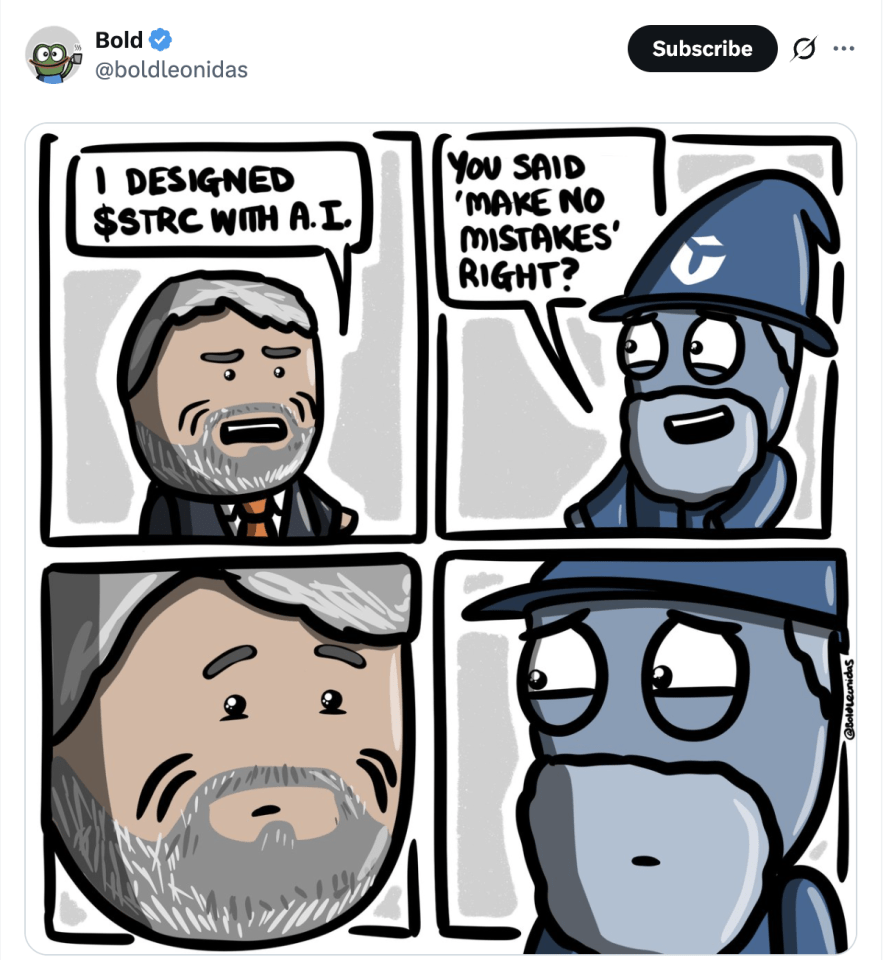
@boldleonidas
The Crypto Twitterati couldn’t help but pile on.