Connect with us

Business

Crypto’s brutal month triggers a stress test for Wall Street

Published

on


Reversals of fortune are nothing new for Bitcoin diehards — euphoric rallies, then brutal selloffs. They happen every few years, or whenever sentiment snaps.

None of those previous episodes, though, have prepared traders for the speed and scale of the past few weeks, in a reversal that was sharper than expected even if it lacked the systemic stress of prior crashes.

Friday’s drop sent Bitcoin to a low near $80,500, putting it on track for its worst month since Terra’s $60 billion collapse in 2022 set off the bankruptcies that ended in FTX. Altogether, some half a trillion dollars in Bitcoin value has been wiped out. And that’s before tallying the carnage across the altcoin complex. 

Bitcoin is still comfortably up since President Donald Trump’s November victory, but much of the heady run has vanished in his first year back in office, the very stretch he hailed as crypto’s golden age. Most of the losses remain on paper. But for the first time since exchange-traded funds helped bring Wall Street and retail into the market, those positions are under pressure.

The spark this time around is harder to spot. These new ETFs didn’t exist during the last big crypto crash. Investors have pulled billions from the 12 Bitcoin-linked funds this month, Bloomberg data show, with past buyers including Harvard’s endowment and several hedge funds.

The slew of digital-asset treasury companies — publicly traded crypto holding vehicles, inspired by Michael Saylor’s Strategy Inc. — have seen even steeper outflows as investors question the value of corporate shells built solely to hold tokens.

What’s clear is that crypto has become much bigger than the retail traders and techno futurists who are committed to HODLing through thick and thin. Now it has become woven into the fabric of Wall Street and the broader public markets, bringing a whole new set of finicky players to the table. 

“What’s happened these last two months was like rocket fuel, as if people were expecting this to crash,” said Fadi Aboualfa, head of research at Copper Technologies Ltd. “That’s what institutional investors do. They’re not there to hold, they don’t have that mentality. They rebalance their portfolio.”

Bitcoin remains up roughly 50% from its pre-election low. And the scale of this pullback still pales next to its 75% collapse during the 2021–2022 bear market. That hints at how much deeper the pain could still go. Back then, each leg down exposed another major player — from Celsius to BlockFi to Three Arrows.

Flash Crash 

But with no obvious blowups or scandals this time, some traders think the current drop is more about technicals and confidence than systemic cracks.

“We aren’t following the same path down; overall macro conditions, government support, and fewer bad actors in the space make today’s market more resilient,” said Luke Youngblood, founder of lending platform Moonwell. “The foundations crypto is building on are stronger, even if there are causes for concern down the line.”

The clearest catalyst was a flash crash on Oct. 10 in which $19 billion of crypto bets were liquidated in a matter of hours. The event exposed the chronic lack of liquidity during weekend trading — the flipside to crypto’s famed 24-7 trading schedule — as well as a build-up of excessive leverage on certain exchanges, knocking Bitcoin from the all-time high of $126,251 that it had reached just days earlier. 

“To some extent, we believe a lot of the decline in crypto markets is due to what happened on 10/10,” Brett Knoblauch and Gareth Gacetta, analysts at Cantor Fitzgerald & Co., wrote in a Thursday note. “It feels as if some big players in the space are being forced to sell, as what happened on 10/10 might have had a far-larger impact on balance sheets than initially thought.”

The problem hasn’t quite died out yet either. Liquidity in crypto markets remains low, with market makers weakened by the crash unable to step in and support prices. Around $1.6 billion in bets were liquidated across exchanges on Friday, according to Coinglass data, as the latest drop hit leveraged traders.

Bitcoin’s gold-like mystique — always a big stretch — has faded. Gold has held its ground. Crypto remains a proxy for fast-twitch risk appetite — and it’s reacting faster than the market around it.

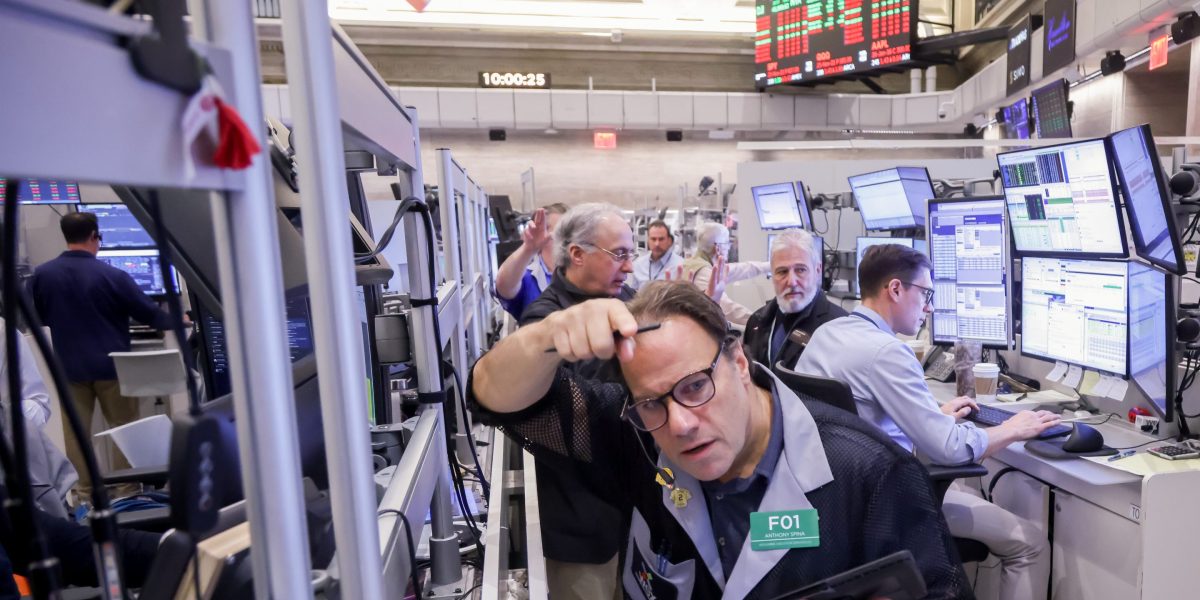
This week, Bitcoin got caught up in topsy-turvy trading in technology stocks, with the token’s volatility being pointed to as both the cause and effect of equities turmoil. On Thursday, for example, the S&P 500 rose early in the day, bolstered by strong earnings from Nvidia Corp., before suffering its biggest intraday reversal since the April tariff turmoil. 

Analysts at Nomura blamed crypto, among other causes. Bill Ackman floated an unusual link — suggesting Fannie and Freddie holdings were behaving like a crypto proxy.

Crypto’s fate is now tied to AI-fueled market optimism. With bubble chatter building, it won’t take much to spook investors into selling. There are also plenty of dangers lurking within the crypto ecosystem. The Saylor copycats have been built on the belief that a public company that does nothing but hold crypto can be worth more than the value of the tokens it holds. 

The push to repurpose public firms into crypto treasuries has endured to this point in the downturn — echoing the overleveraged lenders of 2022. If confidence cracks, forced selling could follow. Many are already underwater on their token holdings.

“When you’ve got a medical device company or a cancer research firm rebranding as a crypto treasury, it’s a sign of where you are in the cycle,” said Adam Morgan McCarthy, senior research analyst at blockchain data firm Kaiko. 

Overall, any positive vibes left in the industry appear to be hurtling toward rock bottom. The Fear and Greed index — a tool that measures sentiment in crypto markets — sat at a score of 11 out of 100 on Friday, according to CoinMarketCap. That’s deep in “extreme fear” territory. 

“Fear sentiment has spiked to relative highs while structural demand for spot remains notably absent, leaving the market without the natural buyers typically present during significant corrections,” said Chris Newhouse, director of research at Ergonia, a firm specializing in decentralized finance.



Source link

Continue Reading

Business

Fortune Article | Fortune

Published

on


Bitcoin is one of the world’s most battle-tested pieces of software. Launched in early 2009, the network has run continuously without being hacked, and today feels more secure than ever. There is, however, a threat on the medium-term horizon that threatens not only Bitcoin but every other type of software that relies on current encryption technology. That threat is quantum computing and, on Wednesday, Coinbase announced it has created a board of outside experts to prepare for its eventual arrival.

The board includes academics from Stanford, Harvard, and the University of California with specialties in fields like computer science, cryptography and fintech. Formally known as the Coinbase Independent Advisory Board on Quantum Computing and Blockchain, it is also composed of experts in blockchain and security from the Ethereum Foundation, the DeFi platform EigenLayer and from Coinbase itself.

In an interview with Fortune, Coinbase Chief Information Security Officer Jeff Lunglhofer explained how the arrival of quantum computing could defeat current encryption mechanisms, including the ones employed to protect the wallets and private keys held by Bitcoin owners.

“In simple terms, modern cryptography relies on hard math problems that would take thousands of years for a modern computer to solve,” he said. “But when we have a million times the horsepower [with quantum computing], that will provide the computation power to solve them.”

While the security threat of quantum computing is real, it is unlikely to be an urgent issue for at least a decade, according to Lunglhofer. His view is consistent with other experts who note that, while companies like Google and IBM have been building quantum computers for years, the current generation of these machines can only operate at a small scale and are not close to being able to crack the algorithms that protect Bitcoin and other networks.

The purpose of the new Advisory Board, says Lunglhofer, is to explore the coming impact of quantum computing in a “non-hype based way.” This will include promoting efforts by the blockchain industry, which are already underway, to update Bitcoin and other networks so that they are resistant to quantum-based attacks.

Currently, the Bitcoin network secures wallets by means of private keys, which are long strings of random numbers and letters that are visible to their owners, but that can only be guessed by means of an impossibly long series of trial-and-error attempts. When the quantum computing era arrives, it will be possible to guess a private key using trial-and-error. In response, Lunglhofer says, blockchain experts anticipate that Bitcoin and other networks will respond by creating larger keys and, at the same time, introducing “noise” to make the location of the key harder to detect in the first place.

All of this will require blockchain networks to introduce and deploy these defensive upgrades, a process that is likely to take years. In the interim, the new Advisory Board will begin publishing research papers and issuing position statements to help the crypto industry prepare for the arrival of quantum computing. The group plans to publish its first paper, which will focus on quantum’s impact on the consensus and transaction layers of blockchain, in the next month or two.

“Quantum computing is both a technological opportunity and a security challenge. By bringing together the foremost experts in the world, Coinbase is ensuring that the blockchain ecosystem is prepared, not just reactive,” said Yehuda Lindell, Head of Cryptography at Coinbase, in a statement.


Source link

Continue Reading

Business

The Walmart C-suite reshuffle shows how the retailer sees itself now: as a tech company

Published

on


When Walmart last week announced that David Guggina, its U.S. e-commerce chief executive, would become CEO of its nearly $500 billion U.S. division, one thing stood out in his résumé: Unlike his predecessors, Guggina has no experience running stores and has never held a merchandising role, at Walmart or elsewhere. These are two classic job requirements in retail. Incoming Walmart CEO John Furner, for example, who has run U.S. operations since 2019, began his Walmart career as an hourly associate in 1993, and held roles in merchandising, operations, and sourcing.

But there’s another realm of experience that Guggina does have in spades: e-commerce, automation, and supply chain. And by putting him atop the division that generates 69% of company revenue, Walmart is signaling that it now sees itself as a tech company, as well as a retailer. Guggina has spent eight years at Walmart, after nine years at arch-rival Amazon.com. In its announcement, Walmart touted Guggina’s work in building delivery capabilities to serve 95% of U.S. households in under three hours, and said his appointment “positions him to continue to drive our goal of being America’s favorite place to shop.”

In the last decade, after years of fits and starts, Walmart has emerged as a formidable e-commerce player, with U.S. digital sales of almost $100 billion a year—still far behind Amazon, but well ahead of any other U.S. retailer. In its most recent quarter, Walmart’s U.S. e-commerce rose 27%. That has been the result of billions in investments to integrate Walmart’s 4,600 stores with its e-commerce operations. This work has helped ensure faster shipping while also integrating technology more effectively into things like inventory management, supply chain, and in-store customer service. Guggina was instrumental in those achievements, working under Furner, who will become Walmart Inc’s new CEO next week.

“This is a unique moment in retail,” Guggina said in a LinkedIn post about his appointment. “AI is changing how people shop, and customer expectations are higher than ever. But no one is more prepared to usher in the next era of retail.”

The timing of Guggina’s promotion was fitting: It came soon after Walmart moved its shares from the New York Stock Exchange to the Nasdaq exchange, where tech giants such as Amazon, Google, and Microsoft list their shares. In December, Walmart said the move underscores its “technology-forward approach.” 

Guggina isn’t the only techy whose star is rising at Walmart. The company also appointed Seth Dallaire chief growth officer for Walmart U.S., charging him with pushing Walmart U.S. further beyond traditional retail into tech-heavy lines of business—including its booming advertising, media, and online marketplace ventures. Dallaire is a veteran of Instacart and Amazon.

Walmart is considered by analysts to be well ahead of other retailers in AI-assisted shopping. In October, it announced a partnership with OpenAI to allow shoppers to browse and buy Walmart products directly inside ChatGPT, using a built-in instant checkout feature. Last week, Walmart and Google announced their own shopping tool. Also last week, Walmart’s executive vice president for AI acceleration, product and design, Daniel Danker, suggested at a conference that the company was developing auto-ordering for the replenishment of staples.

Bolstering Walmart’s tech and AI aura has had the additional benefit of lifting the company’s stock: In the last year, Walmart shares have risen 27%, double the S&P 500’s growth and trouncing Amazon’s 1% increase.

This story was originally featured on Fortune.com


Source link

Continue Reading

Business

The rise of on-demand leadership in the AI economy

Published

on


A quiet but consequential shift is underway in the executive labor market. Companies are rethinking how they access senior judgment in the AI era. 

Rather than defaulting to full-time executive roles that command lofty salaries and long-term overhead, companies are increasingly turning to experienced consultants, strategists, and advisors to provide leadership on a limited and targeted basis.

This is not a dilution of leadership, but a recalibration of where experience delivers the most value.

According to LinkedIn’s latest Jobs on the Rise report, the fastest-growing roles in the U.S. economy sit at the intersection of AI and strategy. AI engineers claimed the top spot, while AI consultants and strategists ranked No. 2 overall. Strategic advisors and consultants also placed in the top 10. Together, the data show that as execution becomes cheaper, human judgment becomes more valuable.

The underlying driver is the implementation gap. After years of AI experimentation, organizations are struggling to convert tools into returns. While they do not lack models or software, many lack orchestration. Companies are increasingly turning to AI consultants and strategists to align technology with business realities, governance, and incentives, work that requires credibility, cross-functional fluency, and the kind of judgment typically associated with senior leadership roles.

The labor market now reflects a clear division of labor. Demand is rising simultaneously for full-time technical AI talent and for senior professionals who can translate those capabilities into business outcomes. As companies scale internal AI teams, they are increasingly relying on external advisors and consultants to provide the judgment required to direct that work at critical moments.

The supply side of this shift is shaped by organizational reality. Executives continue to make daily decisions, but AI has concentrated risk into fewer, more complex, and higher-impact choices around operating models, capital allocation, and governance. Rather than expanding permanent headcount, companies are bringing in experienced external leaders to guide those decisions when the stakes are highest.

The economics reinforce the model. Although senior advisors and consultants often command higher hourly rates, their total annual cost is typically a fraction of a comparable full-time executive role because they are engaged for a limited scope and time. Just as important, this approach allows organizations to draw on multiple forms of expertise rather than binding themselves to a single permanent hire.

The talent profile filling these roles is equally telling. Many of these advisors are former founders, CEOs, and COOs. Experience functions as a filter. LinkedIn’s data shows that many of the fastest-growing strategic roles carry a median of eight or more years of experience. These are not entry-level positions, but mid- or second-act careers for professionals with deep industry context.

The rise of founders and independent consultants on the Jobs on the Rise list also signals that this shift is driven by talent behavior, not just employer demand. Senior professionals are increasingly opting for career paths that offer autonomy, variety, and the opportunity to leverage their skills rather than committing to a single organization in an uncertain environment.

As AI automates and cheapens execution, the market value of human judgment, strategy, and accountability rises. As a result, pricing power shifts from doing the work to deciding what work should be done and how it should scale.

In this environment, experience is the moat. What is often described as “fractional leadership” is better understood as the unbundling of executive judgment from full-time roles. Over time, this model is likely to become not a stopgap but a structural response to the redistribution of value, risk, and expertise in the AI economy.

Join us at the Fortune Workplace Innovation Summit May 19–20, 2026, in Atlanta. The next era of workplace innovation is here—and the old playbook is being rewritten. At this exclusive, high-energy event, the world’s most innovative leaders will convene to explore how AI, humanity, and strategy converge to redefine, again, the future of work. Register now.


Source link

Continue Reading

Trending

Copyright © Miami Select.