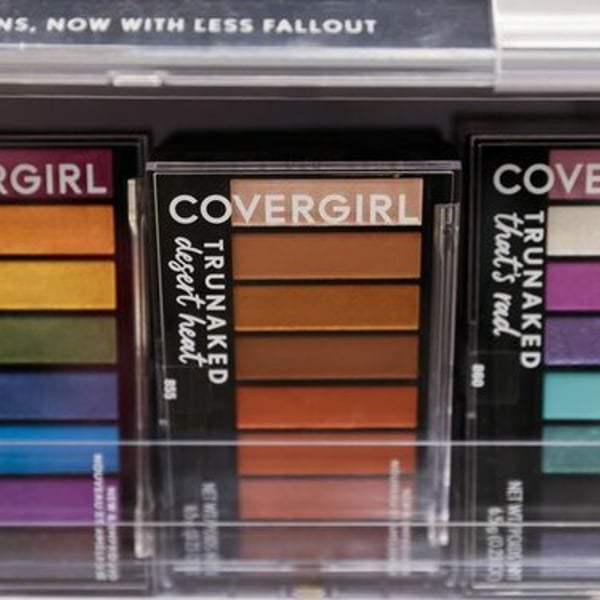
Coty said on Tuesday it had launched a strategic review of its consumer beauty business that could lead to the sale of brands such as CoverGirl and Rimmel, as the cosmetics maker plans to focus on its more profitable fragrances unit.
Reuters
The New York-based company had last month projected a quarterly sales decline as demand for its beauty products softened.
The firm invested heavily into its U.S. mass beauty business at the expense of fragrance, before shifting course as mass beauty struggled with rising competition from lower‑cost online rivals.
The move comes as the U.S. mass-market makeup segment faces pressure, with drugstores destocking products as cost-conscious consumers tighten spending and fierce competition from newer brands building a strong following online.
Anti-theft measures by U.S. retailers and recent changes in immigration policies have also hurt demand in the mass beauty category, company executives have said.
More than a decade ago, Coty paid $12.5 billion for some of these brands in a deal with Procter & Gamble.
“This new structure will… drive renewed momentum and sharper focus for consumer beauty, positioning it to compete more effectively in the evolving beauty landscape,” CEO Sue Nabi said, adding she aims to grow Coty’s prestige portfolio through blockbuster launches and brand elevation.
In 2024, the prestige fragrance market was the fastest growing category, up 12%, according to data firm Circana, while the mass-market makeup category declined 3% compared to 2023.
In the first half of 2025, prestige fragrance sales are up 6% in the U.S., the data showed.
“Coty is signaling it’s done playing drugstore beauty pageant and wants to sit exclusively at the prestige beauty table with LVMH and Estée Lauder as dinner companions, not competitors,” said Michael Ashley Schulman, partner and CIO at Running Point Capital Advisors.
Coty said its review would focus on its $1.2 billion revenue mass color cosmetics segment, which includes brands such as CoverGirl, Rimmel, Sally Hansen and Max Factor, as well as its $400 million standalone Brazil business.
“The review will assess a full range of alternatives including partnerships, divestitures, spin-offs and other potential strategic actions,” Coty said, adding that the aim was to bolster its balance sheet.
Coty’s consumer beauty division, which contributed $2.07 billion to annual sales, saw like-for-like sales drop 5% year-on-year for the 12 months ending June 30, it said last month. In the same period, its ultra-premium, prestige and consumer beauty fragrances grew between 2% and 9%.
Reduced profit has eaten into Coty’s free cash flow, which totaled $277.7 million for the year to June 30, while the company’s total debt was just over $4 billion.
Coty’s previous efforts saw it bring together hair and nail brands into professional beauty business Wella and sell a majority to stake to KKR.
Coty is still working to divest its remaining 26% stake in that business. Coty will bring all fragrance and scent brands under one business unit accounting for 69% of company sales, while aiming to maintain steady growth in cosmetics and skincare.
Shares of the company, which have lost nearly half of their value this year, were up nearly 3% in early trading on Tuesday.
Coty, which licences the fragrance brands of Gucci, Chloe and Burberry, has a market capitalization of about $3 billion, according to LSEG data.
The news was first reported by the Wall Street Journal earlier on Tuesday.
Dancing in the Clouds: the 2026 colour designated by the Pantone Color Institute is Pantone 11-4201 Cloud Dancer: “A neutral shade of white that fosters calm, clarity, and a creative breathing space in a world full of noise.”
Pantone 2026
Pantone’s website crashed as the countdown ended, while the announcement on social media showed a woman dressed in white, gazing dreamily at a cloud-filled sky.
Since 1999, beginning with Cerulean Blue, Pantone’s global experts have been naming the Color of the Year, the shade they believe will become prevalent across fashion, food, design, and entertainment; in 2026, that mantle falls to Cloud Dancer.
Cloud Dancer is a blank canvas on which to begin anew, explained Leatrice Eiseman, executive director of the Pantone Color Institute: “An invitation to open new paths and new ways of thinking.”
The mood is clearly one of serenity and an invitation to open new chapters; the election in New York of the young mayor Zohran Mamdani could be an example of this new philosophy. And yet, given the recent political climate in the US under Donald Trump, some, such as New York Times fashion editor Vanessa Friedman, have raised the possibility of MAGA and anti-DEI instrumentalisation, since the white of 2026 has ‘wiped out’ the 2025 colour, Mocha Mousse, a light brown between cappuccino and chocolate.
“Skin tones did not influence this at all,” Laurie Pressman, president of the Pantone Institute, was quick to point out, noting that Pantone has already received similar questions about other recent choices. “With Peach Fuzz in 2024 and then with Mocha Mousse 2025, we were asked whether the choice had anything to do with race or ethnicity. That’s not how it works. We try to understand what people are looking for and which colour can hopefully provide an answer.” And so Pressman invites us to look beyond metaphors: “It’s a softer white,” she said, describing the hue. “It isn’t a pure white, it isn’t a technical white, it isn’t that optically very bright white that, if we think back to the post-Covid period, people were seeking. This is deliberately an unbleached white, a very natural-looking white.”
Meanwhile, the launch of Cloud Dancer has attracted a host of brands eager to keep pace: Hasbro’s Play-Doh has created a tub of Play-Doh in this hue, while Post-it has released pads in the same shade as part of its Neutrality Collection; and the Mandarin Oriental luxury hotel chain will centre its afternoon tea and spa experiences on this minimalist colour. Spotify has also come on board, in its first collaboration with Pantone, creating a multisensory experience that translates “the emotion of colour” into sound through personalised playlists.
This article is an automatic translation. Click here to read the original article.
This is encouraging news for the European outdoor industry. On November 25, Australian biotechnology company Samsara Eco and the European Outdoor Group (EOG) launched the Nylon Materials Collective, a collaboration designed to make high-performance recycled nylon more accessible to outdoor brands. The initiative forms part of a broader drive to accelerate the sector’s transition to a circular textile economy.
Samsara Eco and EOG launch a collective to pool orders for recycled nylon – Samsara Eco
The Nylon Materials Collective is open to all EOG members and will be officially launched ahead of ISPO Munich 2025, where Samsara Eco will showcase its recycled nylon samples. But why did the EOG choose Samsara Eco? Founded in 2021, the Australian company specialises in recycling nylon 6,6 and polyester using enzymatic technologies- a strategy that has set it apart from direct competitors such as Matter, Recycling Technologies and ReCircle.
A collective of small and medium-sized enterprises
The high-performance recycled nylon produced by Samsara Eco is indistinguishable from virgin nylon, a material highly prized by outdoor brands. Despite their environmental ambitions, small and medium-sized players in the outdoor sector still find recycled nylon hard to access. That is why the EOG has joined forces with Samsara Eco: the Nylon Materials Collective is a collaborative demand-aggregation system that enables brands to participate collectively and access recycled materials.
The EOG represents more than 150 European brands – Gore-Tex
And to keep the collective running smoothly, participating companies must share “similar performance requirements, supply chain partners, and material specifications,” in the words of both parties.
Preparing for future regulations
“We want to do everything we can to help more brands access our materials so we can all reap the benefits of the circular economy,” said Sarah Cook, Samsara Eco’s commercial director. “The Nylon Materials Collective will make it easier for outdoor brands of all sizes to access and integrate recycled materials that are identical to the virgin material into future product ranges, whether they have more modest material needs or typically purchase at the fabric level,” she added.
Samsara Eco’s recycled nylon is identical to virgin nylon – Maloja
This partnership also helps brands strengthen their position ahead of forthcoming European regulations on the circular economy, concerning “extended producer responsibility and minimum recycled content obligations.”
Focus on circular materials
Katy Stevens, CSR and Sustainability Manager at the EOG, says: “The Nylon Materials Collective represents an opportunity for our members to work together with innovators like Samsara Eco to facilitate access to recycled nylon and accelerate the industry’s transition to circular materials.”
Samsara Eco uses enzymatic technologies to recycle nylon and polyester – Samsara Eco
For the European Outdoor Group, which represents around 150 brands, retailers, associations, and organisations along the value chain, this partnership is a concrete step to support the sector in its activities, so that it can “give more than it receives”.
This article is an automatic translation. Click here to read the original article.
Gant has a new CEO as of this month. The Swedish-but-with-American-roots brand has named Fredrik Malm as its chief executive, effective December 1.
Gant CEO Fredrik Malm
It’s an internal appointment with Malm having joined Gant in 2024 as EVP Commercial, Brand & Product. He succeeds Patrik Söderström, who’d led the company for six years.
Before joining the firm, Malm was CEO of SNS, and had been president Europe & International at Coach, as well as president of sales EMEA at Ralph Lauren, and retail director at ECCO.
Gant has been owned by privately-owned Swiss business MF Brands Group (which also owns Lacoste, Tecnifibre and Aigle) since 2008. And MF’s CEO Thierry Guibert said of Gant’s new leader: “Fredrik has brought valuable and extensive leadership experience from global premium fashion and lifestyle brands.
“I have full confidence in his ability to support Gant in its next phase of development, which will notably involve the continued elevation of the collections and an accelerated retailisation across both physical and digital channels.
“I would also like to deeply thank Patrik Söderström for his commitment alongside us over the past 10 years. He has played a pivotal role in transforming and elevating the brand while delivering strong financial performances over the years.”
Gant has been expanding this year, and in late May it reopened its Regent Street, London flagship. It said the refurbishment of the 6,300 sq m space “represents a key milestone in the brand’s global retail investments in the UK and worldwide”. Söderström said at the time that the reopening “kicks off a global initiative to elevate our retail experience”.
The company has also been focusing on its licenses and in June announced the early renewal of its exclusive licensing deal for the design, manufacture, and global distribution of its eyewear with Marcolin.